
Authored by the expert who managed and guided the team behind the Philippines Property Pack
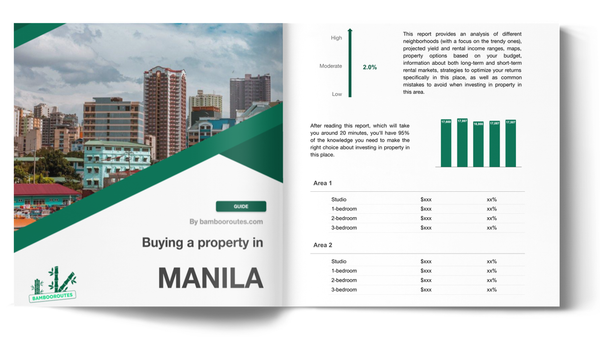
Yes, the analysis of Manila's property market is included in our pack
Manila is a city of extreme contrasts, where ultra-modern districts like BGC sit just a few kilometers from much rougher, infrastructure-stressed neighborhoods.
This guide gives you honest, data-backed answers to everything expats ask before moving to Manila in 2026, from monthly budgets to visa options to which neighborhoods actually work for foreigners.
We constantly update this blog post to reflect the latest official data and on-the-ground realities.
And if you're planning to buy a property in this place, you may want to download our pack covering the real estate market in Manila.

Is Manila a good place to live in 2026?
Is quality of life getting better or worse in Manila in 2026?
As of early 2026, quality of life in Manila is slowly improving in well-managed districts like BGC and Makati, while remaining stagnant or declining in areas where traffic congestion and infrastructure stress go unaddressed.
The factor that has improved most noticeably over the past two to three years is inflation, which has dropped significantly from its 2022-2023 peak, making day-to-day expenses more predictable for residents in Manila.
On the other hand, traffic remains Manila's persistent challenge, with commute unpredictability consistently ranking as the number one quality-of-life issue for both locals and expats, and this has not meaningfully improved despite various government initiatives.
Are hospitals good in Manila in 2026?
As of early 2026, top private hospitals in Manila are genuinely strong and comparable to Western European or North American standards, which is one of the main reasons many expats choose to live in Metro Manila.
The hospitals expats most commonly recommend in Manila include St. Luke's Medical Center (with locations in BGC and Quezon City), Makati Medical Center in Makati, and The Medical City in Ortigas, Pasig.
A standard doctor consultation at these private hospitals in Manila typically costs between 800 and 2,500 Philippine pesos (roughly 14 to 45 USD or 13 to 42 EUR), depending on whether you see a general practitioner or a specialist.
Private health insurance or an HMO plan is strongly recommended for expats in Manila, as it smooths out outpatient costs and reduces the risk of large unexpected bills at the private hospitals where foreigners typically receive care.
Are there any good international schools in Manila in 2026?
As of early 2026, Manila has several high-quality international schools that follow American, British, and other international curricula, making it a viable destination for expat families with school-age children.
The most reputable international schools among expat families in Manila include International School Manila (ISM) in the BGC area, British School Manila (BSM) also in BGC, and Brent International School Manila located in Binan, Laguna.
Annual tuition fees at top international schools in Manila typically range from 15,000 to 30,000 USD (roughly 14,000 to 28,000 EUR or 850,000 to 1,700,000 Philippine pesos), depending on the grade level and additional fees like matriculation or facilities charges.
Waitlists at the most popular international schools in Manila can be long, so families should apply 6 to 12 months ahead, and public schools are generally not the default choice for expats due to curriculum differences, class sizes, and language considerations.
Is Manila a dangerous place in 2026?
As of early 2026, Manila is not uniformly dangerous, but safety varies dramatically by neighborhood, with well-managed districts like BGC and parts of Makati feeling quite safe while other areas require much more caution.
The most common safety concerns for expats in Manila are petty theft, pickpocketing in crowded areas, and taxi scams, rather than violent crime, though certain entertainment zones and poorly lit areas carry higher risks, especially late at night.
The neighborhoods generally considered safest for expats in Manila include BGC (Bonifacio Global City), Legazpi Village and Salcedo Village in Makati, Rockwell Center, and parts of Ortigas Center and Kapitolyo in Pasig.
Women can generally live alone safely in Manila, especially in BGC, Rockwell, Makati CBD, and similar well-managed areas, though standard big-city precautions apply, such as choosing buildings with doormen, using Grab at night, and avoiding isolated walking routes.
Thinking of buying real estate in Manila?
Acquiring property in a different country is a complex task. Don't fall into common traps – grab our guide and make better decisions.

How much does everyday life cost in Manila in 2026?
What monthly budget do I need to live well in Manila in 2026?
As of early 2026, a single person can live comfortably in Manila's expat-friendly areas like BGC or Makati on roughly 150,000 to 220,000 Philippine pesos per month (about 2,700 to 4,000 USD or 2,500 to 3,700 EUR).
For a more modest but decent lifestyle in Manila, perhaps in areas like Ortigas, Kapitolyo, or parts of Quezon City, a single person can manage on around 110,000 to 160,000 pesos monthly (roughly 2,000 to 2,900 USD or 1,850 to 2,700 EUR).
For a more comfortable or upscale lifestyle in Manila, including frequent dining out, gym memberships, and a nice condo in a prime location, couples typically need 220,000 to 300,000 pesos per month (about 4,000 to 5,400 USD or 3,700 to 5,000 EUR).
Housing is by far the largest expense category in Manila, typically consuming 50 to 60 percent of an expat's monthly budget, which is why your neighborhood choice essentially defines your cost of living more than any other factor.
What is the average income tax rate in Manila in 2026?
As of early 2026, the effective income tax rate for a typical middle-income earner in Manila (earning around 60,000 to 120,000 pesos per month) is roughly 6 to 20 percent, depending on exact income level, under the TRAIN law's 2023-onward brackets.
The income tax brackets in the Philippines range from 0 percent for annual income up to 250,000 pesos, scaling progressively to a top marginal rate of 35 percent for income exceeding 8,000,000 pesos annually.
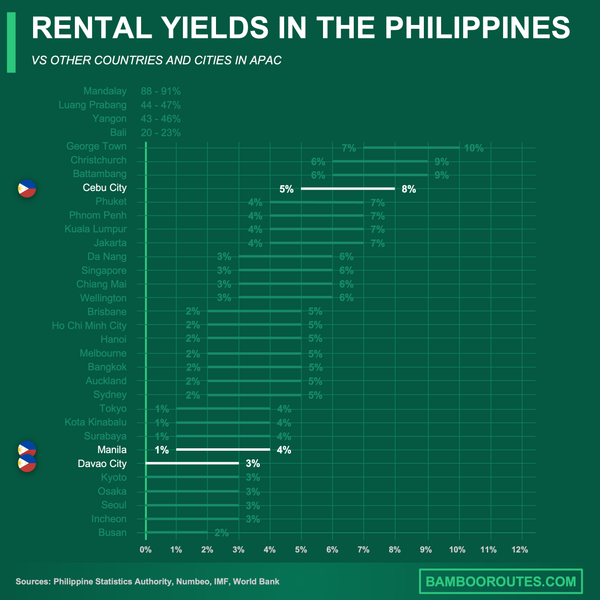
We did some research and made this infographic to help you quickly compare rental yields of the major cities in the Philippines versus those in neighboring countries. It provides a clear view of how this country positions itself as a real estate investment destination, which might interest you if you’re planning to invest there.
What kind of foreigners actually live in Manila in 2026?
Where do most expats come from in Manila in 2026?
As of early 2026, the top nationalities of registered foreign residents in Manila are Chinese (about 50,000), Indians (around 26,000), Vietnamese, Americans (roughly 11,000), and Taiwanese, based on the most recent Bureau of Immigration annual report data.
The total number of registered foreign nationals in the Philippines is approximately 153,000 based on the 2024 annual reporting cycle, though the actual number including unregistered residents and short-term visa holders is likely higher.
The main reasons expats from these top origin countries are drawn to Manila include business opportunities, corporate assignments at multinational companies, the growing BPO and tech sectors, and for some nationalities, the relatively low cost of living compared to their home countries.
The expat population in Manila is a mix of working professionals (particularly in finance, tech, and shared services), entrepreneurs, diplomats and NGO workers, retirees on SRRV visas, and a growing number of digital nomads taking advantage of extended tourist visa options.
Where do most expats live in Manila in 2026?
As of early 2026, expats in Manila concentrate primarily in BGC (Bonifacio Global City) in Taguig, Makati CBD (especially Legazpi Village, Salcedo Village, and Rockwell Center), Ortigas Center and Kapitolyo in Pasig, and Alabang in Muntinlupa for families.
What makes these neighborhoods attractive to expats is that they cluster around international schools, top hospitals, and modern condo buildings with reliable infrastructure, which drastically reduces the daily friction that makes other parts of Manila challenging.
Emerging neighborhoods in Manila that are starting to attract more expats include Eastwood City in Quezon City, which offers a self-contained live-work-play environment, and certain parts of Pasig like Kapitolyo, which has become popular for its food scene and slightly lower rents than BGC.
Are expats moving in or leaving Manila in 2026?
As of early 2026, the trend for expat migration in Manila appears to be a modest net inflow, as evidenced by the 13 percent increase in Bureau of Immigration annual report participation compared to the previous year.
The main factors driving expats to move to Manila right now include the relatively affordable cost of living compared to Singapore or Hong Kong, the strong English-speaking environment, and the growing tech and BPO job market.
The main factors causing some expats to leave Manila include the persistent traffic congestion, air quality concerns, and for some, the lack of a dedicated digital nomad visa, which makes long-term stays administratively burdensome.
Compared to similar destinations in Southeast Asia, Manila's expat population trend is stable but growing more slowly than places like Bangkok or Ho Chi Minh City, partly due to infrastructure challenges that deter some potential relocators.
Get fresh and reliable information about the market in Manila
Don't base significant investment decisions on outdated data. Get updated and accurate information with our guide.
What paperwork do I need to move to Manila in 2026?
What visa options are popular in Manila in 2026?
As of early 2026, the three most popular visa types for expats moving to Manila are the 9(a) Tourist Visa with extensions (which can be renewed for up to 36 months), the Special Resident Retiree's Visa (SRRV), and the 9(g) Pre-arranged Employment Visa for those with job offers.
The most commonly used long-term visa for expats is the SRRV, which requires applicants to be at least 40 years old and maintain a deposit of 15,000 to 50,000 USD depending on age and pension status, following the September 2025 guideline updates.
The Philippines does not currently have a dedicated digital nomad visa, so remote workers typically rely on tourist visa extensions, which allow stays of up to 36 months but technically do not permit employment, creating a legal gray area.
The SRRV grants permanent residency with indefinite validity and multiple entry privileges, while tourist visas require renewal every 1 to 2 months and employment visas typically need annual renewal and are tied to your sponsoring employer.
How long does it take to get residency in Manila in 2026?
As of early 2026, the typical processing time to obtain an SRRV (the most common path to long-term residency) is approximately 20 to 45 working days once all documents are submitted, though this can vary based on the completeness of your application.
Common factors that can delay the residency application process in Manila include incomplete documentation, the need to authenticate foreign documents, delays in NBI clearance processing, or submitting applications through satellite offices rather than the Manila headquarters.
For permanent residency or citizenship, expats must generally live continuously in the Philippines for 10 years before becoming eligible for naturalization, though SRRV holders enjoy permanent resident-like privileges without a path to citizenship.
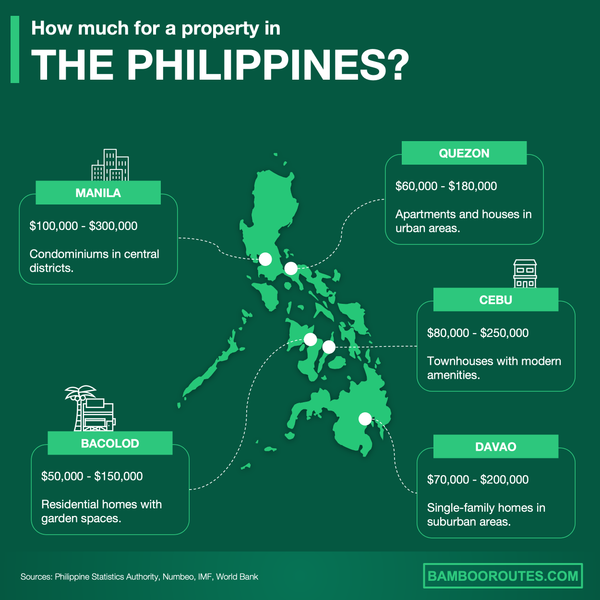
We created this infographic to give you a simple idea of how much it costs to buy property in different parts of the Philippines. As you can see, it breaks down price ranges and property types for popular cities in the country. We hope this makes it easier to explore your options and understand the market.
How hard is it to find a job in Manila in 2026?
Which industries are hiring the most in Manila in 2026?
As of early 2026, the top three industries hiring the most in Manila are IT-BPO (business process outsourcing, which employs over 1.8 million people nationally), technology and software development, and healthcare, with strong additional demand in finance and shared services.
It is realistic for expats to get hired in Manila without speaking Filipino if they work in multinational environments, particularly in tech, finance, leadership roles, or specialized positions where English proficiency and international expertise are valued.
The types of roles most accessible to foreign job seekers in Manila include senior management positions, specialized tech roles (software development, data science, cybersecurity), English teaching at international schools and language centers, and niche consulting positions where foreign expertise adds clear value.
What salary ranges are common for expats in Manila in 2026?
As of early 2026, typical salary ranges for expats working in Manila vary widely, but mid-level professionals often earn between 80,000 and 150,000 pesos monthly (roughly 1,450 to 2,700 USD or 1,350 to 2,500 EUR), while senior roles can reach 250,000 pesos or more.
For entry-level or mid-level expat positions in Manila, salaries typically range from 45,000 to 100,000 pesos per month (about 800 to 1,800 USD or 750 to 1,700 EUR), depending on industry and the specific skills required.
For senior or specialized expat roles in Manila, particularly in tech, finance, or regional management, salaries can range from 150,000 to 400,000 pesos monthly (roughly 2,700 to 7,200 USD or 2,500 to 6,700 EUR), often with additional benefits like housing allowances.
Large multinationals and regulated employers in Manila commonly sponsor work visas (9g visas) for foreign hires, but smaller companies are less likely to do so, so expats should generally target positions where they bring clear, specialized skills.
Get to know the market before buying a property in Manila
Better information leads to better decisions. Get all the data you need before investing a large amount of money. Download our guide.
What's daily life really like for expats in Manila right now?
What do expats love most about living in Manila right now?
Expats in Manila most commonly praise the convenience in expat corridors like BGC and Makati (where condos, malls, and services are all within easy reach), the exceptionally helpful service culture, and the ease of weekend escapes to beaches and mountains.
The lifestyle benefit most frequently praised by expats in Manila is the availability of affordable domestic help, delivery services, and repair services, which makes daily life more convenient than in many other major cities.
The practical advantage expats appreciate most in Manila is the cost of living, which allows for a comfortable lifestyle at a fraction of what it would cost in Singapore, Hong Kong, or Western cities, particularly when it comes to dining out and services.
The social and cultural aspect that makes Manila particularly enjoyable for expats is the warmth and friendliness of Filipinos, combined with the fact that nearly everyone speaks English, which removes the language barrier that exists in many other Asian destinations.
What do expats dislike most about life in Manila right now?
The top complaints expats have about living in Manila are the traffic and commute unpredictability (which can turn a 5-kilometer trip into an hour-long ordeal), flooding during rainy season, and air quality issues in congested areas.
The daily inconvenience that frustrates expats the most in Manila is the traffic, which makes planning anything time-sensitive extremely difficult and leads many expats to structure their entire lives around minimizing commutes.
The bureaucratic issue that causes the most headaches for expats in Manila is the visa renewal process, particularly the need to visit Bureau of Immigration offices regularly, which involves long waits and paperwork, though the recent introduction of online options has helped somewhat.
Most expats find these frustrations manageable rather than deal-breakers, especially if they choose their neighborhood carefully to minimize traffic exposure and accept that some inefficiencies are part of life in a rapidly developing megacity.
What are the biggest culture shocks in Manila right now?
The biggest culture shocks expats experience when moving to Manila include the central role of shopping malls as social and service hubs, the extreme security presence (guards, ID checks, bag inspections) at nearly every building, and the stark contrast between ultra-modern districts and nearby underdeveloped areas.
The social norm that surprises newcomers most in Manila is "mall culture," where malls serve not just as shopping centers but as community gathering places, air-conditioned refuges, and default locations for everything from banking to government services.
The aspect of daily routines that takes the longest for expats to adjust to in Manila is the unpredictability of time, whether due to traffic, the more relaxed approach to punctuality in social settings, or the fact that many things simply take longer than expected.

We made this infographic to show you how property prices in the Philippines compare to other big cities across the region. It breaks down the average price per square meter in city centers, so you can see how cities stack up. It’s an easy way to spot where you might get the best value for your money. We hope you like it.
Can I buy a home as a foreigner in Manila in 2026?
Can foreigners legally own property in Manila in 2026?
As of early 2026, foreign property ownership in Manila is restricted but not prohibited, meaning foreigners can own condominiums but generally cannot own land or houses built on land they would own outright.
The specific restrictions that apply to foreigners buying property in Manila are that foreign ownership in any condominium corporation is capped at 40 percent of total units, and foreigners cannot directly own land under the Philippine Constitution.
In terms of property types, foreigners in Manila can own condominium units (subject to the 40 percent foreign ownership cap in each building), but they cannot own houses, townhouses, or land, though some work around this through long-term leases or Filipino spouse arrangements.
By the way, we've written a blog article detailing the whole property buying process for foreigners in Manila.
What is the average price per m² in Manila in 2026?
As of early 2026, the average price per square meter for residential condos in prime Manila areas like BGC and Makati CBD ranges from approximately 180,000 to 260,000 Philippine pesos (roughly 3,200 to 4,700 USD or 3,000 to 4,400 EUR per square meter).
Property prices in Manila have trended toward stabilization over the past two to three years, with the BSP Residential Property Price Index showing slower growth and even quarter-on-quarter declines in recent periods, which often translates to more bargaining power for buyers and renters.
Also, you'll find our latest property market analysis about Manila here.
Do banks give mortgages to foreigners in Manila in 2026?
As of early 2026, mortgages for foreigners in Manila are available but limited, with most banks requiring extensive documentation and often imposing stricter terms than for Filipino citizens, leading many foreign buyers to use higher down payments or purchase with cash.
Banks in Manila known to offer mortgages to foreigners include BDO Unibank, Bank of the Philippine Islands (BPI), and Metrobank, though approval depends heavily on individual circumstances and documentation.
Typical mortgage conditions for foreigners in Manila include down payments of 20 to 40 percent (higher than the 10 to 20 percent often available to Filipinos), interest rates ranging from 7 to 12 percent annually, and maximum loan terms of 10 to 20 years.
Documents and eligibility requirements foreigners typically need for a mortgage in Manila include a valid long-term visa (SRRV or work visa), proof of income or employment, bank statements, passport copies, and often a Philippine Tax Identification Number (TIN).
You can also read our latest update about mortgage and interest rates in The Philippines.
Buying real estate in Manila can be risky
An increasing number of foreign investors are showing interest. However, 90% of them will make mistakes. Avoid the pitfalls with our comprehensive guide.

What sources have we used to write this blog article?
Whether it's in our blog articles or the market analyses included in our property pack about Manila, we always rely on the strongest methodology we can … and we don't throw out numbers at random.
We also aim to be fully transparent, so below we've listed the authoritative sources we used, and explained how we used them and the methods behind our estimates.
| Source | Why It's Authoritative | How We Used It |
|---|---|---|
| Bangko Sentral ng Pilipinas (BSP) Inflation Data | Official central bank publishing macroeconomic data sourced from PSA. | We use it to anchor cost-of-living direction and track what's getting more or less expensive in Manila. This forms our baseline for 2026 living cost estimates. |
| BSP Residential Property Price Index (RPPI) | Central bank's official housing price index with transparent methodology. | We use it to describe whether housing prices are rising or cooling in Metro Manila. This helps us set realistic property price expectations for expats. |
| Colliers Philippines Residential Reports | Major global real estate consultancy with regular market analysis. | We use it to interpret on-the-ground market dynamics like demand, supply, and promotions. This gives us the private-sector cross-check against official data. |
| Bureau of Immigration Annual Report Data | Official immigration authority publishing foreigner registration statistics. | We use it to estimate the registered foreign resident population and track expat trends. This helps us verify that Manila remains an active expat destination. |
| International School Manila Fee Information | Official school fee disclosure from a top Manila international school. | We use it to provide real 2025-2026 tuition figures. This sets the upper-bound school budget that expat families should expect. |
| Department of Finance TRAIN Law Information | Finance ministry explaining statutory personal income tax changes. | We use it to anchor the tax regime that residents are under in 2026. This ensures our tax rate discussions are aligned with official policy. |
| Philippine Retirement Authority (SRRV Information) | Government agency managing the official retirement visa program. | We use it to explain SRRV requirements and benefits. This gives expats accurate information about the most common residency pathway. |
| Makati Medical Center Price List | Major Manila hospital publishing service pricing information. | We use it to justify that price transparency exists at top private hospitals. This anchors our healthcare cost estimates for expats. |
| JobStreet Philippines | Major local job platform with extensive salary and employment data. | We use it to track job market trends and salary benchmarks. This helps us provide realistic employment expectations for expats. |
| Michael Page Philippines Salary Guide | Established international recruiter publishing market salary data. | We use it to sanity-check role-specific pay bands for expats. This ensures our salary range estimates reflect actual market conditions. |
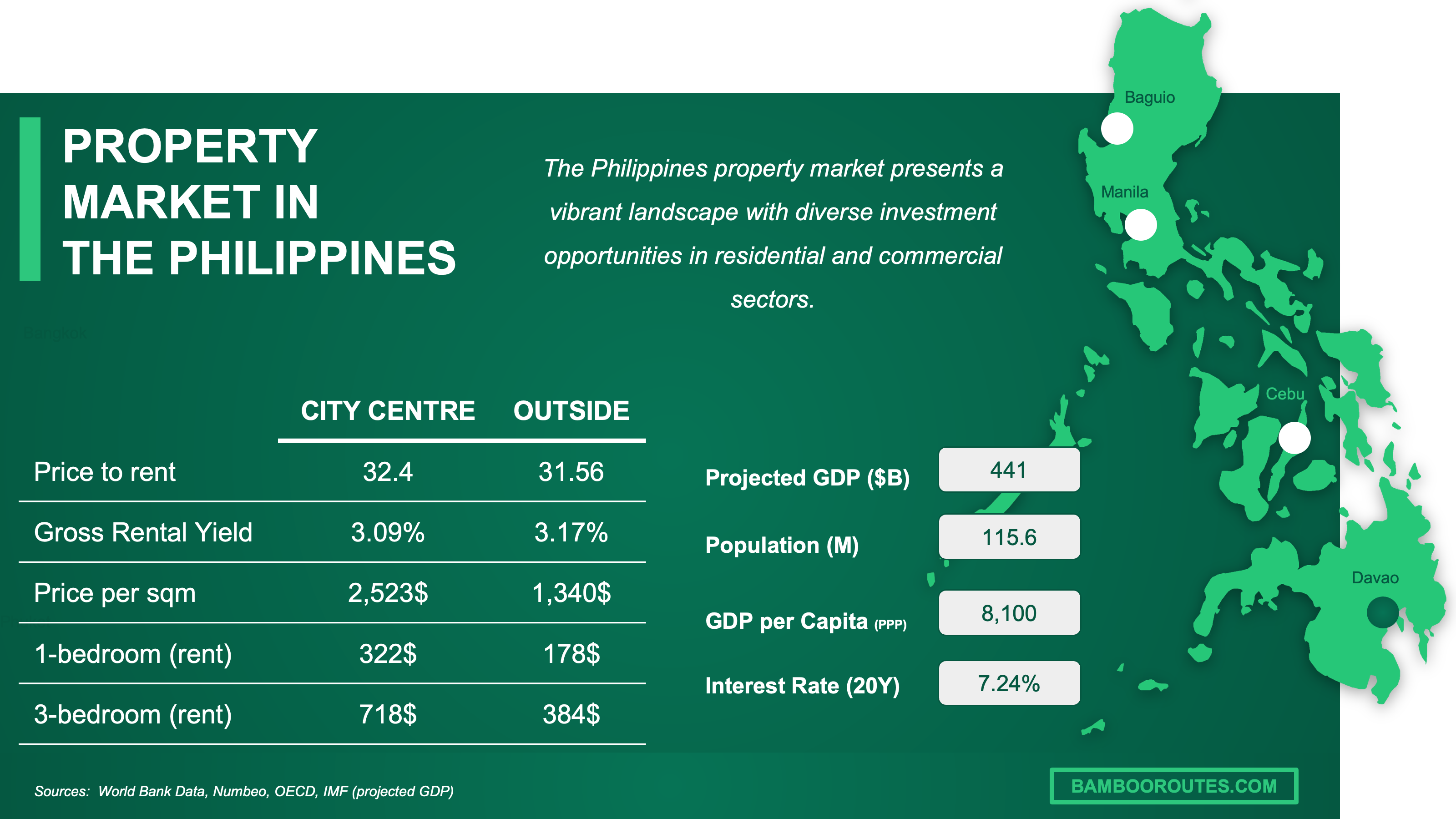
We have made this infographic to give you a quick and clear snapshot of the property market in the Philippines. It highlights key facts like rental prices, yields, and property costs both in city centers and outside, so you can easily compare opportunities. We’ve done some research and also included useful insights about the country’s economy, like GDP, population, and interest rates, to help you understand the bigger picture.
Related blog posts