
Authored by the expert who managed and guided the team behind the Philippines Property Pack
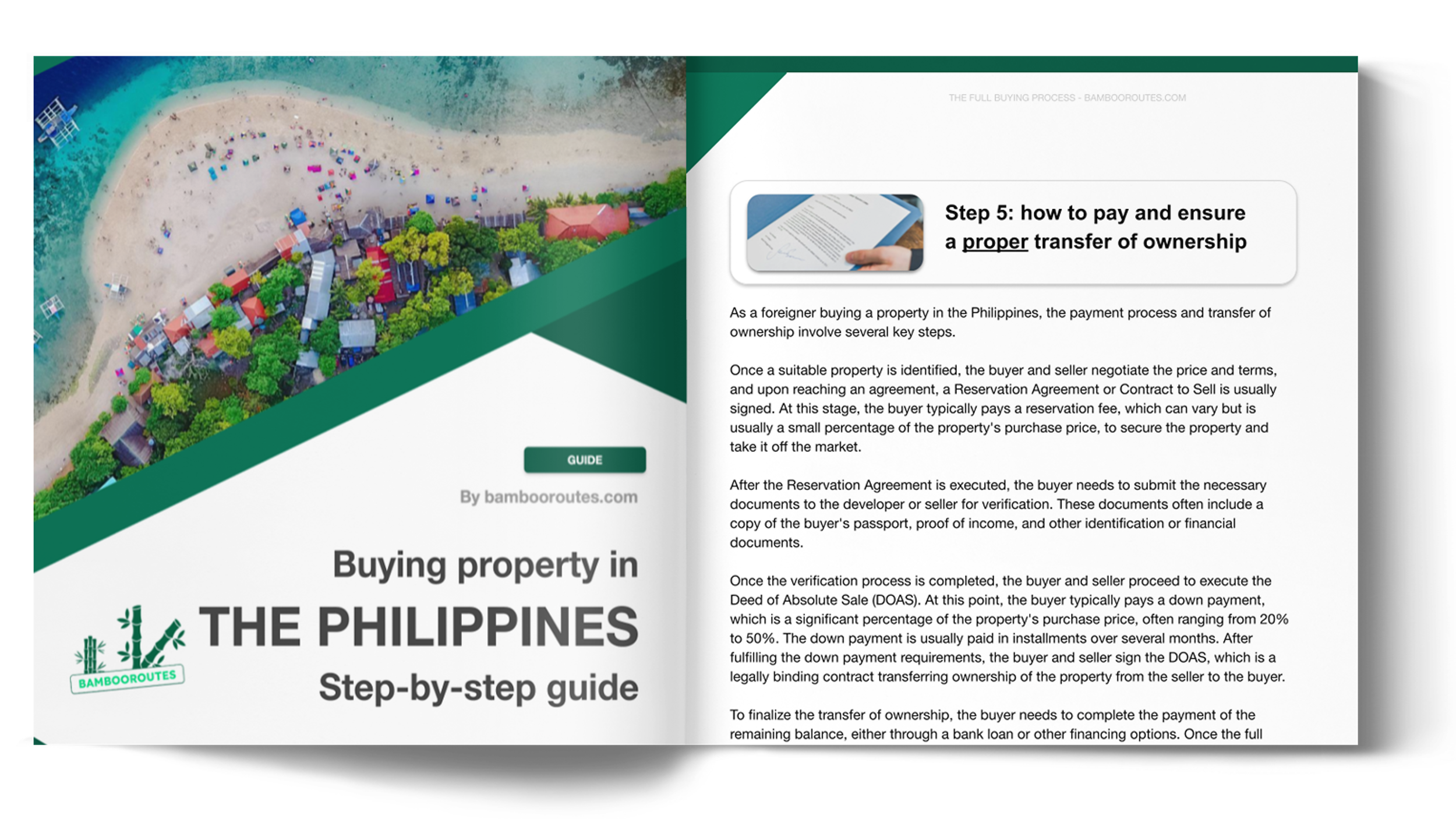
Get all the data you need about the real estate market in The Philippines
This blog post is for foreign buyers who want a simple, updated view of residential property ownership in the Philippines in June 2026.
We constantly update this blog post because Philippine property rules, visa rules, mortgage rates and tax practice can change.
We focus on condos, apartments, houses, townhouses, villas, resort homes and long-term lease homes, not commercial buildings or farmland.
And if you’re planning to buy a property in this place, you may want to download our pack covering the real estate market in the Philippines.

What can I legally buy and truly own as a foreigner in the Philippines?
What property types can foreigners legally buy in the Philippines right now?
Foreigners can legally buy condominium units in the Philippines in 2026, including condo apartments in Manila, Makati, BGC, Ortigas, Cebu, Mactan and Davao, as long as the building stays within the foreign ownership limit.
The most important limit is simple: a foreign buyer can own a condo unit, but foreigners cannot generally own Philippine land in their personal name.
This means a foreigner can usually get clean title to a condo through a Condominium Certificate of Title, but not to a house-and-lot, townhouse-and-lot, villa-and-lot or beach house-and-lot package.
A foreigner may use land through a registered lease or may own a building on land owned by someone else, but that is weaker and more complex than owning a Philippine condo unit directly.
Finally, please note that our pack about the property market in the Philippines is specifically tailored to foreigners.
Can I own land in my own name in the Philippines right now?
No, a foreign citizen generally cannot own private land in the Philippines in their own name in 2026.
The clearest legal alternative is to buy a condominium unit or sign a properly drafted long-term land lease for a house, villa or townhouse site.
The hereditary succession exception exists, and some former Filipino citizens have limited land rights, but those are not normal purchase routes for most foreign buyers in the Philippines.
As of 2026, what other key foreign-ownership rules or limits should I know in the Philippines?
As of 2026, the other key rule is that foreign buyers should check title, condo quota, seller authority, taxes and developer approvals before paying serious money in the Philippines.
The condominium quota is the rule that foreign ownership in a Philippine condominium project should not exceed 40%.
For registration, the practical requirement is that the buyer needs BIR tax processing and Registry of Deeds registration before the new title is cleanly transferred.
There is no broad new rule in June 2026 that suddenly allows foreigners to own Philippine land, so the core condo-versus-land distinction still matters.
If you're interested, we go much more into details about the foreign ownership rights in the Philippines here.
What’s the biggest ownership mistake foreigners make in the Philippines right now?
The biggest mistake is paying for Philippine land through a spouse, partner, friend, employee or nominee while believing that a private side agreement gives the foreign buyer real ownership.
The likely consequence is that the foreign buyer may lose control of the land, face an unenforceable arrangement, or be forced into a difficult dispute.
Other classic pitfalls in the Philippines include ignoring the 40% condo quota, buying pre-selling units without checking the License to Sell, missing title annotations and underestimating unpaid condo dues or real property tax.
Get fresh and reliable information about the market in the Philippines
Don't base significant investment decisions on outdated data. Get updated and accurate information.

Which visa or residency status changes what I can do in the Philippines?
Do I need a specific visa to buy property in the Philippines right now?
You do not usually need a special visa to buy a legally eligible condo in the Philippines in June 2026, and buying on a tourist status is often possible if the buyer can pass normal checks.
The common administrative blocker is not the visa itself, but the ability to complete identity checks, banking checks, tax registration and document signing from abroad.
In practice, a foreign buyer should expect to need a Philippine Taxpayer Identification Number before the title transfer can be completed.
A typical foreign buyer document set includes passport, visa or entry record, TIN, proof of address, proof of funds, signed sale documents and a consularized Special Power of Attorney if the buyer is not present.
Does buying property help me get residency and citizenship in the Philippines in 2026?
As of 2026, buying ordinary residential property in the Philippines does not automatically give a foreigner residency or citizenship.
The Special Resident Retiree’s Visa can help eligible retirees live in the Philippines, but the SRRV is a residency product, not a land ownership shortcut.
Other pathways can include a spouse visa, work status, investor routes or naturalization, but these are separate from buying a condo in the Philippines.
We give you all the details you need about the different pathways to get residency and citizenship in the Philippines here.
Can I legally rent out property on my visa in the Philippines right now?
Your visa usually does not stop you from passively renting out a legally owned Philippine condo, but it can matter if you personally run a rental business on the ground.
You do not need to live in the Philippines to rent out a condo, but you normally need a local manager, clear building permission and proper tax handling.
Foreign owners should check BIR registration, rental income tax, tenant withholding, condo corporation rules and short-term rental restrictions before listing a unit on Airbnb or similar platforms.
We cover everything there is to know about buying and renting out in the Philippines here.
Get to know the market before buying a property in the Philippines
Better information leads to better decisions. Get all the data you need before investing a large amount of money.
How does the buying process actually work step-by-step in the Philippines?
What are the exact steps to buy property in the Philippines right now?
The usual Philippines condo purchase sequence is to confirm eligibility and foreign quota, check title or developer documents, reserve the unit, sign the contract, secure a TIN, pay taxes, obtain BIR clearance, register with the Registry of Deeds and receive the new CCT.
You do not always need to be physically present in the Philippines if a proper Special Power of Attorney is used, but personal inspection is strongly recommended before paying a large amount.
The step that usually makes the deal legally serious is the signed and notarized Deed of Absolute Sale for resale property, or the signed developer contract for a primary sale.
A normal resale condo transfer in the Philippines often takes about one to three months from accepted offer to final registration, although BIR and Registry of Deeds delays can make it longer.
We have a document entirely dedicated to the whole buying process our pack about properties in the Philippines.
Is it mandatory to get a lawyer or a notary to buy a property in the Philippines right now?
A notarized deed is normally needed for a registrable property transfer in the Philippines, while an independent lawyer is not always mandatory but is strongly recommended for foreign buyers.
The notary makes the deed usable for registration, while the lawyer checks title, quota, taxes, seller authority, contract risk and buyer protection.
The lawyer’s scope should clearly include title review, annotation review, condo quota confirmation, tax allocation, unpaid dues, and safe release of funds at closing.
Make a profitable investment in the Philippines
Better information leads to better decisions. Save time and money. Download our data.
What checks should I run so I don’t buy a problem property in the Philippines?
How do I verify title and ownership history in the Philippines right now?
The official place to verify Philippine title and ownership history is the Registry of Deeds under the Land Registration Authority.
For a condo, the key document is a fresh Certified True Copy of the Condominium Certificate of Title, and for land it is the Transfer Certificate of Title.
A realistic look-back is at least the current title plus prior transfer documents, and buyers often review the last ten years when the property history looks complicated.
A red flag that should pause the purchase is any mortgage, adverse claim, notice of levy, lis pendens, duplicate title issue, estate issue or seller name mismatch on the title.
You will find here the list of classic mistakes people make when buying a property in the Philippines.
How do I confirm there are no liens in the Philippines right now?
The standard way to confirm no liens in the Philippines is to get a fresh Certified True Copy of the CCT or TCT and read all annotations on the title.
Common encumbrances to ask about include bank mortgages, unpaid real property tax, notices of levy, adverse claims, lis pendens and unpaid condominium association dues.
The best written proof is a fresh certified title from the Registry of Deeds, supported by tax clearance and condo dues clearance when the property is a condominium unit.
How do I check zoning and permitted use in the Philippines right now?
For zoning and permitted use in the Philippines, check the local government unit, the local zoning office, the DHSUD framework and the project’s approved residential status.
The key reference is usually the local zoning map, zoning ordinance or locational clearance, plus the License to Sell for a subdivision or condominium project.
A common pitfall is assuming a beach villa, resort-style townhouse or fringe-area house can be used as residential rental property just because similar buildings are nearby.
Don't buy the wrong property, in the wrong area of the Philippines
Buying real estate is a significant investment. Don't rely solely on your intuition. Gather the right information to make the best decision.
Can I get a mortgage as a foreigner in the Philippines, and on what terms?
Do banks lend to foreigners for homes in the Philippines in 2026?
As of 2026, Philippine banks can lend to foreigners for homes, but approvals are usually easier for condo purchases than for land-based homes.
A realistic foreigner loan-to-value range in the Philippines is about 40% to 70%, with stronger foreign residents closer to the high end and non-residents often closer to the low end.
The biggest eligibility factor is usually the buyer’s ability to prove stable income, legal stay, banking history and clear repayment capacity.
You can also read our latest update about mortgage and interest rates in The Philippines.
Which banks are most foreigner-friendly in the Philippines in 2026?
As of 2026, the most practical first banks for a foreign mortgage in the Philippines are usually BDO, BPI and Metrobank, with HSBC also useful for internationally banked buyers.
The feature that makes these banks more useful is their stronger home-loan infrastructure, larger branch networks, expat familiarity and ability to assess documented foreign income.
Non-resident lending is possible in some cases, but it is harder, more document-heavy and often comes with lower financing than lending to a foreign resident.
We actually have a specific document about how to get a mortgage as a foreigner in our pack covering real estate in the Philippines.
What mortgage rates are foreigners offered in the Philippines in 2026?
As of 2026, a realistic mortgage rate range for foreigners in the Philippines is about 6.5% to 9.5% for many qualified condo borrowers, depending on income, residency, bank and fixing period.
Fixed-rate loans usually give more payment certainty at the start, while variable or repriced loans may look cheaper early but can rise after the first fixing period.
Get fresh and reliable information about the market in the Philippines
Don't base significant investment decisions on outdated data. Get updated and accurate information.
What will taxes, fees, and ongoing costs look like in the Philippines?
What are the total closing costs as a percent in the Philippines in 2026?
A practical buyer-side budget for closing costs in the Philippines in 2026 is usually around 3% to 5% of the property price when the seller pays capital gains tax.
A realistic low-to-high range is about 3% to 18%, because buyer costs can jump when the buyer absorbs seller tax or buys a VATable developer unit.
The main cost categories are documentary stamp tax, transfer tax, registration fees, notarial fees, legal fees, broker allocation, BIR processing, local government fees and possible VAT.
The biggest swing factor is usually whether capital gains tax or VAT is included in the price or passed to the buyer.
If you want to go into more details, we also have a blog article detailing all the property taxes and fees in the Philippines.
What annual property tax should I budget in the Philippines in 2026?
As of 2026, many standard condo owners in the Philippines should roughly budget ₱10,000 to ₱80,000 per year, about $165 to $1,320 or €155 to €1,220, for annual real property tax on an owner-occupied unit.
Annual real property tax in the Philippines is mainly assessed as a local rate on assessed value, not as a flat rate on the full purchase price.
How is rental income taxed for foreigners in the Philippines in 2026?
As of 2026, a cautious planning estimate for foreigner rental income in the Philippines is about 10% to 25% of gross rent lost to income tax, withholding, compliance and professional help before final personal structuring.
A foreign owner usually needs BIR registration, proper records, tax filing and possible withholding handling when the tenant is a business or the lease is formal.
What insurance is common and how much in the Philippines in 2026?
As of 2026, a standard home insurance budget in the Philippines is often about ₱5,000 to ₱40,000 per year, roughly $80 to $660 or €75 to €610, for basic owner coverage on a normal condo or modest home.
The most common coverage is fire insurance, often with optional contents, earthquake, typhoon, flood and landlord extensions depending on the property.
The biggest pricing factor is local hazard exposure, especially flood, typhoon, storm surge, earthquake and building quality in places like Metro Manila, Cebu, Mactan, Siargao, Palawan and Batangas.
Get to know the market before buying a property in the Philippines
Better information leads to better decisions. Get all the data you need before investing a large amount of money.
What sources have we used to write this blog article?
Whether it’s in our blog articles or the market analyses included in our property pack about the Philippines, we always rely on the strongest methodology we can, and we don’t throw out numbers at random.
We also aim to be fully transparent, so below we’ve listed the authoritative sources we used, and explained how we used them and the methods behind our estimates.
| Source | Why we trust it | How we used it |
|---|---|---|
| 1987 Philippine Constitution | It is the core legal text for Philippine land ownership. | We used it to anchor the rule that foreigners generally cannot own land. We also used it to explain why condo ownership is treated differently. |
| Republic Act No. 4726, Condominium Act | It is the main law governing Philippine condominium ownership. | We used it to explain why foreigners can own condo units. We also used it to confirm the 40% foreign ownership cap. |
| Land Registration Authority | It supervises land title registration in the Philippines. | We used it for title registration logic and buyer due diligence. We also used it to separate CCT checks from TCT checks. |
| Registry of Deeds Directory | It lists the offices that record Philippine property titles. | We used it to identify where title history and annotations are checked. We also used it for the final registration workflow. |
| LRA eSerbisyo Portal | It allows requests for Certified True Copies of titles. | We used it to explain how buyers can request official title copies. We also used it for lien and ownership verification logic. |
| Bureau of Internal Revenue, Primary Registration | BIR is the official Philippine tax authority. | We used it to explain why a TIN matters before title transfer. We also used it for foreign buyer tax onboarding. |
| Bureau of Internal Revenue, Documentary Stamp Tax | It is the official source for DST guidance. | We used it to build the closing-cost section. We also used it to explain why tax allocation must be written into the contract. |
| BIR Revenue Regulations No. 1-2024 | It gives direct guidance on VAT threshold updates. | We used it to estimate when VAT can matter on developer sales. We also used it to explain why low and high closing-cost cases differ. |
| Local Government Code | It sets the framework for local property taxes. | We used it to explain real property tax rate ceilings. We also converted assessed-value rules into a simple annual owner budget. |
| Philippine Retirement Authority, SRRV | It is the official source for the retirement visa. | We used it to explain that SRRV is a residence route. We also used it to show that SRRV does not override land ownership law. |
| Bureau of Immigration Visas | It is the official source for Philippine visa categories. | We used it to separate visa status from ownership rights. We also used it to discuss tourist, spouse and residence pathways. |
| Bangko Sentral ng Pilipinas Key Rates | BSP is the Philippine central bank. | We used it to benchmark the 2026 mortgage rate environment. We also used it for currency context in cost estimates. |
| BSP Residential Property Price Index | It tracks residential prices from bank housing-loan data. | We used it for market-cycle context. We also used it to compare lending conditions with housing demand. |
| Philippine Statistics Authority Construction Statistics | PSA is the national statistics agency. | We used it to understand current residential construction activity. We also used it as a cross-check for market supply context. |
| Colliers Philippines Q1 2026 Residential Report | Colliers is a recognized real estate consultancy. | We used it for Metro Manila condo market evidence. We treated it as market context, not legal authority. |
Make a profitable investment in the Philippines
Better information leads to better decisions. Save time and money. Download our data.