
Authored by the expert who managed and guided the team behind the Philippines Property Pack
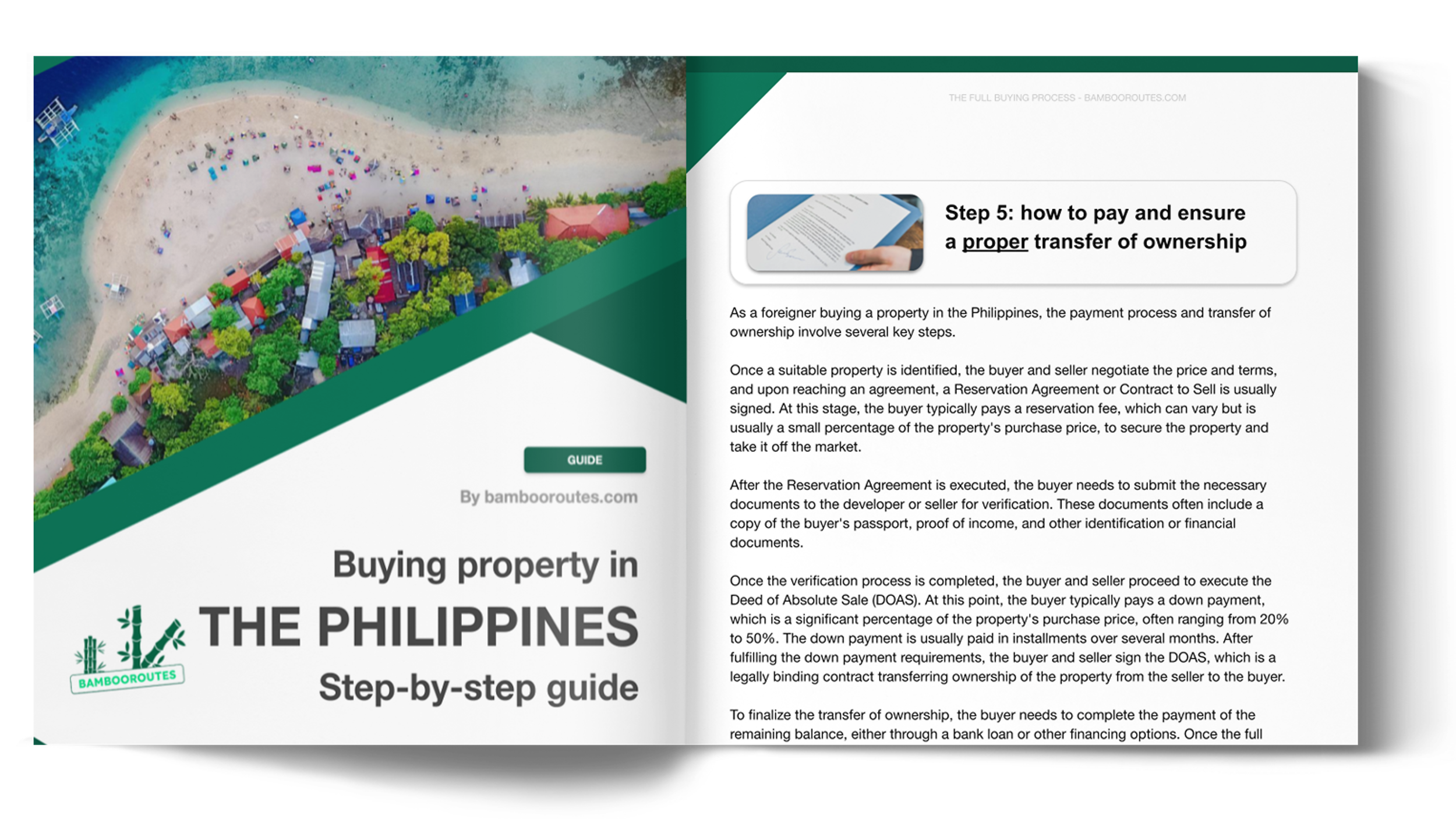
Everything you need to know before buying real estate is included in our The Philippines Property Pack
Panay Island is one of the most attractive destinations in the Western Visayas for foreigners looking to buy residential property, with Iloilo City condos and Boracay resort units drawing the most international interest.
Understanding the ownership rules is essential because the Philippines has strict constitutional limits on what foreigners can actually own in their name.
This guide covers everything you need to know about buying property as a foreigner in Panay Island in January 2026, and we constantly update this blog post as rules and market conditions change.
And if you're planning to buy a property in this place, you may want to download our pack covering the real estate market in Panay Island.
Insights
- Foreigners can legally own condominium units in Panay Island, but the project must maintain at least 60% Filipino ownership, which means you should verify the foreign ownership cap before signing anything in Iloilo City or Boracay.
- The biggest mistake foreigners make in Panay Island is using informal nominee arrangements to buy land, which can result in losing the entire investment because Philippine courts actively enforce the constitutional ban.
- As of early 2026, mortgage rates for foreigners in Panay Island typically range from 6.5% to 9%, with most well-documented buyers landing around 7.5% for a 2 to 3 year fixed rate.
- Total closing costs for a resale condo purchase in Panay Island run between 5% and 8% of the purchase price, with Documentary Stamp Tax at 1.5% often being the single largest fee.
- You do not need a special visa to buy a condo in Panay Island, but you will effectively need a Philippine Tax Identification Number (TIN) to complete the BIR transfer process.
- Annual property tax in Panay Island is roughly 0.5% of market value, and Iloilo City currently offers a 40% discount for early or on-time payment that extends through 2028.
- Non-resident foreigners renting out property in Panay Island are typically taxed at a flat 25% on Philippine-sourced rental income unless a tax treaty provides relief.
- The standard buying process in Panay Island takes 2 to 4 months from accepted offer to title transfer, though pre-selling condos from developers follow a different, longer timeline.
- BDO and BPI are the most foreigner-friendly banks for home loans in Panay Island in 2026, but both require strong income documentation and often ask for higher down payments from non-residents.

What can I legally buy and truly own as a foreigner in Panay Island?
What property types can foreigners legally buy in Panay Island right now?
As a foreigner in Panay Island in January 2026, you can legally buy condominium units (including resort-style condos in Boracay and residential condos in Iloilo City), but you cannot buy land or house-and-lot packages in your own name.
The single most important legal condition is that condominium projects in the Philippines must maintain at least 60% Filipino ownership, so as a foreigner you can only buy into the remaining 40% foreign allocation in any given project.
This means that even if a developer in Mandurriao or Malay is eager to sell you a unit, you need to confirm the project has not already hit its foreign ownership cap before you can legally register the purchase in your name.
In practice, most foreigners in Panay Island focus on condo units in Iloilo City's growing business districts or Boracay's resort developments because these are the cleanest ownership paths that do not require any workaround structures.
Finally, please note that our pack about the property market in Panay Island is specifically tailored to foreigners.
Can I own land in my own name in Panay Island right now?
No, as a foreigner you cannot own land in your own name in Panay Island in January 2026 because the Philippine Constitution explicitly restricts private land ownership to Filipino citizens and corporations that are at least 60% Filipino-owned.
The most common legal alternative foreigners use in Panay Island is to lease land on a long-term basis (up to 50 years, renewable for another 25 years) and then own the house or improvements built on that leased land, which is especially popular in beach areas like Aklan near Boracay.
Another option is to buy through a Philippine corporation that meets the 60% Filipino ownership requirement, but this structure is complex, easy to get wrong, and not recommended for most individual amateur buyers without serious legal guidance.
By the way, we cover everything there is to know about the land buying process in Panay Island here.
As of 2026, what other key foreign-ownership rules or limits should I know in Panay Island?
As of early 2026, the most important rule beyond the land restriction is that condo developers must secure a License to Sell from DHSUD before they can legally sell units, so you should always verify this license before paying any serious money on a pre-selling project in Iloilo or Boracay.
The 40% foreign ownership cap applies at the project level rather than the individual level, which means you need to confirm with the developer or condo corporation that there is still room in the foreign quota before assuming your purchase can be registered.
Foreign buyers in Panay Island must register their purchase with the Bureau of Internal Revenue and the Registry of Deeds, and the BIR process requires proper tax identification and compliance with Documentary Stamp Tax rules before notarization.
There is no major regulatory change taking effect in 2026 that significantly alters the foreign ownership framework in Panay Island, so the constitutional land ban and condo cap rules remain the same as in recent years.
What's the biggest ownership mistake foreigners make in Panay Island right now?
The biggest ownership mistake foreigners make in Panay Island is trying to work around the land ban by putting property in a Filipino friend's or partner's name through an informal nominee arrangement, believing a private contract will protect them.
If you make this mistake, you risk losing your entire investment because Philippine courts actively enforce the constitutional ban and do not recognize side agreements designed to circumvent it, meaning the nominee can legally claim the property as their own.
Other classic pitfalls in Panay Island include buying from developers without verifying their License to Sell, failing to check if a condo project has already hit its 40% foreign cap, and not requesting a Certified True Copy of the title to verify there are no liens or encumbrances.
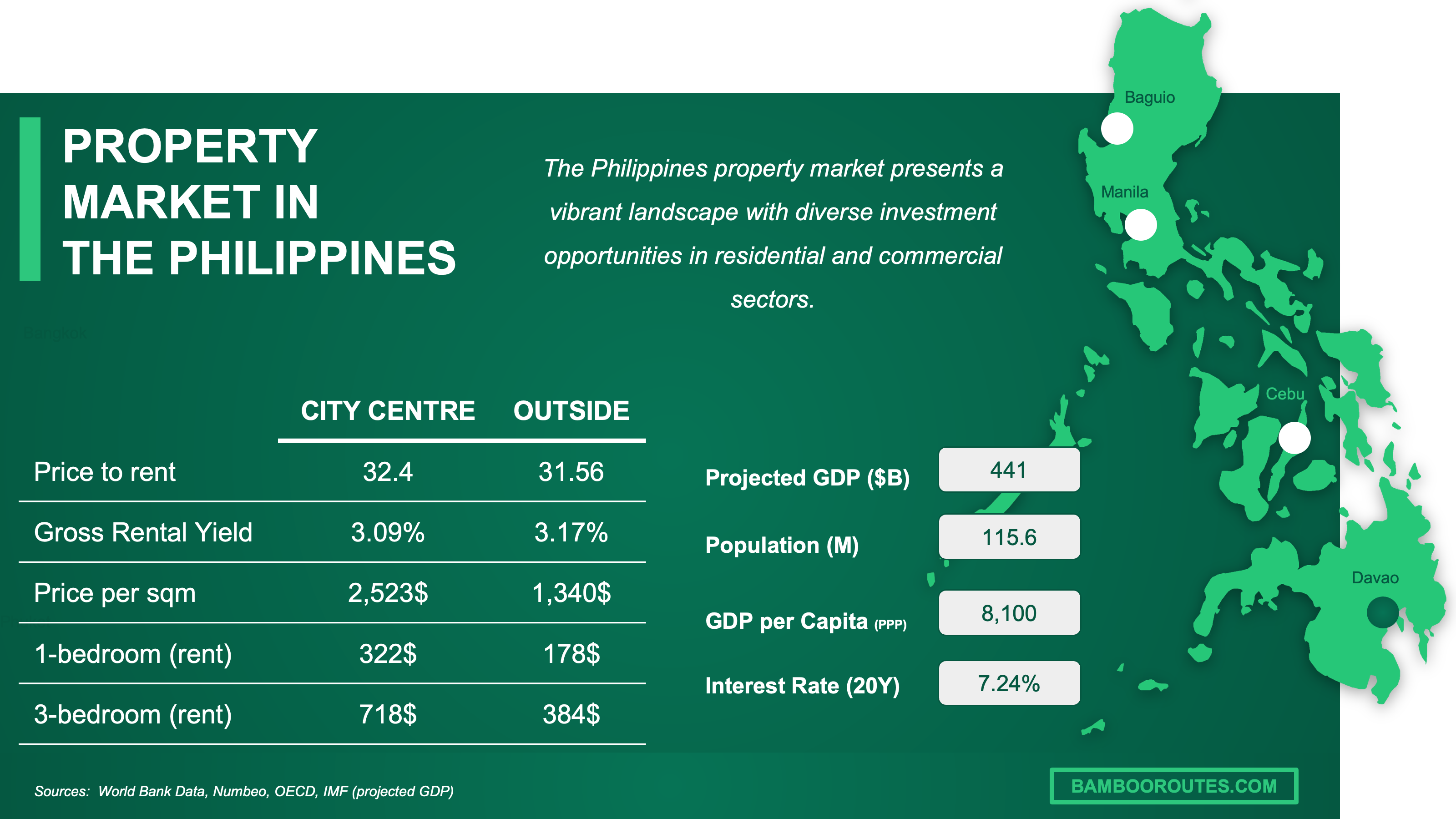
We have made this infographic to give you a quick and clear snapshot of the property market in the Philippines. It highlights key facts like rental prices, yields, and property costs both in city centers and outside, so you can easily compare opportunities. We’ve done some research and also included useful insights about the country’s economy, like GDP, population, and interest rates, to help you understand the bigger picture.
Which visa or residency status changes what I can do in Panay Island?
Do I need a specific visa to buy property in Panay Island right now?
No, you do not need a specific visa to buy a condominium unit in Panay Island in January 2026, and many foreigners successfully purchase property while on a regular tourist visa, though the ownership restrictions (condo allowed, land banned) apply regardless of your immigration status.
The most common administrative barrier for buyers without local residency is opening a Philippine bank account, which some banks require for payment processing and which typically needs additional documentation if you are not a resident.
You will effectively need a Philippine Tax Identification Number (TIN) before buying because the BIR transfer process requires both buyer and seller to be properly identified for tax documentation.
A typical document set for a foreign buyer in Panay Island includes your passport, TIN, proof of funds or bank certification, and if you cannot be present for signing, a properly executed Special Power of Attorney that allows someone to act on your behalf.
Does buying property help me get residency and citizenship in Panay Island in 2026?
As of early 2026, buying residential property in Panay Island does not automatically qualify you for residency or citizenship because the Philippines does not have a "golden visa" program that grants immigration benefits based on real estate purchase alone.
The most commonly cited formal route for foreigners seeking long-term residency is the Special Resident Retiree's Visa (SRRV) run by the Philippine Retirement Authority, which requires a deposit starting around $10,000 to $50,000 depending on your age and chosen program tier.
Other pathways to permanent residency include the Special Investor's Resident Visa (for larger business investments), marriage to a Filipino citizen, or the 13(a) quota immigrant visa, but none of these are triggered simply by buying a condo in Iloilo or Boracay.
We give you all the details you need about the different pathways to get residency and citizenship in Panay Island here.
Can I legally rent out property on my visa in Panay Island right now?
Your visa status does not directly prevent you from renting out a property you legally own in Panay Island, and many foreign condo owners in Iloilo City and Boracay successfully earn rental income while managing the property through local agents.
You do not need to live in the Philippines to rent out your property, but you will need to comply with Philippine tax rules, and non-residents are typically subject to different tax treatment than residents.
The main things foreigners must know when renting out property in Panay Island are that short-term rentals may be restricted by your condo building's rules, you need to register for tax purposes and file or have taxes withheld on your rental income, and non-resident aliens not engaged in business are typically taxed at a flat 25% on Philippine-sourced income.
Get fresh and reliable information about the market in Panay Island
Don't base significant investment decisions on outdated data. Get updated and accurate information with our guide.

How does the buying process actually work step-by-step in Panay Island?
What are the exact steps to buy property in Panay Island right now?
The standard buying process in Panay Island follows this sequence: choose a property and verify it is a condo unit you can legally own, conduct due diligence on the title and seller, sign a Contract to Sell or Reservation, execute a notarized Deed of Absolute Sale, pay required taxes and secure BIR clearances, register with the Registry of Deeds for a new title, and update local tax records.
You do not have to be physically present for every step in Panay Island because many buyers use a Special Power of Attorney (SPA) to authorize a trusted person or lawyer to sign documents and file paperwork on their behalf.
The step that typically makes the deal legally binding is the execution and notarization of the Deed of Absolute Sale, which is the core transfer instrument that transfers ownership from seller to buyer once properly filed.
The typical end-to-end timeline from accepted offer to final title transfer in Panay Island ranges from 2 to 4 months for a straightforward resale condo, though pre-selling purchases from developers follow a longer timeline tied to construction and turnover.
We have a document entirely dedicated to the whole buying process our pack about properties in Panay Island.
Is it mandatory to get a lawyer or a notary to buy a property in Panay Island right now?
A notary is effectively mandatory in Panay Island because the Deed of Absolute Sale must be notarized to be valid for registration, and BIR compliance rules require proper Documentary Stamp Tax payment before or at the time of notarization.
The key difference is that a notary in the Philippines authenticates signatures and makes the document a public instrument, while a lawyer reviews the legal substance of the transaction, verifies title authenticity, checks seller authority, and protects your interests throughout the process.
One key item that should be explicitly included in your lawyer's engagement scope for a property purchase in Panay Island is verification that the condo project has not exceeded its 40% foreign ownership cap, which is something a notary will not check for you.
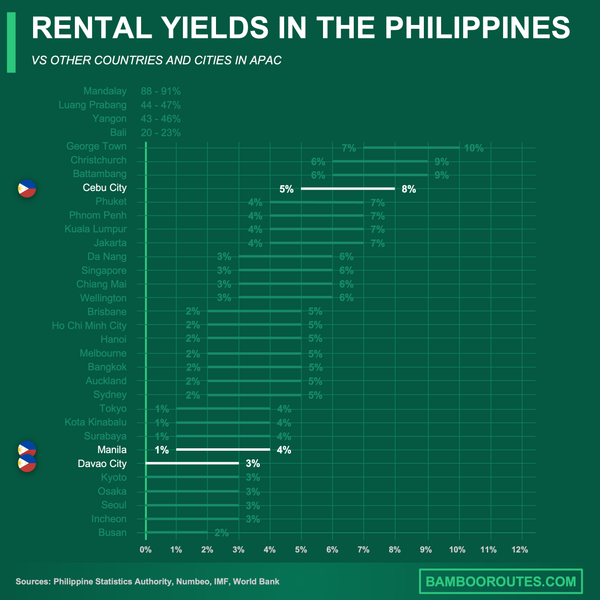
We did some research and made this infographic to help you quickly compare rental yields of the major cities in the Philippines versus those in neighboring countries. It provides a clear view of how this country positions itself as a real estate investment destination, which might interest you if you’re planning to invest there.
What checks should I run so I don't buy a problem property in Panay Island?
How do I verify title and ownership history in Panay Island right now?
The official registry to verify title and ownership history in Panay Island is the Registry of Deeds, which you can access through the Land Registration Authority's eSerbisyo online portal or by visiting the local Registry of Deeds office in Iloilo City or the relevant province.
The key title document you should request is a Certified True Copy (CTC) of the Condominium Certificate of Title (CCT) for condo units, which shows the registered owner, unit description, and any encumbrances or annotations.
A realistic look-back period for ownership history checks in Panay Island is at least 10 to 15 years, which helps you identify any pattern of disputes, frequent transfers, or unresolved claims that could affect your purchase.
One clear red-flag finding that should stop or pause your purchase is any annotation showing an adverse claim, lis pendens (pending litigation), or unresolved mortgage that the seller has not disclosed or cannot demonstrate will be released at closing.
You will find here the list of classic mistakes people make when buying a property in Panay Island.
How do I confirm there are no liens in Panay Island right now?
The standard way to confirm there are no liens or encumbrances on a property in Panay Island is to request a Certified True Copy of the title from the Registry of Deeds, which includes an encumbrances section listing any mortgages, adverse claims, or other annotations.
One common type of lien buyers should specifically ask about in Panay Island is a bank mortgage, especially on resale condos where the previous owner may have used the unit as collateral, and you need to ensure it will be released before or at closing.
The single best form of written proof showing lien status is the Certified True Copy of the CCT or TCT issued by the Registry of Deeds, which is an official government document that shows all registered encumbrances as of the date of certification.
How do I check zoning and permitted use in Panay Island right now?
The authority to check zoning and permitted use for a property in Panay Island is the local government unit (LGU), specifically the City or Municipal Planning and Development Office in places like Iloilo City, Malay (for Boracay access), or the relevant municipality in Capiz, Antique, or Aklan.
The document that typically confirms zoning classification is the Zoning Certificate or Locational Clearance issued by the LGU, which states whether the property's location is classified as residential, commercial, agricultural, or another use category.
One common zoning pitfall that foreign buyers miss in Panay Island is purchasing a condo unit marketed for vacation rentals in an area or building where short-term rental use is restricted by the local zoning ordinance or the condo corporation's house rules.
Buying real estate in Panay Island can be risky
An increasing number of foreign investors are showing interest. However, 90% of them will make mistakes. Avoid the pitfalls with our comprehensive guide.

Can I get a mortgage as a foreigner in Panay Island, and on what terms?
Do banks lend to foreigners for homes in Panay Island in 2026?
As of early 2026, yes, several Philippine banks do lend to foreigners for condo purchases in Panay Island, though you should expect stricter documentation requirements and sometimes higher down payment expectations compared to Filipino borrowers.
The realistic loan-to-value (LTV) range that foreign borrowers most commonly see in Panay Island is 50% to 70%, meaning you will likely need to provide 30% to 50% as a down payment depending on your income documentation and the bank's assessment of your profile.
The single most common eligibility requirement that determines whether a foreigner qualifies is verifiable income, which means the bank needs to see proof of stable earnings (local or offshore) that can support the monthly payments over the loan term.
You can also read our latest update about mortgage and interest rates in The Philippines.
Which banks are most foreigner-friendly in Panay Island in 2026?
As of early 2026, the most foreigner-friendly banks for mortgages in Panay Island are BDO, BPI, and Metrobank, which are large universal banks with established housing loan operations and experience serving expats and overseas Filipino families.
The feature that makes these banks more foreigner-friendly is their standardized home loan processes that can accommodate offshore income documentation and their branch networks in major Panay cities like Iloilo where you can process applications in person.
These banks will sometimes lend to non-residents (buyers without Philippine residency), but approval typically depends on stronger income documentation, a larger down payment, and sometimes a co-borrower or guarantor arrangement.
We actually have a specific document about how to get a mortgage as a foreigner in our pack covering real estate in Panay Island.
What mortgage rates are foreigners offered in Panay Island in 2026?
As of early 2026, the typical mortgage interest rate range for foreigners in Panay Island is 6.5% to 9% per year, with most well-documented borrowers landing around 7.5% for a 2 to 3 year fixed-rate period before the rate adjusts.
Fixed-rate mortgages in Panay Island typically offer rate certainty for 1 to 5 years at a slightly higher initial rate, while variable-rate products start lower but expose you to rate increases when the BSP policy rate or bank funding costs change, which matters more after the initial fixed period ends.

We made this infographic to show you how property prices in the Philippines compare to other big cities across the region. It breaks down the average price per square meter in city centers, so you can see how cities stack up. It’s an easy way to spot where you might get the best value for your money. We hope you like it.
What will taxes, fees, and ongoing costs look like in Panay Island?
What are the total closing costs as a percent in Panay Island in 2026?
The typical total closing cost for a resale condo purchase in Panay Island in 2026 is around 6% to 7% of the purchase price when you add up all buyer-side taxes, fees, and registration costs.
The realistic low-to-high closing cost range that covers most standard transactions in Panay Island is 5% to 8%, with variation depending on how taxes are allocated between buyer and seller and the specific LGU where the property is located.
The specific fee categories that make up total closing costs in Panay Island include Documentary Stamp Tax, transfer tax, registration fees, notary fees, and miscellaneous administrative charges for BIR processing and title issuance.
The single biggest contributor to closing costs in Panay Island is usually the Documentary Stamp Tax (DST), which is 1.5% of the higher of the selling price, zonal value, or assessed value, and it must be paid before or at the time of notarization.
What annual property tax should I budget in Panay Island in 2026?
As of early 2026, a practical annual property tax budget for a standard condo in Panay Island is roughly 0.5% of the property's market value, which for a unit worth PHP 5 million (around $85,000 or EUR 80,000) means about PHP 25,000 per year (around $430 or EUR 400).
Annual property tax (Real Property Tax or RPT) in Panay Island is assessed as a percentage of the property's assessed value (not market value), with the rate varying by location, and Iloilo City currently offers a 40% discount for early or on-time payment that extends through 2028.
How is rental income taxed for foreigners in Panay Island in 2026?
As of early 2026, non-resident foreigners who rent out property in Panay Island are typically taxed at a flat 25% on their Philippine-sourced rental income, though this rate may be reduced if a tax treaty between the Philippines and your home country applies.
The basic withholding requirement for rental income in Panay Island is that either the tenant or a property management company withholds the appropriate tax from rental payments and remits it to the BIR, or you register and file taxes directly if you are managing the property yourself without a withholding agent.
What insurance is common and how much in Panay Island in 2026?
As of early 2026, the typical annual insurance premium for a standard condo in Panay Island ranges from 0.2% to 0.6% of the insured value, which for a PHP 5 million unit (around $85,000 or EUR 80,000) means roughly PHP 10,000 to PHP 30,000 per year (around $170 to $510 or EUR 160 to EUR 480).
The most common type of property insurance coverage that condo owners carry in Panay Island is fire insurance, which is often required by banks if you have a mortgage and is typically bundled with the condo building's master policy for common areas.
The biggest factor that makes insurance premiums higher or lower in Panay Island is location-specific risk, with coastal properties near Boracay and flood-prone areas paying more for typhoon and flood extensions than inland Iloilo City condos in well-elevated buildings.
Get the full checklist for your due diligence in Panay Island
Don't repeat the same mistakes others have made before you. Make sure everything is in order before signing your sales contract.
What sources have we used to write this blog article?
Whether it's in our blog articles or the market analyses included in our property pack about Panay Island, we always rely on the strongest methodology we can ... and we don't throw out numbers at random.
We also aim to be fully transparent, so below we've listed the authoritative sources we used, and explained how we used them and the methods behind our estimates.
| Source | Why It's Authoritative | How We Used It |
|---|---|---|
| 1987 Philippine Constitution | This is the supreme law of the Philippines that defines all land ownership restrictions. | We used it to anchor the "no foreign land ownership" rule and the narrow exceptions. We then translated that into what it means for buying houses versus condos on Panay Island. |
| Republic Act 4726 (Condominium Act) | This is the national law that defines condominium ownership and the foreign ownership cap. | We used it to define what a condo legally is (a unit plus shared interest in common areas). We combined it with the Constitution's nationality limits to explain the 40% foreign cap in condo projects. |
| Bureau of Internal Revenue (BIR) | BIR is the national tax authority and the official source for all property transfer tax rules. | We used it to confirm Documentary Stamp Tax is a real, unavoidable tax on property documents. We paired it with tax-law references to estimate closing costs in Panay Island. |
| BIR Revenue Memorandum Circular No. 056-2025 | This is a current official BIR issuance explaining DST compliance requirements. | We used it to highlight that documents should not be notarized without proper DST payment. We turned that into a practical checklist item for Panay transactions. |
| Bureau of Immigration (BI) | BI is the government agency that controls immigration status and visa extensions. | We used it to ground that tourist status is a real, administered category. We then separated immigration permission to stay from property ownership permission. |
| Philippine Retirement Authority (PRA) | PRA runs the official retirement residency program and publishes SRRV requirements. | We used it to explain what SRRV changes for a buyer (mainly longer legal stay and easier banking). We also clarified what it does not change (land ownership rules). |
| DHSUD (Department of Human Settlements) | DHSUD regulates developers and requires Licenses to Sell for condo projects. | We used it to build a due-diligence step to verify License to Sell. We translated that into what to ask a developer in Iloilo or Boracay projects. |
| Land Registration Authority (LRA) eSerbisyo | LRA is the government custodian of the Torrens land title system and official title services. | We used it to show a practical way to request a Certified True Copy of a title. We then used that as the backbone for title and lien verification steps. |
| Reuters | Reuters is a top-tier wire service with reliable reporting on BSP policy rate decisions. | We used it to update the likely BSP policy-rate level just before January 2026. We then used that to keep our mortgage-rate estimate current. |
| BDO Home Loan Rate Card | This is a primary, published bank rate card with actual interest rate numbers. | We used it to anchor a real-world range of fixed-rate offers. We then adjusted expectations for foreigners to give a confident early-2026 estimate. |
| BPI Housing Loan | This is a major Philippine bank's official product information page. | We used it to validate that mainstream banks actively market housing loans. We used it to support our foreigner-friendly banks shortlist for Panay buyers. |
| PwC Tax Summaries | PwC's tax summaries are a widely used professional reference that is regularly maintained. | We used it to explain how non-resident versus resident tax treatment affects rental income. We then translated that into simple outcomes for a foreign owner renting on Panay. |
| Daily Guardian | This is a local Iloilo newspaper reporting on official city government policy. | We used it to confirm the Iloilo City 40% RPT discount extension through 2028. We incorporated that into our annual property tax budget guidance. |
| ASG Law Partners | This is a Philippine law firm providing legal commentary on foreign ownership enforcement. | We used it to explain the enforcement risk of nominee arrangements. We translated that into a simple "don't do nominee land" rule for Panay buyers. |
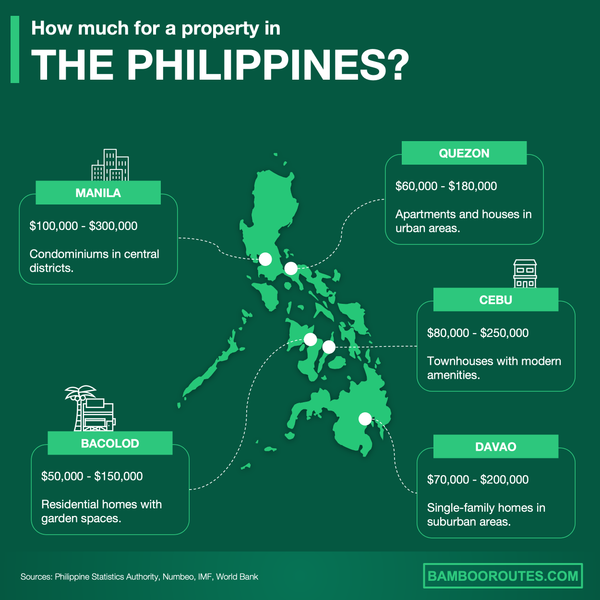
We created this infographic to give you a simple idea of how much it costs to buy property in different parts of the Philippines. As you can see, it breaks down price ranges and property types for popular cities in the country. We hope this makes it easier to explore your options and understand the market.
Related blog posts