
Authored by the expert who managed and guided the team behind the Philippines Property Pack
Everything you need to know before buying real estate is included in our The Philippines Property Pack
This article gives you a clear, honest picture of what foreign buyers can and cannot do when it comes to owning residential land on Panay Island in early 2026, covering the legal restrictions, the workarounds that actually work, the taxes, the scams, and the step-by-step process.
We constantly update this blog post to reflect the latest regulations, market shifts, and on-the-ground realities across Panay Island's four provinces: Aklan, Antique, Capiz, and Iloilo.
And if you're planning to buy a property in this place, you may want to download our pack covering the real estate market in Panay Island.
Insights
- The Philippine Constitution still bans foreign land ownership on Panay Island in 2026, but a September 2025 law now allows foreigners to lease land for up to 99 years, nearly doubling the old limit.
- House-and-lot prices in Iloilo City rose about 6% per year between 2016 and 2023, making it one of the fastest-appreciating residential markets in the Philippines.
- Buyer-side closing costs for a titled residential lot on Panay Island typically run between 3% and 5% of the purchase price, depending on the local government unit.
- Boracay's beachfront land in Malay, Aklan is one of the trickiest areas on Panay Island because what sellers call "beachfront lots" may partly fall on public-domain foreshore that nobody can privately own.
- The Anti-Dummy Law carries prison terms of 5 to 15 years, plus forfeiture of the land, for foreigners caught using Filipino "nominees" to secretly own property on Panay Island.
- Condominium units in Panay Island are capped at 40% foreign ownership per project, so popular buildings in Iloilo City's Mandurriao district may already be full for foreign buyers.
- Lot-only developments in Iloilo recorded roughly 12% annual price growth from 2016 to 2023, outpacing even house-and-lot units in the same period.
- The planned Panay-Guimaras-Negros Inter-Island Bridge, a 188 billion peso project targeted for 2030, is expected to significantly boost property values across western Panay Island.
- A full land purchase on Panay Island, from title verification to registration, typically takes 6 to 12 weeks when the title is clean and both parties are responsive.

Can a foreigner legally own land in Panay Island right now?
Can foreigners own land in Panay Island in 2026?
As of early 2026, foreigners cannot legally own private land on Panay Island because the Philippine Constitution reserves land ownership exclusively for Filipino citizens and corporations that are at least 60% Filipino-owned.
The ban is a blanket prohibition, meaning a foreign individual simply cannot have a Transfer Certificate of Title issued in their own name for any residential lot on Panay Island, whether it sits in downtown Iloilo City or on a hillside in Antique.
The closest legal alternative for foreigners who want residential land on Panay Island is either buying a condominium unit (where the land is held by the condo corporation, not by you personally) or signing a long-term land lease, which since September 2025 can now stretch up to 99 years under Republic Act 12252.
It is also worth noting that the Panay Island land ownership restriction is not tied to your specific nationality: whether you hold a British, American, Chinese, or any other foreign passport, the same constitutional rule applies equally to all non-Filipino citizens.
Can I own a house but not the land in Panay Island in 2026?
As of early 2026, Philippine law does allow foreigners on Panay Island to own a building or house separately from the land it sits on, as long as the foreigner's right to the land comes through a properly documented lease rather than outright ownership.
In practice, the foreigner typically holds a notarized lease contract (ideally registered with the Registry of Deeds) for the land, and the house or structure built on it is treated as a separate asset that the foreigner can legally own during the lease term.
When the underlying land lease expires on Panay Island, the foreigner's right to occupy the land ends as well, so the fate of the building depends entirely on what was negotiated in the lease contract, which is why having a clear "end-of-lease" clause covering the structure's ownership, removal, or compensation is absolutely essential before you build anything.
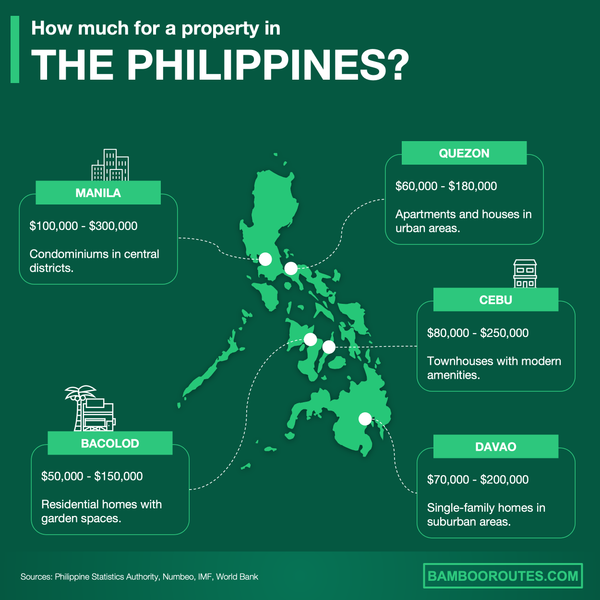
We created this infographic to give you a simple idea of how much it costs to buy property in different parts of the Philippines. As you can see, it breaks down price ranges and property types for popular cities in the country. We hope this makes it easier to explore your options and understand the market.
Do rules differ by region or city for land ownership in Panay Island right now?
The foreign land ownership ban on Panay Island is a national constitutional rule, so it applies identically whether you are looking at a lot in Iloilo City, a beachfront parcel in Malay (Aklan), or a rural plot in Capiz or Antique.
That said, areas with significant coastal or tourism activity, such as Boracay's Station 1, Station 2, and Station 3 in the barangays of Balabag, Manoc-Manoc, and Yapak, tend to have stricter enforcement and extra layers of scrutiny around foreshore classifications, environmental compliance, and zoning rules that can catch unprepared buyers off guard.
The main reason these local differences matter on Panay Island is not the ownership law itself, but the fact that local government units set their own transfer tax rates, zoning rules, and processing timelines, so a transaction in Aklan province can cost and feel quite different from one in Iloilo City even though the same national laws govern both.
We cover a lot of different regions and cities in our pack about the property market in Panay Island.
Can I buy land in Panay Island through marriage to a local in 2026?
As of early 2026, marrying a Filipino citizen does not grant a foreigner the legal right to own land on Panay Island, because the constitutional restriction applies to the buyer's citizenship, not their marital status.
In practice, the land is typically purchased and titled in the Filipino spouse's name, and the foreign spouse should make sure there is a clear, notarized agreement (such as a prenuptial or postnuptial agreement) that documents how the property fits into the couple's financial arrangements, because without proper paperwork, the foreigner has very limited legal standing over the property.
If the marriage ends in annulment (divorce is not available in the Philippines for most couples as of early 2026), the foreign spouse generally cannot claim ownership of the land, since the Constitution does not allow foreign nationals to hold title; the court may, however, order a financial settlement, but the land itself cannot legally be transferred to the foreigner.
There is a lot of mistakes you can make, we cover 99% of them in our list of risks and pitfalls people face when buying property in Panay Island.
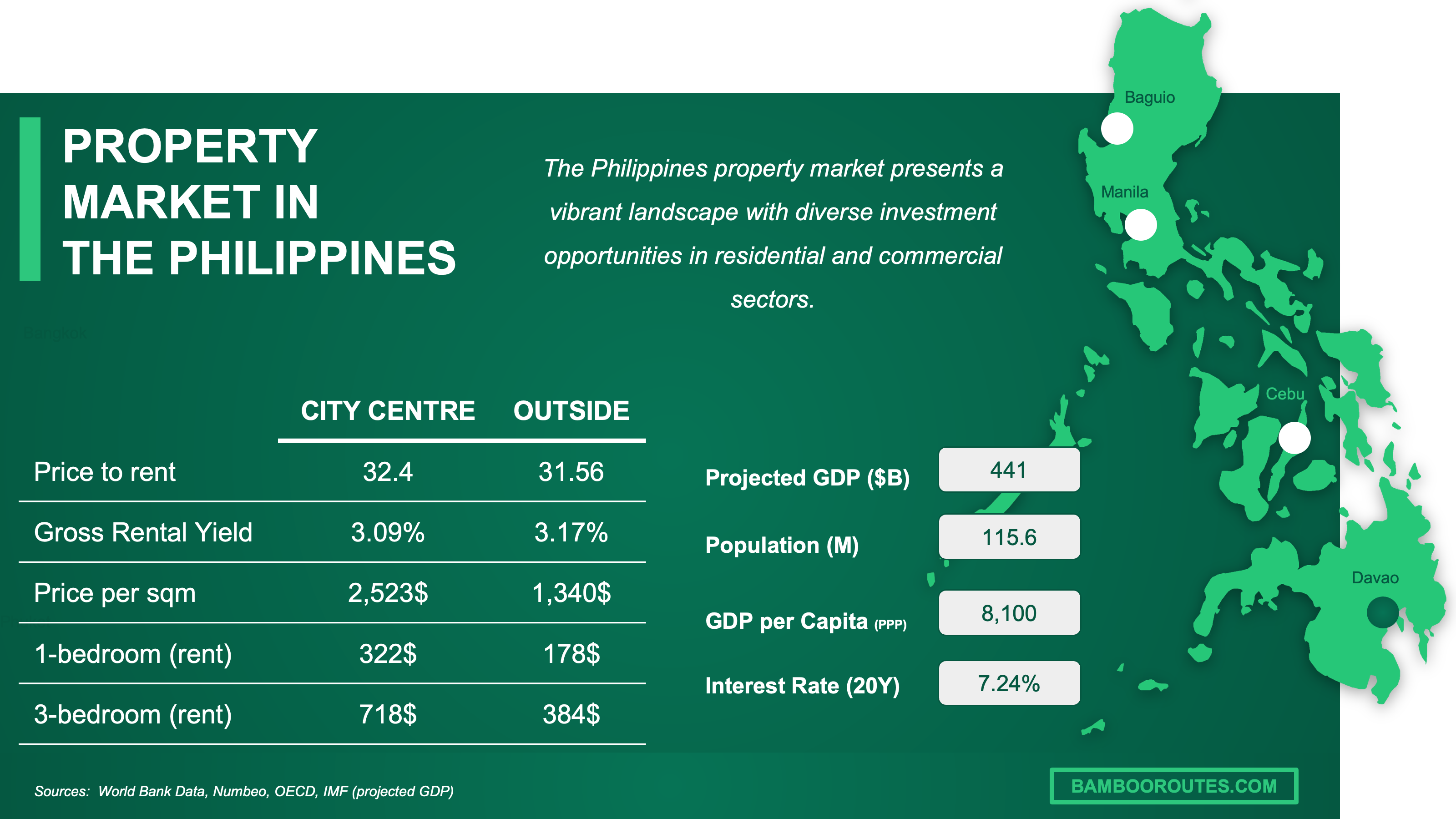
We have made this infographic to give you a quick and clear snapshot of the property market in the Philippines. It highlights key facts like rental prices, yields, and property costs both in city centers and outside, so you can easily compare opportunities. We’ve done some research and also included useful insights about the country’s economy, like GDP, population, and interest rates, to help you understand the bigger picture.
What eligibility and status do I need to buy land in Panay Island?
Do I need residency to buy land in Panay Island in 2026?
As of early 2026, having a Philippine residency visa does not solve the core legal issue, because even a permanent resident foreigner on Panay Island is still constitutionally barred from owning land directly.
No specific visa or permit is required to enter into a land lease or purchase a condominium unit on Panay Island, though you will need to comply with Philippine tax requirements (like obtaining a Tax Identification Number) to complete any real estate transaction.
It is legally possible for a foreigner to buy a condo or sign a lease on Panay Island remotely by granting a Special Power of Attorney to a trusted representative, but the biggest practical risk is paying before independently verifying the title and seller authority through the Land Registration Authority's official channels.
Do I need a local tax number to buy lands in Panay Island?
In practice, you will need a Philippine Tax Identification Number (TIN) from the Bureau of Internal Revenue to complete any real estate transaction on Panay Island, because the BIR requires it for filing Capital Gains Tax, Documentary Stamp Tax, and other transfer-related documents.
Getting a TIN as a foreigner on Panay Island typically involves submitting an application at the local BIR Revenue District Office (such as the one covering Iloilo City or Kalibo), along with your passport and supporting documents; the process can take anywhere from a few days to a few weeks depending on how busy the office is.
Opening a local Philippine bank account is not strictly required by law to purchase property on Panay Island, but it is strongly recommended because a clear, documented bank trail protects you from payment disputes and helps you demonstrate the legitimate source of funds to all parties involved.
Is there a minimum investment to buy land in Panay Island as of 2026?
As of early 2026, there is no government-imposed minimum investment amount for foreigners looking to lease land or buy a condominium unit on Panay Island, because the main barrier is the constitutional eligibility rule (foreigners cannot own land), not a minimum price threshold.
The practical "minimum" depends entirely on what is available in the market: a long-term lease on a small residential lot in rural Capiz or Antique will cost far less than a condominium unit in Iloilo City's Mandurriao district, where pre-selling prices for new projects typically start around 2 to 4 million pesos (roughly 35,000 to 70,000 USD or 32,000 to 65,000 EUR as of early 2026).
Are there restricted zones foreigners can't buy in Panay Island?
Since foreigners are constitutionally banned from owning land anywhere in the Philippines, the concept of "restricted zones" on Panay Island shows up mostly as areas where even leasing or building is complicated by additional legal layers.
The main categories of restricted or problematic zones on Panay Island include agricultural land covered by the Comprehensive Agrarian Reform Program (CARP), foreshore and public-domain coastal strips (especially around Boracay and the Aklan coastline), ancestral domain areas under the Indigenous Peoples' Rights Act, and land classified as forest or timberland by the DENR.
Before committing to any parcel on Panay Island, a foreigner should request a Certified True Copy of the title from the LRA eSerbisyo portal, check the land classification with the DENR and the Department of Agrarian Reform, and have a local lawyer confirm whether the lot falls under any special restrictions.
Can foreigners buy agricultural, coastal or border land in Panay Island right now?
Foreigners on Panay Island face additional restrictions on agricultural, coastal, and certain classified lands that go well beyond the general ownership ban, making these the riskiest categories of property to get involved with.
Agricultural land on Panay Island is the most common trap for foreign buyers: many rural lots in Iloilo, Capiz, and Antique are still classified as agricultural or fall under the Comprehensive Agrarian Reform Program, which means they cannot be freely sold, leased, or converted to residential use without DAR clearance, and any deal without that clearance risks being cancelled later.
Coastal land on Panay Island, particularly around Boracay (Malay, Aklan) and the shorelines of Roxas City (Capiz), requires extra caution because the strip closest to the sea may be classified as public-domain foreshore under DENR rules, meaning nobody, Filipino or foreigner, can privately own it, even if a seller presents it as part of a "beachfront lot."
Panay Island does not border another country, so traditional "border zone" restrictions do not apply, but the coastline itself functions as the practical equivalent: the foreshore easement and public-domain classifications along Panay's 900-plus kilometers of coastline create similar access and ownership limitations that you would see in border zones elsewhere.
Get fresh and reliable information about the market in Panay Island
Don't base significant investment decisions on outdated data. Get updated and accurate information with our guide.

What are the safest legal structures to control land in Panay Island?
Is a long-term lease equivalent to ownership in Panay Island right now?
A long-term lease on Panay Island is the closest legal equivalent to land ownership for foreigners, but it is still not ownership: you hold a contractual right to use the land for a defined period, not a title that you can pass on indefinitely or use with the same flexibility as a Filipino landowner.
Since September 2025, when President Marcos Jr. signed Republic Act 12252, foreign investors on Panay Island can now lease private land for up to 99 years for qualifying projects, which is a major upgrade from the previous limit of 50 years plus a 25-year renewal under the old Investors' Lease Act.
A foreigner can generally sell, transfer, or assign their lease rights on Panay Island to another party, and the new 2025 law explicitly makes leasehold interests transferable and usable as collateral, but everything depends on the specific terms in your lease contract, so you need a lawyer to draft it properly from the start.
Can I buy land in Panay Island via a local company?
A foreigner on Panay Island can participate in land ownership through a Philippine corporation, but only if that corporation is at least 60% Filipino-owned in both voting and outstanding capital, which means you as the foreign investor can hold a maximum of 40% of the company's equity.
In practice, this structure is more commonly used for commercial or investment properties on Panay Island rather than personal homes, and it comes with a serious warning: if the Filipino shareholders are just "nominees" while you secretly control and fund everything, the arrangement violates the Anti-Dummy Law and could result in criminal prosecution, forfeiture of the land, and dissolution of the company.
What "grey-area" ownership setups get foreigners in trouble in Panay Island?
Grey-area ownership arrangements are surprisingly common on Panay Island, especially in tourism-heavy areas like Boracay and fast-growing corridors around Iloilo City, because the gap between what foreigners want (to own land) and what the law allows (they cannot) creates a persistent market for risky workarounds.
The most common grey-area setups on Panay Island include putting a residential lot in a Filipino friend's or partner's name with a secret side agreement saying you are the "real owner," buying land using only a tax declaration instead of a proper Torrens title, purchasing agricultural land that a seller claims is "about to be converted" to residential, and acquiring "beachfront" parcels in Aklan that partly overlap with public-domain foreshore.
If Philippine authorities discover that a foreigner is using a nominee or dummy arrangement to control land on Panay Island, the consequences under the Anti-Dummy Law include prison terms of 5 to 15 years, permanent forfeiture of the property, and potential deportation, which makes these arrangements not just legally shaky but genuinely dangerous.
By the way, you can avoid most of these bad surprises if you go through our pack covering the property buying process in Panay Island.
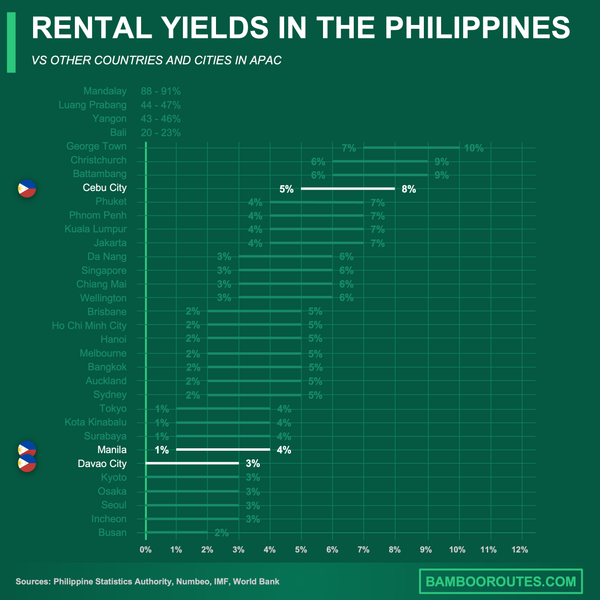
We did some research and made this infographic to help you quickly compare rental yields of the major cities in the Philippines versus those in neighboring countries. It provides a clear view of how this country positions itself as a real estate investment destination, which might interest you if you’re planning to invest there.
How does the land purchase process work in Panay Island, step-by-step?
What are the exact steps to buy land in Panay Island right now?
The standard process for a foreigner acquiring residential property on Panay Island (whether through a lease, a condo purchase, or a Filipino spouse's name) follows eight main steps: verify the title via the LRA, check for encumbrances and annotations, confirm the seller's legal authority, sign a notarized deed or lease contract, pay BIR transaction taxes (Capital Gains Tax and Documentary Stamp Tax), pay the local government transfer tax, register the transaction at the Registry of Deeds, and update the tax declaration at the local Assessor's Office.
From the moment you make your initial offer to the final registration of the new title, a straightforward land purchase on Panay Island typically takes 6 to 12 weeks, though this can stretch to several months if the title has issues like missing heirs, pending DAR clearances, or boundary disputes in less-developed parts of Antique or Capiz.
The key documents you will need to sign during a Panay Island property transaction include the notarized Deed of Absolute Sale (or lease contract), the BIR tax return forms for Capital Gains Tax and Documentary Stamp Tax, the local government's transfer tax forms, and the Registry of Deeds application for title transfer or lease registration.
What scams are common when it comes to buying land in Panay Island right now?
What scams target foreign land buyers in Panay Island right now?
Scams targeting foreign property buyers on Panay Island are not rare: the combination of strong foreign demand (especially around Boracay and Iloilo City), complex land laws, and the constitutional ownership ban creates fertile ground for fraud and misrepresentation.
The most common scams on Panay Island include selling land using only a tax declaration (which is not proof of ownership), presenting fake or photocopied titles, "double-selling" the same lot to multiple buyers in fast-growing Iloilo corridors, pre-selling subdivision lots without the proper DHSUD licenses required by PD 957, and marketing agricultural or CARP-covered land as if it were ready for residential use.
The top three warning signs that a land deal on Panay Island may be fraudulent are: the seller cannot produce an original or certified true copy of the Transfer Certificate of Title, the seller pressures you to pay before you have verified the title at the Registry of Deeds, and the price is significantly below market for the area with no clear explanation.
A foreigner who falls victim to a land scam on Panay Island does have legal options, including filing a criminal complaint for fraud (estafa) and a civil suit for damages, but the Philippine court process is notoriously slow, and recovering money from a scammer who has already disappeared is extremely difficult, which is why prevention through proper due diligence is far more effective than legal action after the fact.
We cover all these things in length in our pack about the property market in Panay Island.
How do I verify the seller is legit in Panay Island right now?
The single best way for a foreign buyer to verify that a land seller on Panay Island is legitimate is to request a Certified True Copy (CTC) of the Transfer Certificate of Title from the Land Registration Authority's eSerbisyo portal or directly from the Registry of Deeds handling the area (Iloilo City, Kalibo, Roxas City, or San Jose de Buenavista), and then match the seller's name and ID documents exactly to what appears on the title.
To confirm that the land title is clean and free of disputes on Panay Island, you should check the back of the Certified True Copy for any annotations, which is where registered encumbrances like adverse claims, lis pendens (pending lawsuits), and mortgage liens are officially recorded.
Existing liens, mortgages, or debts attached to land on Panay Island show up as annotations on the title, but you should also check with the local Treasurer's Office to confirm that all real property taxes are paid up to date, because unpaid taxes can delay or block your transfer.
The most essential professional for verifying seller legitimacy on Panay Island is a local real estate lawyer (not just a notary or an agent), because a lawyer can independently verify the title, check for off-title risks like pending court cases or DAR issues, and ensure that the transaction documents will actually be accepted by the BIR and the Registry of Deeds.
How do I confirm land boundaries in Panay Island right now?
The standard procedure for confirming land boundaries on Panay Island before purchase is to hire a licensed geodetic engineer to conduct a relocation survey, which physically re-establishes the lot's corners and perimeter based on the technical description recorded on the title.
Before the survey, you should review the Transfer Certificate of Title (which contains the official technical description with bearings and distances), the approved survey plan on file at the DENR-Land Management Bureau, and, if available, the tax map from the local Assessor's Office to see how the lot sits relative to neighboring properties.
Hiring a licensed geodetic engineer is not just recommended but practically essential on Panay Island, because relying on fences, trees, or "what the neighbors say" is how buyers end up discovering after the purchase that the actual lot is smaller, differently shaped, or in a slightly different location than what the seller showed them.
Common boundary-related problems that foreign buyers encounter specifically on Panay Island include overlapping survey claims in rural areas of Antique and Capiz where old Spanish-era or tax-declaration-only parcels were never properly surveyed, lots in Iloilo's expanding suburban municipalities (like Pavia or Oton) where rapid subdivision development has created confusion between adjacent lots, and beachfront parcels in Aklan where the foreshore boundary shifts over time due to natural changes in the coastline.
Buying real estate in Panay Island can be risky
An increasing number of foreign investors are showing interest. However, 90% of them will make mistakes. Avoid the pitfalls with our comprehensive guide.

What will it cost me, all-in, to buy and hold land in Panay Island?
What purchase taxes and fees apply in Panay Island as of 2026?
As of early 2026, the total purchase taxes and fees for a residential land transaction on Panay Island typically add up to roughly 7% to 10% of the property's sale price (or declared value, whichever is higher), though this amount is normally split between buyer and seller depending on what the contract says.
The typical buyer-side closing costs on Panay Island fall in the range of 3% to 5% of the purchase price (roughly 150,000 to 250,000 pesos on a 5 million peso lot, or about 2,600 to 4,400 USD / 2,400 to 4,000 EUR), covering your share of Documentary Stamp Tax, local transfer tax, registration fees, and professional fees.
The main individual taxes and fees that make up total closing costs on Panay Island include the Capital Gains Tax at 6% of the sale price or zonal value (usually paid by the seller), the Documentary Stamp Tax at 1.5% (often shared or negotiated), the local government transfer tax (which varies by LGU, typically 0.5% to 0.75%), the Registry of Deeds registration fee (a few thousand pesos), and notarial fees (usually around 1% to 2%).
These taxes and fees on Panay Island do not technically differ based on whether the buyer is a foreigner or a Filipino, since the tax rates are the same for everyone, but as a foreign buyer going through a lease or condo purchase, you may encounter additional legal and documentation costs that local buyers typically do not need.
What hidden fees surprise foreigners in Panay Island most often?
Hidden or unexpected fees on Panay Island typically add an extra 1% to 3% on top of the standard closing costs (roughly 50,000 to 150,000 pesos on a 5 million peso purchase, or about 900 to 2,600 USD / 800 to 2,400 EUR), and they tend to catch foreigners off guard because they are rarely mentioned during initial negotiations.
The specific hidden fees that most frequently surprise foreign buyers on Panay Island include "fixer" or expediting fees that local contacts may pressure you to pay (often unnecessary if you follow official BIR and Registry of Deeds channels), the cost of curing title defects such as missing documents or reconstitution of old titles, geodetic survey or relocation survey fees (10,000 to 50,000 pesos depending on lot size and terrain), and unexpected DAR conversion or clearance fees when land turns out to be classified as agricultural instead of residential.
These hidden fees on Panay Island tend to appear at two critical moments: during the due diligence phase (when you discover the title is not as clean as presented) and during the registration phase at the Registry of Deeds (when missing or incorrect documents create delays that cost time and money to fix).
The best way for a foreign buyer to protect themselves from unexpected fees during a Panay Island property transaction is to budget an extra 2% to 3% above your calculated closing costs as a contingency, insist on a Certified True Copy of the title before signing anything, and hire a local real estate lawyer who can flag these issues before they become expensive surprises.

We made this infographic to show you how property prices in the Philippines compare to other big cities across the region. It breaks down the average price per square meter in city centers, so you can see how cities stack up. It’s an easy way to spot where you might get the best value for your money. We hope you like it.
What sources have we used to write this blog article?
Whether it's in our blog articles or the market analyses included in our property pack about Panay Island, we always rely on the strongest methodology we can ... and we don't throw out numbers at random.
We also aim to be fully transparent, so below we've listed the authoritative sources we used, and explained how we used them and the methods behind our estimates.
| Source | Why we trust it | How we used it |
|---|---|---|
| 1987 Philippine Constitution (Article XII) | It is the supreme law setting foreign land ownership limits. | We used it to explain the core "foreigners cannot own land" rule and the narrow exceptions. We also relied on it to show why private contracts cannot override the constitutional ban. |
| Condominium Act (RA 4726) | It is the primary statute defining condo ownership in the Philippines. | We used it to explain the most common legal path for foreigners: owning a condo unit rather than land. We also used it to ground the 40% foreign ownership cap that applies to every condo project on Panay Island. |
| Investors' Lease Act (RA 7652, amended by RA 12252) | It is the key law allowing long-term land leases for foreigners. | We used it to explain the 99-year lease framework signed into law in September 2025. We also used it to outline what a properly structured lease on Panay Island should look like. |
| Anti-Dummy Law (CA 108) | It is the main criminal law tool against nominee arrangements. | We used it to explain the serious legal risks of "putting land in someone else's name." We also used it to list the grey-area structures that get foreigners in trouble on Panay Island. |
| Bureau of Internal Revenue (BIR) | It is the Philippine tax authority's own portal for property taxes. | We used it to ground the transaction tax discussion, including Capital Gains Tax and Documentary Stamp Tax. We also used it to build our closing cost estimates for Panay Island transactions. |
| Land Registration Authority (LRA) eSerbisyo | It is the official channel for requesting certified true copies of titles. | We used it to recommend the most reliable way to verify a title before paying. We also cited it in the scam-prevention sections as the proper verification channel. |
| LRA Registry of Deeds Directory | It is the official directory for where land titles are registered. | We used it to name the correct offices for Panay Island transactions. We also used it to keep the step-by-step purchase process accurate and grounded in real institutions. |
| DENR Administrative Order 2004-24 (Foreshore) | It is the primary rule defining foreshore lease terms and coastal classifications. | We used it to explain the coastal risk on Panay Island: the strip by the sea may be public domain. We also used it for Boracay-specific warnings about beachfront land claims. |
| PD 957 (Subdivision/Condo Buyers' Protective Decree) | It is the foundational consumer-protection law for subdivision sales. | We used it to explain why pre-selling lots without proper licenses is a red flag. We also used it to motivate a simple buyer rule: verify developer compliance before paying. |
| Colliers Philippines (Iloilo Market Report) | It is a major global real estate advisory with published research on Iloilo. | We used it to provide Panay-specific market context, including Iloilo City's residential demand and development activity. We used it as secondary context only, not as the legal basis. |
| Aklan Province Tax Ordinance | It is a provincial government source for local tax rates on Panay Island. | We used it to show that local transfer taxes vary by LGU across Panay Island. We also used it as a concrete example of how costs differ between Aklan and Iloilo City. |
| Bangko Sentral ng Pilipinas (BSP) RREPI | It is the central bank's official housing price statistics publication. | We used it to cross-check how Philippine housing prices are tracked over time. We also used it as a reality check when evaluating market price claims for Panay Island. |
Get the full checklist for your due diligence in Panay Island
Don't repeat the same mistakes others have made before you. Make sure everything is in order before signing your sales contract.
Related blog posts