
Authored by the expert who managed and guided the team behind the Philippines Property Pack
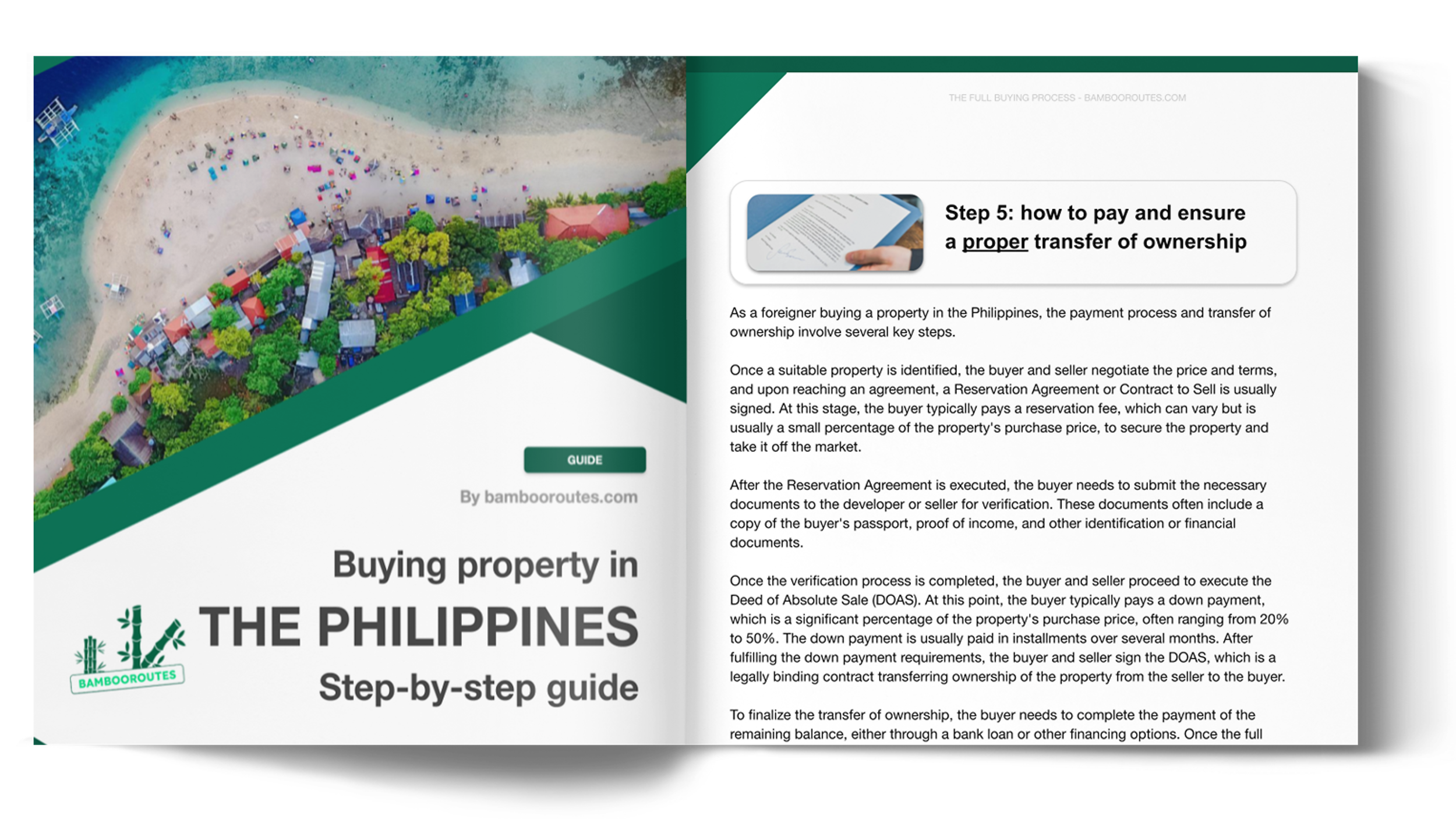
Everything you need to know before buying real estate is included in our The Philippines Property Pack
Panay Island is experiencing a two-speed real estate market in early 2026, with Iloilo City attracting formal developers and bank-financed projects while tourism-driven areas like Boracay see more informal and higher-risk listings.
This guide covers everything foreigners need to know about property scams, pitfalls, and insider lessons specific to Panay Island in 2026.
We constantly update this blog post to reflect the latest market conditions, regulations, and scam patterns affecting foreign buyers in Panay Island.
And if you're planning to buy a property in this place, you may want to download our pack covering the real estate market in Panay Island.

How risky is buying property in Panay Island as a foreigner in 2026?
Can foreigners legally own properties in Panay Island in 2026?
As of early 2026, foreigners in Panay Island can legally own condominium units but are constitutionally prohibited from owning land directly, which is a restriction rooted in the Philippine Constitution's national patrimony framework.
The main restriction for foreigners buying property in Panay Island is that condominium projects must maintain at least 60% Filipino ownership at the corporate level, meaning you can only buy a unit if the building has not exceeded its 40% foreign ownership cap.
When direct land ownership is restricted in Panay Island, foreigners commonly use long-term lease arrangements (up to 50 years with a 25-year renewal option), purchase structures only while leasing the land, or buy condominium units under the Condominium Act which allows ownership of the "airspace" rather than land.
What buyer rights do foreigners actually have in Panay Island in 2026?
As of early 2026, foreigners who properly purchase a condominium unit in Panay Island have rights that are comparable to local buyers, including the ability to sell, mortgage, inherit, and enforce contracts through the Philippine court system.
If a seller breaches a contract in Panay Island, foreign buyers can file civil cases for specific performance or damages, though enforcement depends heavily on having complete and registered documentation rather than verbal agreements or side letters.
The most common right that foreigners mistakenly assume they have in Panay Island is "effective ownership" through nominee arrangements, where they put property in a Filipino partner's name and assume they have enforceable control, when in fact such arrangements are specifically targeted by the Anti-Dummy Law and provide no legal protection.
How strong is contract enforcement in Panay Island right now?
Contract enforcement for real estate transactions in Panay Island is functional but slower than what buyers from Western countries typically expect, with the Philippines ranking in the lower tier globally on the World Justice Project Rule of Law Index, meaning disputes can take years to resolve compared to months in countries like Singapore or Australia.
The main weakness in contract enforcement that foreigners should understand in Panay Island is that court proceedings are time-consuming and documentation-dependent, which means your best protection is preventing disputes through thorough title verification and proper registration rather than relying on your ability to sue later.
By the way, we detail all the documents you need and what they mean in our property pack covering Panay Island.
Buying real estate in Panay Island can be risky
An increasing number of foreign investors are showing interest. However, 90% of them will make mistakes. Avoid the pitfalls with our comprehensive guide.

Which scams target foreign buyers in Panay Island right now?
Are scams against foreigners common in Panay Island right now?
Real estate scams targeting foreigners in Panay Island are common enough that you should assume roughly 10 to 20 percent of opportunities shown through Facebook groups, marketplace listings, or informal "fixers" contain at least one serious red flag such as fake documents, missing authority to sell, or pressure tactics.
The type of property transaction most frequently targeted by scammers in Panay Island is beach-adjacent land deals in tourism areas like Malay (Boracay) and coastal Aklan, where buyers are often sold "rights" or "possession" rather than clean titled ownership.
Foreign buyers most commonly targeted by scammers in Panay Island are those who fall in love with a view or location quickly, shop primarily through online channels without local verification, and are willing to pay "reservation fees" before pulling official documents themselves.
The single biggest warning sign that a deal may be a scam in Panay Island is pressure to pay a reservation fee or deposit quickly, before you have had time to obtain a Certified True Copy of the title directly from the Registry of Deeds or LRA yourself.
What are the top three scams foreigners face in Panay Island right now?
The top three scams foreigners face in Panay Island are: (1) being sold "possession" or a tax declaration instead of actual titled ownership, (2) fake or borrowed land titles combined with rush-to-pay pressure, and (3) purchasing from developers or projects that lack proper License to Sell from DHSUD.
The most common scam in Panay Island typically unfolds like this: a seller shows you a scanned or photographed title, creates urgency by claiming multiple interested buyers, asks for a reservation fee within days, and then either disappears or you later discover the title is fake, the seller is not the owner, or the property has hidden encumbrances.
The single most effective protection against each scam in Panay Island is: for fake titles, always obtain a Certified True Copy yourself from the LRA eSerbisyo portal or Registry of Deeds rather than trusting seller-provided documents; for possession-only deals, insist on a Transfer Certificate of Title (TCT) or Condominium Certificate of Title (CCT); and for unlicensed projects, verify the developer's License to Sell through DHSUD records before paying anything.
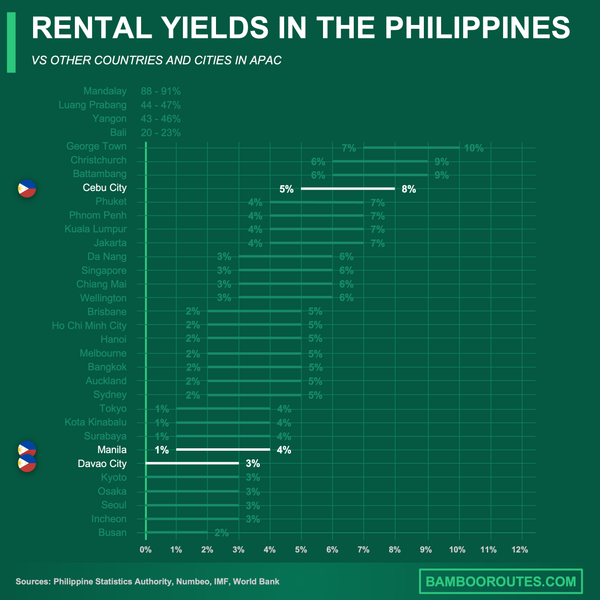
We did some research and made this infographic to help you quickly compare rental yields of the major cities in the Philippines versus those in neighboring countries. It provides a clear view of how this country positions itself as a real estate investment destination, which might interest you if you’re planning to invest there.
How do I verify the seller and ownership in Panay Island without getting fooled?
How do I confirm the seller is the real owner in Panay Island?
The standard verification process to confirm the seller is the real owner in Panay Island is to request a Certified True Copy of the title directly from the Land Registration Authority (LRA) or local Registry of Deeds, then match the registered owner's name to the seller's government-issued ID and ensure spousal consent is obtained if the owner is married.
The official document foreigners should check to verify ownership in Panay Island is the Certified True Copy of the Transfer Certificate of Title (TCT) for land or Condominium Certificate of Title (CCT) for condo units, obtained directly from the LRA eSerbisyo portal or the Registry of Deeds rather than from the seller.
The most common trick fake sellers use to appear legitimate in Panay Island is presenting a scanned or photographed copy of a title (which can be easily edited) combined with fake IDs or claiming to act on behalf of the owner through an unverified "Special Power of Attorney," and this trick is common enough that you should treat any seller-provided document as unverified until you pull official records yourself.
Where do I check liens or mortgages on a property in Panay Island?
The official place to check liens or mortgages on a property in Panay Island is the same Certified True Copy of the title you obtain from the Land Registration Authority or Registry of Deeds, because all liens, mortgages, and adverse claims should appear as annotations or encumbrances on the back of the title.
When checking for liens in Panay Island, you should specifically request and review the "Memorandum of Encumbrances" section of the title, which lists any mortgages, liens, notices of lis pendens (pending litigation), easements, or other claims that could affect your ownership.
The type of encumbrance most commonly missed by foreign buyers in Panay Island is an existing mortgage that the seller promises to "clear later" but cannot actually pay off, leading to situations where you have paid but the title cannot be transferred until the seller settles their debt with the bank.
It's one of the aspects we cover in our our pack about the real estate market in Panay Island.
How do I spot forged documents in Panay Island right now?
The most common type of forged document used in property scams in Panay Island is a fake or altered Transfer Certificate of Title (TCT), often created by editing scanned copies of legitimate titles or by obtaining fraudulent documents from corrupt insiders, and this type of forgery is common enough that you should never treat any seller-provided title copy as authentic.
Specific red flags that indicate a document may be forged in Panay Island include inconsistencies in the title number, owner name spelling, or technical description when compared across multiple documents; poor print quality or obvious signs of digital editing; reluctance by the seller to allow you to pull your own Certified True Copy; and pressure to complete payment before verification.
The official verification method you should use to authenticate documents in Panay Island is to request a Certified True Copy directly from the Land Registration Authority via the eSerbisyo portal or in person at the Registry of Deeds, and then compare every detail against documents provided by the seller.
Get the full checklist for your due diligence in Panay Island
Don't repeat the same mistakes others have made before you. Make sure everything is in order before signing your sales contract.
What "grey-area" practices should I watch for in Panay Island?
What hidden costs surprise foreigners when buying a property in Panay Island?
The three most common hidden costs that foreigners overlook in Panay Island are: transfer taxes and registration fees (around 1.5 to 3% of property value or roughly PHP 75,000 to 150,000 / USD 1,300 to 2,600 / EUR 1,200 to 2,400 on a mid-range condo), documentary stamp tax (1.5% of selling price or zonal value), and for condos, ongoing association dues and special assessments that can add PHP 3,000 to 15,000 (USD 50 to 260 / EUR 45 to 240) monthly.
The hidden cost most often deliberately concealed by sellers or agents in Panay Island is unpaid real property taxes or pending BIR clearances that block the transfer, and this is common enough that you should always verify tax payment status before paying the full purchase price, since an incomplete BIR eCAR (electronic Certificate Authorizing Registration) means the property legally cannot transfer to your name.
Are "cash under the table" requests common in Panay Island right now?
Cash under the table requests in Panay Island property transactions are less common in formal developer sales and bank-financed deals but still happen in informal land transactions, especially in rural areas, coastal properties, and deals involving "fixers" who operate outside the licensed broker system.
The typical reason sellers give for requesting undeclared cash payments in Panay Island is to reduce the declared selling price on documents, which lowers capital gains tax (6% of selling price or zonal value) and transfer taxes, presenting it as a "win-win" for both parties.
The legal risks foreigners face if they agree to an undeclared cash payment in Panay Island include tax evasion liability with the BIR, difficulty proving the actual amount paid if a dispute arises, and for those using nominee arrangements, potential prosecution under the Anti-Dummy Law which specifically targets schemes designed to circumvent foreign ownership restrictions.
Are side agreements used to bypass rules in Panay Island right now?
Side agreements used to bypass foreign ownership rules are common in Panay Island, particularly among foreigners who want to control land they cannot legally own, and these arrangements include putting property in a Filipino partner's or friend's name while holding a "side letter" claiming beneficial ownership.
The most common type of side agreement used to circumvent regulations in Panay Island is a "trust agreement" or undated deed of sale where the foreign buyer pays for land registered in a Filipino nominee's name, combined with separate documents meant to prove the foreigner's "real" ownership or control of the property.
The legal consequences foreigners face if a side agreement is discovered by authorities in Panay Island include nullification of the arrangement, loss of the property with no legal recourse to recover funds, and potential criminal charges under the Anti-Dummy Law, which was specifically enacted to prosecute exactly these kinds of schemes that evade nationality-based ownership restrictions.

We made this infographic to show you how property prices in the Philippines compare to other big cities across the region. It breaks down the average price per square meter in city centers, so you can see how cities stack up. It’s an easy way to spot where you might get the best value for your money. We hope you like it.
Can I trust real estate agents in Panay Island in 2026?
Are real estate agents regulated in Panay Island in 2026?
As of early 2026, real estate agents in Panay Island are regulated under Republic Act 9646 (Real Estate Service Act), which requires brokers and salespersons to be licensed by the Professional Regulation Commission (PRC), though enforcement varies and unlicensed "colorum agents" still operate in the market.
A legitimate real estate agent in Panay Island should have a valid PRC license for real estate brokers (REBL) or real estate salespersons, along with a Professional Tax Receipt (PTR) for the current year and ideally membership in a recognized industry association like the Philippine Association of Real Estate Boards (PAREB).
Foreigners can verify whether an agent is properly licensed in Panay Island by requesting to see the agent's PRC ID and license number, then checking that number through the PRC's online verification system or by contacting DHSUD, though the most practical approach is to ask for references and work only with agents recommended by other verified foreign buyers.
Please note that we have a list of contacts for you in our property pack about Panay Island.
What agent fee percentage is normal in Panay Island in 2026?
As of early 2026, the normal agent fee percentage in Panay Island ranges from about 2.5% to 5% of the property sale price, with most transactions clustering around 5% for the selling broker, though there is no legally fixed rate and fees are negotiable.
The typical range of agent fee percentages that covers most transactions in Panay Island is 3% to 5% for standard residential sales, with fees sometimes going lower for high-value properties or in competitive market conditions where agents are willing to reduce commissions to close deals.
In Panay Island, the seller typically pays the agent's commission as part of the sale proceeds, but foreign buyers should clarify this upfront because some agents attempt to charge the buyer a separate "finder's fee" on top of their seller-side commission without being transparent about double-dipping.
Get the full checklist for your due diligence in Panay Island
Don't repeat the same mistakes others have made before you. Make sure everything is in order before signing your sales contract.
What due diligence actually prevents disasters in Panay Island?
What structural inspection is standard in Panay Island right now?
The standard structural inspection process for property purchases in Panay Island is less formal than what foreigners from Western countries expect, with most mid-market transactions relying on a visual inspection and contractor walk-through rather than a comprehensive engineering report.
A qualified inspector in Panay Island should check foundations, load-bearing walls, roof structure and waterproofing, electrical systems, plumbing, drainage, and for coastal properties, signs of salt corrosion, moisture damage, and flood history.
The type of professional qualified to perform structural inspections in Panay Island is a licensed civil engineer or architect, though for more thorough assessments you can hire an independent building inspector with construction experience who will provide a written punch list of issues.
The most common structural issues that inspections reveal in Panay Island properties are water damage and moisture intrusion (especially in coastal areas), substandard electrical wiring, drainage problems that cause flooding during heavy rains, and roof issues related to typhoon damage that was inadequately repaired.
How do I confirm exact boundaries in Panay Island?
The standard process for confirming exact property boundaries in Panay Island is to hire a licensed geodetic engineer to conduct a relocation survey that physically marks the property corners and compares them to the technical description in the title.
The official document that shows the legal boundaries of a property in Panay Island is the technical description section of the Transfer Certificate of Title (TCT), which contains metes and bounds measurements, and for subdivisions, the approved subdivision plan filed with the Land Registration Authority.
The most common boundary dispute that affects foreign buyers in Panay Island involves properties where physical fences or structures do not match the titled boundaries, often because neighbors have encroached over time or because the seller is showing you land that extends beyond what they actually own.
The professional you should hire to physically verify boundaries on the ground in Panay Island is a licensed geodetic engineer who can perform a relocation survey using the title's technical description, and you can cross-check land status through the DENR Land Management Bureau's online services.
What defects are commonly hidden in Panay Island right now?
The top three defects that sellers frequently conceal from buyers in Panay Island are: water problems including past flooding, roof leaks, and mold (common), documentation defects where the seller cannot actually complete the BIR eCAR and transfer process (common), and access or right-of-way issues where the property lacks legal road access (sometimes happens in provincial lots).
The inspection technique that helps uncover hidden defects in Panay Island is to visit the property during or immediately after heavy rain to see actual drainage and leak patterns, ask neighbors directly about flooding history, and most importantly, verify that the seller has all documents ready for BIR eCAR processing before you finalize payment.
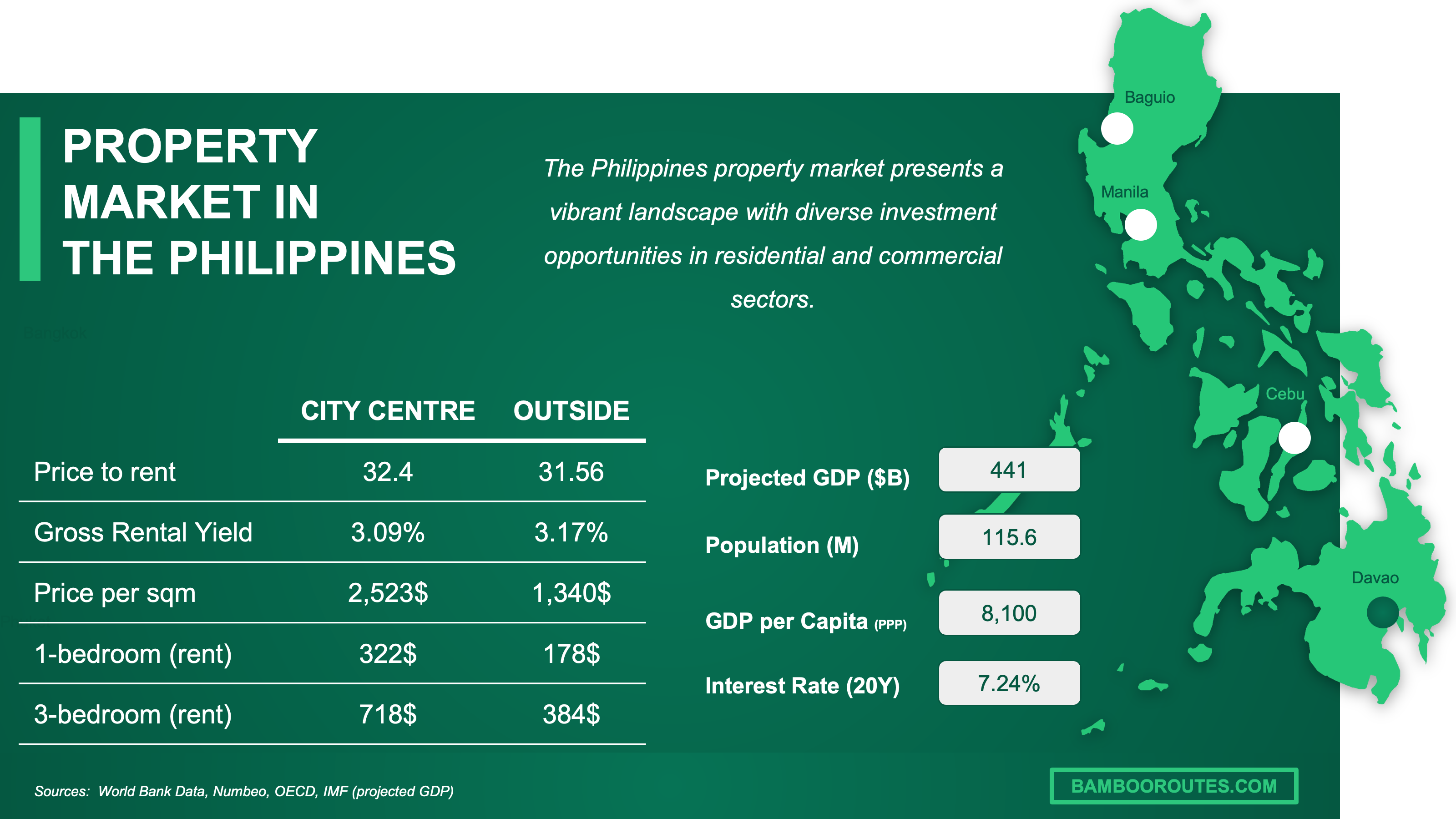
We have made this infographic to give you a quick and clear snapshot of the property market in the Philippines. It highlights key facts like rental prices, yields, and property costs both in city centers and outside, so you can easily compare opportunities. We’ve done some research and also included useful insights about the country’s economy, like GDP, population, and interest rates, to help you understand the bigger picture.
What insider lessons do foreigners share after buying in Panay Island?
What do foreigners say they did wrong in Panay Island right now?
The most common mistake foreigners say they made when buying property in Panay Island is falling in love with a location or view and treating paperwork verification as a formality to complete later rather than the first step before emotional or financial commitment.
The top three regrets foreigners most frequently mention after buying in Panay Island are: paying a reservation fee before obtaining a Certified True Copy themselves, accepting nominee or side agreement arrangements that felt safe at the time but created legal exposure, and not asking enough questions about the seller's ability to complete the BIR eCAR and title transfer process.
The single piece of advice experienced foreign buyers most often give to newcomers in Panay Island is to never trust any document provided by the seller and always pull your own Certified True Copy from the LRA or Registry of Deeds before signing anything or paying any money.
The mistake foreigners say cost them the most money or caused the most stress in Panay Island is entering into nominee arrangements with a Filipino partner or friend, which seemed practical at the time but led to complete loss of the property when the relationship changed or the nominee refused to cooperate.
What do locals do differently when buying in Panay Island right now?
The key difference in how locals approach buying property compared to foreigners in Panay Island is that locals treat the Registry of Deeds or LRA verification as an automatic first step rather than something to do later, and they ask blunt questions about transfer readiness ("Can you complete eCAR? Are your documents ready?") that foreigners often feel too polite to ask.
The verification step locals routinely take that foreigners often skip in Panay Island is checking with neighbors and barangay officials about the property's history, ownership disputes, flooding, and whether the seller actually lives there or has authority to sell, which provides ground-truth information that documents alone cannot reveal.
The local knowledge advantage that helps locals get better deals in Panay Island is understanding which neighborhoods in Iloilo City (like Mandurriao, Jaro, La Paz, and Molo) and growth towns (like Pavia, Oton, and Santa Barbara) have more formal developer presence and cleaner paperwork, allowing them to focus on lower-risk opportunities rather than getting distracted by cheap but problematic listings in tourism-driven areas.
Don't buy the wrong property, in the wrong area of Panay Island
Buying real estate is a significant investment. Don't rely solely on your intuition. Gather the right information to make the best decision.

What sources have we used to write this blog article?
Whether it's in our blog articles or the market analyses included in our property pack about Panay Island, we always rely on the strongest methodology we can … and we don't throw out numbers at random.
We also aim to be fully transparent, so below we've listed the authoritative sources we used, and explained how we used them and the methods behind our estimates.
| Source | Why it's authoritative | How we used it |
|---|---|---|
| Bangko Sentral ng Pilipinas (BSP) RPPI | The Philippine central bank's official residential property price index. | We used it to describe the early 2026 housing market direction. We used it to avoid relying on broker anecdotes about prices. |
| Land Registration Authority (LRA) eSerbisyo Portal | The national government portal for requesting certified true copies of land titles. | We used it to explain the safest way to verify a title. We used it to anchor the verification workflow in an official process. |
| 1987 Philippine Constitution (LawPhil) | The top rule for land ownership limits in the Philippines. | We used it to anchor the "foreigners can't own land" rule. We used it so the ownership discussion isn't based on hearsay. |
| Anti-Dummy Law (Supreme Court E-Library) | The core law used to prosecute Filipino nominee arrangements. | We used it to explain why "put it in your partner's name" is risky. We used it to identify the legal risk foreigners often underestimate. |
| Republic Act 9646 (Real Estate Service Act) | The statute that regulates real estate brokers and licensing. | We used it to explain what "licensed" means for agents. We used it to show what regulation exists and what it doesn't guarantee. |
| World Justice Project Rule of Law Index 2025 | A global benchmark widely cited for justice and governance quality. | We used it to discuss contract enforcement reality in Panay Island. We used it to set expectations on dispute resolution. |
| AMLC Land Investment Scam Advisory | A Philippine financial-intelligence regulator warning about land scams. | We used it to illustrate scam patterns that target foreigners. We used it to build "red flag" warnings you should treat seriously. |
| Bureau of Internal Revenue (BIR) Capital Gains Tax | The tax authority's official reference page for property tax rules. | We used it to explain common tax obligations and hidden costs. We used it to map compliance steps foreigners often miss. |
| Colliers Philippines Residential Report | A major global real estate consultancy with formal research practice. | We used it to describe Iloilo's demand story within Panay Island. We used it to ground the regional market narrative. |
| DHSUD (Department of Human Settlements) | The Philippine government's central housing and real estate authority. | We used it to frame developer compliance expectations. We used it to flag that project paperwork is a real risk area. |
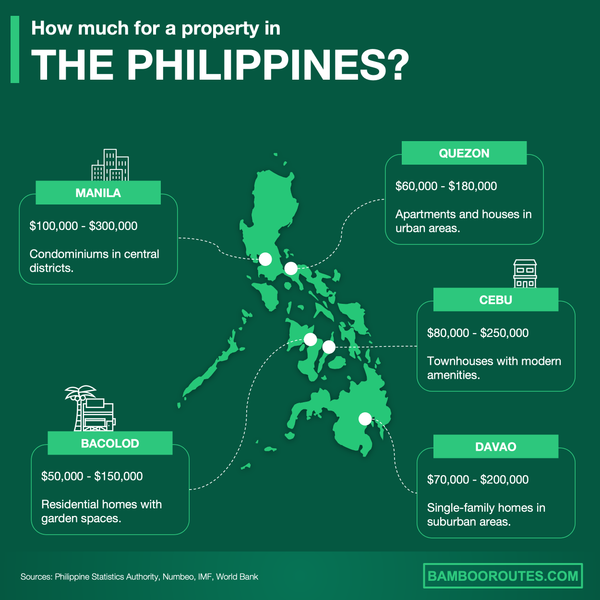
We created this infographic to give you a simple idea of how much it costs to buy property in different parts of the Philippines. As you can see, it breaks down price ranges and property types for popular cities in the country. We hope this makes it easier to explore your options and understand the market.
Related blog posts