
Authored by the expert who managed and guided the team behind the Philippines Property Pack
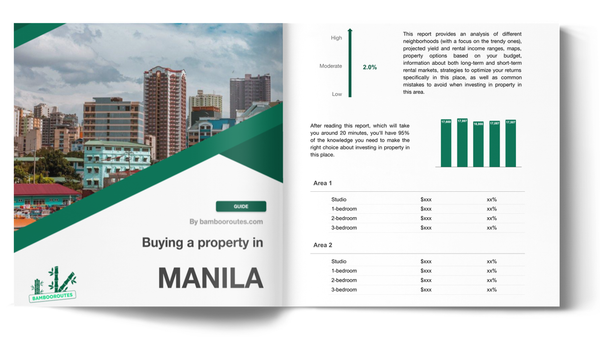
Yes, the analysis of Manila's property market is included in our pack
Renting out a property in Manila as a foreigner is absolutely possible in 2026, but you need to understand the ownership rules and local compliance requirements first.
This guide covers everything from legal structures and rental yields to neighborhood performance and short-term rental regulations.
We constantly update this blog post to reflect the latest Manila rental market conditions and regulatory changes.
And if you're planning to buy a property in this place, you may want to download our pack covering the real estate market in Manila.
Insights
- Manila condos typically yield between 4.5% and 6.5% gross annually, but after accounting for association dues, vacancy, and management fees, most landlords actually net around 3% to 4%.
- Short-term rentals in Manila average only 45% occupancy according to AirDNA data, which means your unit could sit empty more than half the year if you go the Airbnb route.
- The rent increase cap of 2.3% for 2025 only applies to units rented at ₱10,000 or below per month, so most foreign-owned Manila condos are not affected by this regulation.
- Student-driven neighborhoods like Sampaloc and the U-Belt area often deliver better yields than premium Malate locations because purchase prices are lower while rent demand stays consistently high.
- Furnished Manila condos rent roughly 2 to 4 weeks faster than unfurnished ones, which matters a lot in a market where Colliers reports elevated vacancy rates across Metro Manila.
- The biggest practical barrier for foreign landlords in Manila is not the law but condo building rules, as many associations have banned or heavily restricted Airbnb-style short-term rentals.
- Manila's holding costs for a typical rental condo run between ₱7,000 and ₱18,000 per month before mortgage payments, with association dues and property management being the two largest expenses.
- Foreigners cannot own land in the Philippines, but the Condominium Act allows them to own condo units as long as foreign ownership in the building stays below 40%.

Can I legally rent out a property in Manila as a foreigner right now?
Can a foreigner own-and-rent a residential property in Manila in 2026?
As of early 2026, foreigners can legally own and rent out residential property in Manila, but only condominium units since the Philippine Constitution prohibits foreign land ownership.
The most common legal arrangement for foreigners is direct condo ownership under Republic Act 4726 (the Condominium Act), which allows foreign nationals to own units as long as total foreign ownership in the building does not exceed 40%.
The single biggest restriction you will face is that you cannot buy a house with land, a townhouse, or any property type where land title transfers to you directly, which is why condos are essentially your only practical option in Manila.
If you're not a local, you might want to read our guide to foreign property ownership in Manila.
Do I need residency to rent out in Manila right now?
You do not need to be a Philippine resident to rent out your Manila condo, and many foreign landlords manage their properties entirely from abroad using local agents or property managers.
However, you will need a Philippine Tax Identification Number (TIN) and BIR registration to legally collect and report rental income, which you can arrange through a local representative.
A local bank account is not strictly required, but it is strongly recommended because most Manila tenants pay rent via local bank transfers or e-wallets like GCash, and your building dues and repairs will be billed in pesos.
Managing a Manila rental remotely is definitely feasible if you hire a property manager or leasing agent, though you should budget for their fees and expect some communication delays on maintenance issues.
Thinking of buying real estate in Manila?
Acquiring property in a different country is a complex task. Don't fall into common traps – grab our guide and make better decisions.

What rental strategy makes the most money in Manila in 2026?
Is long-term renting more profitable than short-term in Manila in 2026?
As of early 2026, long-term renting is generally the safer and more predictable choice in Manila, though short-term rentals can generate higher gross revenue if your building allows it and you execute well.
A well-managed long-term rental in a good Manila location might earn ₱25,000 to ₱35,000 per month (around $420 to $590 or €390 to €550), while a well-managed short-term rental could gross ₱50,000 to ₱70,000 monthly ($850 to $1,190 or €790 to €1,110), but with much higher operating costs and only 45% average occupancy.
Short-term renting tends to work best in Manila for properties near hospitals like Philippine General Hospital, major universities, or tourist areas in Malate and Ermita, where transient visitors and medical tourists create steady booking demand.
What's the average gross rental yield in Manila in 2026?
As of early 2026, the average gross rental yield for Manila condos ranges from 4.5% to 6.5% per year, with most investor-grade studios and one-bedrooms landing around 5% to 5.5%.
The realistic range spans from about 3.5% gross for overpriced units in weak locations up to 7% or slightly higher for well-located studios in high-demand pockets like Sampaloc or along the Taft Avenue corridor.
Studios and small one-bedroom units typically achieve the highest gross yields in Manila because they have the lowest purchase prices relative to achievable rents, especially near universities and transit stations.
By the way, we have much more granular data about rental yields in our property pack about Manila.
What's the realistic net rental yield after costs in Manila in 2026?
As of early 2026, the average net rental yield for Manila condos after all costs falls between 2.8% and 4.3% per year, with most landlords experiencing around 3.3% to 3.8% net.
The realistic range runs from about 2% net for high-maintenance buildings with frequent vacancies up to 4.5% for efficiently managed units in strong rental locations with minimal turnover.
The three main cost categories that eat into your Manila rental yield are condo association dues (which can run ₱3,000 to ₱6,000 monthly in decent buildings), vacancy periods (budget 1 to 3 months per year), and the 10% to 12% withholding tax on rental income that applies to most landlord setups.
You might want to check our latest analysis about gross and net rental yields in Manila.
What monthly rent can I get in Manila in 2026?
As of early 2026, typical monthly rents in Manila run around ₱20,000 to ₱25,000 ($340 to $420 or €320 to €400) for studios, ₱28,000 to ₱35,000 ($475 to $590 or €445 to €555) for one-bedrooms, and ₱45,000 to ₱60,000 ($760 to $1,020 or €715 to €950) for two-bedrooms.
A decent entry-level studio in Manila neighborhoods like Sampaloc or Paco can realistically rent for ₱16,000 to ₱22,000 per month ($270 to $375 or €255 to €350), though you will need to accept older buildings or less central locations.
A typical mid-range one-bedroom apartment in areas like Malate or Ermita rents for ₱25,000 to ₱35,000 monthly ($420 to $590 or €400 to €555), depending on furnishing quality and building amenities.
A standard two-bedroom condo in Manila commands ₱40,000 to ₱60,000 per month ($680 to $1,020 or €635 to €950), with higher rents for newer buildings, included parking, and better views.
If you want to know more about this topic, you can read our guide about rents and rental incomes in Manila.
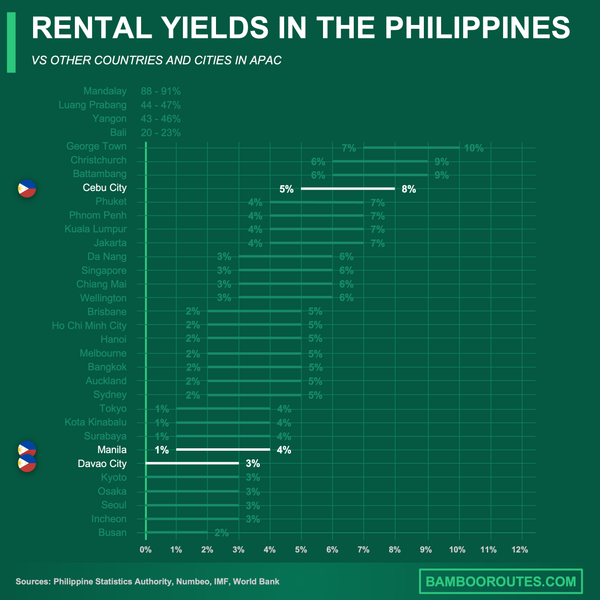
We did some research and made this infographic to help you quickly compare rental yields of the major cities in the Philippines versus those in neighboring countries. It provides a clear view of how this country positions itself as a real estate investment destination, which might interest you if you’re planning to invest there.
What are the real numbers I should budget for renting out in Manila in 2026?
What's the total "all-in" monthly cost to hold a rental in Manila in 2026?
As of early 2026, the total monthly cost to hold a Manila rental condo (excluding mortgage) runs between ₱7,000 and ₱18,000 ($120 to $305 or €110 to €285), depending on your building and whether you use a property manager.
The realistic range spans from about ₱5,000 monthly ($85 or €80) for a basic studio in an older building you manage yourself, up to ₱25,000 ($425 or €400) for a larger unit in a premium building with full professional management.
Condo association dues are typically the single largest holding cost in Manila, often running ₱2,500 to ₱6,000 per month, followed closely by property management fees if you hire someone to handle tenant relations and maintenance.
You want to go into more details? Check our list of property taxes and fees you have to pay when buying a property in Manila.
What's the typical vacancy rate in Manila in 2026?
As of early 2026, the typical vacancy rate for Manila rental condos ranges from 8% to 25%, which translates to roughly 1 to 3 months of lost rent per year for most landlords.
You should budget for at least 1.5 to 2 months of vacancy annually in Manila because the market has elevated supply and tenants have many options, meaning even good units take time to fill between leases.
The main factor driving vacancy differences across Manila neighborhoods is proximity to employment and education centers, with areas near LRT stations, hospitals, and universities consistently outperforming more residential pockets.
Tenant turnover in Manila typically peaks during April and May when leases signed the previous year expire, and again around October when some academic and corporate cycles create movement.
We have a whole part covering the best rental strategies in our pack about buying a property in Manila.
Get fresh and reliable information about the market in Manila
Don't base significant investment decisions on outdated data. Get updated and accurate information with our guide.
Where do rentals perform best in Manila in 2026?
Which neighborhoods have the highest long-term demand in Manila in 2026?
As of early 2026, the three Manila neighborhoods with the strongest overall long-term rental demand are Malate (central location and lifestyle amenities), Sampaloc and the U-Belt area (university students), and Ermita (hospitals, embassies, and business travelers).
Families looking for rentals in Manila tend to gravitate toward Santa Ana and parts of Paco, where units are slightly larger, the environment feels more residential, and international schools are relatively accessible.
Student rental demand in Manila concentrates heavily in Sampaloc, Quiapo edges near campuses, and parts of Santa Mesa, where proximity to universities like UST, FEU, and UE drives consistent turnover and occupancy.
Expats and international professionals who stay within Manila city limits (rather than Makati or BGC) typically prefer Malate and Ermita for the walkable lifestyle, embassy proximity, and relatively cosmopolitan restaurant and nightlife scene.
By the way, we've written a blog article detailing what are the current best areas to invest in property in Manila.
Which neighborhoods have the best yield in Manila in 2026?
As of early 2026, the three Manila neighborhoods delivering the best rental yields are Sampaloc and the U-Belt corridor (student demand keeps occupancy high), value pockets along the Taft Avenue corridor in Ermita and Malate edges (good rent with negotiable prices), and Santa Mesa near LRT-2 stations (transit access supports steady demand).
These top-yielding Manila neighborhoods typically achieve gross rental yields between 5.5% and 7%, compared to the citywide average of around 5%.
What allows these neighborhoods to outperform is the combination of structurally supported demand (students, hospital workers, transit commuters) and relatively affordable purchase prices, meaning you pay less upfront for properties that still command competitive rents.
We cover a lot of neighborhoods and provide a lot of updated data in our pack about real estate in Manila.
Where do tenants pay the highest rents in Manila in 2026?
As of early 2026, the three Manila neighborhoods where tenants pay the highest rents are premium Malate buildings along Roxas Boulevard with bay views, select Ermita towers near major hospitals and Robinsons Place Manila, and newer high-amenity developments in Santa Mesa near LRT stations.
In these premium Manila locations, a standard one-bedroom apartment typically rents for ₱40,000 to ₱70,000 per month ($680 to $1,190 or €635 to €1,110), while two-bedrooms can reach ₱80,000 to ₱120,000 ($1,360 to $2,030 or €1,270 to €1,900).
These neighborhoods command the highest rents because they offer something scarce in Manila: unobstructed bay views, modern building infrastructure with reliable elevators and backup power, and walkable access to both work and lifestyle amenities.
The tenant profile in these highest-rent Manila neighborhoods typically includes expatriate professionals on housing allowances, senior medical staff at nearby hospitals, and business owners who want central city access without commuting to Makati or BGC.
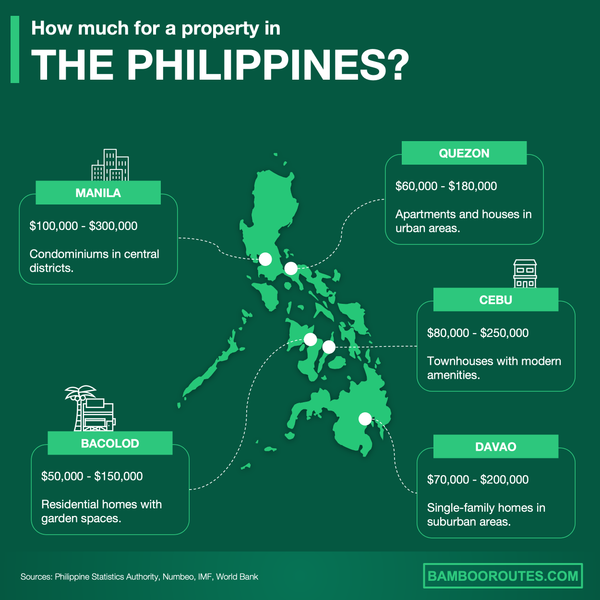
We created this infographic to give you a simple idea of how much it costs to buy property in different parts of the Philippines. As you can see, it breaks down price ranges and property types for popular cities in the country. We hope this makes it easier to explore your options and understand the market.
What do tenants actually want in Manila in 2026?
What features increase rent the most in Manila in 2026?
As of early 2026, the three property features that increase monthly rent the most in Manila are reliable high-speed internet with a dedicated line (critical for remote workers), a functional workspace setup (desk, chair, good lighting), and a unit location within a 10-minute walk of an LRT or MRT station.
Reliable internet connectivity can add a 10% to 15% rent premium in Manila because frequent outages plague many older buildings, and tenants who work from home will pay more for guaranteed connectivity.
One commonly overrated feature in Manila is a swimming pool or rooftop gym, as many tenants appreciate these amenities but rarely pay significantly more rent for them compared to units in buildings without such facilities.
An affordable upgrade that delivers strong returns for Manila landlords is installing a modern split-type inverter air conditioner, which costs around ₱25,000 to ₱40,000 but can justify ₱2,000 to ₱3,000 higher monthly rent while also reducing tenant complaints.
Do furnished rentals rent faster in Manila in 2026?
As of early 2026, furnished apartments in Manila typically rent 2 to 4 weeks faster than unfurnished ones because the market has high supply and tenants prefer move-in-ready units that save them the hassle of buying furniture.
Furnished Manila condos also command a rent premium of roughly 15% to 25% over comparable unfurnished units, though the premium shrinks if the furnishing is outdated or mismatched.
Get to know the market before you buy a property in Manila
Better information leads to better decisions. Get all the data you need before investing a large amount of money. Download our guide.
How regulated is long-term renting in Manila right now?
Can I freely set rent prices in Manila right now?
Landlords in Manila have broad freedom to set initial rent prices for new leases, with no government-mandated caps on what you can charge when a tenant first moves in.
However, rent increases during a tenancy are capped at 2.3% for units rented at ₱10,000 per month or below under a 2025 government resolution, though most foreign-owned Manila condos rent well above this threshold and are therefore not affected.
What's the standard lease length in Manila right now?
The standard lease length for residential condo rentals in Manila is 12 months, which is what most landlords, property managers, and tenants expect as the default arrangement.
Landlords in Manila commonly require 2 months of security deposit plus 1 to 2 months of advance rent, which means tenants typically pay 3 to 4 months upfront (₱60,000 to ₱140,000 or $1,020 to $2,370 or €950 to €2,220 for a mid-range one-bedroom).
Security deposits should be returned within 30 days after lease termination and unit inspection, minus any documented deductions for unpaid utilities, damages beyond normal wear and tear, or outstanding dues.

We made this infographic to show you how property prices in the Philippines compare to other big cities across the region. It breaks down the average price per square meter in city centers, so you can see how cities stack up. It’s an easy way to spot where you might get the best value for your money. We hope you like it.
How does short-term renting really work in Manila in 2026?
Is Airbnb legal in Manila right now?
Airbnb-style short-term rentals are not explicitly banned citywide in Manila, but they exist in a gray zone where your condo building rules and local permit compliance matter more than any single national regulation.
If you operate your Manila short-term rental as a business, you should obtain a barangay clearance, Mayor's permit, and BIR registration, and depending on how you market the unit, DOT accreditation standards for accommodation establishments may also apply.
Manila does not have a famous citywide cap on rental nights like some Western cities, so the practical limit on your Airbnb activity usually comes from your condo association's house rules rather than government restrictions.
The most common consequence for non-compliant short-term rental operators in Manila is building-level enforcement, such as fines from your condo association, loss of access for guests, or warnings that can escalate to unit sale restrictions.
By the way, we also have a blog article detailing whether owning an Airbnb rental is profitable in Manila.
What's the average short-term occupancy in Manila in 2026?
As of early 2026, the average annual occupancy rate for short-term rentals in Manila is approximately 45%, meaning your unit will likely sit empty more than half the year if you rely solely on Airbnb-style bookings.
The realistic range spans from about 25% to 30% occupancy for poorly reviewed or badly located units up to 60% to 70% for top-performing listings with excellent reviews, professional photos, and prime locations near hospitals or tourist areas.
The highest occupancy months for Manila short-term rentals are typically December through February (holiday travel and cool season) and during major events like Sinulog spillover visitors or large conventions.
The lowest occupancy months in Manila are usually June through September, when the rainy season dampens tourism and fewer visitors come to the city.
Finally, please note that you can find much more granular data about this topic in our property pack about Manila.
What's the average nightly rate in Manila in 2026?
As of early 2026, the average nightly rate for short-term rentals in Manila is approximately ₱2,350 to ₱2,400 ($40 or €37), though this varies significantly based on unit quality, location, and guest capacity.
The realistic range runs from about ₱1,200 to ₱1,500 per night ($20 to $25 or €19 to €24) for basic studios up to ₱5,000 to ₱8,000 ($85 to $135 or €80 to €130) for well-furnished larger units in premium locations.
During peak season (December to February and Holy Week), Manila short-term rental rates typically increase by ₱500 to ₱1,500 per night ($8 to $25 or €8 to €24) compared to off-season rates, though aggressive discounting is common during the June to September slow period.
Is short-term rental supply saturated in Manila in 2026?
As of early 2026, the Manila short-term rental market is moderately to highly saturated, with AirDNA tracking over 50,000 active listings across the metro area and significant competition for bookings.
The number of active short-term rental listings in Manila has been growing steadily, driven by condo investors pivoting from weak long-term rental returns and new supply entering the market.
The most oversaturated Manila neighborhoods for short-term rentals are Malate and Ermita (heavy tourist and medical tourism focus) and areas near Manila Bay where condo density is very high.
Neighborhoods that still have room for new short-term rental supply include Sampaloc (underserved student and parent visitor demand), Santa Mesa (growing LRT-2 corridor appeal), and Paco (central but less saturated than Malate).
Don't lose money on your property in Manila
100% of people who have lost money there have spent less than 1 hour researching the market. We have reviewed everything there is to know. Grab our guide now.

What sources have we used to write this blog article?
Whether it's in our blog articles or the market analyses included in our property pack about Manila, we always rely on the strongest methodology we can … and we don't throw out numbers at random.
We also aim to be fully transparent, so below we've listed the authoritative sources we used, and explained how we used them and the methods behind our estimates.
| Source | Why it's authoritative | How we used it |
|---|---|---|
| Bangko Sentral ng Pilipinas (BSP) | The Philippines' central bank publishes official housing price data. | We used it to anchor macro price trends using official bank loan data. We relied on its hedonic methodology to justify treating price trends as more reliable than asking prices. |
| LawPhil (Constitution) | Widely cited legal repository used by practitioners and students. | We used it to ground the core rule that foreigners cannot own land. We translated this into practical guidance on what rental investors can actually buy. |
| LawPhil (Condominium Act) | Primary law governing condominium ownership structures in the Philippines. | We used it to explain why condos are the standard path for foreign buyers. We framed the key compliance check around foreign ownership caps at the building level. |
| Colliers Philippines | Major global real estate consultancy with formal research practice. | We used it to anchor Metro Manila vacancy conditions and oversupply context. We used submarket commentary to tailor neighborhood strategy recommendations. |
| AirDNA | Leading short-term rental data provider tracking Airbnb and Vrbo markets. | We used it to estimate occupancy, daily rates, and monthly revenue for Manila. We cross-checked direction with other market commentary before drawing conclusions. |
| HousingInteractive | Long-running Philippine property portal publishing listing statistics. | We used it to estimate asking rent levels specifically in Manila city. We cross-checked with Lamudi listing clusters to make bedroom-level estimates realistic. |
| Philippine News Agency (PNA) | Government's official newswire for policy announcements. | We used it to confirm the rent-increase cap resolution scope for 2025. We treated it as the official narrative cross-check against newspaper reporting. |
| Bureau of Internal Revenue (BIR) | Official tax authority explaining registration and taxpayer obligations. | We used it to support the practical point that rental income requires BIR registration. We kept tax guidance grounded in official agency information. |
| City Council of Manila | Primary local government legislative source for Manila ordinances. | We used it to justify that business permitting is LGU-regulated and ordinance-driven. We framed short-term rentals as a compliance workflow rather than a loophole. |
| DOT Memorandum Circular (UP Law archive) | Official tourism department memo hosted by a top university law center. | We used it to support claims about accommodation establishment standards. We explained why condo building and LGU compliance matters for Airbnb-style rentals. |
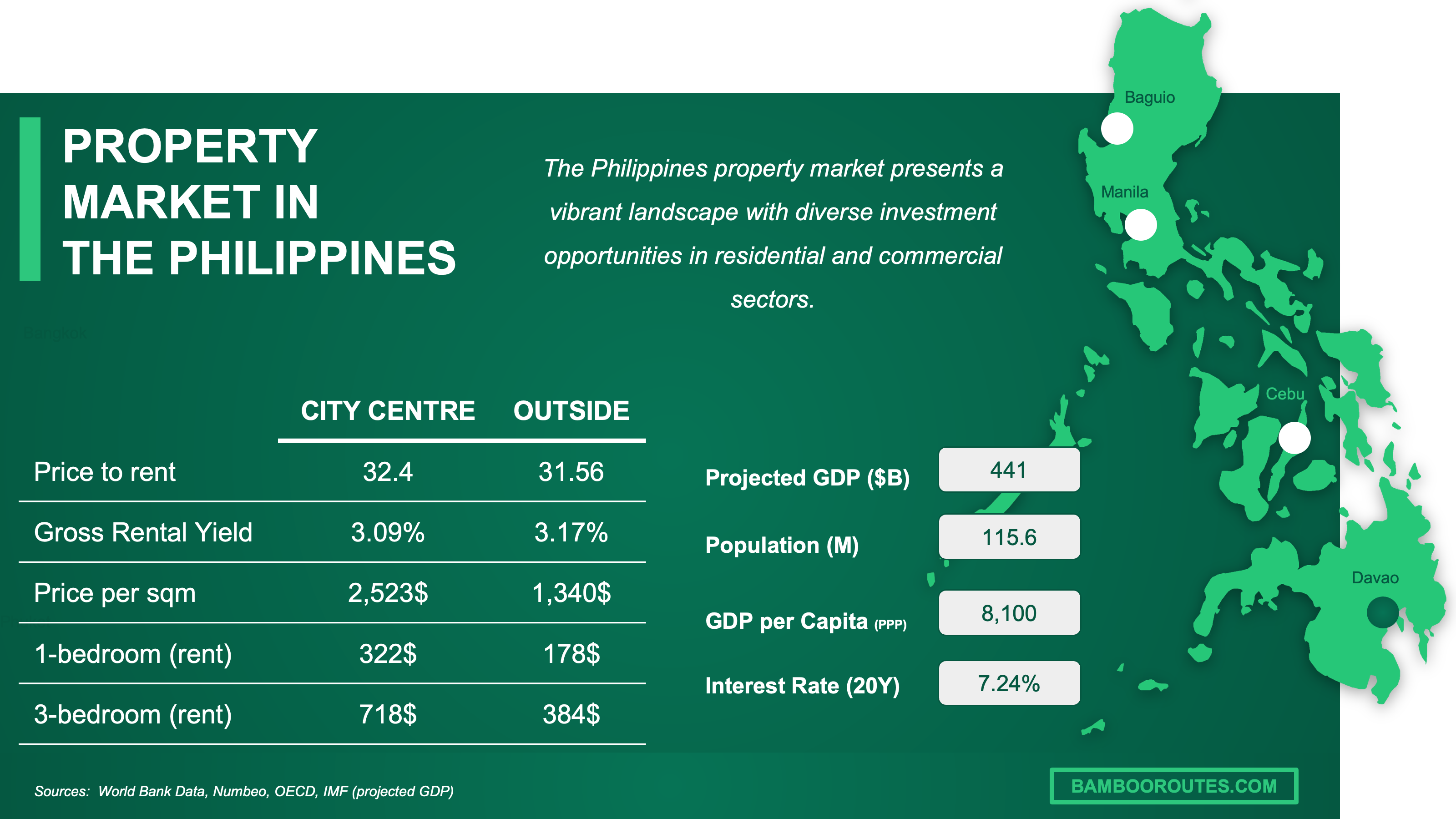
We have made this infographic to give you a quick and clear snapshot of the property market in the Philippines. It highlights key facts like rental prices, yields, and property costs both in city centers and outside, so you can easily compare opportunities. We’ve done some research and also included useful insights about the country’s economy, like GDP, population, and interest rates, to help you understand the bigger picture.
Related blog posts