
Authored by the expert who managed and guided the team behind the Philippines Property Pack
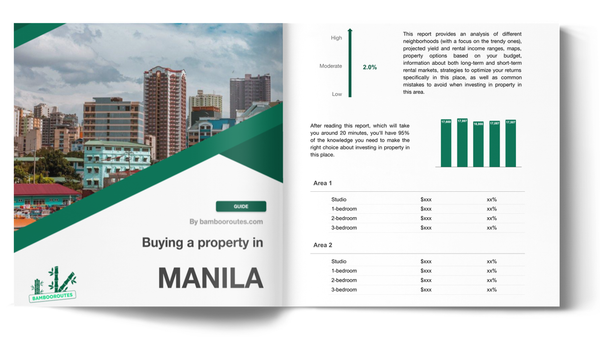
Get all the data you need about the real estate market in Manila
Manila can still work for Airbnb in 2026, but the best results come from choosing the right building, not just the right neighborhood.
In this article, we look at the current housing prices in Manila, Airbnb income, occupancy, expenses, local rules, and the areas where short-term rental demand is strongest.
We constantly update this blog post so the Manila Airbnb numbers stay close to the latest market data available in early 2026.
And if you’re planning to buy a property in this place, you may want to download our pack covering the real estate market in Manila.
Insights
- Manila Airbnb legality in 2026 is less about a citywide ban and more about condo house rules, business permits, BIR tax registration, and guest-entry procedures.
- A realistic Airbnb nightly price in Manila in 2026 is around ₱2,300, or about $40 and €37, but bay-view units can price much higher.
- The average Manila Airbnb listing looks modest on paper, but serious whole-unit condos in Ermita, Malate, Binondo, and Manila Bay can earn much more.
- Generic studio condos around ₱1,500 to ₱2,500 per night are the most crowded Airbnb product in Manila in 2026.
- The best white space in Manila Airbnb demand is not luxury villas, but clean 2BR condos for families, medical travelers, balikbayan visitors, and small groups.
- Manila’s short-term rental market benefits from NAIA traffic, Intramuros events, universities, hospitals, embassies, and Pasay convention demand.
- For a non-professional owner, a well-managed Manila Airbnb can make ₱10,000 to ₱35,000 net per month before tax and mortgage costs.
- Building friction is the hidden profit killer in Manila, because complicated lobby checks and unclear guest registration can lower reviews and occupancy.
- Metro Manila data can overstate or blur Manila city performance, because Makati, BGC, Pasay, Quezon City, and Mandaluyong compete for similar guests.


Can I legally run an Airbnb in Manila in 2026?
Is short-term renting allowed in Manila in 2026?
As of early 2026, short-term renting is generally possible in Manila, but an Airbnb host should treat the market as allowed with paperwork and building-rule checks.
Manila does not appear to have one dedicated citywide Airbnb law, so the main framework is a mix of Department of Tourism accommodation rules, local business-permit rules, BIR tax rules, and private condo regulations.
The most important condition for a Manila Airbnb host is that the condo corporation, subdivision association, or building administrator must allow short-term guests.
Hosts may also need barangay clearance, a Manila business permit, BIR registration, receipts or invoices, fire and safety compliance, and possibly DOT accreditation if the unit is operated like a tourism accommodation business.
The usual consequence of illegal Airbnb operation in Manila is not one simple city fine, but a combination of tax penalties, permit problems, guest-entry blocks, building sanctions, and possible delisting risk.
For a more general view, you can read our article detailing what exactly foreigners can own and buy in The Philippines.
If you are an American, you might want to read our blog article detailing the property rights of US citizens in The Philippines.
Are there minimum-stay rules and maximum nights-per-year caps for Airbnbs in Manila as of 2026?
As of early 2026, Manila does not appear to have a clear citywide minimum-stay rule or a maximum nights-per-year cap for Airbnb listings.
This means there is no obvious 90-night, 120-night, or 180-night Manila Airbnb cap for condos, apartments, houses, townhouses, owner-occupied homes, or secondary homes.
In practice, the real minimum stay often comes from the building, because some Manila condo administrators prefer weekly or monthly stays to reduce lobby traffic.
Do I have to live there, or can I Airbnb a secondary home in Manila right now?
There is no clear Manila rule in early 2026 that says an Airbnb host must live in the property being rented.
This means a secondary condo, apartment, house, or townhouse in Manila can usually be used as an Airbnb if the building allows it and the host follows business, tax, and safety rules.
For a non-primary residence, the extra conditions are usually practical ones, such as business registration, BIR compliance, barangay or city permit review, and written building approval where needed.
The main difference between a primary residence and a secondary home in Manila is not owner-occupancy, but whether the rental activity looks occasional or like a full-time lodging business.
Get fresh and reliable information about the market in Manila
Don't base significant investment decisions on outdated data. Get updated and accurate information.

Can I run multiple Airbnbs under one name in Manila right now?
In early 2026, one person can generally operate more than one Airbnb in Manila, because we found no clear citywide rule limiting a host to one listing.
There also appears to be no Manila-wide maximum number of residential short-term rental properties that one person or company can list.
However, a host with several Manila Airbnb units should expect stronger compliance needs, including DTI or SEC registration, BIR registration, Manila business-permit review, bookkeeping, guest records, and written condo approvals.
The reason is simple: several Airbnb units in Manila look like a small hospitality business, not casual home-sharing.
Do I need a short-term rental license or a business registration to host in Manila as of 2026?
As of early 2026, Manila does not appear to offer one simple Airbnb license, but a serious Airbnb host may still need business registration, BIR registration, local permits, and possibly DOT accreditation.
The usual process is to register the business name, register with BIR, check barangay and Manila business-permit requirements, ask the building for written STR approval, and then review whether DOT accreditation applies.
Typical documents may include a valid ID, proof of ownership or lease authority, DTI or SEC registration, BIR Certificate of Registration, barangay clearance, fire-safety documents, and condo approval if relevant.
Costs vary by business size, location, and permit classification, so a small Manila Airbnb host should budget for registration fees, professional help, annual renewals, and possible tax-accounting support.
Are there neighborhood bans or restricted zones for Airbnb in Manila as of 2026?
As of early 2026, we found no clear citywide Manila neighborhood ban that blocks Airbnb in Ermita, Malate, Binondo, Intramuros-adjacent areas, Santa Cruz, Sampaloc, Paco, or Manila Bay.
The strictest places are usually individual condo buildings in Ermita, Malate, Manila Bay, Binondo, and university-adjacent Sampaloc, where administrators may restrict daily guests or require advance registration.
These areas are sensitive because they mix tourists, students, residents, hospitals, embassies, nightlife, and dense elevator traffic in the same buildings.
Get to know the market before buying a property in Manila
Better information leads to better decisions. Get all the data you need before investing a large amount of money.
How much can an Airbnb earn in Manila in 2026?
What's the average and median nightly price on Airbnb in Manila in 2026?
As of early 2026, the estimated average nightly price for an Airbnb listing in Manila is about ₱2,300, or about $40 and €37, while the median is closer to ₱1,900, or about $33 and €30.
A normal Manila Airbnb price range covering roughly 80% of residential listings is about ₱1,200 to ₱5,500 per night, or about $21 to $95 and €19 to €88.
The biggest pricing factor in Manila is not unit size alone, but the mix of location, building quality, view, smooth guest entry, and proximity to Manila Bay, Intramuros, embassies, hospitals, universities, or Binondo.
By the way, you will find much more detailed rent ranges in our property pack covering the real estate market in Manila.
How much do nightly prices vary by neighborhood in Manila in 2026?
As of early 2026, nightly Airbnb prices in Manila range from about ₱1,100, or $19 and €18, in cheaper areas like Paco, Pandacan, and San Andres to about ₱6,500, or $112 and €103, in stronger Manila Bay and Roxas Boulevard units.
The three highest-price Manila Airbnb areas are usually Manila Bay and Roxas Boulevard at about ₱2,300 to ₱5,500 per night, Ermita and Malate at about ₱1,800 to ₱3,500, and Intramuros-adjacent or Port Area units at about ₱1,700 to ₱3,800.
The three lower-price Manila Airbnb areas are usually Sampaloc at about ₱1,200 to ₱2,300, Paco at about ₱1,100 to ₱2,200, and Pandacan or San Andres at about ₱1,100 to ₱2,200, but guests still choose these areas for exams, hospitals, family visits, and lower prices.
What's the typical occupancy rate in Manila in 2026?
As of early 2026, the typical Airbnb occupancy rate in Manila is around 30% to 45% for visible listings and closer to 50% to 65% for well-run entire condos in strong areas.
Most Manila Airbnb listings sit somewhere between 25% and 65% occupancy, because inactive listings, difficult buildings, weak photos, and poor check-in instructions pull the average down.
Compared with the wider Metro Manila short-term rental market, Manila city can look weaker in some datasets because guests also compare it with Makati, BGC, Pasay, Quezon City, and airport-area condos.
The biggest factor behind above-average occupancy in Manila is reducing guest friction, especially with clean check-in instructions, clear lobby rules, fast replies, strong Wi-Fi, cold air conditioning, and honest photos.
Make a profitable investment in Manila
Better information leads to better decisions. Save time and money. Download our data.
What's the average monthly revenue per listing in Manila in 2026?
As of early 2026, a broad average Manila Airbnb listing earns about ₱25,000 to ₱45,000 per month, or about $430 to $775 and €400 to €715.
A realistic monthly revenue range covering roughly 80% of Manila Airbnb listings is about ₱15,000 to ₱95,000, or about $260 to $1,640 and €240 to €1,510.
Top Manila Airbnb listings can reach about ₱120,000 or more in strong months, or about $2,070 and €1,900, when the unit has a strong location, view, reviews, self-check-in, and enough space for families or groups.
For example, a Manila Airbnb charging ₱3,500 per night at 70% occupancy earns about ₱74,000 per month before cleaning fees, platform fees, utilities, and taxes.
Finally, note that we give here all the information you need to buy and rent out a property in Manila.
What's the typical low-season vs high-season monthly revenue in Manila in 2026?
As of early 2026, a decent Manila Airbnb may earn about ₱30,000 to ₱55,000 per month in low season, or about $520 to $950 and €475 to €875, and about ₱80,000 to ₱125,000 in high season, or about $1,380 to $2,155 and €1,270 to €1,985.
Low season is often around post-holiday and rainy months, while high season is usually linked to December travel, June Manila events, Intramuros activities, board-exam periods, conventions, concerts, long weekends, and family visits.
What's a realistic Airbnb monthly expense range in Manila in 2026?
As of early 2026, a realistic monthly expense range for a Manila Airbnb is about ₱25,000 to ₱55,000 for a studio or 1BR, or about $430 to $950 and €400 to €875, before mortgage costs.
The largest cost category in Manila is usually cleaning, laundry, utilities, and management combined, which can easily reach ₱15,000 to ₱35,000 per month, or about $260 to $605 and €240 to €555.
Most Manila Airbnb hosts should expect operating expenses to absorb about 35% to 60% of gross revenue before debt service, income tax, and major repairs.
If you want to go into more details, we also have a blog article detailing all the property taxes and fees in Manila.
What's realistic monthly net profit and profit per available night for Airbnb in Manila in 2026?
As of early 2026, a good Manila Airbnb owned without debt can make about ₱10,000 to ₱35,000 in monthly net profit for a studio or 1BR, or about $170 to $605 and €160 to €555, with profit per available night around ₱300 to ₱1,200.
Most Manila Airbnb listings realistically fall between negative profit and about ₱35,000 per month, or between below $0 and about $605, because weak buildings, low occupancy, mortgages, and management fees can erase profit.
A normal net profit margin for a Manila Airbnb is roughly 10% to 35% before income tax, major repairs, and financing costs.
A typical Manila Airbnb often needs about 40% to 55% occupancy to break even before mortgage, and a financed condo may need much more.
In our property pack covering the real estate market in Manila, we explain the best strategies to improve your cashflows.
Don't buy the wrong property, in the wrong area of Manila
Buying real estate is a significant investment. Don't rely solely on your intuition. Gather the right information to make the best decision.
How competitive is Airbnb in Manila as of 2026?
How many active Airbnb listings are in Manila as of 2026?
As of early 2026, City of Manila has roughly 1,100 to 1,500 active Airbnb-style listings, depending on whether the dataset counts only active City of Manila listings or a wider Manila search area.
This looks broadly stable to slightly competitive compared with the previous year, while the longer trend is that Metro Manila short-term rental supply has become much deeper because Makati, BGC, Pasay, Quezon City, and Mandaluyong also compete for guests.
Which neighborhoods are most saturated in Manila as of 2026?
As of early 2026, the most saturated Manila Airbnb neighborhoods are Ermita, Malate, Manila Bay and Roxas Boulevard, Binondo and Santa Cruz, and Sampaloc near the University Belt.
These areas are saturated because they combine tourist demand, hospitals, universities, embassies, nightlife, transport, malls, and many condo buildings that are easy to furnish as short-term rentals.
Relatively undersaturated Manila areas include Paco, Pandacan, San Andres, Santa Ana, and parts of Tondo, but these areas need a stronger booking reason such as parking, family space, hospital access, or a very good price.
If you want to know more, we have a blog article listing all the top property areas in Manila.
What local events spike demand in Manila in 2026?
As of early 2026, Airbnb demand in Manila spikes around Independence Day, Manila founding events, Intramuros cultural activities, major concerts, World Trade Center and SMX trade fairs, board exams, university events, and December travel.
During strong event periods, well-located Manila Airbnb hosts may see bookings and nightly rates rise by about 15% to 40%, especially near Manila Bay, Ermita, Malate, Binondo, Sampaloc, and Pasay-accessible zones.
Hosts should adjust prices and availability about 4 to 8 weeks before major Manila events, and earlier for December stays, conventions, concerts, and board-exam periods.
What occupancy differences exist between top and average hosts in Manila in 2026?
As of early 2026, top-performing Manila Airbnb hosts can reach about 70% to 80% occupancy in strong buildings and during event-heavy months.
An average Manila Airbnb host is more likely to sit around 30% to 45% occupancy, especially if the listing is generic, the building rules are unclear, or check-in is stressful.
A new Manila Airbnb host usually needs 6 to 12 months to reach top-performer occupancy because reviews, guest trust, pricing history, and operational routines take time to build.
We give more details about the different Airbnb strategies to adopt in our property pack covering the real estate market in Manila.
Which price points are most crowded, and where's the "white space" for new hosts in Manila right now?
The most crowded Manila Airbnb price range in early 2026 is about ₱1,500 to ₱2,500 per night, or about $26 to $43 and €24 to €40, because many hosts offer similar studio and 1BR condos.
The clearest white space is around ₱3,500 to ₱6,500 per night, or about $60 to $112 and €56 to €103, for high-quality 2BR units, bay-view 1BR units, and monthly-stay-ready apartments.
A new host can compete in this underserved Manila Airbnb segment with a real desk, washer or easy laundry, self-check-in, great Wi-Fi, strong air conditioning, family capacity, parking access, and a building that handles guests smoothly.

We made this infographic to show you how property prices in the Philippines compare to other big cities across the region. It breaks down the average price per square meter in city centers, so you can see how cities stack up. It’s an easy way to spot where you might get the best value for your money. We hope you like it.
What property works best for Airbnb demand in Manila right now?
What bedroom count gets the most bookings in Manila as of 2026?
As of early 2026, studios and 1BR condos get the most Airbnb bookings in Manila because they are cheaper, common, easy to clean, and close to the city’s main demand nodes.
A realistic Manila booking mix is about 35% studios, 40% 1BR units, 20% 2BR units, and 5% 3BR or larger homes, although the exact split changes by building and neighborhood.
Studios and 1BR units perform best in booking volume because Manila guests often stay for embassy visits, hospital appointments, exams, food trips, events, and short city breaks where price and location matter more than size.
What property type performs best in Manila in 2026?
As of early 2026, condos and apartments are the best-performing residential Airbnb property type in Manila, while houses and townhouses work only in specific family, parking, or group-stay situations.
Condos and apartments in strong Manila buildings can reach about 50% to 65% occupancy when well managed, while houses, townhouses, and larger homes often need lower pricing or a special guest reason to compete.
Condos outperform other property types in Manila because they offer security, elevators, known locations, easier cleaning, predictable utilities, and better access to Manila Bay, Ermita, Malate, Binondo, hospitals, universities, and Intramuros.
What sources have we used to write this blog article?
Whether it’s in our blog articles or the market analyses included in our property pack about Manila, we always rely on the strongest methodology we can and we don’t throw out numbers at random.
We also aim to be fully transparent, so below we’ve listed the authoritative sources we used, and explained how we used them and the methods behind our estimates.
| Source | Why we trust it | How we used it |
|---|---|---|
| Airbnb Help Center, Responsible hosting in the Philippines | It is Airbnb’s own guidance page for hosts operating in the Philippines. | We used it to identify the national compliance lens for Airbnb hosts in Manila. We cross-checked its guidance against DOT and BIR sources. |
| Airbnb 2026 Philippines Host Tax Guide | It explains tax obligations for short-term rental hosts in the Philippines. | We used it to confirm that Manila Airbnb income may trigger taxpayer registration, tax filing, and tax payment obligations. We treated it as general guidance, not personal tax advice. |
| DOT Accreditation Portal | It is the official Department of Tourism portal for tourism-accommodation accreditation. | We used it to confirm that accommodation accreditation remains an active official process. We did not assume that every casual condo listing is automatically DOT-accredited. |
| DOT Memorandum Circular No. 2020-005 | It defines accommodation establishments and includes private homes, serviced apartments, condotels, and homestays. | We used it to understand when a Manila Airbnb could fall into tourism-accommodation regulation. We paired it with Airbnb guidance and local permit sources. |
| DILG advisory on DOT-accredited tourism enterprises | It is a government advisory linking local permits and DOT accreditation for tourism enterprises. | We used it to understand the relationship between local permits and DOT accreditation. We used it cautiously because not every residential Airbnb is treated the same way as a hotel. |
| DTI Business Name Registration System | It is the official DTI portal for sole-proprietor business-name registration. | We used it to map the business-registration path for individual Manila Airbnb hosts. We separated DTI registration from BIR tax duties and Manila local permits. |
| Bureau of Internal Revenue | It is the official Philippine tax authority. | We used it to support the tax-compliance section for Airbnb income in Manila. We kept the article simple because exact tax treatment depends on each host’s situation. |
| City Council of Manila ordinances | It is the official Manila city ordinance repository. | We used it to check for any clear Manila Airbnb ban, cap, or neighborhood restriction. We did not find a citywide Airbnb-style cap comparable to London or New York. |
| Manila Ordinance No. 8754 | It is a Manila ordinance on streamlined local business clearances and permits. | We used it to support the local-permit pathway for business activity in Manila. We used it carefully because it is not an Airbnb-specific ordinance. |
| BSP Residential Property Price Index | It is the central bank’s official residential property price index. | We used it to anchor Manila property-market direction in official price data. We cross-checked it with Colliers and JLL market reports. |
| PSA Philippine Tourism Satellite Account | It is the official statistics source for tourism’s contribution to the Philippine economy. | We used it to frame travel demand behind Manila short-term rentals. We did not use it for neighborhood Airbnb revenue because it does not provide that level of detail. |
| Colliers Q1 2026 Residential Philippines | Colliers is a major real-estate consultancy with local Philippine market research. | We used it for Metro Manila residential supply, vacancy, and buyer-demand context. We cross-checked Airbnb investment logic against JLL and BSP. |
| JLL Q1 2026 Residential Manila | JLL is a major real-estate advisory firm with transparent quarterly market reporting. | We used it for Q1 2026 rent and capital-value benchmarks. We treated its premium-residential figures as an upper-market reference, not a whole-market average. |
| AirDNA Manila STR data | AirDNA is one of the best-known short-term rental analytics providers. | We used it for market-level ADR, occupancy, and listing-performance direction. We cross-checked it with AirROI and Airbtics because STR datasets define “Manila” differently. |
| AirROI Manila 2026 data portal | It provides a 2026 Manila Airbnb dataset with listing count, ADR, occupancy, and revenue fields. | We used it for City-of-Manila-scale listing and revenue estimates. We treated it as private-sector data and triangulated it against AirDNA and Airbtics. |
| Airbtics Metro Manila 2026 data | It is an established STR analytics provider with market-level Airbnb estimates. | We used it to benchmark Metro Manila-wide demand and active-listing scale. We did not use it alone because its metro scope is wider than Manila city. |
| New NAIA Infra Corp 2025 passenger traffic | It is the airport operator’s direct statement on Manila gateway traffic. | We used it to frame travel demand into Metro Manila and Manila city. We cross-checked demand implications with PSA tourism statistics. |
| Intramuros Administration June 2026 calendar | It is an official source for Manila-specific cultural events in Intramuros. | We used it for event-driven demand around Intramuros, Ermita, Malate, and Binondo. We treated events as short demand spikes, not year-round occupancy guarantees. |
| World Trade Center Metro Manila calendar | It is an official venue calendar for trade shows and business events near Manila. | We used it to identify business-event demand near Manila Bay and Pasay-adjacent zones. We cross-checked this with airport traffic and STR seasonality. |
Get fresh and reliable information about the market in Manila
Don't base significant investment decisions on outdated data. Get updated and accurate information.
Related blog posts