
Authored by the expert who managed and guided the team behind the Philippines Property Pack

Get all the data you need about the real estate market in Calabarzon
Buying a home in Calabarzon in June 2026 is not an obvious yes or no decision, because the region has both cooling prices and very strong long-term demand.
We constantly update this blog post so buyers can read it with the freshest public data, local signals, and market estimates available.
This article looks at houses and lots, townhouses, row houses, condominiums, apartments, and residential lots, but not villas because villas are only a niche market in places like Tagaytay, Batangas, and lakeside areas.
And if you’re planning to buy a property in this place, you may want to download our pack covering the real estate market in Calabarzon.
So, is now a good time?
Rather yes, June 2026 is a decent time to buy a property in Calabarzon, but only if the home is in a practical commuter, jobs, or rental location.
The strongest signal is that official Philippine residential price growth has cooled, with Areas Outside NCR rising only about 1.0% year-on-year in Q4 2025.
Another strong signal is that Calabarzon remains the largest region in the Philippines, with about 16.93 million people in 2024, which gives the market a deep buyer and renter base.
Other strong signals are the 2025 regional economy, CALAX progress, industrial jobs, and steady Metro Manila spillover into Cavite, Laguna, Rizal, and Batangas.
The best strategy is to buy a well-priced house-and-lot, townhouse, or compact rental unit near transport, jobs, schools, and flood-aware daily services, then hold it for the medium to long term.
This is not financial or investment advice, because we do not know your personal situation, your financing, or your risk tolerance, so you should do your own research.

Is it smart to buy now in Calabarzon, or should I wait as of 2026?
Do real estate prices look too high in Calabarzon as of 2026?
As of 2026, residential property prices in Calabarzon look about 5% to 12% above fair value in the hottest Cavite and Laguna commuter corridors, close to fair value in many Batangas and Rizal family-housing areas, and still cheaper than Metro Manila for buyers who need more space.
The clearest listings signal is that overpriced condos and fringe subdivisions in Calabarzon need longer marketing periods or small discounts, while well-located house-and-lot and townhouse units in Imus, Dasmariñas, General Trias, Santa Rosa, Biñan, and Antipolo still attract active buyers.
Another useful signal is that the market is not moving as one block, because a practical townhouse near CALAX, SLEX, a school, or an industrial estate can feel fairly priced while a preselling condo far from daily transport can feel stretched.
You can also read our latest update regarding the housing prices in Calabarzon.
Does a property price drop look likely in Calabarzon as of 2026?
As of 2026, the risk of a meaningful property price decline in Calabarzon over the next 12 months looks low to medium, with higher risk in weak condos, remote subdivisions, and homes priced above local financing capacity.
A sensible 12-month range for residential property prices in Calabarzon is roughly minus 3% to plus 7%, with the downside more likely in poor-access projects and the upside more likely in Cavite, Laguna, Rizal, and Batangas growth nodes.
The macro factor that would most increase the chance of a Calabarzon property price drop is a renewed mortgage squeeze, because higher monthly payments would hurt the middle-income buyers who dominate the house-and-lot and townhouse market.
This factor is possible but not our base case, because the BSP policy rate was 4.50% in early June 2026, which is no longer as high as the peak period but still high enough to keep banks and buyers careful.
Finally, please note that we cover the price trends for next year in our pack about the property market in Calabarzon.
Could property prices jump again in Calabarzon as of 2026?
As of 2026, the chance of a renewed broad price surge in Calabarzon within the next 12 months looks medium, but the chance of sharp jumps in a few transport-linked areas is higher.
A plausible upside range is about 3% to 7% for good Calabarzon residential locations over the next 12 months, with 8% to 12% possible in specific Cavite, Laguna, and Rizal pockets helped by transport or township demand.
The biggest demand-side trigger would be a return of buyers who delayed purchases during the high-rate period, because lower payment stress would quickly support townhouses and small house-and-lot units near Metro Manila.
Please also note that we regularly publish and update real estate price forecasts for Calabarzon here.
Are we in a buyer or a seller market in Calabarzon as of 2026?
As of 2026, Calabarzon is a neutral to slightly seller-leaning market for good landed homes, but it is buyer-leaning for generic condos, poor-access subdivisions, and units priced too high for local incomes.
There is no official regional months-of-inventory number for Calabarzon, but our closest estimate is about 4 to 7 months for good house-and-lot and townhouse stock and 7 to 12 months for weaker condo or fringe supply, which means buyers can negotiate in some segments but not everywhere.
Our close proxy for price reductions is that about 15% to 25% of visible resale listings need some discount or seller flexibility, which suggests that Calabarzon sellers still have leverage only when the property is practical, clean-title, and well located.
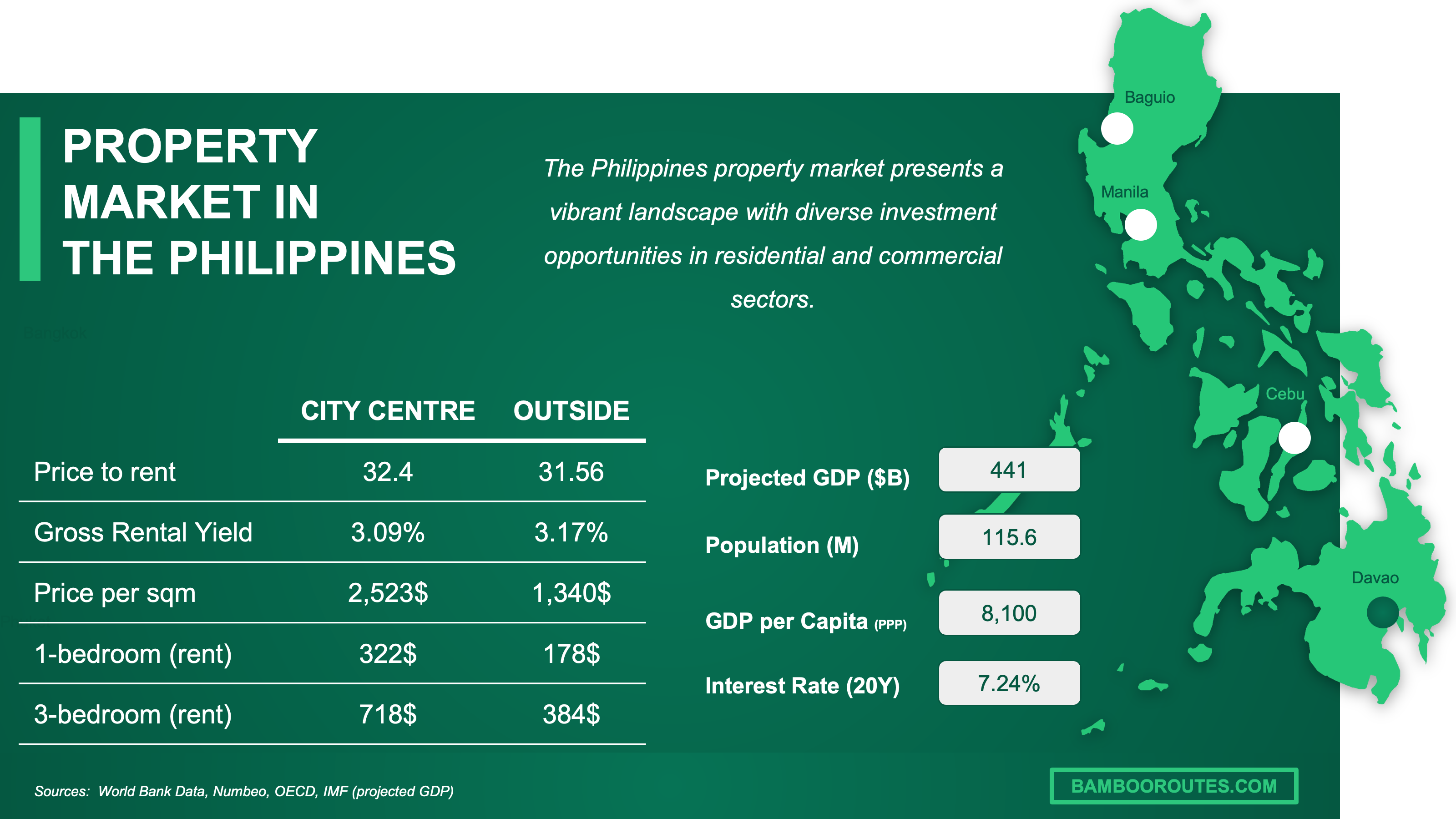
We have made this infographic to give you a quick and clear snapshot of the property market in the Philippines. It highlights key facts like rental prices, yields, and property costs both in city centers and outside, so you can easily compare opportunities. We’ve done some research and also included useful insights about the country’s economy, like GDP, population, and interest rates, to help you understand the bigger picture.
Are homes overpriced, or fairly priced in Calabarzon as of 2026?
Are homes overpriced versus rents or versus incomes in Calabarzon as of 2026?
As of 2026, Calabarzon homes look slightly expensive versus local incomes, but only mildly expensive versus rents in worker-heavy and commuter-heavy areas such as Santa Rosa, Biñan, Cabuyao, Calamba, Dasmariñas, Imus, Cainta, Taytay, and Antipolo.
The estimated price-to-rent ratio in Calabarzon is roughly 15 to 25 years for most practical residential properties, while a balanced market often feels closer to 14 to 20 years, so the region is not cheap but not extreme either.
The estimated price-to-income multiple in Calabarzon is around 7 to 12 times annual household income for many middle-income homes, which is above a comfortable affordability range and explains why dual-income families, OFWs, and Metro Manila spillover buyers matter so much.
Finally please note that you will have all the indicators you need in our property pack covering the real estate market in Calabarzon.
Are home prices above the long-term average in Calabarzon as of 2026?
As of 2026, home prices in the best Calabarzon commuter locations look roughly 15% to 30% above 2019 nominal levels, but only about 0% to 10% above a reasonable inflation-adjusted trend in many ordinary family-housing areas.
The estimated recent 12-month price change for Calabarzon is close to the Areas Outside NCR signal of about 1% year-on-year in Q4 2025, which is much slower than the strongest post-pandemic years.
In real terms, many Calabarzon homes do not look far above their prior cycle peak, because inflation has absorbed part of the nominal price rise and buyers have become more payment-sensitive.
Get fresh and reliable information about the market in Calabarzon
Don't base significant investment decisions on outdated data. Get updated and accurate information.

What local changes could move prices in Calabarzon as of 2026?
Are big infrastructure projects coming to Calabarzon as of 2026?
As of 2026, the single biggest near-term infrastructure price catalyst for Calabarzon is CALAX, because the opened Cavite-Laguna segment can improve access between Biñan, Silang, General Trias, and nearby commuter towns.
The key timeline is no longer just a future promise, because Subsection 3 opened in 2026, while remaining CALAX works and other transport links should be treated as future bonuses until they are actually usable.
For the latest updates on the local projects, you can read our property market analysis about Calabarzon here.
Are zoning or building rules changing in Calabarzon as of 2026?
The most important planning change in Calabarzon is the continuing update of Comprehensive Land Use Plans and zoning ordinances, because LGUs are trying to balance housing, industry, flood risk, agriculture, and transport corridors.
As of 2026, these zoning updates should have a mild positive effect on well-serviced residential areas and a mild negative effect on poorly planned subdivisions, because rules may push development toward safer and better-connected locations.
The areas most affected are fast-growing LGUs in Cavite, Laguna, Rizal, and Batangas, especially places near expressways, industrial estates, upland expansion zones, and flood-sensitive lowlands.
Are foreign-buyer or mortgage rules changing in Calabarzon as of 2026?
As of 2026, foreign-buyer rules for Calabarzon look broadly stable and should not move prices much, while mortgage conditions matter more because financing decides how many local buyers can afford townhouses, houses, lots, and condos.
The most likely foreign-buyer change is not a new opening of land ownership, but stricter attention to the existing rule that foreigners generally cannot own Philippine land and may mainly buy condominium units within legal limits.
The most likely mortgage change is a shift in bank pricing and approval caution rather than a sudden new loan rule, because inflation and the BSP policy rate keep lenders focused on borrower capacity.
You can also read our latest update about mortgage and interest rates in The Philippines.
Buying real estate in Calabarzon can be risky
An increasing number of foreign investors are showing interest. However, 90% of them will make mistakes. Avoid the pitfalls with our comprehensive guide.

Will it be easy to find tenants in Calabarzon as of 2026?
Is the renter pool growing faster than new supply in Calabarzon as of 2026?
As of 2026, renter demand appears to be growing faster than usable rental supply in the best Calabarzon nodes, especially near industrial parks, transport corridors, universities, hospitals, and Metro Manila spillover areas.
The strongest renter-demand signal is Calabarzon’s 16.93 million population in 2024 and its 5.1% real economic growth in 2025, because those two facts point to a large region with jobs and household formation.
The supply signal is more mixed, because new building permits show future supply, but many new homes are not in the exact places tenants want, so Santa Rosa, Biñan, Cabuyao, Calamba, Imus, Dasmariñas, Lipa, Cainta, Taytay, and Antipolo can still tighten first.
Are days-on-market for rentals falling in Calabarzon as of 2026?
As of 2026, rental days-on-market in the best Calabarzon areas look roughly 2 to 6 weeks for well-priced units and appear to be falling in the strongest worker and commuter nodes.
The gap is large because a practical unit near Santa Rosa, Biñan, Cabuyao, Calamba, Imus, Lipa, Cainta, or Antipolo can rent much faster than a remote subdivision home that may sit for 2 to 4 months.
One reason time-to-let falls in Calabarzon is that many tenants are not searching for a luxury home, but for a simple place near a plant, school, expressway, hospital, or family support network.
Are vacancies dropping in the best areas of Calabarzon as of 2026?
As of 2026, vacancies are probably dropping in the best rental areas of Calabarzon, especially Santa Rosa, Biñan, Cabuyao, Calamba, Dasmariñas, Imus, General Trias, Lipa, Cainta, Taytay, San Mateo, and Antipolo.
Our estimate is that stronger Calabarzon rental nodes have about 4% to 7% vacancy, while weaker or speculative projects can sit closer to 10% to 15% or more.
A practical landlord signal is when tenants ask first about commute time, tricycle access, flood history, parking, and association dues before asking for a discount, because that means usable homes are scarce.
By the way, we’ve written a blog article detailing what are the current rent levels in Calabarzon.
Make a profitable investment in Calabarzon
Better information leads to better decisions. Save time and money. Download our data.
Am I buying into a tightening market in Calabarzon as of 2026?
Is for-sale inventory shrinking in Calabarzon as of 2026?
As of 2026, we estimate that good for-sale inventory in Calabarzon is about 10% to 20% tighter than in 2023 and 2024 for practical landed homes, although total visible listings are not clearly shrinking across every property type.
The closest months-of-supply proxy is about 4 to 7 months for good house-and-lot and townhouse stock, compared with a simple balanced-market guide of around 6 months.
The most likely reason inventory is shrinking in good locations is that owners of well-located family homes are not forced to sell, while replacement homes have become more expensive and mortgage decisions remain cautious.
Are homes selling faster in Calabarzon as of 2026?
As of 2026, attractive homes in Calabarzon usually sell in about 1 to 3 months when priced well, while average homes often need 4 to 8 months and weak condos or poor-access subdivisions can take longer.
The year-over-year change in median days-on-market is probably flat to slightly faster for good landed homes and flat to slower for weaker condo and fringe projects, which shows why property type matters so much in Calabarzon.
Are new listings slowing down in Calabarzon as of 2026?
As of 2026, we are not fully confident in one exact year-over-year number for new Calabarzon resale listings, but the practical signal is that good owner-occupied family homes are not coming to market as quickly as buyers want.
The seasonal pattern usually improves when families prepare for school, job moves, and financing decisions, but the current level still feels tight in Bacoor, Imus, Dasmariñas, General Trias, Santa Rosa, Biñan, Cabuyao, Calamba, and Antipolo.
The most plausible reason new listings are slower in good areas is seller caution, because many owners know they still need to buy or rent another home in the same expensive corridor.
Is new construction failing to keep up in Calabarzon as of 2026?
As of 2026, new construction in Calabarzon is probably failing to keep up with demand in the best connected locations, but not across the whole region where land is still available in weaker or farther areas.
The recent trend in permits and construction signals is mixed, because residential building permits show future supply, but higher financing costs and local planning limits make delivery slower in the exact areas where demand is strongest.
The biggest bottleneck is not only land, but serviced and flood-aware land near jobs, expressways, schools, and public transport, which is much harder to create than a subdivision far from daily demand.
Get to know the market before buying a property in Calabarzon
Better information leads to better decisions. Get all the data you need before investing a large amount of money.
Will it be easy to sell later in Calabarzon as of 2026?
Is resale liquidity strong enough in Calabarzon as of 2026?
As of 2026, resale liquidity in Calabarzon is strong enough for realistic sellers of middle-income landed homes, townhouses, and well-located compact condos, but weak for overpriced preselling units and poor-access projects.
The estimated median days-on-market for healthy resale homes in Calabarzon is about 60 to 120 days, while a liquid market usually means a realistic seller can find a buyer within 3 to 4 months.
The property feature that most improves resale liquidity in Calabarzon is not luxury finish, but daily usefulness, meaning clean title, flood-aware location, easy commute, parking or transport access, and a price that fits bank financing.
Is selling time getting longer in Calabarzon as of 2026?
As of 2026, selling time in Calabarzon is not clearly getting longer for good homes, but it is getting longer for overpriced condos, weak subdivisions, and properties that need a buyer to ignore flood or access problems.
The estimated current selling-time range is about 30 to 90 days for strong listings, 90 to 240 days for average listings, and 9 to 15 months for weak assets or unrealistic pricing.
The main reason selling time can lengthen in Calabarzon is affordability pressure, because many buyers like the region but still need the monthly payment to work under bank or Pag-IBIG financing.
Is it realistic to exit with profit in Calabarzon as of 2026?
As of 2026, the likelihood of selling with a profit in Calabarzon is medium to high for well-bought homes in strong nodes, but low for buyers who overpay for weak-access units or speculative preselling condos.
The minimum holding period that usually makes profit realistic in Calabarzon is about 5 to 7 years, because price growth needs time to beat taxes, broker fees, transfer costs, maintenance, and possible vacancy.
The estimated round-trip cost drag is roughly 8% to 12% of the property value, which is about ₱320,000 to ₱480,000 on a ₱4 million home, or about $5,200 to $7,800 and about €4,600 to €6,800 using mid-June 2026 exchange rates.
The factor that most increases profit odds in Calabarzon is buying below market in a daily-demand location, because a practical home near jobs, transport, schools, and services keeps both resale and rental options open.

We made this infographic to show you how property prices in the Philippines compare to other big cities across the region. It breaks down the average price per square meter in city centers, so you can see how cities stack up. It’s an easy way to spot where you might get the best value for your money. We hope you like it.
What sources have we used to write this blog article?
Whether it’s in our blog articles or the market analyses included in our property pack about Calabarzon, we always rely on the strongest methodology we can, and we don’t throw out numbers at random.
We also aim to be fully transparent, so below we’ve listed the authoritative sources we used, and explained how we used them and the methods behind our estimates.
| Source used | Why this source matters | How we used it |
|---|---|---|
| BSP Residential Property Price Index, Q4 2025 | BSP is the central bank and its RPPI is the strongest official housing-price index. | We used it to judge whether Philippine home prices were accelerating or cooling. We treated Areas Outside NCR as the closest official proxy for Calabarzon. |
| BSP RPPI methodology page | It explains what the RPPI measures and how BSP builds the index. | We used it to avoid over-reading asking prices. We relied more on bank-loan transaction data than simple listing prices. |
| PSA 2024 population data | PSA is the official statistics agency and census data is the base demand signal. | We used it to measure the buyer and renter pool in Calabarzon. We also used it to compare the region with smaller Philippine markets. |
| PSA CALABARZON GRDP 2025 release | It is the official regional economic growth release for Calabarzon. | We used it to assess jobs, income support, and local demand. We gave special attention to manufacturing because it supports worker rentals. |
| PSA GRDP tables | These tables are the official regional GDP dataset for the Philippines. | We used them to confirm Calabarzon’s national economic weight. We treated the 2025 figures as fresh but still early for June 2026 buyers. |
| PSA Family Income and Expenditure Survey | FIES is the official household income and spending survey. | We used it to test affordability against household incomes. We adjusted the interpretation for 2024 to 2026 inflation and financing pressure. |
| PSA building construction statistics | Building permits are the best official early signal of future supply. | We used them to judge whether new housing supply is growing. We separated total construction from usable supply in the best locations. |
| CALABARZON Regional Development Plan 2023 to 2028 | The regional plan is the official medium-term development blueprint. | We used it to identify growth corridors, land-use priorities, and infrastructure themes. We cross-checked project timing with transport and PPP sources. |
| PPP Center CALAX update | PPP Center is the official source for public-private partnership projects. | We used it to verify CALAX progress in 2026. We linked the project to Cavite and Laguna commuter demand. |
| Philippine News Agency CALAX report | PNA reports official government project openings and transport updates. | We used it to confirm the 2026 CALAX opening and travel-time effect. We treated opened infrastructure as more price-relevant than promised infrastructure. |
| LRMC LRT-1 Cavite Extension page | LRMC is the LRT-1 operator and provides the project scope. | We used it to assess the Bacoor and Cavite transit premium. We discounted the full impact because later benefits remain delayed. |
| PIA report on DHSUD CALABARZON land-use planning | PIA reports official DHSUD planning activity in the region. | We used it to assess zoning and land-use risk. We treated CLUP updates as a medium-term factor, not a sudden price shock. |
| Philippine Constitution, Article XII | The Supreme Court E-Library gives the legal basis for land restrictions. | We used it to explain foreign-buyer limits on land. We cross-checked it with the Condominium Act for condo ownership. |
| Republic Act 4726, Condominium Act | Lawphil provides the full legal text of the condominium law. | We used it to explain why condos are the main foreign-buyer route. We separated condos from house-and-lot and residential land. |
| Colliers Philippines residential Q4 2025 | Colliers is a major real-estate consultancy with regular market reporting. | We used it for private-sector absorption and developer signals. We treated it as support, not a replacement for BSP and PSA data. |
| Lamudi Philippines property trends | Lamudi is a major property portal and useful for buyer-interest signals. | We used it only for listing demand and location texture. We did not use it as a transaction-price source. |
Don't buy the wrong property, in the wrong area of Calabarzon
Buying real estate is a significant investment. Don't rely solely on your intuition. Gather the right information to make the best decision.
Related blog posts
- What are the best areas to buy a property in property in Calabarzon?