
Authored by the expert who managed and guided the team behind the Philippines Property Pack
Get all the data you need about the real estate market in Calabarzon
This blog post is constantly updated so foreign buyers can understand the property ownership rules in Calabarzon in 2026.
Calabarzon is one of the Philippines’ most active residential regions, but the legal rules for foreign buyers are not the same for condos, land, townhouses, and house-and-lot projects.
In simple terms, foreigners can usually own condos in Calabarzon, but they must be very careful with land, titles, taxes, visas, and rental rules.
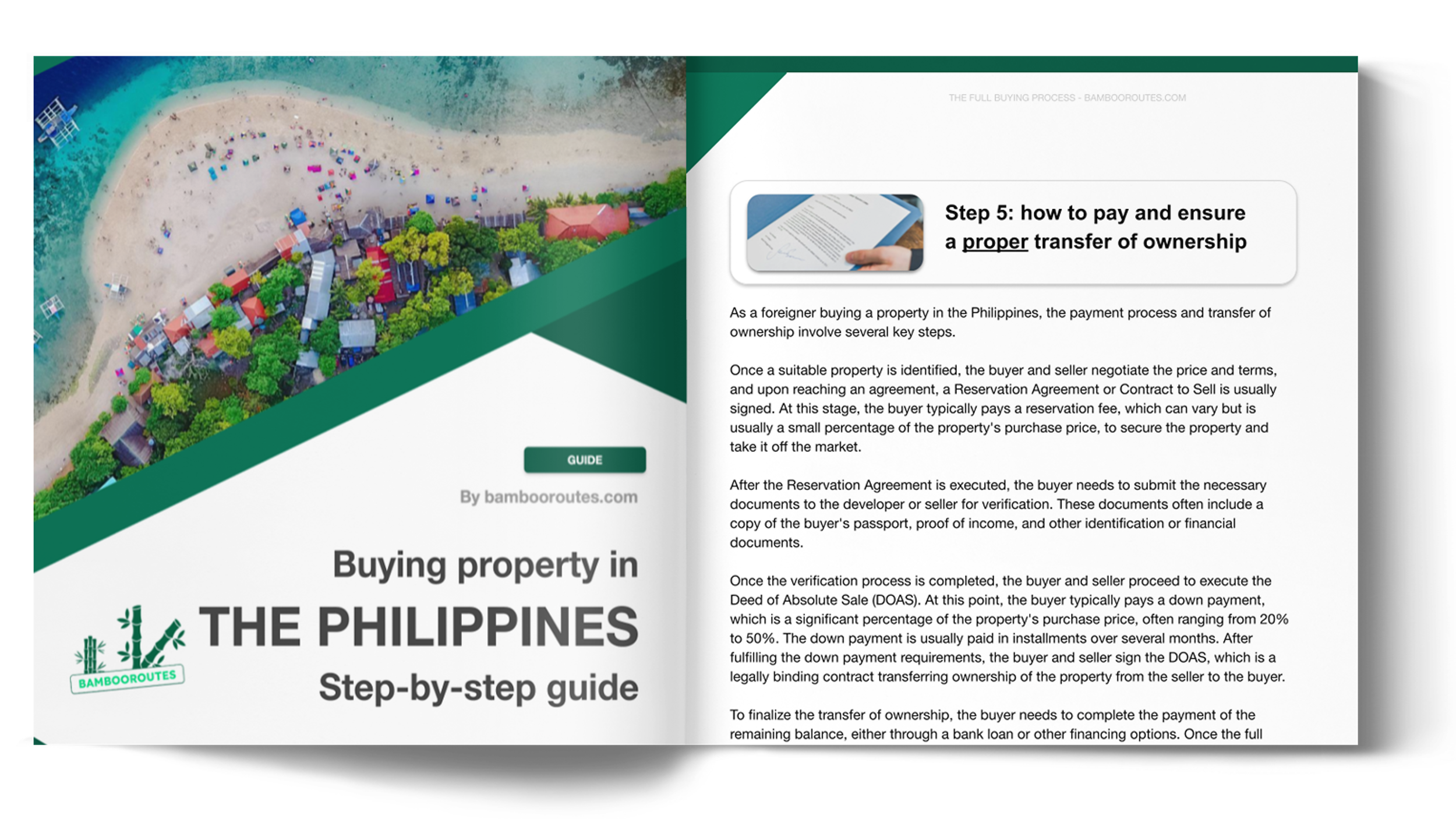
And if you’re planning to buy a property in this place, you may want to download our pack covering the real estate market in Calabarzon.

What can I legally buy and truly own as a foreigner in Calabarzon?
What property types can foreigners legally buy in Calabarzon right now?
In Calabarzon in June 2026, a foreigner can usually buy and own a condominium unit, including an apartment-style condo, a resort condo in Tagaytay or Batangas, or a low-rise condo in Cavite, Laguna, or Rizal.
The main rule is that the condo project must stay within the 40% foreign ownership limit, while land-based homes in Calabarzon are generally not directly ownable by a foreign individual.
This means that a house-and-lot in Cavite, a townhouse with land in Laguna, a villa lot in Tagaytay, a beach lot in Batangas, or a subdivision lot in Rizal is usually not a clean foreigner-owned purchase.
So, for most foreign buyers in Calabarzon, the safest direct ownership path is a properly titled condominium unit with a Condominium Certificate of Title and written confirmation that the foreign quota is still open.
Finally, please note that our pack about the property market in Calabarzon is specifically tailored to foreigners.
Can I own land in my own name in Calabarzon right now?
No, a foreign individual generally cannot own land in their own name in Calabarzon in June 2026, whether the land is in Cavite, Laguna, Batangas, Rizal, or Quezon.
The clearly legal alternative for many ordinary foreign buyers is to buy a condominium unit, because the foreign buyer owns the unit while the land is held through the condominium structure.
Another legal route can be a long-term private land lease, but in Calabarzon this is not the same as owning the land and the newer 99-year investor lease route is mainly for qualifying foreign investors.
By the way, we cover everything there is to know about the land buying process in Calabarzon here.
As of 2026, what other key foreign-ownership rules or limits should I know in Calabarzon?
As of 2026, foreign buyers in Calabarzon should also watch title type, project licensing, foreign quota certificates, tax registration, and whether the property is pre-selling or already titled.
For condos in Calabarzon, the key apartment-style ownership rule is that foreigners can own units only while total foreign ownership in the condominium project stays within the 40% legal ceiling.
The common registration requirement is not a special foreign buyer approval, but the buyer still needs tax, notarization, BIR, Registry of Deeds, and condo corporation paperwork to complete the transfer.
The recent regulatory change that matters in 2026 is Republic Act No. 12252, which expanded long-term private land leases for qualifying foreign investors, but did not turn normal residential land into foreign freehold property.
What’s the biggest ownership mistake foreigners make in Calabarzon right now?
The biggest ownership mistake in Calabarzon is paying for land through a Filipino spouse, partner, friend, employee, or nominee and thinking a private agreement gives the foreigner real land ownership.
If that mistake happens, the foreign buyer may lose control of the property, struggle to recover money, or face a serious legal dispute because the land title is not in the foreign buyer’s name.
Other classic Calabarzon pitfalls include buying a “condo-style” project that is not a true condominium, ignoring the 40% foreign quota, missing a DHSUD License to Sell, and skipping flood, slope, volcano, or access checks.
Get fresh and reliable information about the market in Calabarzon
Don't base significant investment decisions on outdated data. Get updated and accurate information.

Which visa or residency status changes what I can do in Calabarzon?
Do I need a specific visa to buy property in Calabarzon right now?
You do not usually need a special visa to buy a legally permitted condo in Calabarzon in June 2026, and a foreigner can often start the purchase while on a tourist visa.
The common administrative problem is not the visa itself, but practical KYC, bank transfer, notarization, address, and tax registration requirements that can slow down a non-resident buyer.
In practice, a foreign buyer should get a Philippine Tax Identification Number before completion because BIR transfer paperwork normally needs buyer and seller tax details.
A typical foreign buyer document set in Calabarzon includes passport, visa or entry stamp, TIN, proof of address, proof of funds, marital status documents if relevant, and a Special Power of Attorney if someone signs locally.
Does buying property help me get residency and citizenship in Calabarzon in 2026?
As of 2026, buying a condo in Calabarzon does not automatically give a foreigner Philippine residency, permanent residency, or citizenship.
The Philippines has special visa routes such as the Special Resident Retiree’s Visa and the Special Investor’s Resident Visa, but these are separate programs with their own rules.
For most foreign buyers, residency is more likely to come from retirement, investment, marriage, employment, or long-term immigration pathways than from an ordinary condo purchase in Tagaytay, Santa Rosa, Bacoor, Antipolo, or Batangas.
Can I legally rent out property on my visa in Calabarzon right now?
Your visa status usually affects your right to stay in the Philippines, not the basic ability to rent out a legally owned Calabarzon condo and receive Philippine-source rental income.
You do not need to live in the Philippines to rent out a Calabarzon condo, but you need local management for tenants, taxes, repairs, association dues, and emergencies.
The important local detail is that short-term rentals in Tagaytay, Batangas beach towns, Antipolo, and resort-style projects may be limited by condo rules, LGU permits, tourism rules, or building restrictions.
We cover everything there is to know about buying and renting out in Calabarzon here.
Get to know the market before buying a property in Calabarzon
Better information leads to better decisions. Get all the data you need before investing a large amount of money.
How does the buying process actually work step-by-step in Calabarzon?
What are the exact steps to buy property in Calabarzon right now?
The standard Calabarzon purchase sequence is to choose an eligible condo, check foreign quota and title, verify seller and project documents, reserve the unit, get a TIN, sign the contract, complete due diligence, pay through traceable channels, notarize the deed, pay taxes, secure the BIR Certificate Authorizing Registration, register the transfer, and update condo and tax records.
You do not always need to be physically present for every step in Calabarzon because a properly drafted and apostilled or consularized Special Power of Attorney can let a trusted representative sign and process documents.
The step that usually makes the deal legally binding is the signed contract to sell or deed of sale, depending on whether the purchase is developer pre-selling, installment-based, or a completed resale.
A realistic timeline in Calabarzon is about 30 to 90 days for a clean resale condo transfer, and longer for pre-selling units, bank-financed purchases, missing documents, or slow BIR and Registry of Deeds processing.
We have a document entirely dedicated to the whole buying process our pack about properties in Calabarzon.
Is it mandatory to get a lawyer or a notary to buy a property in Calabarzon right now?
A notary is effectively needed for the deed and transfer documents in Calabarzon, while an independent lawyer is not always mandatory but is strongly recommended for foreign buyers.
The notary mainly authenticates the signed document, while the lawyer checks whether the foreign buyer can safely buy, whether the title is clean, and whether the contract protects the buyer.
The lawyer’s scope should clearly include foreign ownership eligibility, condo foreign quota, title annotations, seller authority, tax allocation, handover conditions, and refund rights if the project is pre-selling.
Make a profitable investment in Calabarzon
Better information leads to better decisions. Save time and money. Download our data.
What checks should I run so I don’t buy a problem property in Calabarzon?
How do I verify title and ownership history in Calabarzon right now?
To verify title and ownership history in Calabarzon, use the Land Registration Authority, the relevant Registry of Deeds, and the official Certified True Copy of the title.
For a foreign buyer, the key document is usually the Condominium Certificate of Title for a condo unit, while a Transfer Certificate of Title usually signals land ownership issues for foreign individuals.
A realistic look-back check in Calabarzon is at least the current title plus prior transfers visible in the documents, with deeper review if the property recently changed hands, came from inheritance, or has old annotations.
A red flag that should pause the purchase is any mismatch between the seller, title number, unit description, floor area, annotations, tax declaration, or condo corporation records.
You will find here the list of classic mistakes people make when buying a property in Calabarzon.
How do I confirm there are no liens in Calabarzon right now?
The standard way to check liens in Calabarzon is to read the annotations on the latest Certified True Copy of the title and compare them with seller, bank, tax, and condo corporation clearances.
A common encumbrance to ask about is a bank mortgage, because many Calabarzon condos and homes are bought with financing and the mortgage may still be annotated on the title.
The best written proof is the current Certified True Copy of title, supported by a mortgage release if needed, a real property tax clearance, and a condo dues clearance for condominium units.
How do I check zoning and permitted use in Calabarzon right now?
To check zoning and permitted use in Calabarzon, ask the City or Municipal Planning and Development Office, the Zoning Administrator, and the relevant LGU where the property is located.
The usual document or map reference is the local zoning map or zoning certification based on the city or municipality’s Comprehensive Land Use Plan.
A common Calabarzon pitfall is assuming a unit can be used for Airbnb-style rentals, guesthouse use, or commercial activity when the LGU, condo corporation, subdivision deed restrictions, or tourism rules say otherwise.
Don't buy the wrong property, in the wrong area of Calabarzon
Buying real estate is a significant investment. Don't rely solely on your intuition. Gather the right information to make the best decision.
Can I get a mortgage as a foreigner in Calabarzon, and on what terms?
Do banks lend to foreigners for homes in Calabarzon in 2026?
As of 2026, Philippine banks may lend to foreigners for eligible Calabarzon condo purchases, but approval is much easier with residency, documented income, strong banking history, or a Filipino spouse or co-borrower.
A realistic Calabarzon loan-to-value range is about 40% to 70% for foreign borrowers, with the higher end reserved for strong, well-documented applicants and bank-approved condo projects.
The most common eligibility requirement is stable, verifiable income, because banks need to confirm that the foreign buyer can repay the loan even if the buyer lives or earns outside the Philippines.
You can also read our latest update about mortgage and interest rates in The Philippines.
Which banks are most foreigner-friendly in Calabarzon in 2026?
As of 2026, the three most practical banks to test first for a foreigner mortgage in Calabarzon are BDO, BPI, and Security Bank, with Metrobank, RCBC, Chinabank, and HSBC also worth checking.
What makes these banks more useful is their scale, developer relationships, home-loan operations, and ability to review foreign income or international banking profiles in some cases.
For non-residents without Philippine income, these banks may still review the file, but they usually ask for stronger documents, a larger down payment, and a property that fits their approved collateral rules.
We actually have a specific document about how to get a mortgage as a foreigner in our pack covering real estate in Calabarzon.
What mortgage rates are foreigners offered in Calabarzon in 2026?
As of 2026, a realistic mortgage-rate range for qualified foreign buyers in Calabarzon is about 6.75% to 9.5% per year, depending on borrower strength, fixing period, loan size, and bank relationship.
Fixed-rate offers usually cost more than short fixing or repricing options, but many foreign buyers accept the higher price because predictable payments are easier to manage from abroad.
Get fresh and reliable information about the market in Calabarzon
Don't base significant investment decisions on outdated data. Get updated and accurate information.
What will taxes, fees, and ongoing costs look like in Calabarzon?
What are the total closing costs as a percent in Calabarzon in 2026?
The typical total closing-cost budget in Calabarzon in 2026 is about 7% to 9% of the property value for a standard resale transaction, although the contract decides who pays each item.
A realistic low-to-high range is about 4% to 10%, with the lower end more common for selected developer packages and the higher end more common when seller taxes, legal fees, and transfer costs are not bundled.
The common fee categories are capital gains tax, documentary stamp tax, local transfer tax, registration fees, notarial fees, legal fees, broker fees, condo or association clearances, and move-in or utility charges.
The biggest single contributor is usually the 6% capital gains tax on the higher of selling price, zonal value, or fair market value, even if the seller often pays it in practice.
If you want to go into more details, we also have a blog article detailing all the property taxes and fees in Calabarzon.
What annual property tax should I budget in Calabarzon in 2026?
As of 2026, a normal Calabarzon condo or house buyer should often budget about ₱16,000 to ₱70,000 per year for real property tax, roughly $260 to $1,160 or €250 to €1,080 for many mid-market homes.
Annual property tax in Calabarzon is mainly assessed through a local rate applied to assessed value, so the tax bill is not simply a fixed percentage of the purchase price.
How is rental income taxed for foreigners in Calabarzon in 2026?
As of 2026, a practical foreign landlord in Calabarzon should assume Philippine tax leakage of about 20% to 25% of gross rent unless a tax adviser confirms a different classification or treaty result.
The basic requirement is to report or withhold Philippine-source rental income through the right BIR process, with the exact filing treatment depending on residency, taxpayer classification, lease structure, and whether the rental is passive or business-like.
What insurance is common and how much in Calabarzon in 2026?
As of 2026, a standard Calabarzon home insurance budget is often about ₱6,000 to ₱28,000 per year for a mid-market condo, roughly $100 to $460 or €90 to €430 depending on insured value and coverage.
The most common property insurance is fire insurance with allied perils, and bank-financed buyers are usually required to carry fire cover on the mortgaged property.
The biggest local pricing factor is hazard exposure, because flood-prone parts of Cavite and Laguna, slope areas in Rizal, volcano-related areas near Tagaytay, and coastal areas in Batangas can cost more to insure.
Get to know the market before buying a property in Calabarzon
Better information leads to better decisions. Get all the data you need before investing a large amount of money.
What sources have we used to write this blog article?
Whether it’s in our blog articles or the market analyses included in our property pack about Calabarzon, we always rely on the strongest methodology we can … and we don’t throw out numbers at random.
We also aim to be fully transparent, so below we’ve listed the authoritative sources we used, and explained how we used them and the methods behind our estimates.
| Source used | Why this source is reliable | How we used it |
|---|---|---|
| 1987 Philippine Constitution, Official Gazette | It is the highest legal source for land ownership rules in the Philippines. | We used it to confirm the foreign land-ownership ban. We treated it as the controlling source for Calabarzon land rules. |
| Republic Act No. 4726, Condominium Act | It is the core statute governing condominium ownership in the Philippines. | We used it to explain why condo units can be owned separately. We connected it to the 40% foreign ownership limit. |
| Commonwealth Act No. 108, Anti-Dummy Law | It is the main law used against fake Filipino nominee structures. | We used it to explain nominee risk. We applied it to common Calabarzon spouse, partner, and friend-title arrangements. |
| Republic Act No. 12252 | It is the 2025 law updating long-term private land leases for foreign investors. | We used it to explain the 99-year investor lease reform. We separated investor leases from normal freehold home buying. |
| Board of Investments, RA 12252 Implementing Rules | BOI helps implement the updated investor lease framework. | We used it to confirm that the lease reform had practical rules by 2026. We avoided presenting it as simple land ownership. |
| Land Registration Authority eSerbisyo | LRA is the official land title registration authority. | We used it for Certified True Copy title checks. We also used it to explain how buyers verify liens and ownership. |
| LRA Certified True Copy Guide | It explains the official process for requesting title copies. | We used it to identify the title document buyers should request. We applied it to CCT and TCT checks in Calabarzon. |
| BIR Capital Gains Tax | BIR is the official Philippine tax authority. | We used it to estimate closing costs. We also used it to explain why capital gains tax is a major transfer cost. |
| BIR Documentary Stamp Tax | It is the official source for documentary stamp tax rules. | We used it to include DST in buyer budgets. We combined it with registration and local transfer fee estimates. |
| BIR Primary Registration | It explains taxpayer registration and TIN procedures. | We used it to explain why foreign buyers need a TIN. We connected it to BIR transfer paperwork and title registration. |
| Bureau of Immigration, Visas | It is the Philippine authority for visa and stay categories. | We used it to separate property ownership from immigration status. We avoided treating a condo purchase as automatic residency. |
| Philippine Retirement Authority, SRRV | PRA administers the Special Resident Retiree’s Visa. | We used it to explain one possible residence route. We made clear that SRRV is separate from a normal condo purchase. |
| Board of Investments, SIRV | BOI administers the Special Investor’s Resident Visa process. | We used it to explain investor visa logic. We did not treat ordinary Calabarzon home buying as a SIRV shortcut. |
| Bangko Sentral ng Pilipinas, Key Rates | BSP is the Philippine central bank and sets the policy-rate context. | We used it to anchor 2026 mortgage-rate estimates. We also used its exchange-rate context for simple USD conversions. |
| Philippine Statistics Authority, Calabarzon Population | PSA is the official statistics agency for population data. | We used it to understand why Calabarzon is a large residential market. We connected population demand to subdivisions, townhouses, and condos. |
| DHSUD eServices and Stakeholder Portal | DHSUD regulates housing, subdivision, and condominium projects. | We used it to explain License to Sell checks. We linked it to pre-selling risk in Calabarzon developer projects. |
Make a profitable investment in Calabarzon
Better information leads to better decisions. Save time and money. Download our data.
Related blog posts