
Authored by the expert who managed and guided the team behind the Philippines Property Pack
Everything you need to know before buying real estate is included in our The Philippines Property Pack
Yes, Calabarzon is attracting more foreign buyers every year, thanks to its lower prices compared to Metro Manila and improved expressway connections.
But here is the thing: foreigners cannot legally own land in the Philippines, including anywhere in Calabarzon, and that catches most people by surprise.
We constantly update this blog post to reflect the latest rules, so you always get accurate information.
And if you're planning to buy a property in this place, you may want to download our pack covering the real estate market in Calabarzon.
Insights
- Foreigners in Calabarzon face a constitutional ban on direct land ownership, but can legally own condominium units in buildings where foreign ownership stays below the 40% cap.
- The 2025 amendment to the Investors' Lease Act (RA 12252) now allows foreign investors to lease private land in Calabarzon for up to 99 years for qualifying projects, nearly doubling the previous 75-year maximum.
- Closing costs in Calabarzon typically run 3% to 5% of the purchase price for buyers covering DST, transfer tax, and registration fees, but can reach 8% to 12% if the buyer also shoulders the seller's Capital Gains Tax.
- BIR zonal values in Calabarzon growth corridors like Santa Rosa, Tagaytay, and Silang often exceed negotiated prices, so taxes may be higher than expected based on your contract price alone.
- Common scams in Calabarzon include selling "rights only" properties with just a tax declaration, no Torrens title, which is especially risky along fast-developing corridors in Cavite and Laguna.
- A Special Power of Attorney (SPA) allows foreigners to complete condo purchases or lease signings remotely, but the SPA must be apostilled or consularized abroad before use in Calabarzon.
- Marriage to a Filipino citizen does not grant a foreigner the right to own land in Calabarzon; the land title must still be in the Filipino spouse's name only.
- Ancestral domain lands in Calabarzon, particularly in mountainous areas of Rizal and Quezon, are heavily restricted and often void for sale to non-indigenous buyers.

Can a foreigner legally own land in Calabarzon right now?
Can foreigners own land in Calabarzon in 2026?
As of early 2026, a foreign individual generally cannot legally own land outright anywhere in Calabarzon because the Philippine Constitution reserves land ownership for Filipino citizens and corporations that are at least 60% Filipino-owned.
The specific ban means that if you are a foreign national, you cannot have your name on a Transfer Certificate of Title (TCT) or Original Certificate of Title (OCT) for any lot in Cavite, Laguna, Batangas, Rizal, or Quezon.
The closest legal alternatives for foreigners who want to control property in Calabarzon are long-term leases under the amended Investors' Lease Act (now allowing up to 99 years for qualifying investments), condominium unit ownership where foreign ownership in the building stays below 40%, or buying through a Philippine corporation with at least 60% Filipino shareholders.
There are no nationality-based distinctions that favor one foreign passport over another when it comes to land ownership in Calabarzon; the rule is simply Filipino versus non-Filipino, applied uniformly nationwide.
Can I own a house but not the land in Calabarzon in 2026?
As of early 2026, there is no widespread legal framework in Calabarzon that lets a foreigner own a standalone house on land they do not also control, because most residential properties come as "house and lot" packages tied to a single land title.
What foreigners typically do instead is own a building or improvements on land they have leased long-term, and in that case the lease contract (not a land title) documents your right to use the property, while any structures you build can be registered separately via tax declarations at the local assessor's office.
When the underlying land lease expires in Calabarzon, your building ownership becomes complicated because you lose the right to occupy the land, meaning you would need to negotiate a renewal with the landowner, remove the structure, or sell your improvements before the lease ends.
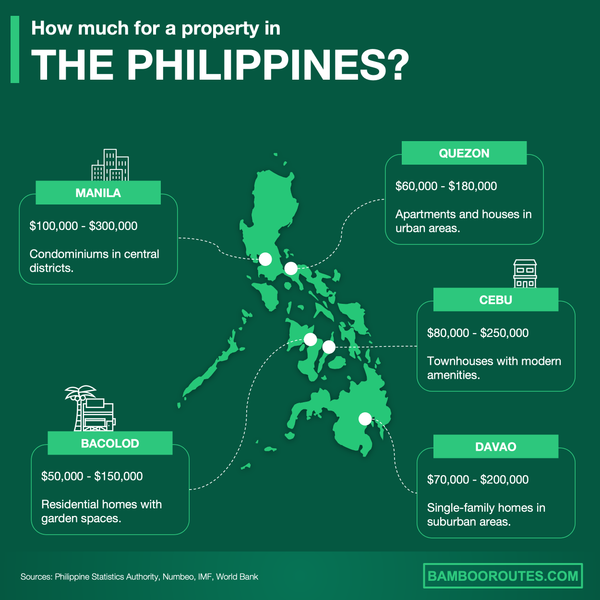
We created this infographic to give you a simple idea of how much it costs to buy property in different parts of the Philippines. As you can see, it breaks down price ranges and property types for popular cities in the country. We hope this makes it easier to explore your options and understand the market.
Do rules differ by region or city for land ownership in Calabarzon right now?
The constitutional ban on foreign land ownership applies identically across all five Calabarzon provinces (Cavite, Laguna, Batangas, Rizal, and Quezon), so there is no city or municipality in the region where foreigners can bypass the restriction.
What does differ significantly between Calabarzon localities are local transfer tax rates and processing timelines at registries of deeds, with cities generally charging up to 0.75% transfer tax while provincial municipalities often cap at 0.5%.
These local variations exist because the Local Government Code gives each LGU authority to set rates within national ceilings, so your closing costs may shift depending on whether your property is in a highly urbanized city like Antipolo or a provincial municipality like Tanauan in Batangas.
We cover a lot of different regions and cities in our pack about the property market in Calabarzon.
Can I buy land in Calabarzon through marriage to a local in 2026?
As of early 2026, marriage to a Filipino citizen does not grant you the legal right to own land in Calabarzon because the constitutional restriction is based on citizenship, not marital status.
What typically happens in practice is the land title goes solely in your Filipino spouse's name, and you should have proper documentation such as a prenuptial agreement or postnuptial contract that clarifies financial contributions, though these do not override the ownership ban.
If the marriage ends in divorce or annulment in Calabarzon, the foreign spouse has no direct claim to the land title itself, and any informal side agreements attempting to give you "real" ownership could be challenged or voided as prohibited circumvention.
There is a lot of mistakes you can make, we cover 99% of them in our list of risks and pitfalls people face when buying property in Calabarzon.
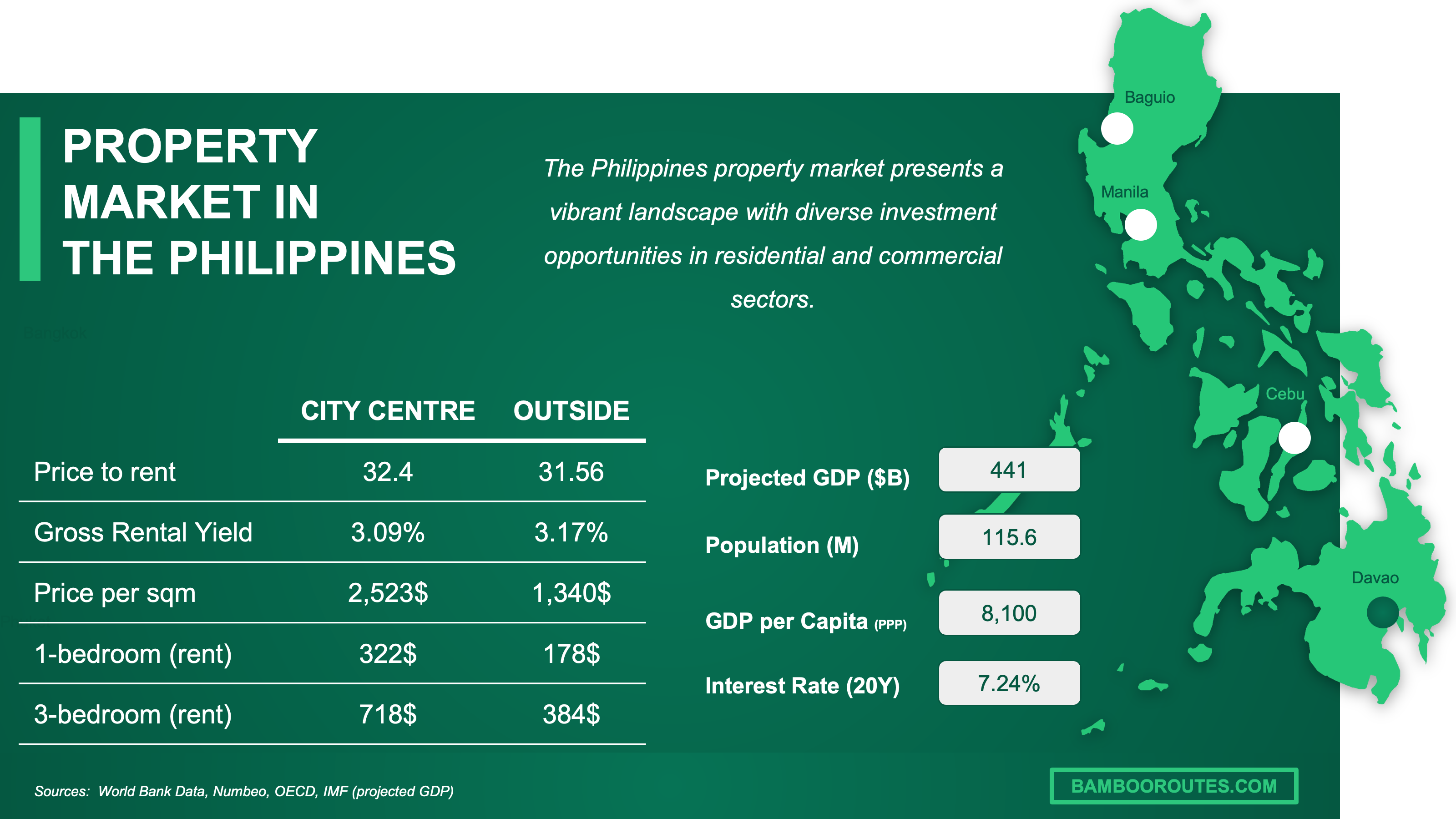
We have made this infographic to give you a quick and clear snapshot of the property market in the Philippines. It highlights key facts like rental prices, yields, and property costs both in city centers and outside, so you can easily compare opportunities. We’ve done some research and also included useful insights about the country’s economy, like GDP, population, and interest rates, to help you understand the bigger picture.
What eligibility and status do I need to buy land in Calabarzon?
Do I need residency to buy land in Calabarzon in 2026?
As of early 2026, residency status in the Philippines does not help you overcome the foreign land ownership ban in Calabarzon, because the qualifier is citizenship, not how long you have lived in the country.
For transactions you are legally allowed to do, such as buying a condo unit or signing a long-term lease, no specific visa type is required to complete the deal, though having a valid passport and proper documentation is essential for notarization and registration.
Yes, it is legally possible for a foreigner to buy a condo or sign a lease in Calabarzon remotely without being physically present, as long as you execute a properly apostilled or consularized Special Power of Attorney (SPA) that authorizes a representative to sign on your behalf.
Do I need a local tax number to buy lands in Calabarzon?
In practice, yes, you should expect to need a Philippine Tax Identification Number (TIN) to complete any property transaction in Calabarzon because the BIR requires tax forms for closing, and registries will ask for your TIN during title transfers.
Getting a TIN as a foreigner in Calabarzon typically involves visiting a BIR Revenue District Office with your passport and filling out BIR Form 1904, a process that can take one to three weeks depending on the office workload.
While not strictly required by law for every transaction, opening a local Philippine bank account makes property purchases in Calabarzon much smoother because you can easily pay taxes, document fund sources, and avoid the complications of large cash transactions.
Is there a minimum investment to buy land in Calabarzon as of 2026?
As of early 2026, there is no minimum investment amount that would allow a foreigner to buy land directly in Calabarzon because the issue is legal qualification based on citizenship, not how much money you are willing to spend.
For the legal alternatives such as condo units or long-term leases, there is also no government-mandated minimum, though developers in Calabarzon typically set their own reservation fees and payment terms that vary by project and location.
Are there restricted zones foreigners can't buy in Calabarzon?
Since foreigners generally cannot buy any land in Calabarzon, the practical question becomes which zones you must avoid even when leasing or buying other property rights.
The main restricted categories in Calabarzon include ancestral domains recognized under IPRA (common in mountainous Rizal and Quezon), agrarian reform lands under CARP that carry transfer restrictions, and protected forestlands or untitled public lands often marketed with only tax declarations.
To verify whether a specific plot in Calabarzon falls within a restricted zone, you should check with the National Commission on Indigenous Peoples (NCIP) for ancestral domain status, the Department of Agrarian Reform for CLOA restrictions, and the DENR for land classification.
Can foreigners buy agricultural, coastal or border land in Calabarzon right now?
Foreigners cannot legally own agricultural, coastal, or border land in Calabarzon because the constitutional ban applies to all private land regardless of its classification or location.
Agricultural land in Calabarzon carries extra complications because much of it falls under Comprehensive Agrarian Reform Program (CARP) coverage, meaning even Filipinos face restrictions on selling or converting these lots for years after receiving titles.
Coastal land in Batangas areas like Nasugbu, Lian, and Calatagan is particularly risky because many "beach lots" have messy paperwork involving easement issues, foreshore claims, or informal subdivisions that are not properly titled.
Border land restrictions are less relevant in Calabarzon since the region is not near international borders, but you should still verify that any lot you consider has a clean Torrens title and not just a tax declaration or possessory rights claim.
Get fresh and reliable information about the market in Calabarzon
Don't base significant investment decisions on outdated data. Get updated and accurate information with our guide.

What are the safest legal structures to control land in Calabarzon?
Is a long-term lease equivalent to ownership in Calabarzon right now?
A long-term lease in Calabarzon gives you control-by-contract over land, not ownership-by-title, so it is the closest practical substitute for foreigners but definitely not the same as having your name on a TCT.
As of early 2026, the amended Investors' Lease Act (RA 12252) allows foreign investors with approved and registered projects to lease private land in Calabarzon for up to 99 years, and lease rights can often be renewed, extended, or assigned if properly drafted into your contract.
Yes, a foreigner can typically sell, transfer, or bequeath lease rights in Calabarzon to another party if the lease contract includes clear assignment clauses and the landowner's consent requirements are met, making transferability one of the most important features to negotiate upfront.
Can I buy land in Calabarzon via a local company?
You can only safely hold land in Calabarzon through a Philippine corporation if that company genuinely maintains at least 60% Filipino ownership and control, because the constitutional rule requires real compliance, not just paper arrangements.
The shareholding structure must show Filipinos owning at least 60% of both voting and non-voting shares, and Filipinos must truly control the board of directors, because arrangements where nominees hold shares for foreigners are illegal under the Anti-Dummy Law and increasingly targeted by regulators.
What "grey-area" ownership setups get foreigners in trouble in Calabarzon?
Grey-area ownership arrangements are unfortunately common in Calabarzon's fast-growing property corridors, particularly in Cavite and Laguna where intense demand tempts both buyers and sellers to cut corners.
The most common problematic setups include nominee ownership (where a Filipino holds the title with side agreements giving you "real" control), simulated mortgages or back-to-back deeds meant to transfer ownership later, and buying mere "rights" backed only by tax declarations without any Torrens title.
If Philippine authorities discover you are using an illegal ownership structure in Calabarzon, consequences can include nullification of the sale, forfeiture of the property to the state, and potential criminal liability under the Anti-Dummy Law, leaving you with no legal recourse to recover your money.
By the way, you can avoid most of these bad surprises if you go through our pack covering the property buying process in Calabarzon.
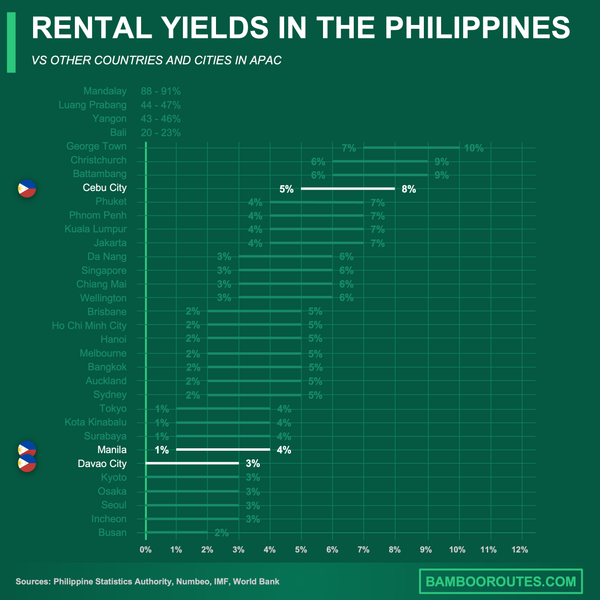
We did some research and made this infographic to help you quickly compare rental yields of the major cities in the Philippines versus those in neighboring countries. It provides a clear view of how this country positions itself as a real estate investment destination, which might interest you if you’re planning to invest there.
How does the land purchase process work in Calabarzon, step-by-step?
What are the exact steps to buy land in Calabarzon right now?
Because foreigners cannot hold land title in Calabarzon, the step-by-step process here applies to legal alternatives like condo purchases or lease arrangements: first identify what is being sold (titled lot, condo unit, or rights only), then verify the title via a Certified True Copy from LRA, check for encumbrances and the seller's authority, review BIR zonal values for tax budgeting, draft the appropriate contract, and finally complete registration through BIR, LGU, and Registry of Deeds.
A typical clean transaction in Calabarzon takes roughly 6 to 12 weeks from initial agreement to final registration, though complications like missing tax clearances, estate settlement issues, or title problems can extend the timeline to 3 to 6 months or longer.
The key documents you will sign during a property transaction in Calabarzon include the Deed of Absolute Sale (for condo purchases) or Long-Term Lease Contract (for land control), plus various BIR forms for Capital Gains Tax and Documentary Stamp Tax, the Certificate Authorizing Registration (CAR), and the new title transfer paperwork at the Registry of Deeds.
What scams are common when it comes to buying land in Calabarzon right now?
What scams target foreign land buyers in Calabarzon right now?
Scams targeting foreign buyers are relatively common in Calabarzon's high-growth areas, particularly along the Cavite-Laguna corridor where rapid development attracts both legitimate sellers and fraudsters.
The most frequent scams include selling "tax declaration only" land as if it were titled, double-selling the same property to multiple buyers, using forged or fake titles, offering "rights" to untitled land, and promising that putting land directly in a foreigner's name is "no problem" when it is actually illegal.
The top warning signs that a Calabarzon land deal may be fraudulent are: the seller refuses to provide a Certified True Copy of the title from LRA, the price seems too good to be true compared to market rates, or the seller pressures you to close quickly without proper due diligence.
If you fall victim to a land scam in Calabarzon, legal recourse exists through the Philippine court system, but cases can drag on for years and recovering money is difficult, which is why prevention through proper due diligence is far more effective than litigation.
We cover all these things in length in our pack about the property market in Calabarzon.
How do I verify the seller is legit in Calabarzon right now?
The best way to verify that a land seller is legitimate in Calabarzon is to match their government-issued IDs to the name on the Certified True Copy (CTC) of the title, and if they claim to represent the owner, demand to see an authenticated Special Power of Attorney.
To confirm the title is clean in Calabarzon, you must obtain a CTC from the Registry of Deeds (available online via LRA eSerbisyo) and carefully read the annotations section for any mortgages, adverse claims, lis pendens, or other encumbrances.
You can check for existing liens or debts by reviewing the title annotations and also visiting the local Treasurer's Office to verify that Real Property Tax (RPT) is current, because unpaid taxes can become your problem after purchase.
The most essential professional for verifying seller legitimacy in Calabarzon is a licensed real estate lawyer who can conduct thorough due diligence, review contracts, and flag legal issues before you commit money.
How do I confirm land boundaries in Calabarzon right now?
The standard procedure for confirming land boundaries in Calabarzon before purchase is to hire a licensed Geodetic Engineer to conduct a relocation survey that compares the actual lot corners to the technical description on the title.
You should review the title's technical description, any approved subdivision plans filed with the Land Management Bureau, and the lot's tax declaration map at the local Assessor's Office to verify boundaries in Calabarzon.
Hiring a licensed surveyor is strongly recommended (and often required by lenders) for boundary verification in Calabarzon, especially for lots outside master-planned communities where fences and "understood" boundaries may not match official records.
Common boundary problems foreign buyers encounter in Calabarzon include discovering that existing fences encroach on or are encroached by neighbors, finding that the lot is smaller than stated due to road widening or easement issues, and learning that informal subdivisions created irregular lots that do not match any approved plan.
Buying real estate in Calabarzon can be risky
An increasing number of foreign investors are showing interest. However, 90% of them will make mistakes. Avoid the pitfalls with our comprehensive guide.

What will it cost me, all-in, to buy and hold land in Calabarzon?
What purchase taxes and fees apply in Calabarzon as of 2026?
As of early 2026, the total closing costs for a property transaction in Calabarzon typically range from 8% to 12% of the higher of the selling price, BIR zonal value, or assessed fair market value, when combining both buyer and seller obligations.
If you are the buyer covering only the standard buyer-side costs (DST, local transfer tax, registration fees, notarial fees), expect to pay roughly 3% to 5% of the property value; for a PHP 5 million condo, that translates to approximately PHP 150,000 to PHP 250,000 (around USD 2,700 to USD 4,500 or EUR 2,500 to EUR 4,100).
The main individual costs in Calabarzon are: Capital Gains Tax at 6% (typically seller), Documentary Stamp Tax at 1.5% (typically buyer), Local Transfer Tax at 0.5% to 0.75% depending on the LGU, plus Registry of Deeds registration fees that vary by property value and notarial fees of around PHP 20,000 to PHP 50,000 (USD 360 to USD 900 or EUR 330 to EUR 820).
These taxes and fees apply equally to foreign and local buyers in Calabarzon, with no additional surcharges or different rates based on your nationality.
What hidden fees surprise foreigners in Calabarzon most often?
Hidden fees in Calabarzon typically add an extra 1% to 3% on top of expected closing costs, with surprises ranging from PHP 50,000 to PHP 200,000 (USD 900 to USD 3,600 or EUR 820 to EUR 3,300) depending on the property and location.
The most common hidden fees that catch foreigners off guard in Calabarzon are: taxes computed on BIR zonal values that exceed your negotiated price, unpaid Real Property Tax arrears the buyer gets pressured to settle, relocation survey costs for lots outside subdivisions, and developer "miscellaneous fees" for processing, move-in deposits, or association dues.
These hidden fees typically appear at different stages: zonal value surprises emerge when you file with BIR, RPT arrears surface during title transfer at the Registry of Deeds, and developer fees often hit at turnover for pre-selling or newly completed units.
To protect yourself from unexpected fees in Calabarzon, always check BIR zonal values early in your due diligence, request a Real Property Tax clearance before signing, get a detailed breakdown of all developer charges in writing, and budget at least 10% above listed costs for contingencies.

We made this infographic to show you how property prices in the Philippines compare to other big cities across the region. It breaks down the average price per square meter in city centers, so you can see how cities stack up. It’s an easy way to spot where you might get the best value for your money. We hope you like it.
What sources have we used to write this blog article?
Whether it's in our blog articles or the market analyses included in our property pack about Calabarzon, we always rely on the strongest methodology we can and we don't throw out numbers at random.
We also aim to be fully transparent, so below we've listed the authoritative sources we used, and explained how we used them and the methods behind our estimates.
| Source | Why It's Authoritative | How We Used It |
|---|---|---|
| 1987 Philippine Constitution (Lawphil) | The primary legal text that establishes foreign land ownership restrictions. | We used it to anchor the constitutional ban on foreign ownership. We treated all alternatives as workarounds that must respect this foundational rule. |
| Supreme Court E-Library (Article XII) | Official judiciary mirror of constitutional provisions courts rely on. | We used it to verify exact phrasing of land transfer restrictions. We cross-checked against Lawphil to avoid transcription errors. |
| Republic Act 12252 (2025 Lease Act Amendment) | The newest controlling law on long-term leasing by foreigners. | We used it to explain the updated 99-year lease maximum. We warned readers to distinguish lease rights from actual ownership. |
| Condominium Act (RA 4726) | The statute that makes condo ownership the cleanest foreign path. | We used it to explain why condos work for foreigners. We clarified the 40% foreign ownership cap and what it means in practice. |
| Bureau of Internal Revenue (BIR) | The national tax authority's official reference for property taxes. | We used it to anchor CGT, DST, and zonal value discussions. We translated BIR rules into practical percentage budgets for buyers. |
| Local Government Code (RA 7160) | Main statute for local transfer tax authority and rate ceilings. | We used it to explain why transfer tax rates vary across Calabarzon. We applied this to province versus city distinctions. |
| Land Registration Authority (LRA) eSerbisyo | Official online channel for title verification requests. | We used it to recommend the safest way to verify titles remotely. We built our verification checklist around certified copies, not photos. |
| DHSUD (Housing Regulator) | National housing regulator for developer licensing. | We used it for warnings about unlicensed subdivision sellers. We pointed buyers to DHSUD checks for developer legitimacy. |
| National Commission on Indigenous Peoples (NCIP) | Official agency for ancestral domain restrictions. | We used it to flag ancestral land as a restricted category. We translated this into an easy red flag for foreign buyers in Calabarzon. |
| Bamboo Routes Calabarzon Analysis | Specialized research on Calabarzon real estate markets. | We used it for local market context and area-specific risks. We incorporated their pricing data and growth corridor analysis. |
Get the full checklist for your due diligence in Calabarzon
Don't repeat the same mistakes others have made before you. Make sure everything is in order before signing your sales contract.
Related blog posts