
Authored by the expert who managed and guided the team behind the Philippines Property Pack
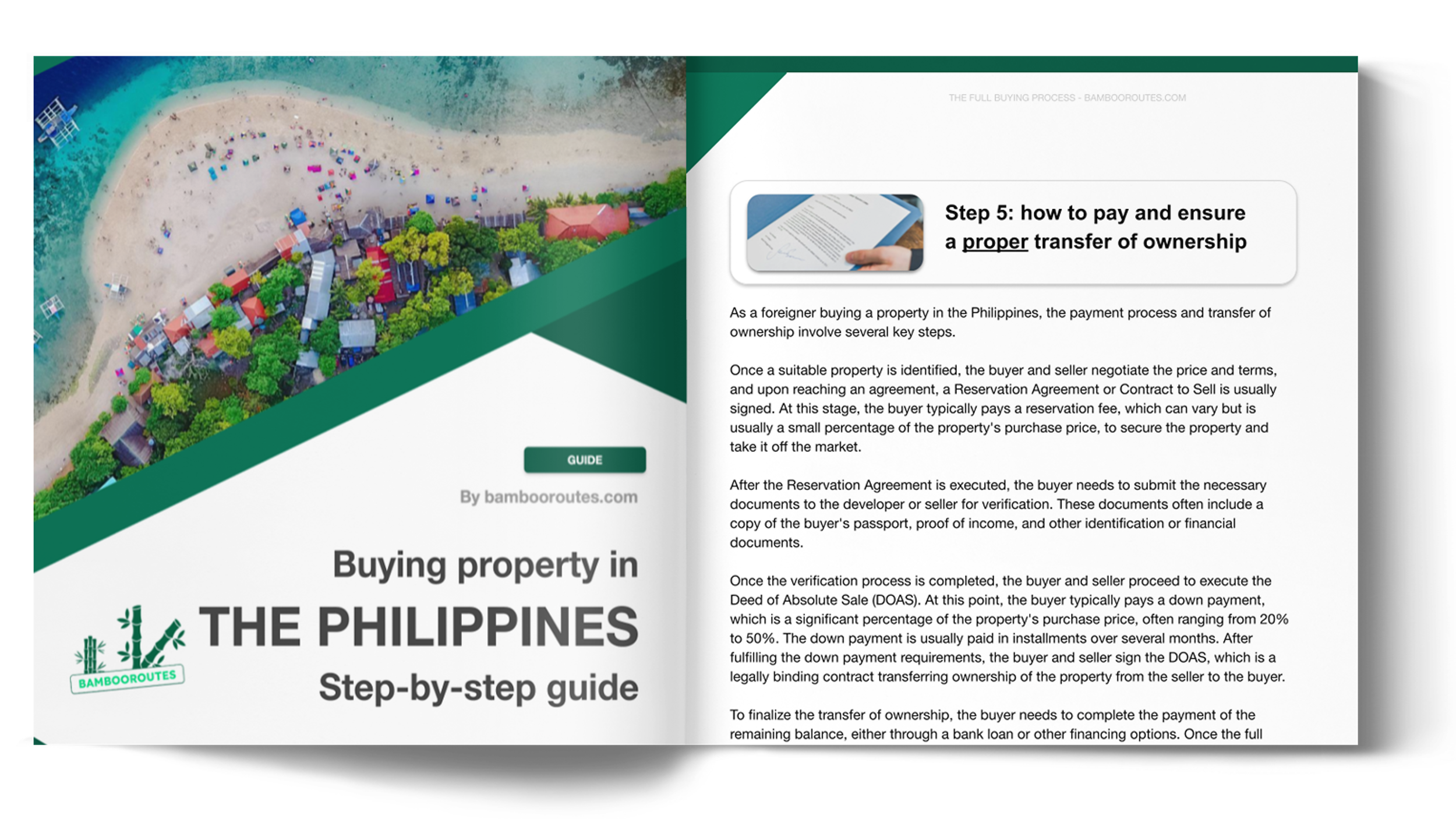
Everything you need to know before buying real estate is included in our The Philippines Property Pack
In this guide, we break down the current housing prices in The Philippines at every budget level, from $100k all the way to luxury, so you know exactly what your money can buy in 2026.
We constantly update this blog post with the latest market data, exchange rates, and neighborhood pricing, so the numbers you see always reflect what is actually happening on the ground.
Whether you are a foreigner exploring your first purchase or comparing cities like Manila, Cebu, and Davao, this is designed to save you hours of confusing research.
And if you're planning to buy a property in this place, you may want to download our pack covering the real estate market in The Philippines.

What can I realistically buy with $100k in The Philippines right now?
Are there any decent properties for $100k in The Philippines, or is it all scams?
Yes, $100,000 (about 5.9 million pesos at the early 2026 exchange rate of roughly 59 PHP per dollar) can buy you a decent, legitimate condo unit in The Philippines, though as a foreigner your realistic option is almost always a condominium because Philippine law does not allow foreigners to own land directly.
The best value for a $100k budget in The Philippines tends to be in "fringe CBD" neighborhoods of Metro Manila like Cubao and Commonwealth in Quezon City, the Boni area in Mandaluyong, or Ortigas fringe zones in Pasig, and also in Cebu City neighborhoods like Lahug and the IT Park vicinity, or Davao City areas like Bajada, Lanang, and Matina, where your peso stretches further than in the traditional business districts.
Buying in the most popular upscale areas of The Philippines like Makati CBD, BGC in Taguig, or Rockwell for $100k is technically possible but it means accepting a very small micro-studio (under 25 square meters), an older building, or a fringe pocket just outside the prime streets, because per-square-meter prices in those premium locations easily reach 300,000 to 450,000 pesos, which pushes anything comfortable well above the 5.9 million peso mark.
What property types can I afford for $100k in The Philippines (studio, land, old house)?
For $100,000 (about 5.9 million pesos) in The Philippines, a foreign buyer can realistically afford a studio or small one-bedroom condo of roughly 25 to 40 square meters in a mainstream Metro Manila neighborhood, or a slightly larger unit of 35 to 55 square meters in Cebu City or Davao City, but direct land or house-and-lot purchases are generally off the table for foreigners because the Philippine Constitution restricts foreign land ownership.
At this price point in The Philippines, expect a mix of older buildings (5 to 15 years old) and basic finishes, and budget around 150,000 to 600,000 pesos for a light renovation like paint, fixtures, and a kitchen or bathroom refresh, or more if the unit has serious plumbing or electrical issues.
For long-term value at the $100k level in The Philippines, a condo unit in a well-managed building near a transit line or business district (like Cubao in Quezon City or the Ortigas fringe in Pasig) tends to hold its resale appeal better than a cheaper unit in an oversupplied or poorly maintained tower, because building management and commute access are the two things Filipino renters and buyers consistently pay a premium for.
What's a realistic budget to get a comfortable property in The Philippines as of 2026?
As of early 2026, the realistic minimum budget to get a comfortable condo as a foreigner in The Philippines is roughly 8.9 million pesos ($150,000 or about 138,000 euros) in Metro Manila, around $120,000 in Cebu City, or around $100,000 in Davao City, because below those levels you are constantly making trade-offs between size, location, and building quality.
Most foreign buyers in The Philippines who want a solid one-bedroom or small two-bedroom in a decent neighborhood end up spending between 8.9 and 14.8 million pesos ($150,000 to $250,000, or roughly 138,000 to 230,000 euros) in Metro Manila, and proportionally a bit less in Cebu and Davao, which is the range where you stop compromising on the basics.
"Comfortable" in The Philippines in 2026 generally means a condo of at least 35 to 50 square meters with reliable building management, working amenities (pool, gym, security), air conditioning in every room, and a location within reasonable commuting distance of a business district, a hospital, and everyday shopping.
That said, the budget can vary dramatically depending on the neighborhood in The Philippines: in Makati CBD or BGC, "comfortable" might start at $200,000 or more, while in Quezon City or Mandaluyong you can reach a similar comfort level for $130,000 to $160,000, and in Davao City you might feel genuinely comfortable from $100,000 onward.
Get fresh and reliable information about the market in the Philippines
Don't base significant investment decisions on outdated data. Get updated and accurate information with our guide.

What can I get with a $200k budget in The Philippines as of 2026?
What "normal" homes become available at $200k in The Philippines as of 2026?
As of early 2026, $200,000 (about 11.8 million pesos) is where "normal" living finally becomes available for foreign condo buyers in The Philippines, meaning a proper one-bedroom or compact two-bedroom unit in a building with decent amenities, in a neighborhood where daily life feels convenient rather than a constant compromise.
In Metro Manila, 11.8 million pesos typically gets you a condo of roughly 35 to 60 square meters depending on whether you pick a CBD-fringe area like Ortigas or a secondary location like Eastwood in Quezon City, while in Cebu City you can expect around 45 to 75 square meters and in Davao City around 55 to 90 square meters, because price per square meter drops significantly once you leave Metro Manila.
By the way, we have much more granular data about housing prices in our property pack about The Philippines.
What places are the smartest $200k buys in The Philippines as of 2026?
As of early 2026, the smartest $200k buys in The Philippines are in Metro Manila areas like Pasig (Ortigas fringe, Kapitolyo), Quezon City (Cubao, Katipunan fringe, Eastwood vicinity), and Mandaluyong (Boni, Pioneer area), plus Cebu City's IT Park and Lahug, and Davao City's Bajada and Lanang districts.
What makes these areas smarter than other $200k options in The Philippines is their combination of strong commute access to business districts, relatively stable rental demand, and a building stock that is newer and better-managed than what you find in cheaper neighborhoods, without the premium pricing of top-tier CBDs.
The main growth driver in these smart-buy areas of The Philippines right now is the oversupply pressure in Metro Manila's most expensive condo pockets, which is pushing price-conscious buyers and renters toward these better-value districts, while upcoming infrastructure projects like new MRT extensions and expressway links continue to improve connectivity and lift property values in these "fringe but functional" zones.
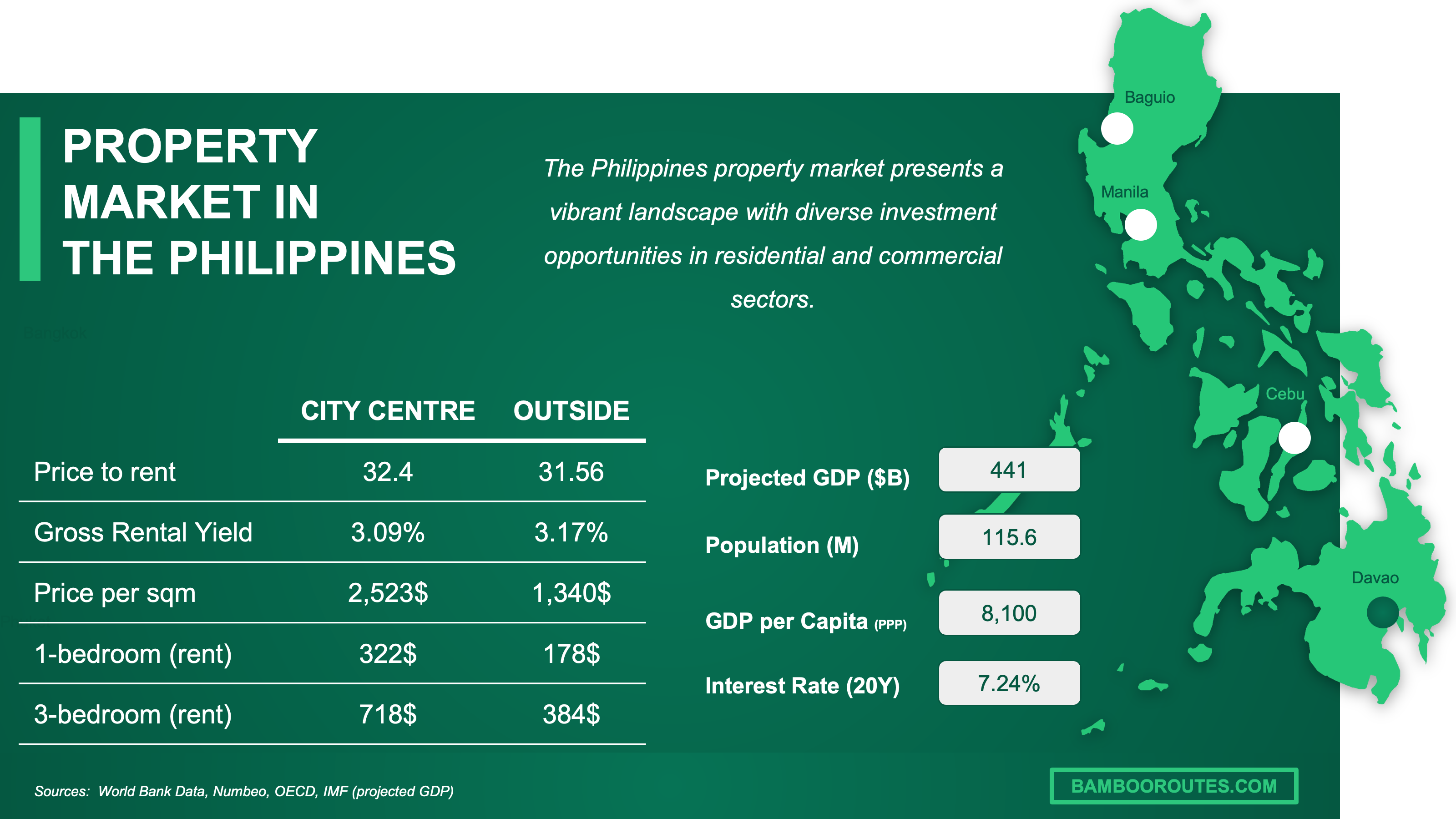
We have made this infographic to give you a quick and clear snapshot of the property market in the Philippines. It highlights key facts like rental prices, yields, and property costs both in city centers and outside, so you can easily compare opportunities. We’ve done some research and also included useful insights about the country’s economy, like GDP, population, and interest rates, to help you understand the bigger picture.
What can I buy with $300k in The Philippines in 2026?
What quality upgrade do I get at $300k in The Philippines in 2026?
As of early 2026, the jump from $200k to $300k (from 11.8 million to about 17.7 million pesos) in The Philippines is where you typically move from "good enough" to "genuinely comfortable," because the extra budget lets you choose a newer building, a larger layout (often a proper two-bedroom), and a better-managed development with stronger amenities.
Yes, $300k can absolutely buy a property in a newer building in The Philippines right now, especially in fringe-CBD areas like Pasig, Mandaluyong, and Quezon City, and in many parts of Cebu City, where recent completions and ready-for-occupancy developer promotions have made newer stock more accessible than usual.
At this budget, typical upgrades include better kitchen and bathroom finishes, a proper balcony, a separate dining area, reliable building amenities like a gym, pool, and function rooms, and a condo corporation that actually maintains common areas, which matters a lot for foreigners who may not be living in The Philippines full-time and need the building to run smoothly without their constant attention.
Can $300k buy a 2-bedroom in The Philippines in 2026 in good areas?
As of early 2026, $300,000 (about 17.7 million pesos) can very realistically buy a 2-bedroom condo in good areas of The Philippines, and in many submarkets outside ultra-premium CBDs, this is exactly the price point where decent 2-bedroom options start to become widely available.
Specific good areas in The Philippines where a $300k two-bedroom works well include Ortigas Center and Kapitolyo in Pasig, the Pioneer and Boni areas of Mandaluyong, the Cubao and Eastwood vicinity in Quezon City, IT Park and Lahug in Cebu City, and Lanang and Bajada in Davao City.
A $300k two-bedroom in these areas of The Philippines typically offers 50 to 75 square meters in Metro Manila (about 540 to 810 square feet), and can be even larger in Cebu or Davao, which is enough space for a couple or a small family to live without feeling cramped.
Which places become "accessible" at $300k in The Philippines as of 2026?
At $300,000 (about 17.7 million pesos) in The Philippines, the neighborhoods that become newly accessible include Makati fringe pockets like the San Antonio Village area, non-BGC parts of Taguig with good access to the business district, the edges of Ortigas Center, and higher-tier buildings in Cebu's Banilad and premium IT Park towers.
What makes these newly accessible areas more desirable than what is available at lower budgets in The Philippines is that they sit much closer to the country's biggest employment hubs, best hospitals, and most established retail and dining scenes, which translates into stronger rental demand and faster resale if you ever want to exit.
In these newly accessible areas of The Philippines, $300k typically buys a well-finished one-bedroom to compact two-bedroom condo in a mid-rise or high-rise building with a branded developer pedigree, good building management, and the kind of walkable surroundings that premium tenants actively seek out.
By the way, we've written a blog article detailing what are the current best areas to invest in property in the Philippines.
Get to know the market before buying a property in the Philippines
Better information leads to better decisions. Get all the data you need before investing a large amount of money. Download our guide.
What does a $500k budget unlock in The Philippines in 2026?
What's the typical size and location for $500k in The Philippines in 2026?
As of early 2026, $500,000 (about 29.5 million pesos) in The Philippines typically buys a spacious two-bedroom or full three-bedroom condo of 80 to 120 square meters (860 to 1,290 square feet) in strong Metro Manila locations like Ortigas Center, Mandaluyong, or Quezon City, and can reach even larger sizes in Cebu City or Davao City where prices per square meter are lower.
For foreigners in The Philippines, a true family home with a yard and outdoor space at $500k is legally tricky because it almost always involves land ownership, which the Constitution restricts, but you can get the next best thing: a large condo with a terrace or balcony, or a penthouse-type unit with outdoor living space that does not require you to own land directly.
At this budget in The Philippines, two bedrooms with two bathrooms is very standard, and three bedrooms with two bathrooms becomes realistic in many strong but not ultra-luxury neighborhoods, giving enough room for a family with children or for a buyer who wants a dedicated home office.
Finally, please note that we cover all the housing price data in the Philippines here.
Which "premium" neighborhoods open up at $500k in The Philippines in 2026?
At $500,000 (about 29.5 million pesos) in The Philippines, the premium neighborhoods that open up include BGC (Bonifacio Global City) in Taguig, Makati CBD, Rockwell Center in Makati, Ortigas Center proper in Pasig, Banilad and Cebu Business Park in Cebu City, and the Lanang premium corridor in Davao City.
What makes these neighborhoods considered premium in The Philippines is their concentration of multinational offices, top-tier international schools and hospitals, high-end retail and dining, strong 24/7 security, well-maintained streetscapes, and the kind of walkability that is rare in most other parts of the country.
For $500k in these premium neighborhoods of The Philippines, buyers can realistically expect a well-finished one-bedroom to two-bedroom condo of 50 to 90 square meters in a newer, branded-developer tower (like Ayala Land, Rockwell, or Megaworld projects), often with high-floor views, a parking slot, and resort-style amenities.
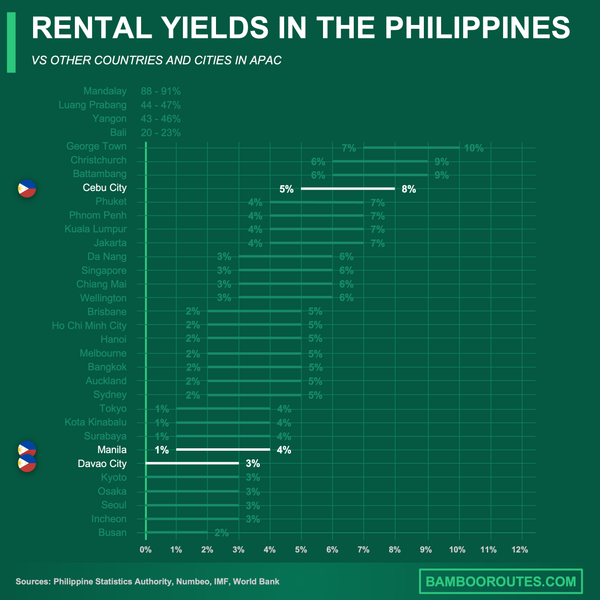
We did some research and made this infographic to help you quickly compare rental yields of the major cities in the Philippines versus those in neighboring countries. It provides a clear view of how this country positions itself as a real estate investment destination, which might interest you if you’re planning to invest there.
What counts as "luxury" in The Philippines in 2026?
At what amount does "luxury" start in The Philippines right now?
In The Philippines in 2026, properties start being considered luxury at roughly 25 million pesos (about $425,000 or 390,000 euros) and above, which is the point where you consistently get premium finishes, branded-developer buildings, and prime addresses in Metro Manila's most sought-after districts.
What defines the entry point to luxury real estate in The Philippines is not just price but a combination of top-tier building management, branded developer names like Rockwell or Ayala Land Premier, concierge services, imported finishes, high-speed elevators, resort-grade amenities, and locations within walking distance of the best restaurants, hospitals, and international schools in Metro Manila.
Compared to luxury thresholds in cities like Bangkok, Kuala Lumpur, or Jakarta, the luxury entry point in The Philippines is broadly similar in dollar terms, though Manila's ultra-luxury stock in places like Rockwell can rival pricing you would see in much more expensive Asian cities.
For mid-tier luxury in The Philippines, expect to pay 25 to 60 million pesos ($425,000 to $1 million, or roughly 390,000 to 920,000 euros), and for ultra-luxury or trophy properties in Rockwell, top BGC towers, or the most exclusive Makati developments, prices typically start at 60 million pesos ($1 million or about 920,000 euros) and can reach well above 200 million pesos.
Which areas are truly high-end in The Philippines right now?
The truly high-end neighborhoods in The Philippines right now are Rockwell Center in Makati (home to The Proscenium and other ultra-premium towers), BGC (Bonifacio Global City) in Taguig, the traditional Makati CBD around Ayala Avenue and Legazpi Village, and, increasingly, the most exclusive new developments in Ortigas Center and select resort-branded projects in Boracay and Panglao (Bohol).
What makes these areas truly high-end in The Philippines is not just the price tag but the combination of extremely limited land supply, developer-curated master planning, world-class retail (like Rockwell's Power Plant Mall), proximity to top-tier healthcare and international schools, and the perception of exclusivity that Filipino and foreign wealthy buyers actively seek.
The typical buyer profile in these high-end areas of The Philippines includes wealthy Filipino families upgrading or diversifying their portfolios, overseas Filipino workers who have built significant savings, Chinese-Filipino business families, foreign executives on long-term assignments, and a growing number of international investors from Greater China, South Korea, and the Middle East looking for a Southeast Asian foothold.
Don't buy the wrong property, in the wrong area of the Philippines
Buying real estate is a significant investment. Don't rely solely on your intuition. Gather the right information to make the best decision.
How much does it really cost to buy, beyond the price, in The Philippines in 2026?
What are the total closing costs in The Philippines in 2026 as a percentage?
As of early 2026, total buyer-side closing costs in The Philippines typically add up to about 3% to 5% of the purchase price, though they can edge slightly higher if you factor in legal help, document procurement, and other administrative expenses.
For most standard condo transactions in The Philippines, the realistic low-to-high range that covers the vast majority of buyers is 3% to 6% of the purchase price, with the lower end applying to straightforward resale condos and the upper end to more complex deals or those needing extra legal support.
The main fee categories that make up this total in The Philippines are the documentary stamp tax (about 1.5%), local transfer tax (0.5% to 0.75% depending on the city), registration fees at the Land Registration Authority (about 0.25% to 0.5%), and notary and miscellaneous document costs (roughly 0.5% to 1%).
To avoid hidden costs and bad surprises, you can check our our pack covering the property buying process in The Philippines.
How much are notary, registration, and legal fees in The Philippines in 2026?
As of early 2026, combined notary, registration, and legal fees for a typical condo purchase in The Philippines usually run between 60,000 and 300,000 pesos ($1,000 to $5,000 or roughly 920 to 4,600 euros), depending on the property price and whether you hire an independent lawyer for due diligence.
As a percentage of the property price in The Philippines, these three fees together typically represent about 1% to 2%, with registration fees (set by the LRA on a graduated scale) accounting for roughly 0.25% to 0.5%, notary fees adding about 0.5% to 1%, and legal fees for a private lawyer ranging from a flat 50,000 to 200,000 pesos depending on deal complexity.
Of the three, legal fees tend to be the most expensive in The Philippines for foreign buyers specifically, because a good lawyer will handle title verification, foreign-ownership cap checks, contract review, and coordination with the Register of Deeds, which adds up faster than the fixed-schedule registration and notary costs.
What annual property taxes should I expect in The Philippines in 2026?
As of early 2026, the annual property tax (called Real Property Tax) on a typical condo in The Philippines usually works out to roughly 10,000 to 80,000 pesos ($170 to $1,350 or about 155 to 1,250 euros) per year for properties in the $100k to $500k range, because the tax is calculated on "assessed value," which is almost always much lower than market value.
In The Philippines, annual property taxes nominally run at 1% (in provinces) to 2% (in cities and Metro Manila) of assessed value, plus a 1% Special Education Fund levy, but because assessed values are set well below actual market prices, the effective tax rate you pay as a percentage of your property's real market value is usually only about 0.2% to 0.6% per year.
Property taxes in The Philippines can vary significantly depending on where the property is: a condo in Makati City might have a higher assessed value (and therefore a higher tax bill of 40,000 to 80,000 pesos per year at the $300k to $500k level) than a similar unit in Davao City or a provincial area, where annual taxes could be as low as 8,000 to 20,000 pesos.
Senior citizens (60 years and older) who are Filipino residents may qualify for property tax discounts in some local government units in The Philippines, and newly assessed properties sometimes benefit from phase-in provisions, but foreign owners generally do not receive special exemptions beyond what the standard local ordinances provide.
You can find the list of all property taxes, costs and fees when buying in the Philippines here.
Is mortgage a viable option for foreigners in The Philippines right now?
Getting a mortgage as a foreigner in The Philippines is possible but not easy, and most foreign buyers end up paying cash or using developer in-house financing, because Philippine banks are conservative and typically require long-term residency, a qualifying visa, and locally verifiable income before approving a home loan.
For foreigners who do qualify in The Philippines, typical loan-to-value ratios are 60% to 70% (meaning a 30% to 40% down payment), and mortgage interest rates as of early 2026 hover around 7% to 8.5% per year for fixed-rate periods, though the BSP's recent rate cuts to 4.25% are gradually putting downward pressure on lending rates.
To qualify for a mortgage in The Philippines, foreign buyers generally need a valid long-term visa (such as a Special Resident Retiree Visa or a working visa), a Philippine Tax Identification Number, proof of stable income (local employment contract or well-documented overseas income), valid IDs, and a clean credit history, all of which banks like BPI, BDO, and Metrobank will verify through a process that can take two to three months.
You can also read our latest update about mortgage and interest rates in The Philippines.

We made this infographic to show you how property prices in the Philippines compare to other big cities across the region. It breaks down the average price per square meter in city centers, so you can see how cities stack up. It’s an easy way to spot where you might get the best value for your money. We hope you like it.
What should I predict for resale and growth in The Philippines in 2026?
What property types resell fastest in The Philippines in 2026?
As of early 2026, the property types that resell fastest in The Philippines are mid-income, ready-for-occupancy condos in commute-friendly Metro Manila districts near business hubs, transit lines, hospitals, and schools, because these are the units that attract the largest pool of Filipino end-user buyers and renters.
A well-priced condo in a resilient Metro Manila submarket (like Pasig, Mandaluyong, or mainstream Quezon City) currently takes roughly 2 to 4 months to sell, while an average condo with nothing special about it can sit on the market for 4 to 9 months, and luxury or niche units in oversupplied areas can take 9 to 18 months or longer.
What makes certain condos sell faster than others in The Philippines is strong building management (clean lobbies, responsive admin, predictable monthly dues), because Filipino buyers are increasingly skeptical of poorly run buildings after seeing maintenance problems in the wave of towers completed during the 2015 to 2020 boom.
The slowest-reselling property types in The Philippines right now are condos in the oversupplied Bay Area of Manila (where vacancy rates have reached nearly 59%), large luxury units above 100 square meters in non-prime locations (because the buyer pool shrinks dramatically), and offshore pre-selling units from developers with weak track records, because burned buyers from delayed pandemic-era projects are now very cautious.
If you're interested, we cover all the best exit strategies in our real estate pack about The Philippines.
Make a profitable investment in the Philippines
Better information leads to better decisions. Save time and money. Download our guide.
What sources have we used to write this blog article?
Whether it's in our blog articles or the market analyses included in our property pack about The Philippines, we always rely on the strongest methodology we can ... and we don't throw out numbers at random.
We also aim to be fully transparent, so below we've listed the authoritative sources we used, and explained how we used them and the methods behind our estimates.
| Source | Why we trust it | How we used it |
|---|---|---|
| Bangko Sentral ng Pilipinas (BSP) - RPPI | The Philippines' central bank and official housing price index publisher. | We used it to anchor the overall market direction and define what "current" means in early 2026. We treated it as the neutral baseline whenever discussing price growth or market trends. |
| BSP - Daily Reference Exchange Rate Bulletin | The official central bank foreign exchange reference for the Philippines. | We used it to convert all USD budgets into Philippine pesos at the January 2026 reference rate. We priced everything in PHP because listings and taxes in The Philippines are all peso-based. |
| Colliers Philippines - Q3 2025 Residential Report | A major global real estate consultancy with a transparent local research team. | We used it to size the market by segment, identify resilient submarkets, and translate budgets into realistic sizes and neighborhoods. We also used it to assess oversupply and vacancy patterns across Metro Manila. |
| JLL - Manila Residential Market Q3 2025 | Another top-tier global real estate consultancy publishing per-sqm capital values. | We used it as an independent cross-check on Metro Manila condo capital values per square meter. We then translated those benchmarks into realistic unit sizes for each budget level. |
| Bureau of Internal Revenue (BIR) | The Philippines' official national tax authority for documentary stamp tax. | We used it to confirm DST rates as part of standard closing costs. We translated the official schedule into a practical percentage estimate for buyers. |
| Local Government Code (RA 7160) | The governing law that sets transfer tax and real property tax ceilings. | We used it to ground the legal basis for local transfer tax and annual property tax rates. We then explained how those legal ceilings translate into real costs for buyers. |
| Land Registration Authority (LRA) | The government registry authority for property titles and registration fees. | We used it to confirm that registration fees follow an official graduated schedule. We applied that schedule to estimate realistic percentage ranges for each budget level. |
| 1987 Philippine Constitution | The country's highest law, which sets foreign land ownership restrictions. | We used it to explain why foreigners cannot own land directly in The Philippines. We then steered foreign buyers toward legally straightforward options, primarily condominiums. |
| BPI - Housing Loan Requirements | A primary source from one of the largest banks in The Philippines. | We used it to show what banks actually require for mortgage applications. We also used it to explain why many foreigners without local income or a long-term visa end up buying with cash. |
| BusinessWorld | A major Philippine business newspaper with clearly attributed Colliers data. | We used it to contextualize oversupply pressure and negotiation leverage in Metro Manila condo markets. We also used it to inform resale timelines across different submarkets. |
| Global Property Guide | An international property research platform with detailed Philippines coverage. | We used it to cross-check luxury pricing thresholds and historical price trends. We also referenced their foreign buyer lending data to validate mortgage viability assessments. |
| DHSUD (Dept. of Human Settlements and Urban Development) | The national housing regulator and successor to HLURB licensing functions. | We used it to verify developer compliance and project licensing status. We also used it to frame what "safe developer" and "safe paperwork" means for foreign buyers. |
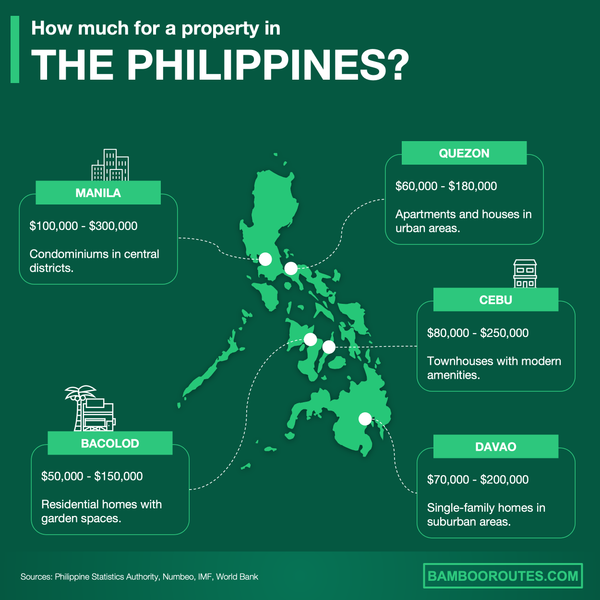
We created this infographic to give you a simple idea of how much it costs to buy property in different parts of the Philippines. As you can see, it breaks down price ranges and property types for popular cities in the country. We hope this makes it easier to explore your options and understand the market.