
Authored by the expert who managed and guided the team behind the Philippines Property Pack
Everything you need to know before buying real estate is included in our The Philippines Property Pack
Panay Island offers a rare combination of affordable living, modern infrastructure in Iloilo City, and world-class beaches in Boracay, making it one of the most appealing destinations in the Philippines for foreigners in 2026.
This guide covers everything you need to know about moving to Panay Island, from visa requirements and cost of living to healthcare, schools, and property ownership rules.
We constantly update this blog post with fresh data from official Philippine government sources and real expat experiences on the ground.
And if you're planning to buy a property in this place, you may want to download our pack covering the real estate market in Panay Island.

Is Panay Island a good place to live in 2026?
Is quality of life getting better or worse in Panay Island in 2026?
As of early 2026, quality of life on Panay Island is improving, particularly in Iloilo City where modern infrastructure and formal business investment continue to expand.
The most significant improvement in recent years has been the development of the Iloilo Business Park in Mandurriao, which brought new condominiums, international dining options, walkable public spaces, and reliable internet to what was once a quiet provincial city.
The persistent challenge remains infrastructure stress during typhoon season, when power outages and flooding can disrupt daily life even in developed neighborhoods, though Iloilo City is investing in flood control and drainage upgrades.
Are hospitals good in Panay Island in 2026?
As of early 2026, hospitals in Iloilo City meet good provincial-city standards and can handle most medical needs, though expats often keep Manila or Cebu as backup options for complex procedures.
The hospitals most commonly recommended by expats in Panay Island are The Medical City Iloilo in the Molo area, which is part of a respected national hospital network, and St. Paul's Hospital of Iloilo in City Proper, a well-established tertiary facility.
A standard doctor consultation at a private clinic in Iloilo City typically costs around 600 pesos (about 10 USD or 9 EUR), while specialist visits run closer to 1,500 pesos (about 25 USD or 23 EUR), with Boracay clinics charging roughly 20 to 40 percent more during peak season.
Private health insurance is strongly recommended for expats living in Panay Island because it ensures smooth access to private hospitals and can cover medical evacuation to Manila if needed, which is especially important given Boracay's limited healthcare facilities.
Are there any good international schools in Panay Island in 2026?
As of early 2026, Panay Island has limited true international school options, with the most established one located on Boracay rather than in Iloilo City.
The most well-known international school serving Panay Island is Boracay European International School in Manoc-Manoc, Malay, Aklan, which offers English-medium instruction following international curriculum standards; in Iloilo City, expat families typically choose strong private schools like Assumption Iloilo or Ateneo de Iloilo, though these follow Philippine curriculum.
Annual tuition at Boracay European International School runs approximately 250,000 pesos (about 4,200 USD or 3,900 EUR), while private schools in Iloilo City are considerably more affordable at around 80,000 to 150,000 pesos per year.
Waitlists at Boracay European International School can be competitive because the expat family market is small and capacity is limited, so applying 3 to 6 months before the school year is recommended; public schools in Panay Island vary widely in quality and most expats with options choose private education.
Is Panay Island a dangerous place in 2026?
As of early 2026, Panay Island is considered safe by Philippine standards, with Iloilo City and the main Boracay tourist areas presenting normal urban safety levels where common sense precautions are sufficient.
The most common safety concerns for expats in Panay Island are petty theft and tourist-targeted overcharging rather than violent crime; in Boracay, tricycle drivers and vendors sometimes quote higher prices to foreigners, while in Iloilo City, the main issue is opportunistic pickpocketing in crowded markets.
The safest neighborhoods for expats in Panay Island include Mandurriao and Molo in Iloilo City, where modern condominiums have 24-hour security, and in Boracay, the Station 1 and Station 2 areas in Balabag offer well-lit streets and regular police patrols.
Women can generally live alone safely in Panay Island, particularly in Iloilo City's newer residential areas with guarded buildings; standard precautions like avoiding unlit streets at night and using reputable transportation services are recommended, just as in any urban area.
Thinking of buying real estate in Panay Island?
Acquiring property in a different country is a complex task. Don't fall into common traps – grab our guide and make better decisions.

How much does everyday life cost in Panay Island in 2026?
What monthly budget do I need to live well in Panay Island in 2026?
As of early 2026, a single person can live comfortably in Iloilo City on approximately 60,000 pesos per month (about 1,000 USD or 930 EUR), which covers rent in a good area, air conditioning, regular dining out, and some savings.
For a more modest lifestyle in Iloilo City or smaller towns like Roxas City, a budget of around 45,000 pesos per month (about 760 USD or 700 EUR) is realistic, though you would need to limit restaurant meals and choose a simpler apartment.
For a more comfortable or upscale lifestyle in Panay Island, particularly if you want a newer condominium in Mandurriao, frequent restaurant dining, and weekend trips, you should budget around 80,000 to 90,000 pesos per month (about 1,350 to 1,500 USD or 1,250 to 1,400 EUR), with Boracay requiring even more due to tourism pricing.
Housing typically takes the largest share of your monthly budget in Panay Island, especially in Boracay where rents can be double those in Iloilo City; in Iloilo City itself, expect rent to consume about 30 percent of your budget, followed by food and dining at around 20 percent.
What is the average income tax rate in Panay Island in 2026?
As of early 2026, a typical middle-income earner in Panay Island with a gross salary of around 100,000 pesos per month would face an effective income tax rate of approximately 14 percent, because the Philippine tax system is progressive and your average rate is lower than your top marginal bracket.
The income tax brackets in the Philippines range from 0 percent on the first 250,000 pesos of annual income up to 35 percent on income exceeding 8 million pesos, with most expat salaries in Panay Island falling into the 20 to 30 percent marginal bracket range; on top of income tax, employees also pay mandatory contributions to SSS, PhilHealth, and Pag-IBIG which add several percent to your total payroll deductions.
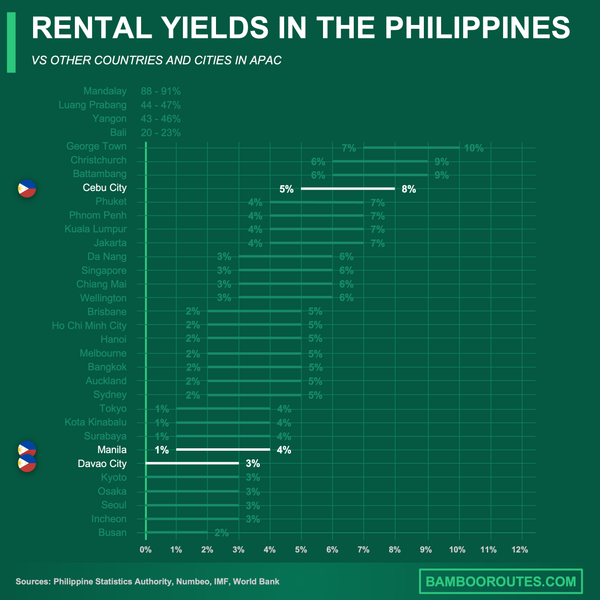
We did some research and made this infographic to help you quickly compare rental yields of the major cities in the Philippines versus those in neighboring countries. It provides a clear view of how this country positions itself as a real estate investment destination, which might interest you if you’re planning to invest there.
What kind of foreigners actually live in Panay Island in 2026?
Where do most expats come from in Panay Island in 2026?
As of early 2026, the largest groups of expats living in Panay Island come from Europe, North America, and Australia, with a notable East Asian presence particularly from South Korea and Japan, especially in Boracay's tourism and hospitality sector.
The total number of foreign residents in Panay Island is relatively small compared to Manila or Cebu, with estimates suggesting a few thousand long-term expats spread between Iloilo City and Boracay, though exact figures are difficult to verify since many stay on extended tourist visas.
European and American expats are drawn to Panay Island primarily for the combination of affordable living costs, the world-famous Boracay beach lifestyle, and increasingly, Iloilo City's emerging modern infrastructure which offers city convenience without the chaos of Manila.
The expat population in Panay Island is a mix of retirees attracted by the SRRV visa program, working professionals in BPO and IT sectors, digital nomads, and lifestyle-focused individuals who have married Filipino spouses and settled permanently.
Where do most expats live in Panay Island in 2026?
As of early 2026, the most popular neighborhoods for expats in Panay Island are Mandurriao in Iloilo City, which includes the Iloilo Business Park area with modern condominiums and malls, and in Boracay, the Balabag area covering Stations 1 and 2 where most tourist facilities and expat services are concentrated.
Mandurriao attracts expats because it offers the newest residential developments, reliable utilities, walkable streets, proximity to SM City Iloilo and Festive Walk Mall, and a concentration of restaurants and cafes catering to international tastes, essentially providing a lifestyle similar to what you would find in Cebu or Makati but at lower cost.
Emerging neighborhoods that are starting to attract more expats include Molo in Iloilo City, which offers riverside living near The Medical City Iloilo, and Manoc-Manoc in Boracay, which has a quieter feel than the main beach strip and is where Boracay European International School is located, making it popular with families.
Are expats moving in or leaving Panay Island in 2026?
As of early 2026, Panay Island is experiencing a net inflow of expats, particularly in Iloilo City where new condominium developments and the expanding BPO sector are attracting working professionals and retirees seeking an affordable alternative to Manila and Cebu.
The main factor driving expats to move to Panay Island right now is the cost-of-living advantage combined with improving infrastructure; Iloilo City offers reliable internet, modern hospitals, and urban amenities at roughly half the cost of Manila, while Boracay continues to attract lifestyle-focused expats despite higher local prices.
The main factor causing some expats to leave Panay Island is the limited healthcare capacity for serious medical conditions, which pushes some retirees to relocate to Cebu or Manila as they age, along with Boracay's seasonal volatility where tourism regulations and crowding can suddenly change the living environment.
Compared to similar destinations in the Philippines like Dumaguete or Davao, Panay Island shows stronger expat growth momentum in Iloilo City because of the visible infrastructure investment, though Boracay's expat population tends to be more transient with higher turnover than these quieter alternatives.
Get fresh and reliable information about the market in Panay Island
Don't base significant investment decisions on outdated data. Get updated and accurate information with our guide.
What paperwork do I need to move to Panay Island in 2026?
What visa options are popular in Panay Island in 2026?
As of early 2026, the three most popular visa types for expats moving to Panay Island are the tourist visa with extensions for trial living, the 9G Pre-Arranged Employment Visa for those with local jobs, and the 13A Marriage Visa for foreigners married to Filipino citizens.
The most commonly used expat visa in Panay Island is the tourist visa with extensions, which allows most nationalities to enter visa-free for 30 days and extend their stay at Bureau of Immigration offices up to 36 months total; this requires proof of onward travel, sufficient funds, and extension fees paid every one to two months.
The Philippines launched a Digital Nomad Visa program in 2025 that allows remote workers to stay up to one year with the possibility of renewal; eligibility requires proof of remote work for an overseas employer, sufficient income generated outside the Philippines, health insurance, and no criminal record, though the program operates on a reciprocity basis with qualifying countries.
For the tourist visa path, initial entry is 30 days and extensions can be processed for one or two months at a time at the Bureau of Immigration Iloilo office; the 9G work visa is typically valid for one to three years and requires employer sponsorship and renewal through the company; the SRRV retirement visa grants indefinite stay with annual ID renewal.
How long does it take to get residency in Panay Island in 2026?
As of early 2026, processing times for residency in the Philippines vary from same-day tourist visa extensions at the Bureau of Immigration to approximately 4 to 8 weeks for the SRRV retirement visa, with the 9G work visa pathway typically taking 6 to 10 weeks total when combining the Alien Employment Permit and immigration steps.
Common factors that can delay residency applications include incomplete documentation, seasonal backlogs at immigration offices, and for work visas, delays in employer petition processing; factors that speed up the process include using authorized visa agents, having all documents properly authenticated, and applying during off-peak periods.
To become eligible for permanent residency in the Philippines, the 13A Marriage Visa provides permanent status after a one-year probationary period, while the SRRV grants immediate indefinite stay rights; citizenship through naturalization requires 10 years of continuous residence, though this is a separate and rarely pursued path for most expats.
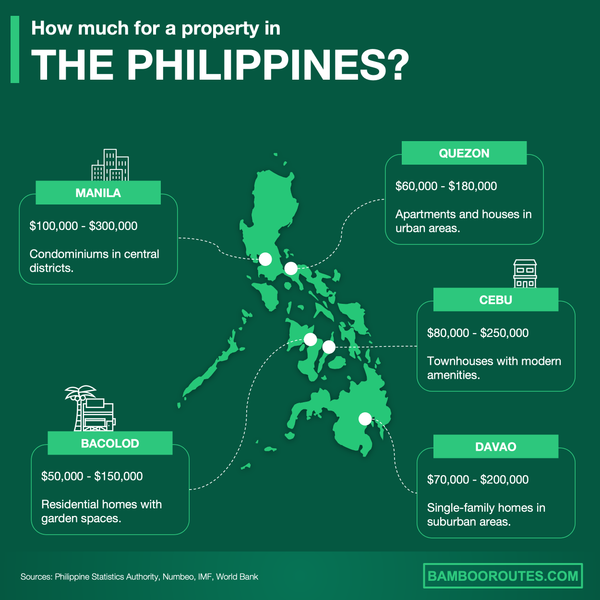
We created this infographic to give you a simple idea of how much it costs to buy property in different parts of the Philippines. As you can see, it breaks down price ranges and property types for popular cities in the country. We hope this makes it easier to explore your options and understand the market.
How hard is it to find a job in Panay Island in 2026?
Which industries are hiring the most in Panay Island in 2026?
As of early 2026, the top three industries hiring the most in Panay Island are IT-BPM (business process management) concentrated in Iloilo City's PEZA zones, tourism and hospitality across Boracay and the Aklan coastal belt, and construction and real estate driven by Iloilo's ongoing development boom.
Getting hired in Panay Island without speaking the local language is realistic in expat-facing roles and international businesses, since English is widely used in BPO operations, tourism, and professional services; however, learning basic Hiligaynon (the Ilonggo language spoken in Iloilo, Capiz, and Antique) significantly improves your integration and opens doors to local network opportunities.
The most accessible roles for foreign job seekers in Panay Island include English teaching positions, hospitality management in Boracay hotels and restaurants, IT and software development roles in Iloilo City BPO companies, and specialized technical or managerial positions where Filipino candidates with equivalent qualifications are not readily available.
What salary ranges are common for expats in Panay Island in 2026?
As of early 2026, typical salary ranges for expats working locally in Panay Island span from 60,000 to 150,000 pesos per month gross (about 1,000 to 2,500 USD or 930 to 2,300 EUR), with most positions clustering in the middle of this range for managerial and technical roles.
For entry-level or mid-level expat positions in Panay Island, such as English teachers or junior hospitality managers, salaries typically range from 40,000 to 80,000 pesos per month (about 680 to 1,350 USD or 630 to 1,250 EUR), which is sufficient for a comfortable local lifestyle but modest by Western standards.
For senior or specialized expat roles in Panay Island, such as BPO operations managers, IT architects, or hotel general managers, salaries can reach 120,000 to 200,000 pesos per month (about 2,000 to 3,400 USD or 1,860 to 3,150 EUR), with some executive positions in larger companies exceeding this range.
Employers in Panay Island do sponsor work visas, but this is less common than in Manila or Cebu and typically happens through BPO companies, large hospitality groups, or for specialized roles where no qualified Filipino candidate is available; many expats working in Panay Island are either remote workers or have secured sponsorship through regional offices of national companies.
Get to know the market before buying a property in Panay Island
Better information leads to better decisions. Get all the data you need before investing a large amount of money. Download our guide.
What's daily life really like for expats in Panay Island right now?
What do expats love most about living in Panay Island right now?
Expats living in Panay Island most commonly praise the combination of affordable cost of living, the friendliness of Ilonggo people, and having access to both city conveniences in Iloilo and world-class beaches in Boracay within the same island group.
The lifestyle benefit most frequently praised by expats in Panay Island is the relaxed pace of life compared to Manila, where you can enjoy morning coffee at a modern cafe in Iloilo Business Park, take a quick ferry to pristine beaches, and still have reliable internet for remote work, all without the traffic nightmare of the capital.
The practical advantage expats appreciate most in Panay Island is the value for money, since you can rent a modern condominium with amenities, eat well at local restaurants, use private healthcare, and maintain a comfortable lifestyle on a budget that would only cover basic expenses in most Western cities.
The social and cultural aspect that makes Panay Island particularly enjoyable for expats is the genuine warmth of the Ilonggo culture, which is known throughout the Philippines for hospitality; the Dinagyang Festival in Iloilo City and the smaller community fiestas throughout the year create regular opportunities to connect with neighbors and experience authentic Filipino celebration.
What do expats dislike most about life in Panay Island right now?
The most common complaints from expats living in Panay Island include typhoon season disruptions to power and internet, the limited healthcare options for serious medical conditions requiring Manila or Cebu trips, and in Boracay specifically, the tourism-driven price inflation that makes everyday purchases significantly more expensive.
The daily inconvenience that frustrates expats the most in Panay Island is the occasional power outage and internet instability outside the newest development areas, which can interrupt remote work and require investment in backup power solutions like UPS units or generators.
The bureaucratic issue that causes the most headaches for expats in Panay Island is the Bureau of Immigration visa extension process, which requires regular visits to the Iloilo BI office, waiting in queues, and navigating paperwork that can change requirements without clear notice; many expats use fixers or visa agents to manage this process.
Despite these frustrations, most expats in Panay Island consider them manageable tradeoffs rather than deal-breakers, since the overall quality of life, community warmth, and cost advantages outweigh the inconveniences for those who prepare properly and maintain realistic expectations about provincial Philippine living.
What are the biggest culture shocks in Panay Island right now?
The biggest culture shocks expats experience when moving to Panay Island are the different relationship with time where schedules are flexible and queues move slowly, the constant ambient noise from neighborhood activity including karaoke and roosters, and the stark price differences between tourist areas like Boracay and local markets.
The social norm that surprises newcomers the most in Panay Island is the extended family culture, where Filipino friends and partners often have financial obligations to relatives that Westerners might find unexpected; understanding that family support is a core value rather than a burden helps expats integrate more smoothly.
The aspect of daily routines that takes the longest for expats to adjust to in Panay Island is the heat management lifestyle, where locals structure their day around the midday sun, many businesses close for siesta-like breaks, and air conditioning becomes not a luxury but a necessity for comfortable sleep, which significantly impacts electricity bills.

We made this infographic to show you how property prices in the Philippines compare to other big cities across the region. It breaks down the average price per square meter in city centers, so you can see how cities stack up. It’s an easy way to spot where you might get the best value for your money. We hope you like it.
Can I buy a home as a foreigner in Panay Island in 2026?
Can foreigners legally own property in Panay Island in 2026?
As of early 2026, foreign property ownership in Panay Island is restricted by the Philippine Constitution, which prohibits foreigners from owning land, but allows ownership of condominium units within buildings where at least 60 percent of units are Filipino-owned.
The specific restriction that applies to foreigners buying property in Panay Island is Article XII, Section 7 of the 1987 Constitution, which limits private land ownership to Filipino citizens and corporations with at least 60 percent Filipino ownership; exceptions exist only for hereditary succession and certain former Filipino citizens.
In terms of property types, foreigners in Panay Island can legally purchase condominium units under the Condominium Act (RA 4726), but cannot directly own houses, lots, or land; the common workaround is long-term lease agreements of up to 50 years with renewal options, or purchasing through a Filipino spouse's name with proper legal documentation.
By the way, we've written a blog article detailing the whole property buying process for foreigners in Panay Island.
What is the average price per m² in Panay Island in 2026?
As of early 2026, the average price per square meter for residential property in Panay Island varies dramatically by location, with Iloilo City condominiums in good areas like Mandurriao averaging around 110,000 pesos per square meter (about 1,860 USD or 1,720 EUR), while Boracay properties can exceed 180,000 pesos per square meter due to scarcity and tourism demand.
Property prices in Panay Island have been rising steadily over the past two to three years, driven by Iloilo City's infrastructure development and Boracay's recovery from pandemic closures; Iloilo Business Park area properties have seen particularly strong appreciation as the district matures and attracts more residents and businesses.
Do banks give mortgages to foreigners in Panay Island in 2026?
As of early 2026, mortgage availability for foreigners in Panay Island is limited rather than widespread, with most banks requiring more stringent conditions for non-Filipino borrowers and focusing primarily on condominium financing where title ownership is clearer.
The banks in the Philippines that are known to consider foreign mortgage applications include BDO Unibank, Bank of the Philippine Islands, and Metrobank, though approval depends heavily on individual circumstances and the property type.
Typical mortgage conditions for foreigners in Panay Island include a larger down payment requirement of 30 to 40 percent compared to 20 percent for Filipinos, interest rates ranging from 7 to 10 percent annually, and maximum loan terms of 10 to 15 years rather than the 20 to 25 years available to citizens.
To qualify for a mortgage as a foreigner in Panay Island, banks typically require proof of stable income or local employment, valid long-term visa status such as SRRV or 13A, clear property title documents, and often a local co-borrower or guarantor; having an existing relationship with a Philippine bank improves approval chances.
You can also read our latest update about mortgage and interest rates in The Philippines.
Buying real estate in Panay Island can be risky
An increasing number of foreign investors are showing interest. However, 90% of them will make mistakes. Avoid the pitfalls with our comprehensive guide.

What sources have we used to write this blog article?
Whether it's in our blog articles or the market analyses included in our property pack about Panay Island, we always rely on the strongest methodology we can, and we don't throw out numbers at random.
We also aim to be fully transparent, so below we've listed the authoritative sources we used, and explained how we used them and the methods behind our estimates.
| Source | Why it's authoritative | How we used it |
|---|---|---|
| Bangko Sentral ng Pilipinas (BSP) | This is the Philippine central bank's official exchange rate data. | We used it to anchor all USD and EUR conversions throughout the guide. We also used it as a sanity check when comparing tourist pricing versus local pricing across Panay Island. |
| Philippine Statistics Authority (PSA) | PSA is the national statistical office for labor and economic data. | We used it to ground the job market discussion and unemployment context for Panay Island. We cross-checked media summaries against official releases for accuracy. |
| Bureau of Internal Revenue (BIR) | BIR is the national tax authority with official tax bracket information. | We used it to calculate realistic effective tax rates for expat incomes. We avoided relying on unofficial blogs for tax information. |
| MREIT Iloilo Business Park | MREIT is a major listed property firm developing Iloilo's flagship district. | We used it to explain why Mandurriao attracts expats and higher-end rentals. We grounded neighborhood recommendations in actual urban development data. |
| The Medical City Iloilo | This is the official page of a major national hospital network. | We used it to provide verifiable healthcare options for expats. We supported the healthcare quality discussion with a primary source rather than anecdotes. |
| St. Paul's Hospital of Iloilo | This is the hospital's own primary source for services and capabilities. | We used it to identify another major tertiary hospital option. We triangulated hospital availability beyond a single provider. |
| Boracay European International School | This is the school's official website with curriculum and enrollment information. | We used it to give a concrete international school option with real details. We anchored tuition expectations to verifiable information rather than estimates. |
| Philippine Economic Zone Authority (PEZA) | PEZA oversees economic zones and publishes company locator data. | We used it to validate where formal jobs are located in Iloilo City. We supported the industries-hiring section with official business presence data. |
| Supreme Court E-Library | This is the primary legal text source hosted by the Philippine judiciary. | We used it to support the explanation of condo ownership rules under the Condominium Act. We avoided relying on informal legal blogs for property law. |
| Philippine Retirement Authority (PRA) | PRA is the official agency administering the SRRV retirement visa program. | We used it to verify current SRRV requirements and benefits. We ensured visa information reflects 2025 to 2026 regulations. |
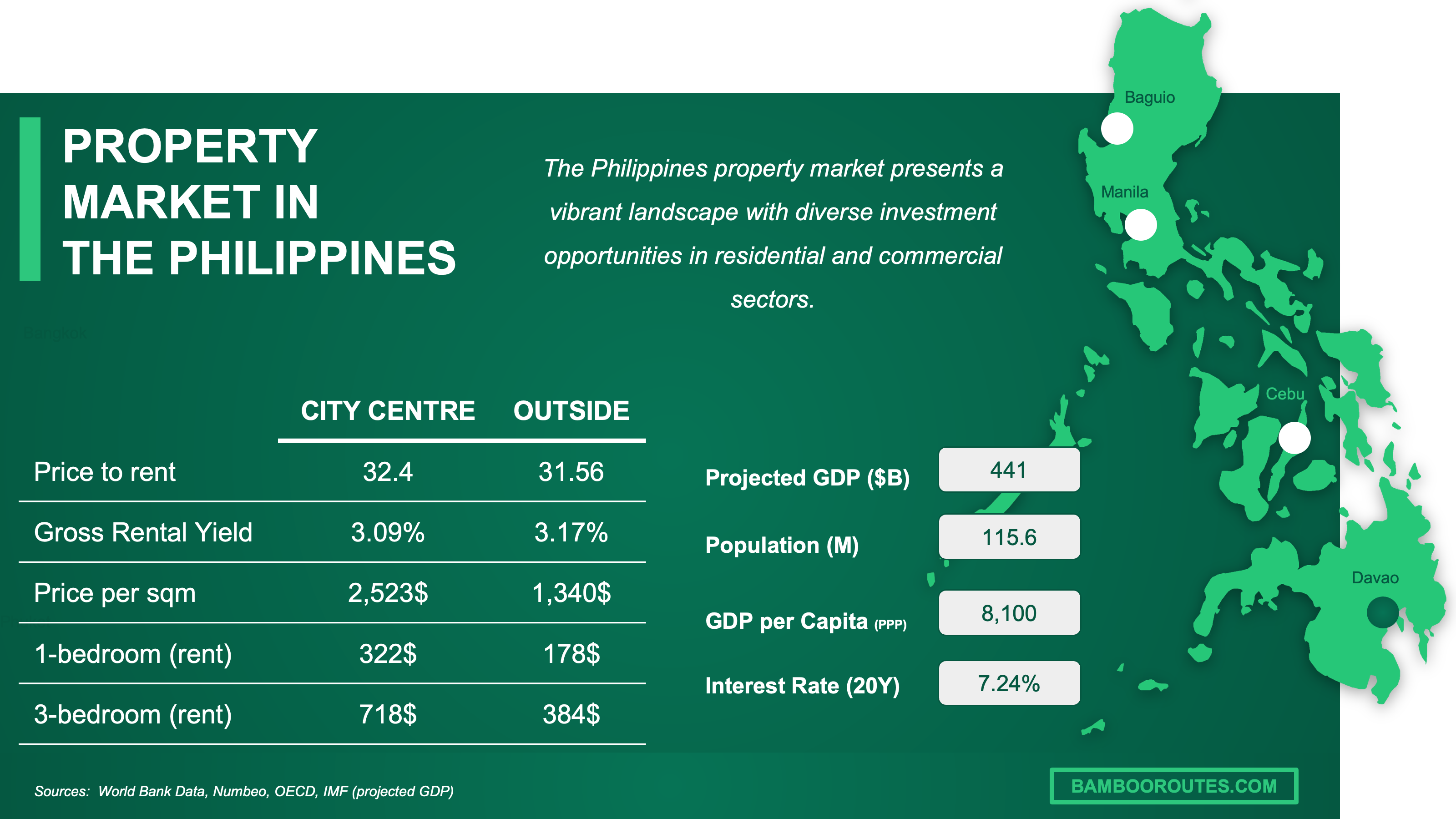
We have made this infographic to give you a quick and clear snapshot of the property market in the Philippines. It highlights key facts like rental prices, yields, and property costs both in city centers and outside, so you can easily compare opportunities. We’ve done some research and also included useful insights about the country’s economy, like GDP, population, and interest rates, to help you understand the bigger picture.
Related blog posts