
Authored by the expert who managed and guided the team behind the Philippines Property Pack

Everything you need to know before buying real estate is included in our The Philippines Property Pack
Negros Island sits in the heart of the Visayas region and offers two distinct living experiences: Bacolod for urban convenience and Dumaguete for a slower, expat-friendly pace.
This guide covers everything from monthly budgets and visa options to neighborhoods, safety, and property ownership rules for foreigners considering Negros Island in 2026.
We constantly update this blog post to reflect the latest data and conditions on the ground.
And if you're planning to buy a property in this place, you may want to download our pack covering the real estate market in Negros Island.

Is Negros Island a good place to live in 2026?
Is quality of life getting better or worse in Negros Island in 2026?
As of early 2026, the overall quality of life trajectory on Negros Island is improving, supported by manageable inflation expectations and continued infrastructure investments across both Bacolod and Dumaguete.
One specific factor that has improved noticeably over the past two to three years is healthcare accessibility in Dumaguete, where private clinics and specialist services have expanded to meet growing expat demand, reducing the need for trips to Cebu for routine care.
However, power reliability remains a persistent challenge on Negros Island, particularly in areas outside the main city centers, where brownouts can still disrupt daily life and push up electricity costs for those running air conditioning regularly.
Are hospitals good in Negros Island in 2026?
As of early 2026, hospitals on Negros Island provide good care for routine and common procedures, but they fall short of Western European or North American standards for highly specialized treatments, which often require travel to Cebu or Manila.
The hospitals expats most commonly recommend on Negros Island include Riverside Medical Center and The Doctors' Hospital in Bacolod, as well as Silliman University Medical Center in Dumaguete.
A standard doctor consultation on Negros Island in 2026 typically costs between 500 and 1,500 pesos (around $9 to $27 USD or 8 to 25 EUR) at private clinics, with specialist visits ranging from 800 to 2,500 pesos.
Private health insurance is strongly recommended for expats on Negros Island because PhilHealth coverage, while available to foreign residents with an ACR I-Card, is best treated as cost-sharing rather than comprehensive protection, and the fastest care pathways often require out-of-pocket payment.
Are there any good international schools in Negros Island in 2026?
As of early 2026, Negros Island has a limited but growing selection of international-style schools, with most options concentrated in Bacolod and Dumaguete, though none match the large international school campuses found in Manila.
Among the most reputable schools for expat families on Negros Island are Silliman University (which offers basic education programs) in Dumaguete, Lamblight International School in Bacolod partnered with Cambridge-accredited Wolsey Hall Oxford, and Bethel International School in Sibulan near Dumaguete offering a U.S.-based curriculum.
Annual tuition fees for international-style schools on Negros Island in 2026 typically range from 60,000 to 160,000 pesos ($1,000 to $2,700 USD or 900 to 2,400 EUR) for strong private K-12 programs, and can reach 150,000 to 350,000 pesos for premium international programs where available.
Waitlists on Negros Island are generally shorter than in Manila, but popular schools still experience pressure for kindergarten entry slots, and public schools are typically not the default choice for expat families due to class sizes and curriculum differences.
Is Negros Island a dangerous place in 2026?
As of early 2026, Negros Island is generally considered safe for expats by Philippine standards, with both Bacolod and Dumaguete ranking as manageable cities where violent crime targeting foreigners is rare.
The most common safety concerns expats should be aware of on Negros Island are opportunistic theft such as pickpocketing in crowded markets, motorbike snatching in poorly lit areas, and occasional scams targeting newcomers unfamiliar with local pricing.
The neighborhoods generally considered safest for expats on Negros Island include Mandalagan, Villamonte, Bata, and Granada in Bacolod, while in Dumaguete the areas around Daro, Piapi, Bagacay, and Banilad are popular for their walkability and proximity to services.
Women can generally live alone safely on Negros Island, particularly in the expat-friendly zones around Silliman University in Dumaguete, though standard precautions like avoiding poorly lit streets at night and not displaying expensive items remain advisable.
Thinking of buying real estate in Negros Island?
Acquiring property in a different country is a complex task. Don't fall into common traps – grab our guide and make better decisions.

How much does everyday life cost in Negros Island in 2026?
What monthly budget do I need to live well in Negros Island in 2026?
As of early 2026, a single person can live comfortably on Negros Island with a monthly budget of around 70,000 to 100,000 pesos ($1,200 to $1,700 USD or 1,100 to 1,550 EUR) in Bacolod, or 60,000 to 90,000 pesos ($1,000 to $1,550 USD or 900 to 1,400 EUR) in Dumaguete.
For a more modest but decent lifestyle on Negros Island in 2026, a single person can manage on 45,000 to 65,000 pesos ($770 to $1,100 USD or 700 to 1,000 EUR) per month, assuming simpler housing, limited air conditioning use, and mostly local dining.
For a more comfortable or upscale lifestyle on Negros Island, including a modern condo, regular restaurant meals, a vehicle, and private health coverage, expect to budget 100,000 to 150,000 pesos ($1,700 to $2,550 USD or 1,550 to 2,300 EUR) per month as a single person.
The expense category that typically takes the largest share of a monthly budget on Negros Island is housing combined with electricity, because many expats choose better-than-local standards and run air conditioning daily, which can push utility bills to 5,000 to 15,000 pesos per month.
What is the average income tax rate in Negros Island in 2026?
As of early 2026, the effective income tax rate for a typical middle-income earner on Negros Island falls roughly between 10% and 20%, depending on taxable income after deductions, with the first 250,000 pesos of annual income exempt from tax under Philippine law.
The income tax bracket range in the Philippines for 2026 starts at 0% for income up to 250,000 pesos annually, then rises progressively through rates of 15%, 20%, 25%, and 30%, reaching a top marginal rate of 35% on income exceeding 8 million pesos.
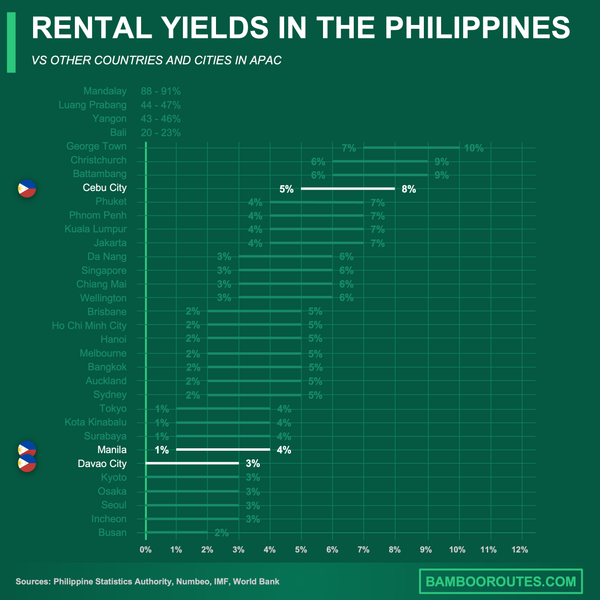
We did some research and made this infographic to help you quickly compare rental yields of the major cities in the Philippines versus those in neighboring countries. It provides a clear view of how this country positions itself as a real estate investment destination, which might interest you if you’re planning to invest there.
What kind of foreigners actually live in Negros Island in 2026?
Where do most expats come from in Negros Island in 2026?
As of early 2026, the most common countries of origin for expats on Negros Island are the United States, Australia, the United Kingdom, Germany, and Canada, with smaller communities from other European countries and South Korea.
The total number of foreign residents on Negros Island is difficult to pinpoint precisely, but estimates suggest several thousand long-stay foreigners live across Dumaguete and Bacolod combined, representing a small but visible portion of the local population.
The main reason expats from these top origin countries are drawn to Negros Island is the combination of affordable cost of living, English being widely spoken, tropical climate, and a less hectic pace compared to Manila or Cebu.
The expat population on Negros Island is predominantly a mix of retirees seeking a comfortable long-stay lifestyle and digital nomads or remote workers attracted by low costs and good internet in urban areas.
Where do most expats live in Negros Island in 2026?
As of early 2026, the neighborhoods where expats concentrate most heavily on Negros Island include Daro, Piapi, Bagacay, and Banilad in Dumaguete, plus Mandalagan, Villamonte, and Bata in Bacolod.
The main characteristic that makes these neighborhoods attractive to expats on Negros Island is walkable access to cafes, restaurants, healthcare facilities, and the waterfront, combined with reliable utilities and a visible foreign community that makes settling in easier.
Emerging areas on Negros Island that are starting to attract more expats include Valencia (a cooler upland town about 20 minutes from Dumaguete) and the developing townships near Bacolod-Silay Airport, where new residential and commercial projects are being built.
Are expats moving in or leaving Negros Island in 2026?
As of early 2026, the trend for expat migration on Negros Island shows a steady net inflow, with new arrivals driven by retirees and remote workers continuing to outnumber those leaving.
The main factor driving expats to move to Negros Island right now is the attractive combination of low living costs, a welcoming English-speaking environment, and the new Digital Nomad Visa making longer stays easier to arrange legally.
The main factor causing some expats to leave Negros Island recently is the need for more advanced healthcare that requires regular travel to Cebu or Manila, along with frustration over occasional power interruptions and slower-than-expected internet in some areas.
Compared to similar destinations in the region such as Cebu or Bohol, Negros Island remains smaller in total expat numbers but is growing steadily, offering a quieter alternative for those who find larger hubs too crowded or commercial.
Get fresh and reliable information about the market in Negros Island
Don't base significant investment decisions on outdated data. Get updated and accurate information with our guide.
What paperwork do I need to move to Negros Island in 2026?
What visa options are popular in Negros Island in 2026?
As of early 2026, the three most popular visa types for expats moving to Negros Island are the Tourist Visa (9A) with extensions, the Special Resident Retiree Visa (SRRV), and the newly launched Digital Nomad Visa (DNV).
The most commonly used expat visa on Negros Island is the Tourist Visa (9A), which allows citizens of many countries to enter visa-free for 30 days and then extend their stay for up to 36 months through periodic visits to the Bureau of Immigration.
Yes, the Philippines now offers a Digital Nomad Visa as of mid-2025, which allows remote workers earning at least $24,000 USD annually from foreign sources to stay for up to 12 months initially, with the option to renew for a second year.
Tourist Visa extensions can be processed every one to two months for stays up to three years, while the SRRV provides indefinite residency with no renewal required as long as the deposit is maintained, and the Digital Nomad Visa is valid for 12 months and renewable once.
How long does it take to get residency in Negros Island in 2026?
As of early 2026, the typical processing time for residency on Negros Island ranges from a few weeks for SRRV applications with complete documents, to several months for work-based visas requiring employer sponsorship and DOLE permits.
Common factors that can delay residency applications on Negros Island include incomplete documentation, backlogs at the Bureau of Immigration, missing medical clearances, and delays in obtaining police clearances from the applicant's home country.
For permanent residency eligibility in the Philippines, expats must typically live in the country for at least 10 consecutive years under a qualifying visa before applying for naturalization, though SRRV holders enjoy indefinite stay privileges without needing to pursue citizenship.
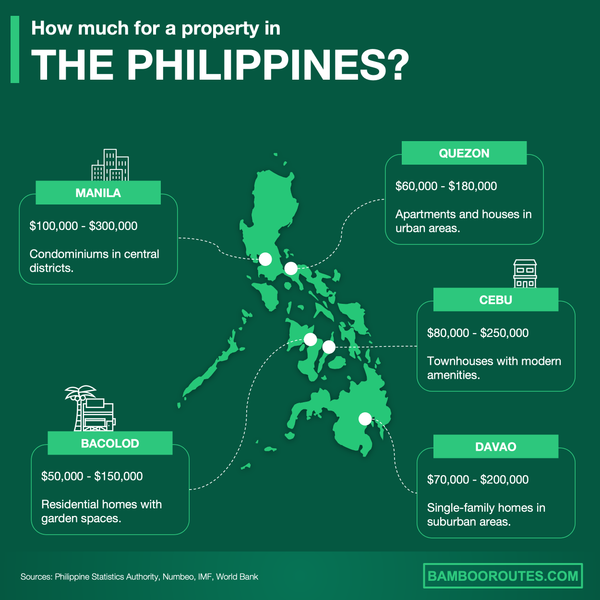
We created this infographic to give you a simple idea of how much it costs to buy property in different parts of the Philippines. As you can see, it breaks down price ranges and property types for popular cities in the country. We hope this makes it easier to explore your options and understand the market.
How hard is it to find a job in Negros Island in 2026?
Which industries are hiring the most in Negros Island in 2026?
As of early 2026, the top three industries hiring the most on Negros Island are hospitality and tourism (especially coastal resorts in Dauin and Sipalay), education (language schools and universities centered around Dumaguete), and business process outsourcing services expanding in Bacolod.
Getting hired on Negros Island without speaking Filipino is realistic in hospitality, education, and expat-facing service roles, since English is widely used, but learning basic conversational Filipino significantly improves daily interactions and job prospects outside these niches.
The types of roles most accessible to foreign job seekers on Negros Island include English teaching positions, dive instructor and tourism management roles, specialized technical consultants, and remote positions for international companies that allow local residence.
What salary ranges are common for expats in Negros Island in 2026?
As of early 2026, the typical salary range for expats working locally on Negros Island spans from 40,000 to 120,000 pesos per month ($680 to $2,000 USD or 620 to 1,850 EUR), depending heavily on the industry and whether the role is locally or internationally compensated.
Entry-level or mid-level expat positions on Negros Island, such as English teachers or hospitality supervisors, typically pay between 25,000 and 60,000 pesos per month ($425 to $1,000 USD or 390 to 920 EUR), which requires careful budgeting but remains livable given local costs.
Senior or specialized expat roles on Negros Island, such as school administrators, resort managers, or technical consultants, can command salaries of 80,000 to 200,000 pesos per month ($1,360 to $3,400 USD or 1,230 to 3,070 EUR) or higher for rare expertise.
Employers on Negros Island do sponsor work visas for foreign hires, but this is relatively uncommon and typically reserved for specialized roles where no qualified Filipino candidate is available, as documented through the DOLE Alien Employment Permit process.
Get to know the market before buying a property in Negros Island
Better information leads to better decisions. Get all the data you need before investing a large amount of money. Download our guide.
What's daily life really like for expats in Negros Island right now?
What do expats love most about living in Negros Island right now?
The top things expats love most about living on Negros Island are the genuinely friendly local culture, the low cost of living compared to Western countries, and the easy access to natural attractions like Apo Island diving and Valencia's cool mountain air.
The lifestyle benefit most frequently praised by expats on Negros Island is the relaxed pace of life, where days unfold without the stress and congestion of larger cities, allowing time for beaches, cafes, and genuine community connections.
The practical advantage expats appreciate most on Negros Island is affordability, where a comfortable lifestyle including good housing, regular dining out, and domestic travel costs a fraction of what it would in Europe, North America, or Australia.
The social and cultural aspect that makes Negros Island particularly enjoyable for expats is the warmth of Filipinos, combined with vibrant local traditions like Bacolod's MassKara Festival and Dumaguete's university-town atmosphere that creates a welcoming, inclusive community feel.
What do expats dislike most about life in Negros Island right now?
The top complaints expats have about living on Negros Island are unreliable power supply leading to brownouts, limited specialist healthcare requiring travel to Cebu or Manila, and higher-than-expected electricity bills when running air conditioning daily.
The daily inconvenience that frustrates expats the most on Negros Island is the combination of tropical heat and power interruptions, which can leave homes without air conditioning during the hottest parts of the day and disrupt work-from-home routines.
The bureaucratic issue that causes the most headaches for expats on Negros Island is the visa extension process, which requires periodic trips to immigration offices with long wait times and paperwork that can feel repetitive after months of renewals.
Most expats find these frustrations manageable rather than deal-breakers, accepting them as tradeoffs for the lower costs and lifestyle benefits, though those with serious medical conditions or low tolerance for infrastructure gaps may find Negros Island challenging.
What are the biggest culture shocks in Negros Island right now?
The biggest culture shocks expats experience when moving to Negros Island are the fluid concept of time where schedules run on "Filipino time," the constant background noise of karaoke and fiestas in residential areas, and the deeply relationship-oriented approach to business and daily life.
The social norm that surprises newcomers the most on Negros Island is the importance of personal relationships and introductions in getting things done, where who you know often matters more than formal procedures or official channels.
The aspect of daily routines that takes the longest for expats to adjust to on Negros Island is the slower pace of administrative tasks and services, where patience is essential and rushing or showing frustration is culturally counterproductive.

We made this infographic to show you how property prices in the Philippines compare to other big cities across the region. It breaks down the average price per square meter in city centers, so you can see how cities stack up. It’s an easy way to spot where you might get the best value for your money. We hope you like it.
Can I buy a home as a foreigner in Negros Island in 2026?
Can foreigners legally own property in Negros Island in 2026?
As of early 2026, foreign property ownership on Negros Island is restricted under Philippine constitutional law, meaning foreigners cannot directly own land but can legally own condominium units subject to foreign ownership caps within each development.
The specific restrictions that apply to foreigners buying property on Negros Island include a constitutional prohibition on land ownership and a rule that foreign ownership in any condominium project must not exceed 40% of total units.
Foreigners on Negros Island can own condominium units outright, can sign long-term land leases up to 50 years with renewal options, but cannot directly own houses with land unless through a Filipino spouse or a corporation with at least 60% Filipino ownership.
By the way, we've written a blog article detailing the whole property buying process for foreigners in Negros Island.
What is the average price per m² in Negros Island in 2026?
As of early 2026, the average price per square meter for residential property on Negros Island ranges from approximately 35,000 to 70,000 pesos ($600 to $1,200 USD or 540 to 1,080 EUR) in outer Bacolod areas, up to 110,000 to 240,000 pesos ($1,870 to $4,080 USD or 1,690 to 3,690 EUR) per square meter in premium Dumaguete and Bacolod locations.
Property prices on Negros Island have trended upward over the past two to three years, with nominal increases of around 6% in 2025 and real growth of approximately 4% after adjusting for inflation, supported by BSP interest rate cuts that improved mortgage accessibility.
Do banks give mortgages to foreigners in Negros Island in 2026?
As of early 2026, mortgages for foreigners on Negros Island are available but limited, with only a handful of banks willing to lend to non-citizens and typically only for condominium purchases where the foreigner can legally hold title.
The banks on Negros Island known to consider mortgage applications from foreigners include BDO (Banco de Oro) for qualifying visa holders, Metrobank which accepts foreign citizen applications, and HSBC Philippines for clients with existing international banking relationships.
Typical mortgage conditions for foreigners on Negros Island in 2026 include down payments of 20% to 30%, interest rates between 6% and 12% per annum with a fixed period of one to five years before repricing, and maximum loan terms of 15 to 20 years depending on the borrower's age.
To qualify for a mortgage on Negros Island, foreigners typically need a valid long-term visa such as SRRV or work visa, an Alien Certificate of Registration (ACR), proof of stable income, bank statements, and often a Filipino co-borrower or guarantor for house-and-lot properties.
You can also read our latest update about mortgage and interest rates in The Philippines.
Buying real estate in Negros Island can be risky
An increasing number of foreign investors are showing interest. However, 90% of them will make mistakes. Avoid the pitfalls with our comprehensive guide.

What sources have we used to write this blog article?
Whether it's in our blog articles or the market analyses included in our property pack about Negros Island, we always rely on the strongest methodology we can … and we don't throw out numbers at random.
We also aim to be fully transparent, so below we've listed the authoritative sources we used, and explained how we used them and the methods behind our estimates.
| Source | Why It's Authoritative | How We Used It |
|---|---|---|
| Philippine Statistics Authority (PSA) | Official government statistics agency for population, prices, and poverty data. | We used PSA data to ground cost-of-living and quality-of-life assessments in official inflation and poverty trends. We treat PSA as our anchor for triangulating other sources. |
| Bangko Sentral ng Pilipinas (BSP) | The central bank's official economic outlook with credible macro forecasts. | We used BSP materials to frame 2026 expectations for inflation and growth that affect wages, rents, and borrowing. We paired this with other BSP data series for consistency. |
| Bureau of Immigration Philippines | Official government source for visa requirements and extensions. | We used BI pages to describe the most common tourist visa pathway foreigners use while scouting Negros Island. We cross-checked with PRA and DOLE for other visa categories. |
| Philippine Retirement Authority (PRA) | Official retirement visa program page for long-stay foreign retirees. | We used PRA to outline the most popular retirement pathway for expats seeking stability. We paired it with PhilHealth rules and realistic processing timelines. |
| PhilHealth | Official health insurance agency statement on foreign resident coverage. | We used PhilHealth statements to explain what public coverage can realistically do for expats. We supplemented with private insurance recommendations for comprehensive protection. |
| Lamudi Philippines | Major real estate marketplace with large visible property inventory. | We used Lamudi to verify real asking prices and rent bands foreigners will encounter. We treat listings as market temperature and cross-check with other portals. |
| Dot Property Philippines | Established property portal with computed price averages from listings. | We used Dot Property as one numeric pillar for price-per-square-meter estimates. We triangulated with Lamudi and Colliers market reports for confidence. |
| The LawPhil Project | Widely used legal repository for Philippine statutes and constitutional text. | We used LawPhil to cite the Condominium Act and Constitution for foreign ownership rules. We then translated legal text into practical buying structures. |
| Philippine News Agency (PNA) | Official state news wire that publishes government agency statistical briefings. | We used PNA to ground safety assessments in reported national crime trend data. We then localized guidance to Negros Island neighborhoods and transport patterns. |
| Department of Labor and Employment (DOLE) | Official report on work permits issued to foreign nationals. | We used DOLE data to describe what kinds of foreigners work legally in the Philippines. We used it as a reality check against assumptions about job availability. |
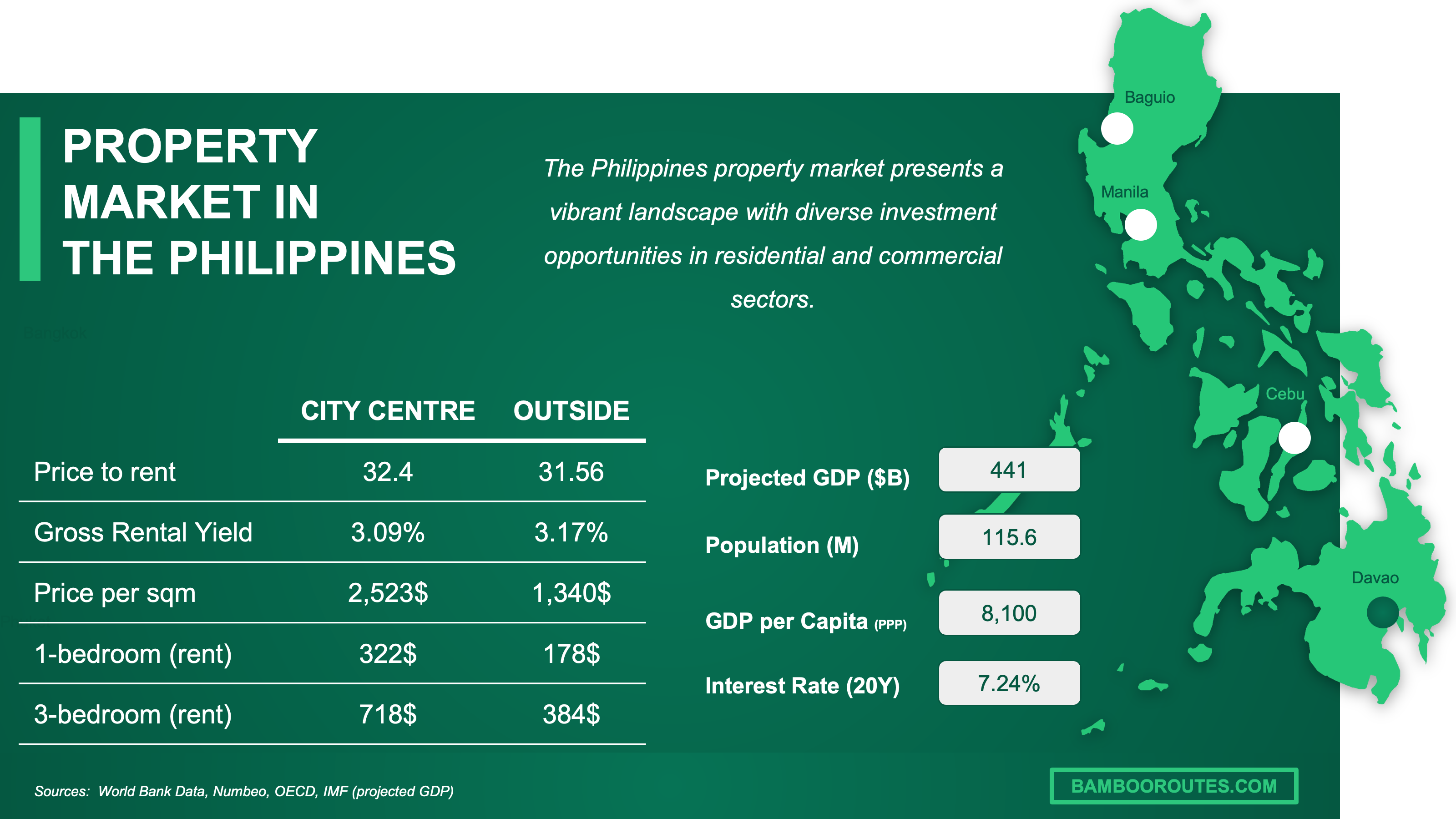
We have made this infographic to give you a quick and clear snapshot of the property market in the Philippines. It highlights key facts like rental prices, yields, and property costs both in city centers and outside, so you can easily compare opportunities. We’ve done some research and also included useful insights about the country’s economy, like GDP, population, and interest rates, to help you understand the bigger picture.
Related blog posts