
Authored by the expert who managed and guided the team behind the Philippines Property Pack
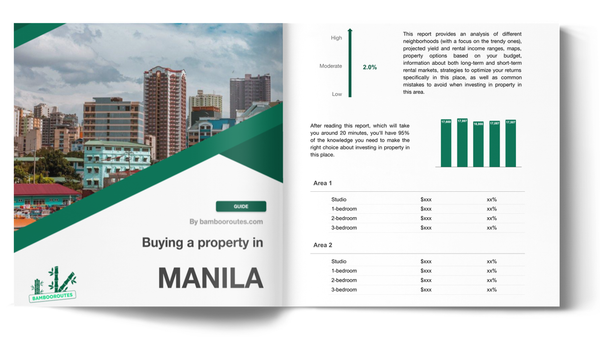
Yes, the analysis of Manila's property market is included in our pack
If you're thinking about buying property in Manila as a foreigner, one of the first questions you probably have is: what can I actually afford?
In this guide, we break down what you can realistically buy in Manila at every budget level, from $100k all the way up to the luxury market, and we keep this article constantly updated with the latest 2026 housing price data.
We also cover the hidden costs, closing fees, and what to expect for resale so you can plan properly.
And if you're planning to buy a property in this place, you may want to download our pack covering the real estate market in Manila.

What can I realistically buy with $100k in Manila right now?
Are there any decent properties for $100k in Manila, or is it all scams?
For around $100,000 (approximately 5.8 million Philippine pesos), you can realistically buy a small studio or an older one-bedroom condo in Manila, typically ranging from 18 to 35 square meters in non-prime locations.
The best value neighborhoods in Manila for a $100k budget include areas like Cubao and Commonwealth in Quezon City, the Boni-Pioneer corridor in Mandaluyong, Santa Mesa and Sampaloc in Manila City, and parts of the Taft Avenue area in Pasay, where you get more space for your money and legitimate resale options.
Buying in premium areas like Rockwell, Makati CBD, or BGC at this price point is technically possible but extremely rare, and any listing claiming to offer a large or new unit in these prime locations for under 6 million pesos should be treated with serious caution until you verify the title and seller credentials through the Registry of Deeds.
What property types can I afford for $100k in Manila (studio, land, old house)?
At the $100k level (around 5.8 million pesos) in Manila, your realistic options are almost entirely limited to condominium units because foreign individuals cannot legally own land in the Philippines under the 1987 Constitution, which means studios, micro-units, and older one-bedroom condos are what this budget actually buys.
For condition, expect that newer studios in this price range will be move-in ready but very compact (often under 25 square meters), while older resale units might give you more space but could need 150,000 to 600,000 pesos in renovations for things like fresh paint, air conditioning, and bathroom updates.
The property type that tends to offer the best long-term value at this budget in Manila is a well-located studio or small one-bedroom near transit hubs or employment centers like Ortigas-adjacent areas or MRT-accessible Mandaluyong, because these units attract steady rental demand and tend to resell faster than fringe-location bargains.
What's a realistic budget to get a comfortable property in Manila as of 2026?
As of early 2026, the realistic minimum budget to get a comfortable condo in Manila starts at around 11.5 million pesos ($200,000 USD or approximately 185,000 EUR), which is where you begin to find true one-bedroom units with actual living space rather than just a bed squeezed into a corner.
Most buyers who want a comfortable standard in Metro Manila end up spending between 11.5 million and 17.5 million pesos ($200,000 to $300,000 USD, or roughly 185,000 to 275,000 EUR) to get a unit that feels like a real home rather than just a place to sleep.
In Manila, "comfortable" generally means a condo of at least 40 to 60 square meters with a proper bedroom, a functional kitchen, decent building amenities like a pool and gym, and a location that does not require a two-hour commute to reach anything useful.
The required budget can swing dramatically depending on neighborhood, since the same 50-square-meter unit might cost 8 million pesos in Quezon City but 15 million pesos or more in Makati CBD, so where you choose to buy matters as much as how much you spend.
Get fresh and reliable information about the market in Manila
Don't base significant investment decisions on outdated data. Get updated and accurate information with our guide.

What can I get with a $200k budget in Manila as of 2026?
What "normal" homes become available at $200k in Manila as of 2026?
As of early 2026, a $200,000 budget (around 11.5 million pesos) in Manila unlocks what most people would call a "normal" home: a genuine one-bedroom condo with a separate living area, or sometimes a compact two-bedroom in mid-tier neighborhoods like Mandaluyong, Pasig near Ortigas, or parts of Quezon City.
At this price point in Manila, you can typically expect 40 to 60 square meters in mid-tier Metro Manila locations, though if you insist on Makati CBD or BGC, that same budget shrinks your options to around 28 to 45 square meters because you are paying a premium for the address.
By the way, we have much more granular data about housing prices in our property pack about Manila.
What places are the smartest $200k buys in Manila as of 2026?
As of early 2026, the smartest neighborhoods to buy at the $200,000 level (around 11.5 million pesos) in Manila include Mandaluyong near MRT stations like Boni and Shaw, Ortigas-adjacent areas in Pasig, and parts of Quezon City near universities and hospitals, because these locations combine reasonable prices with strong rental demand.
These areas are smarter buys than other $200k options in Manila because they sit in established employment and education corridors where end-users actually want to live, rather than speculative fringe developments that look cheap on paper but struggle to attract tenants or resale buyers.
The main growth factor driving value in these smart-buy areas of Manila is infrastructure connectivity, particularly proximity to MRT lines and major business districts like Ortigas Center, which keeps demand steady even when other submarkets experience oversupply and rising vacancies.
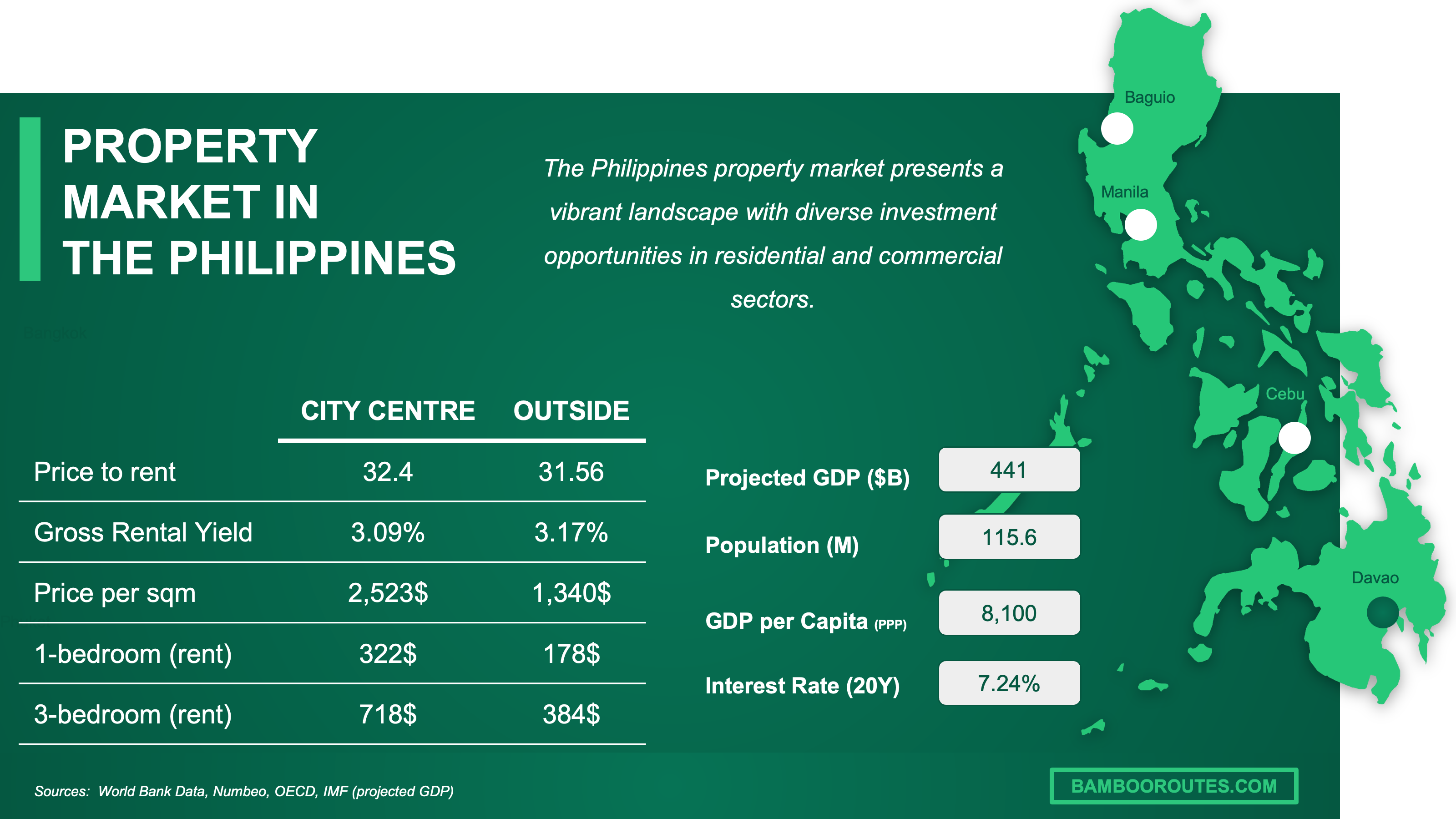
We have made this infographic to give you a quick and clear snapshot of the property market in the Philippines. It highlights key facts like rental prices, yields, and property costs both in city centers and outside, so you can easily compare opportunities. We’ve done some research and also included useful insights about the country’s economy, like GDP, population, and interest rates, to help you understand the bigger picture.
What can I buy with $300k in Manila in 2026?
What quality upgrade do I get at $300k in Manila in 2026?
As of early 2026, moving from $200k to $300k (from about 11.5 million to 17.5 million pesos) in Manila typically upgrades you from a compact one-bedroom to a proper two-bedroom unit, or lets you stay in a one-bedroom but move into a significantly better building or more desirable neighborhood.
Yes, $300k can definitely buy a property in a newer building in Manila right now, especially because developers have been offering aggressive "ready-for-occupancy" promotions to move inventory in certain segments, which means you are not stuck choosing between "new but tiny" or "spacious but old."
At this budget in Manila, you typically gain access to features like better building amenities (pools, gyms, function rooms), more modern finishes, branded appliances, and units in developments with professional property management rather than older buildings where maintenance can be hit-or-miss.
Can $300k buy a 2-bedroom in Manila in 2026 in good areas?
As of early 2026, finding a two-bedroom property for $300,000 (around 17.5 million pesos) in good areas of Manila is realistic and achievable, though "good areas" means different things depending on whether you prioritize Makati prestige or Ortigas practicality.
Specific good areas in Manila where $300k buys a two-bedroom include Ortigas-adjacent neighborhoods in Pasig and Mandaluyong, the Kapitolyo area, Shaw Boulevard corridor, and value pockets in Makati like San Antonio Village or Poblacion, where you get solid locations without paying absolute top-tier prices.
A $300k two-bedroom in Manila typically offers 55 to 85 square meters in mid-tier locations, though in Makati CBD or BGC you might find smaller two-bedrooms around 50 to 65 square meters because the price per square meter is higher in those premium addresses.
Which places become "accessible" at $300k in Manila as of 2026?
At the $300,000 price point (around 17.5 million pesos) in Manila, neighborhoods that become meaningfully accessible include BGC-adjacent areas in Taguig like Pembo and Comembo, fringe Makati locations around Legazpi Village and Salcedo Village edges, and premium Pasig spots like Kapitolyo and the Bridgetowne area near Ortigas.
These newly accessible areas are more desirable than lower-budget options because they offer proximity to Manila's most sought-after business districts without requiring you to pay full CBD prices, plus they tend to have better walkability, dining options, and overall neighborhood feel.
In these newly accessible Manila areas at $300k, buyers can typically expect a well-maintained one-bedroom or compact two-bedroom condo in a mid-rise or high-rise development with decent amenities, usually in buildings less than 10 to 15 years old.
By the way, we've written a blog article detailing what are the current best areas to invest in property in Manila.
Get to know the market before buying a property in Manila
Better information leads to better decisions. Get all the data you need before investing a large amount of money. Download our guide.
What does a $500k budget unlock in Manila in 2026?
What's the typical size and location for $500k in Manila in 2026?
As of early 2026, a $500,000 budget (around 29 million pesos) in Manila typically buys 80 to 140 square meters in prime CBD locations like Makati, BGC, or Ortigas core, with the exact size depending on the specific tower, building age, and whether you are buying resale or new.
For foreign buyers in Manila, a $500k budget cannot easily buy a traditional family home with outdoor space because land ownership restrictions under the Philippine Constitution block foreigners from owning land directly, so your practical equivalent is a larger condo with a balcony or terrace, or a townhouse through more complex legal structures like long-term leases.
At this price point in Manila, you can realistically expect a high-quality two-bedroom or even a three-bedroom condo in the best-known districts, usually with two bathrooms, and often with parking included or available for purchase.
Finally, please note that we cover all the housing price data in Manila here.
Which "premium" neighborhoods open up at $500k in Manila in 2026?
At the $500,000 price point (around 29 million pesos) in Manila, premium neighborhoods that fully open up to buyers include Rockwell Center in Makati, Legazpi Village, Salcedo Village, the Ayala Avenue corridor, BGC core areas like High Street and Fort, and Uptown Bonifacio in Taguig.
These neighborhoods are considered premium in Manila because they combine top-tier building quality with walkable urban design, strong security, proximity to high-end retail and dining, and the concentration of multinational offices and embassies that creates a cosmopolitan, globally-connected atmosphere.
In these premium Manila neighborhoods, $500k realistically buys a spacious one-bedroom or a proper two-bedroom condo (often 70 to 100 square meters) in a well-managed building with premium amenities, though three-bedroom units at this price will typically be in slightly older but still prestigious towers.
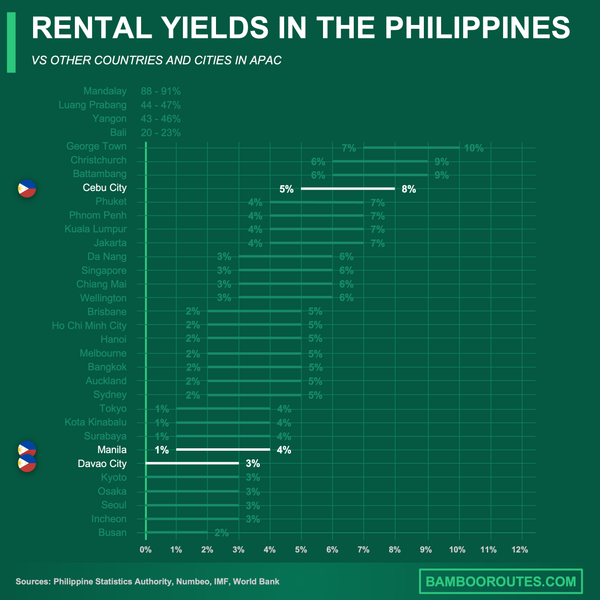
We did some research and made this infographic to help you quickly compare rental yields of the major cities in the Philippines versus those in neighboring countries. It provides a clear view of how this country positions itself as a real estate investment destination, which might interest you if you’re planning to invest there.
What counts as "luxury" in Manila in 2026?
At what amount does "luxury" start in Manila right now?
In Manila, luxury real estate generally starts at around 20 to 30 million pesos ($350,000 to $520,000 USD, or roughly 320,000 to 480,000 EUR) for entry-level luxury, which typically means a prime-district one-bedroom or compact two-bedroom in a top-tier building.
The entry point to luxury in Manila is defined by a combination of address prestige (Makati CBD, Rockwell, or BGC core), unit size that feels genuinely spacious rather than just "not cramped," and building pedigree from developers known for quality construction and strong property management.
Compared to other Southeast Asian capitals like Bangkok or Kuala Lumpur, Manila's luxury threshold is similar in dollar terms, though Manila's premium locations tend to be more geographically concentrated in just a few districts rather than spread across the city.
Mid-tier luxury in Manila runs from about 40 to 80 million pesos ($700,000 to $1.4 million USD, or 640,000 to 1.3 million EUR), while top-tier luxury penthouses and premium units can exceed 100 million pesos ($1.7 million USD or 1.6 million EUR) in the most exclusive addresses.
Which areas are truly high-end in Manila right now?
The truly high-end neighborhoods in Manila right now are Rockwell Center in Makati, Makati CBD (specifically Legazpi Village and Salcedo Village), and BGC core in Taguig, which consistently command the highest prices and attract the most affluent buyers.
These areas are considered truly high-end in Manila because they offer a rare combination of walkability, security, proximity to international schools and hospitals, concentration of luxury retail and fine dining, and buildings developed by the most reputable names in Philippine real estate like Rockwell Land and Ayala Land.
The typical buyer profile for these high-end Manila areas includes senior executives of multinational corporations, successful business owners, overseas Filipinos returning with foreign earnings, and a growing segment of foreign professionals and retirees who want the most convenient and secure lifestyle Metro Manila can offer.
Don't buy the wrong property, in the wrong area of Manila
Buying real estate is a significant investment. Don't rely solely on your intuition. Gather the right information to make the best decision.
How much does it really cost to buy, beyond the price, in Manila in 2026?
What are the total closing costs in Manila in 2026 as a percentage?
As of early 2026, total closing costs in Manila typically range from about 2% to 12% of the purchase price, with the wide range depending entirely on how the buyer and seller negotiate who pays the major taxes.
In most standard Manila transactions, buyers can expect to pay somewhere between 2% and 4% if the seller covers Capital Gains Tax and Documentary Stamp Tax, or 8% to 12% if the buyer ends up absorbing most of the tax burden as part of price negotiations.
The specific fee categories that make up this total in Manila include Capital Gains Tax (6% of selling price or zonal value, whichever is higher), Documentary Stamp Tax (1.5%), transfer tax (around 0.5% to 0.75% depending on the city), registration fees, and notarial fees.
To avoid hidden costs and bad surprises, you can check our our pack covering the property buying process in Manila.
How much are notary, registration, and legal fees in Manila in 2026?
As of early 2026, notary fees in Manila typically cost 0.5% to 1.5% of the property price, registration and LRA-related fees run about 0.2% to 0.5%, and independent legal counsel (if you hire one) adds roughly 50,000 to 200,000 pesos ($850 to $3,500 USD, or 780 to 3,200 EUR) depending on transaction complexity.
Combined, these three fee types in Manila usually represent about 1% to 3% of the property price, with the exact percentage dropping as the property value increases since some components are fixed or capped.
Of these three fees in Manila, legal fees tend to be the most expensive if you hire independent counsel for a complex transaction (like one involving a corporate structure for a foreign buyer), while notary fees are the largest percentage cost for straightforward resale deals where you just need documentation notarized.
What annual property taxes should I expect in Manila in 2026?
As of early 2026, annual property taxes in Manila for a typical mid-range condo (say, a 10-million-peso unit) usually come to around 20,000 to 30,000 pesos per year ($350 to $520 USD, or 320 to 480 EUR), which is quite manageable compared to property taxes in Western countries.
Property taxes in Metro Manila are based on assessed value (not market price) and typically represent about 1% to 1.25% of that assessed value annually, with assessed value usually set well below what you actually paid for the property.
Property taxes in Manila vary by city and property type, with Makati, Taguig, and Pasig having slightly different rates and assessment levels, so a condo in BGC might have a different tax bill than an identical-value unit in Quezon City even though both are in Metro Manila.
Exemptions or reductions are limited for foreign buyers in Manila, though senior citizens and persons with disabilities may qualify for certain discounts on their property tax bills under Philippine law.
You can find the list of all property taxes, costs and fees when buying in Manila here.
Is mortgage a viable option for foreigners in Manila right now?
Getting a mortgage as a foreigner in Manila is possible but more difficult than for Filipino citizens, with most foreign buyers finding it easier to purchase with cash or with financing arranged outside the Philippines to avoid the extra paperwork and stricter requirements local banks impose.
When Philippine banks do lend to foreigners, loan-to-value ratios typically cap at around 60% to 70% (versus up to 80% for citizens), and interest rates for housing loans currently run between 7% and 10% annually depending on the bank and loan terms.
Foreign buyers seeking a Manila mortgage typically need to provide proof of stable income, valid long-term visa or residency documentation, passport copies, bank statements, and sometimes a local co-borrower or guarantor, with each bank having slightly different requirements and comfort levels with non-citizen applicants.
You can also read our latest update about mortgage and interest rates in The Philippines.

We made this infographic to show you how property prices in the Philippines compare to other big cities across the region. It breaks down the average price per square meter in city centers, so you can see how cities stack up. It’s an easy way to spot where you might get the best value for your money. We hope you like it.
What should I predict for resale and growth in Manila in 2026?
What property types resell fastest in Manila in 2026?
As of early 2026, the property types that resell fastest in Manila are studios and one-bedroom condos in genuinely convenient locations near CBDs, MRT stations, universities, and hospitals, because these unit types match what the largest pool of buyers and renters actually need and can afford.
A correctly priced studio or one-bedroom in a liquid Manila location typically sells within 2 to 6 months, while two-bedroom and family-sized condos take longer at around 4 to 9 months, and luxury or high-ticket units can sit on the market for 6 to 12 months or more.
What makes certain properties sell faster in Manila specifically is proximity to employment hubs like Makati, BGC, and Ortigas, because the city's notorious traffic means buyers strongly prefer locations where they can walk or take a short train ride to work rather than sitting in a car for hours.
The slowest-selling property types in Manila tend to be large luxury units in oversupplied areas like parts of the Bay Area (Pasay/Paranaque waterfront), where high vacancy rates and aggressive developer competition mean resale buyers have many options and little urgency.
If you're interested, we cover all the best exit strategies in our real estate pack about Manila.
Make a profitable investment in Manila
Better information leads to better decisions. Save time and money. Download our guide.
What sources have we used to write this blog article?
Whether it's in our blog articles or the market analyses included in our property pack about Manila, we always rely on the strongest methodology we can ... and we don't throw out numbers at random.
We also aim to be fully transparent, so below we've listed the authoritative sources we used, and explained how we used them and the methods behind our estimates.
| Source | Why It's Authoritative | How We Used It |
|---|---|---|
| Bangko Sentral ng Pilipinas RPPI Report | Official central bank housing price index with documented methodology. | We used it to understand the overall direction of Metro Manila's property market. This helped us set realistic expectations for price movements and negotiations. |
| Colliers Philippines Quarterly Report | Top-tier global real estate consultancy with consistent research methodology. | We used it to identify which Manila submarkets show resilience versus oversupply. This informed our neighborhood recommendations at each budget level. |
| JLL Manila Residential Market Dynamics | Leading global property consultancy with regional market expertise. | We used it to cross-check Colliers data on rents, capital values, and supply trends. This triangulation kept our budget expectations realistic. |
| Philstar Business Section | Major national newspaper citing specific price-per-square-meter research data. | We used it as our primary source for NCR average and city-level condo prices. This anchored our calculations of what each budget actually buys in Manila. |
| Bureau of Internal Revenue | Official Philippine tax authority for all property transaction taxes. | We used it to map the major taxes that affect your total purchase cost. This helped us build realistic closing-cost scenarios for buyers. |
| DILG Local Government Code | Official government document governing local property taxation structure. | We used it to explain how annual property taxes work in Metro Manila. This helped buyers understand their ongoing ownership costs. |
| Land Registration Authority | Government agency responsible for all land title registration in the Philippines. | We used it to anchor the registration and title transfer process. This supports our buyer checklist for proper due diligence. |
| Condominium Act (RA 4726) | The controlling statute for condo ownership including foreign buyer rules. | We used it to clarify what foreigners can legally buy in Manila. This shaped our focus on condos as the practical option for foreign individuals. |
| 1987 Philippine Constitution | The supreme law establishing foreign land ownership restrictions. | We used it to explain why foreign buyers cannot own land directly. This is essential context for understanding your real options in Manila. |
| Lamudi Philippines | Major property portal with large, verifiable listing inventory. | We used it to reality-check what actually appears for sale at different price points. This validated our budget-to-size calculations. |
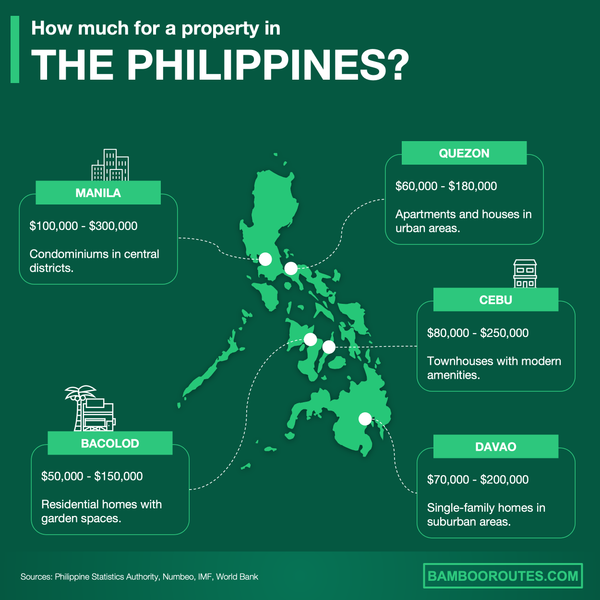
We created this infographic to give you a simple idea of how much it costs to buy property in different parts of the Philippines. As you can see, it breaks down price ranges and property types for popular cities in the country. We hope this makes it easier to explore your options and understand the market.
Related blog posts