
Get all the data you need about the real estate market in Manila
SUMMARY
We analyzed apartment rental yields in Manila, as of 2026, for residential apartment buyers, using the raw dataset provided and treating it as the factual basis for this guide.
Using that dataset, we compared estimated purchase prices, monthly rents, gross rental yields, and net rental yields across Manila neighborhoods and apartment sizes.
This page is updated regularly, so the figures should be read as a current Manila apartment yield snapshot for May 2026, not as a fixed long-term forecast.
The main finding is that Manila apartment rental yields are strongest where central rents are high but purchase prices have not moved too far ahead of income. Legazpi Village, Salcedo Village, Ermita, Malate, Ortigas Center, and Poblacion stand out in different ways.
The clearest net-yield leaders are Legazpi Village and Salcedo Village, where several apartment types reach around 4.8% to 5.0% net yield while still offering strong tenant depth and resale liquidity.
Ermita and Malate show some of the highest gross yields in the table, with studio gross yields around 6.9%, but those areas require stricter building checks because vacancy, management quality, and tenant turnover can vary sharply.
BGC and Rockwell are expensive, but they remain credible for rental income because rents are high and tenant demand is deep. BGC studios and 2-bedroom apartments both show about 6.3% gross yield and 4.7% net yield.
The weaker pure-yield areas are Alabang, New Manila, and some parts of Greenhills. They can be good places to live, but the rent often does not fully compensate for the purchase price from a rental-income perspective.
For a beginner foreign buyer, the safest Manila apartment rental yield strategy is usually a 1-bedroom apartment in a proven rental district. It costs more than a studio, but it usually attracts a broader and more stable tenant pool.
The practical takeaway is simple: compare net yield, tenant depth, building quality, liquidity, and supply risk together. In Manila, a high yield is only attractive when the building and neighborhood can actually keep the unit rented.
Get fresh and reliable information about the market in Manila
Don't base significant investment decisions on outdated data. Get updated and accurate information.

Neighborhoods and apartment rental yields in Manila in 2026
This table compares apartment rental yields in Manila by neighborhood and apartment type.
For each area, the table shows estimated purchase price, estimated monthly rent, gross rental yield, and net rental yield for studios, 1-bedroom apartments, and 2-bedroom apartments.
Finally, please note you will find much more detailed data in our real estate pack about Manila, including the operating assumptions and neighborhood-level risk interpretation behind the estimates.
| Neighborhood | Studio average purchase price | Studio average monthly rent | Studio gross rental yield | Studio net rental yield | 1-bedroom average purchase price | 1-bedroom average monthly rent | 1-bedroom gross rental yield | 1-bedroom net rental yield | 2-bedroom average purchase price | 2-bedroom average monthly rent | 2-bedroom gross rental yield | 2-bedroom net rental yield |
|---|---|---|---|---|---|---|---|---|---|---|---|---|
| Alabang | ₱5,800,000 | ₱26,000 | 5.4% | 4.0% | ₱8,900,000 | ₱38,000 | 5.1% | 3.8% | ₱13,800,000 | ₱62,000 | 5.4% | 4.0% |
| Arca South | ₱5,400,000 | ₱25,000 | 5.6% | 4.1% | ₱8,400,000 | ₱37,000 | 5.3% | 3.9% | ₱12,800,000 | ₱57,000 | 5.3% | 3.9% |
| Bay Area (MOA/Entertainment City) | ₱6,200,000 | ₱30,000 | 5.8% | 4.1% | ₱9,300,000 | ₱46,000 | 5.9% | 4.2% | ₱14,500,000 | ₱76,000 | 6.3% | 4.5% |
| BGC | ₱8,200,000 | ₱43,000 | 6.3% | 4.7% | ₱12,800,000 | ₱65,000 | 6.1% | 4.6% | ₱21,000,000 | ₱110,000 | 6.3% | 4.7% |
| Eastwood | ₱5,200,000 | ₱26,000 | 6.0% | 4.4% | ₱7,600,000 | ₱38,000 | 6.0% | 4.4% | ₱11,400,000 | ₱58,000 | 6.1% | 4.5% |
| Ermita | ₱3,800,000 | ₱22,000 | 6.9% | 4.9% | ₱6,000,000 | ₱33,000 | 6.6% | 4.6% | ₱9,200,000 | ₱50,000 | 6.5% | 4.6% |
| Greenhills | ₱6,000,000 | ₱28,000 | 5.6% | 4.1% | ₱9,400,000 | ₱43,000 | 5.5% | 4.1% | ₱14,800,000 | ₱70,000 | 5.7% | 4.2% |
| Kapitolyo | ₱4,800,000 | ₱24,000 | 6.0% | 4.4% | ₱7,000,000 | ₱34,000 | 5.8% | 4.3% | ₱10,500,000 | ₱52,000 | 5.9% | 4.3% |
| Legazpi Village | ₱7,000,000 | ₱39,000 | 6.7% | 5.0% | ₱10,800,000 | ₱58,000 | 6.4% | 4.8% | ₱17,200,000 | ₱95,000 | 6.6% | 5.0% |
| Malate | ₱3,500,000 | ₱20,000 | 6.9% | 4.7% | ₱5,400,000 | ₱30,000 | 6.7% | 4.6% | ₱8,200,000 | ₱46,000 | 6.7% | 4.6% |
| McKinley Hill | ₱6,400,000 | ₱32,000 | 6.0% | 4.4% | ₱9,600,000 | ₱49,000 | 6.1% | 4.5% | ₱15,800,000 | ₱82,000 | 6.2% | 4.5% |
| New Manila | ₱4,600,000 | ₱21,000 | 5.5% | 3.9% | ₱6,800,000 | ₱31,000 | 5.5% | 3.9% | ₱10,200,000 | ₱48,000 | 5.6% | 4.1% |
| Ortigas Center | ₱5,600,000 | ₱30,000 | 6.4% | 4.8% | ₱8,300,000 | ₱44,000 | 6.4% | 4.7% | ₱12,700,000 | ₱69,000 | 6.5% | 4.8% |
| Poblacion | ₱5,900,000 | ₱32,000 | 6.5% | 4.8% | ₱8,800,000 | ₱46,000 | 6.3% | 4.6% | ₱13,700,000 | ₱72,000 | 6.3% | 4.6% |
| Quezon Avenue/Timog | ₱3,900,000 | ₱20,500 | 6.3% | 4.5% | ₱5,800,000 | ₱29,500 | 6.1% | 4.4% | ₱8,700,000 | ₱45,000 | 6.2% | 4.5% |
| Rockwell | ₱8,400,000 | ₱42,000 | 6.0% | 4.6% | ₱13,400,000 | ₱66,000 | 5.9% | 4.5% | ₱22,500,000 | ₱118,000 | 6.3% | 4.8% |
| Salcedo Village | ₱7,300,000 | ₱40,000 | 6.6% | 4.9% | ₱11,200,000 | ₱60,000 | 6.4% | 4.8% | ₱17,800,000 | ₱98,000 | 6.6% | 5.0% |
| San Lorenzo | ₱6,700,000 | ₱36,000 | 6.4% | 4.8% | ₱10,400,000 | ₱54,000 | 6.2% | 4.6% | ₱16,300,000 | ₱90,000 | 6.6% | 4.9% |
| Vertis North | ₱5,500,000 | ₱27,000 | 5.9% | 4.3% | ₱8,200,000 | ₱41,000 | 6.0% | 4.4% | ₱12,600,000 | ₱63,000 | 6.0% | 4.4% |
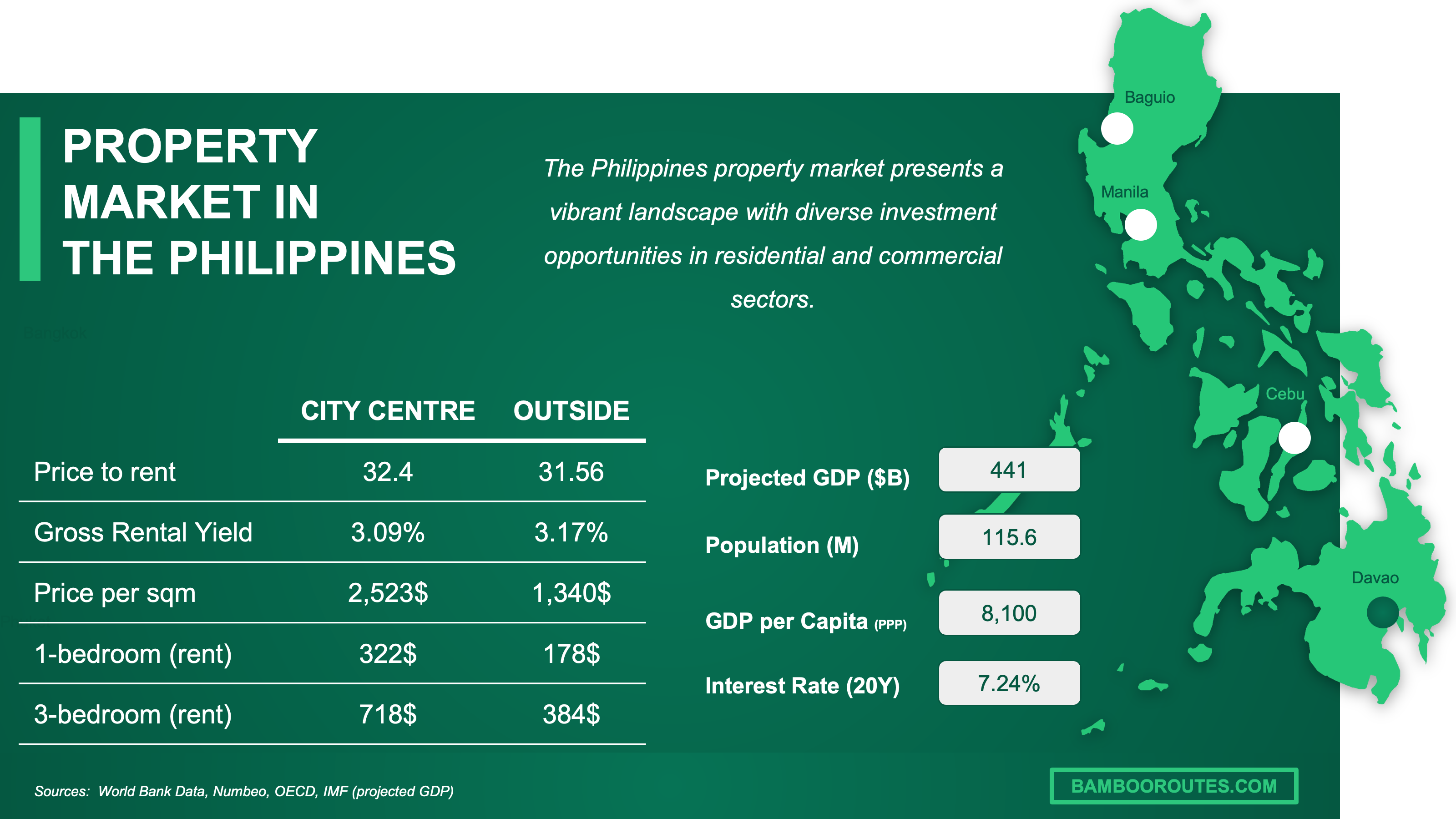
We have made this infographic to give you a quick and clear snapshot of the property market in the Philippines. It highlights key facts like rental prices, yields, and property costs both in city centers and outside, so you can easily compare opportunities. We’ve done some research and also included useful insights about the country’s economy, like GDP, population, and interest rates, to help you understand the bigger picture.
Which neighborhoods offer the best net yield among areas people actually want to live in Manila?
The neighborhoods that offer the best net yield among areas people actually want to live in Manila are Legazpi Village, Salcedo Village, Ortigas Center, BGC, Poblacion, and San Lorenzo.
These areas combine estimated net yields of roughly 4.6% to 5.0% with real tenant depth, walkability, office demand, and resale liquidity.
Legazpi Village and Salcedo Village are the clearest examples because the yield is not just a spreadsheet number. Legazpi Village reaches about 5.0% net yield for studios and 2-bedroom apartments, while Salcedo Village reaches about 4.8% to 5.0% across the three apartment types.
Ortigas Center is the value version of the same idea. A 1-bedroom apartment is estimated at ₱8.3 million and ₱44,000 monthly rent, producing about 4.7% net yield, while a 2-bedroom reaches about 4.8% net yield.
BGC is more expensive, but the rent base is strong enough to support the numbers. A 1-bedroom apartment is estimated at ₱12.8 million and ₱65,000 monthly rent, which still gives about 4.6% net yield.
Poblacion and San Lorenzo also look useful for income buyers, but for different reasons. Poblacion benefits from nightlife, restaurants, and flexible renters, while San Lorenzo benefits from Makati access and a more conventional business-district tenant pool.
Where can I find apartments with above-average yields and below-average entry prices in Manila?
The clearest neighborhoods with above-average yields and below-average entry prices in Manila are Ortigas Center, Eastwood, Kapitolyo, Quezon Avenue/Timog, Ermita, and Malate.
For a beginner buyer, Ortigas Center, Eastwood, and Kapitolyo are usually easier to underwrite than Ermita and Malate because the tenant story is cleaner and less dependent on building-by-building variation.
Eastwood is a good example of a discounted but still functional rental market. A 1-bedroom apartment is estimated at ₱7.6 million with ₱38,000 monthly rent, producing about 6.0% gross yield and 4.4% net yield.
Kapitolyo is also below the most expensive central areas, with a studio estimate of ₱4.8 million and ₱24,000 monthly rent. That gives about 6.0% gross yield and 4.4% net yield.
Ermita and Malate look cheaper and higher-yielding on paper. Ermita studios are estimated at ₱3.8 million and ₱22,000 monthly rent, while Malate studios are estimated at ₱3.5 million and ₱20,000 monthly rent.
The honest interpretation is that cheap entry price is not enough. In Manila, value works best when a lower purchase price comes with real tenant demand, not when the discount is caused by weak management, poor streets, or unstable occupancy.
Where does the rent level justify the purchase price most clearly in Manila?
The rent level justifies the purchase price most clearly in Legazpi Village, Salcedo Village, Ortigas Center, BGC, and Eastwood.
These neighborhoods show a rational relationship between rent and price because tenants pay for concrete advantages such as walkability, office access, lifestyle amenities, and shorter commutes.
Legazpi Village is one of the strongest examples. A studio apartment is estimated at ₱7.0 million and ₱39,000 monthly rent, which produces about 6.7% gross yield and 5.0% net yield.
Salcedo Village shows a similar pattern. A 2-bedroom apartment is estimated at ₱17.8 million and ₱98,000 monthly rent, producing about 6.6% gross yield and 5.0% net yield.
Ortigas Center is the best mid-price rational market. A 2-bedroom apartment is estimated at ₱12.7 million and ₱69,000 monthly rent, which gives about 6.5% gross yield and 4.8% net yield.
Eastwood is rational for a different reason. The entry prices are lower than BGC or Makati, but rents are still supported by offices, nearby Quezon City employment, and live-work convenience.
We have actually built the our real estate pack about Manila to make sure you will not buy in the wrong area. Check it out.
Make a profitable investment in Manila
Better information leads to better decisions. Save time and money. Download our data.
Where is the best place to buy if I want stable rental income rather than maximum yield in Manila?
The best places to buy for stable rental income rather than maximum yield in Manila are BGC, Legazpi Village, Salcedo Village, Rockwell, Ortigas Center, and Alabang.
These areas are not always the highest-yield neighborhoods, but they offer deeper tenant pools and better liquidity than more speculative or more uneven submarkets.
BGC is the clearest stability market. Estimated rents are ₱43,000 for studios, ₱65,000 for 1-bedroom apartments, and ₱110,000 for 2-bedroom apartments, which gives landlords a strong rent base.
Legazpi Village and Salcedo Village are stable because they sit inside Makati's most practical rental zone. Tenants pay for offices, restaurants, parks, banks, embassies, and walkability.
Rockwell is not cheap, but it is very strong for tenant quality. A 2-bedroom apartment is estimated at ₱22.5 million and ₱118,000 monthly rent, the highest 2-bedroom rent in the table.
Alabang is more family-oriented and less yield-driven. Its net yields sit around 3.8% to 4.0%, but well-located apartments near business parks, schools, malls, and southern road links can still produce stable tenants.
Which apartment type gives the best return for the lowest total investment in Manila?
The apartment type that gives the best return for the lowest total investment in Manila is usually the studio, but the safest beginner product is often the 1-bedroom apartment.
Studios have the lowest capital requirement and can show strong yields. In Malate, a studio is estimated at ₱3.5 million and ₱20,000 monthly rent, giving about 6.9% gross yield and 4.7% net yield.
Ermita studios also look strong, with an estimated ₱3.8 million purchase price and ₱22,000 monthly rent. That gives about 6.9% gross yield and 4.9% net yield.
The issue is tenant depth. Studio demand can be narrow in some Manila areas because it often depends on students, young professionals, single expats, or short-stay style renters.
One-bedroom apartments usually attract a broader renter group. Singles, couples, hybrid workers, expats, and corporate tenants can all use a good 1-bedroom apartment in BGC, Makati, Ortigas, Eastwood, or Poblacion.
Two-bedroom apartments can work in BGC, Rockwell, Salcedo Village, San Lorenzo, and Legazpi Village, but they require much more capital. For a beginner, the practical balance is usually a well-located 1-bedroom apartment.
We give you more details in the our real estate pack about Manila.
Which neighborhoods offer strong rental income with the lowest vacancy risk in Manila?
The neighborhoods that offer strong rental income with the lowest vacancy risk in Manila are BGC, Legazpi Village, Salcedo Village, Rockwell, Ortigas Center, and San Lorenzo.
These areas combine high monthly rents with tenant demand that does not depend on one narrow renter group.
BGC has the broadest rent base in the table. A 2-bedroom apartment is estimated at ₱110,000 monthly rent, while a 1-bedroom apartment is estimated at ₱65,000.
Legazpi Village and Salcedo Village have similar depth. Their 2-bedroom rents are estimated at ₱95,000 and ₱98,000, and their net yields reach around 5.0% for the strongest apartment types.
Rockwell has the highest 2-bedroom rent estimate in the dataset at ₱118,000 per month. The tenant pool is smaller, but it is usually higher-income and more focused on building quality, safety perception, and convenience.
Ortigas Center is less glamorous but practical. Estimated 1-bedroom rent of ₱44,000 and 2-bedroom rent of ₱69,000 are supported by offices, malls, hospitals, schools, and cross-city access.
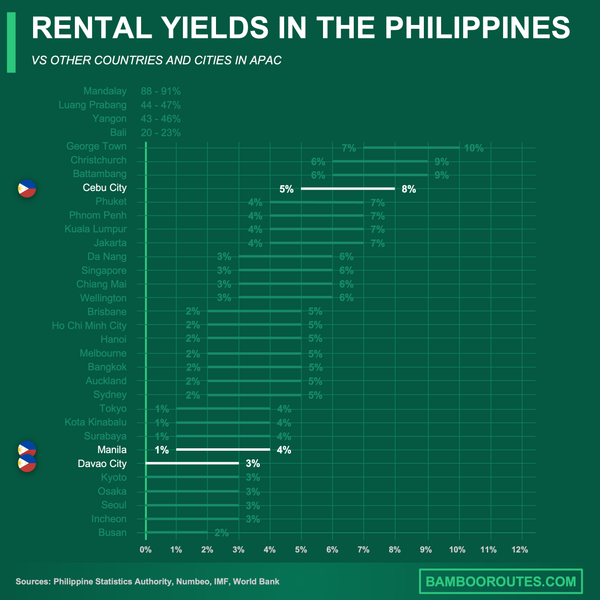
We did some research and made this infographic to help you quickly compare rental yields of the major cities in the Philippines versus those in neighboring countries. It provides a clear view of how this country positions itself as a real estate investment destination, which might interest you if you’re planning to invest there.
Which areas look overpriced relative to their rental income in Manila?
The areas that look most overpriced relative to their rental income in Manila are Alabang, New Manila, Greenhills, Rockwell, and some BGC units bought at a premium.
These are often good places to live, but the income return can be weaker when purchase prices rise faster than achievable rent.
Alabang is the clearest lower-yield example in the table. A 1-bedroom apartment is estimated at ₱8.9 million and ₱38,000 monthly rent, giving about 5.1% gross yield and 3.8% net yield.
New Manila also trails the stronger rental districts. A 1-bedroom apartment is estimated at ₱6.8 million and ₱31,000 monthly rent, which gives about 3.9% net yield.
Greenhills is more ownership-led and lifestyle-driven. Its 1-bedroom estimate of ₱9.4 million and ₱43,000 monthly rent gives about 4.1% net yield, which is below the stronger Makati and Ortigas figures.
Rockwell and BGC are different. They can still be good investments, but buyers must avoid overpaying for view premiums, luxury finishes, or branded buildings when the rent does not rise by the same amount.
Which neighborhoods should I avoid even if the rental yield looks attractive in Manila?
Beginner investors should be careful with Malate, Ermita, parts of the Bay Area, and weaker buildings in Quezon Avenue/Timog, even when the rental yield looks attractive in Manila.
The issue is not that these areas cannot work. The issue is that the headline yield can hide higher vacancy, weaker management, tenant turnover, or more competition.
Malate has one of the better headline yield profiles. Studios show about 6.9% gross yield and 4.7% net yield, while 1-bedroom apartments show about 6.7% gross yield and 4.6% net yield.
Ermita is similar. A studio is estimated at ₱3.8 million and ₱22,000 monthly rent, producing about 4.9% net yield, but investors must check the building, the surrounding streets, and the tenant profile carefully.
The Bay Area has attractive 2-bedroom numbers, with a ₱14.5 million purchase price, ₱76,000 monthly rent, and about 4.5% net yield. The risk is that similar units can compete heavily when supply is high.
Quezon Avenue/Timog can work if the building is near transport, offices, hospitals, or universities. It becomes riskier when the unit depends only on being cheap.
Which neighborhoods look risky even though the rental yield is high in Manila?
The neighborhoods that look risky even though the rental yield is high in Manila are Malate, Ermita, Bay Area, Quezon Avenue/Timog, and parts of Arca South.
Each area has a different risk source, so a high yield should not be read in the same way across all neighborhoods.
Malate and Ermita look high-yield because purchase prices are low relative to central rents. The risk is that tenant consistency and building quality can vary much more than in BGC, Makati, Rockwell, or Ortigas Center.
Bay Area yields look attractive because rents can be strong, especially for larger furnished apartments. But the same district can face more competition from similar ready units, which creates rent negotiation risk.
Quezon Avenue/Timog has reasonable yields, with studio net yield around 4.5% and 2-bedroom net yield around 4.5%. The problem is that demand is very micro-location dependent.
Arca South has a development story, but it is still a maturing rental market. Net yields of about 3.9% to 4.1% are not high enough to justify paying too much for future expectations.
Get to know the market before buying a property in Manila
Better information leads to better decisions. Get all the data you need before investing a large amount of money.
What neighborhoods should I avoid when buying a rental apartment in Manila?
When buying a rental apartment in Manila, a beginner should avoid weak buildings in Malate, Ermita, Bay Area, Quezon Avenue/Timog, and New Manila unless the price is clearly discounted.
These are not automatic no-go neighborhoods. They are areas where buying the wrong building can erase the apparent yield advantage.
In Malate, avoid poorly managed older buildings and apartments far from reliable demand anchors. The area can rent well near universities, hospitals, LRT access, and Manila Bay, but weak streets and tired buildings can create vacancy risk.
In Ermita, do not buy only because the spreadsheet looks good. A studio can show about 4.9% net yield, but the building condition, tenant screening, and street-level appeal matter heavily.
In Bay Area, avoid paying a premium for a generic unit. The district has tourism, gaming, mall, and airport-linked demand, but the buyer must price in supply competition.
In New Manila, avoid expecting high income yield from a calm residential address. Estimated net yields of about 3.9% to 4.1% are below many Manila alternatives, so the area often suits owner-use or capital preservation better than yield chasing.
Which neighborhoods are seeing rental demand weaken, and why, in Manila?
The neighborhoods where rental demand looks most pressured in Manila are Bay Area, parts of Quezon City including New Manila and Cubao, weaker Pasig fringe locations, and Alabang to Las Piñas.
The problem is not always falling rent. The problem is often more competition for tenants, which can mean longer vacancy, more negotiation, or higher furnishing expectations.
Bay Area demand has not disappeared, but it is less clean than before. Tourism, mall access, gaming, airport proximity, and Manila Bay views support rents, but many similar units can compete at the same time.
New Manila and parts of Quezon City face a different issue. They are residential and affordable, but some buildings lack the walkability or lifestyle pull of BGC, Makati, Ortigas Center, or Eastwood.
Pasig fringe locations outside the strongest Ortigas and Kapitolyo corridors can also be pressured. Tenants compare them with Ortigas Center, Mandaluyong, Eastwood, and cheaper Quezon City options.
This looks more like a supply-cycle slowdown than a structural collapse. The investor response should be to buy only at a discount, favor proven buildings, and avoid assuming that every new apartment tower will rent quickly.
Which neighborhoods are seeing new developments that could create stronger rental demand in Manila?
The Manila neighborhoods where new developments could create stronger rental demand are BGC, Ortigas/Shaw, Arca South, Vertis North, Bay Area, and Alabang.
The key is whether development creates tenants, not just more apartment supply. New offices, transport, hospitals, schools, malls, and mixed-use districts can deepen renter demand, while new towers can simply add competition.
BGC has the clearest demand story because it already has offices, lifestyle retail, international amenities, and high-income renters. In the table, BGC 2-bedroom apartments are estimated at ₱110,000 monthly rent and 4.7% net yield.
Ortigas and Shaw also have a practical rental story. Ortigas Center offers a 1-bedroom estimate of ₱8.3 million, ₱44,000 monthly rent, and 4.7% net yield, which is strong for a business-district market below Makati and BGC prices.
Arca South is more speculative. It can benefit from Taguig growth and future mixed-use activity, but current net yields around 3.9% to 4.1% mean investors should not pay BGC-like prices for a market that is still maturing.
Vertis North benefits from Quezon City's large local catchment and office-retail growth. The area looks like a medium-term rental bet, not an instant substitute for Makati or BGC.
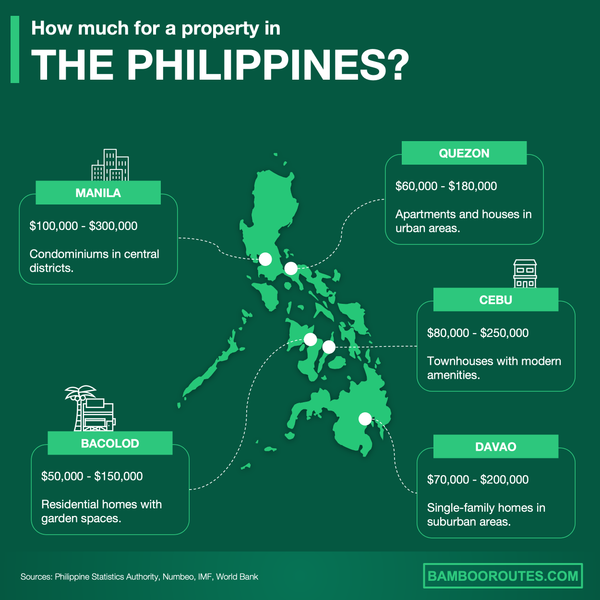
We created this infographic to give you a simple idea of how much it costs to buy property in different parts of the Philippines. As you can see, it breaks down price ranges and property types for popular cities in the country. We hope this makes it easier to explore your options and understand the market.
Which neighborhoods have become less attractive for apartment investors over the last 12 months in Manila?
The neighborhoods that have become less attractive for apartment investors over the last 12 months in Manila are Bay Area, New Manila/Cubao, Alabang to Las Piñas, and weaker Pasig fringe locations.
The common issue is that supply and pricing have moved faster than tenant absorption in several apartment submarkets.
Bay Area remains attractive for some tenants, but it is less attractive than before for generic investor units. A well-furnished 2-bedroom with views can still rent well, but many similar apartments can compete for the same renter.
New Manila and Cubao have become more difficult because supply is visible while rents remain moderate. In the table, New Manila net yields sit around 3.9% to 4.1%, which does not leave much cushion for vacancy or pricing mistakes.
Alabang is still livable and can work for family stability, but income yields are modest. The 1-bedroom net yield is about 3.8%, the weakest 1-bedroom figure in the dataset.
Weaker Pasig fringe locations face comparison pressure from Ortigas Center, Kapitolyo, Mandaluyong, and Eastwood. They may still work, but only at the right price and in the right building.
The practical conclusion is not to avoid these areas blindly. The safer rule is to avoid paying full price for generic units in supply-heavy or slower-absorbing locations.
Which apartment types are becoming harder to rent in Manila, and in which neighborhoods?
The apartment types becoming harder to rent in Manila are generic studios in oversupplied areas and expensive 2-bedroom apartments outside deep family or expat markets.
The weakness depends on location, not just apartment size. A studio in Legazpi Village, Salcedo Village, BGC, Ortigas Center, or Eastwood can be very different from a generic studio in a weaker building.
Studios are still liquid in BGC, Legazpi Village, Salcedo Village, Poblacion, Ortigas Center, Eastwood, and university-linked parts of Ermita or Malate. They work when the tenant pool is obvious.
Generic studios are more exposed in Bay Area, New Manila/Cubao, and some Quezon City buildings. If the apartment is unfurnished, badly managed, or far from transport, tenants have many alternatives.
One-bedroom apartments remain the safest Manila rental product. They serve singles, couples, hybrid workers, expats, and corporate tenants, and the format is easier to lease than a weak studio or a very expensive 2-bedroom apartment.
Two-bedroom apartments work best in BGC, Rockwell, Salcedo Village, San Lorenzo, Legazpi Village, and selected Bay Area buildings. They become harder in areas without family demand, corporate tenants, parking, good amenities, or clear access to schools and offices.
For a beginner buyer, the practical rule is simple: buy a 1-bedroom apartment in a proven rental district, or buy a studio only where the tenant pool is obvious.
Don't buy the wrong property, in the wrong area of Manila
Buying real estate is a significant investment. Don't rely solely on your intuition. Gather the right information to make the best decision.
INSIGHTS
These insights are drawn from the Manila apartment rental yield dataset, with a focus on what a foreign individual buyer should understand before buying a residential apartment to rent out.
You will find even more insights in our our real estate pack about Manila.
- Manila studios can produce strong headline yields, but they are not automatically safer than 1-bedroom apartments. The investor should compare tenant depth, building quality, and vacancy risk before treating a studio as the best choice.
- Legazpi Village and Salcedo Village offer the cleanest mix of yield and liquidity. Their best apartment types reach around 5.0% net yield, but the bigger value is that tenants understand and trust the location.
- Ortigas Center is one of the most useful value markets in the Manila dataset. It gives business-district demand at a lower entry price than Makati or BGC, which keeps the rent-to-price relationship attractive.
- BGC is expensive, but the rental case is still defensible. High rents from corporate tenants, expats, and professionals help protect net yield even when purchase prices are high.
- Rockwell is a stability asset more than a maximum-yield asset. It can earn very high monthly rent, especially for 2-bedroom apartments, but the buyer pays heavily for prestige, management quality, and address.
- Ermita and Malate are high-yield but higher-risk markets. The numbers look strong, but the investor must check management, street quality, tenant profile, and vacancy history more carefully than in prime Makati or BGC.
- Bay Area 2-bedroom apartments look attractive on rent, but supply risk matters. A high monthly rent is less valuable if many similar units compete for the same tenant base.
- Eastwood gives Manila buyers a practical middle-market option. It is cheaper than BGC and Makati, yet still has a live-work renter base that supports stable apartment demand.
- Kapitolyo works best as a value corridor near stronger Pasig and Ortigas demand. The area can offer decent yield, but the building must have a clear commuter or lifestyle advantage.
- New Manila is not a bad residential area, but it is weaker for income yield. Net yields around 3.9% to 4.1% mean buyers should not expect it to behave like a prime rental district.
- Alabang is better for stability and lifestyle than pure rental return. Its net yields are among the lowest in the dataset, but family-oriented tenants can still value the area.
- Greenhills is a useful reminder that centrality does not guarantee strong yield. Purchase prices can reflect schools, shopping, and established ownership demand more than rental income.
- San Lorenzo is a strong Makati alternative because the rent level remains high relative to purchase price. The 2-bedroom estimate reaches 4.9% net yield, which is close to the strongest figures in the table.
- Quezon Avenue/Timog is highly building-specific. The area can show fair yields, but investors need a stronger reason than affordability, such as access to offices, hospitals, universities, or transport.
- The most important Manila investment lesson is to compare net yield, not only gross yield. Vacancy, leasing costs, repairs, dues, and management friction can turn a good-looking headline yield into an average investment.
Don't lose money on your property in Manila
100% of people who have lost money there have spent less than 1 hour researching the market. We have reviewed everything there is to know. Grab our guide now.

OUR METHODOLOGY TO BUILD THIS TRACKER
To estimate purchase price, monthly rent, and rental yield in different Manila neighborhoods, we built the analysis manually from the ground up by neighborhood and apartment type. We did not reuse a third-party yield dataset.
For each area, we first collected current residential sale listings for studios, 1-bedroom apartments, and 2-bedroom apartments from major real estate platforms relevant to Manila, including Lamudi, Dot Property Philippines, and REAL.ph.
We then cleaned the sale sample. Duplicate listings, incomplete listings, unrealistic asking prices, luxury outliers, distressed assets, serviced-style offers, and non-comparable properties were removed so that each neighborhood estimate reflected ordinary residential apartment units.
For each neighborhood and apartment type, we kept only reasonably comparable properties based on location, property type, size, condition, building quality, and listing quality. We used the median purchase price as the main reference where possible, and the average only when the sample was clean.
We built the rental side of the dataset separately. For the same neighborhood and apartment type, we manually collected rental listings, removed outliers and non-comparable offers, and estimated a realistic monthly rent using the median rent where possible.
Purchase prices and rents were then matched by neighborhood and apartment type to estimate gross rental yield. The formula is simple: gross rental yield equals annual rent divided by estimated purchase price.
To estimate net yield, we did not apply one flat discount to every apartment. The deduction was adjusted by neighborhood and apartment type because association dues, vacancy risk, maintenance, repairs, leasing fees, management costs, tax friction, insurance, and building-level costs differ across Manila.
A small central studio, a high-dues tower apartment, a family-sized 2-bedroom apartment, and a slower-renting unit in a supply-heavy district should not be treated as if they have the same operating cost profile.
Each estimate was assigned a confidence level based on the size and quality of the comparable listing sample. A sample of 30 to 40 comparable listings means higher confidence, 20 to 30 comparable listings means usable but less robust, and fewer than 20 comparable listings means directional only unless the comparable area is widened.
These estimates are updated regularly and should be read as structured market estimates, not as guarantees of future rental income. Honesty, quality, and rigor are central to our work, and they are also what you will find in our real estate pack about Manila.
