
Authored by the expert who managed and guided the team behind the South Korea Property Pack
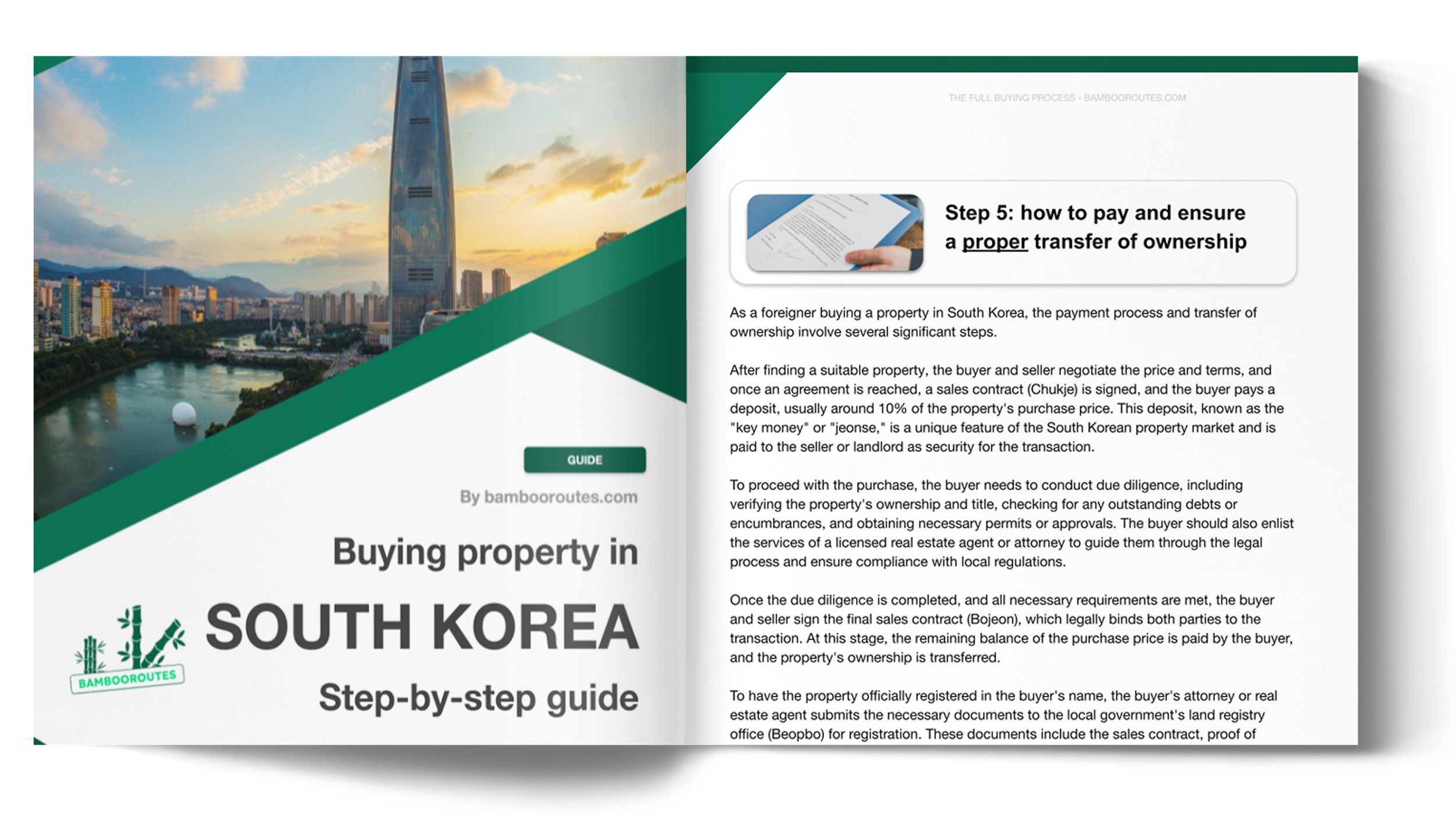
Everything you need to know before buying real estate is included in our South Korea Property Pack
Daejeon is a city where two employment engines drive the residential property market: the government complex in Seo-gu and the research and development cluster around Yuseong-gu.
If you're looking at buying property in Daejeon in 2026, you need to understand which neighborhoods sit closest to these job anchors, because that's where rents hold up and resale stays liquid.
We constantly update this blog post to keep the data fresh and relevant for buyers making decisions right now.
And if you're planning to buy a property in this place, you may want to download our pack covering the real estate market in Daejeon.

What's the Current Real Estate Market Situation by Area in Daejeon?
Which areas in Daejeon have the highest property prices per square meter in 2026?
As of early 2026, the three most expensive areas in Daejeon are Dunsan-dong in Seo-gu, Doryong-dong in Yuseong-gu, and Wolpyeong-dong in Seo-gu, where proximity to government offices and research facilities keeps demand consistently high.
In these premium Daejeon neighborhoods, you can expect to pay anywhere from 5 million to 7 million Korean won per square meter for newer apartment complexes, which translates to roughly 18 to 23 million won per 3.3 square meters (the traditional Korean measurement called "pyeong").
Each of these expensive areas commands high prices for distinct reasons:
- Dunsan-dong (Seo-gu): Home to the Government Complex Daejeon, ensuring stable demand from civil servants.
- Doryong-dong (Yuseong-gu): Sits within the Daedeok Innopolis research corridor, attracting high-income R&D professionals.
- Wolpyeong-dong (Seo-gu): Strong school districts and large parks make it the top choice for families.
These price levels were confirmed when multiple news reports in 2025 documented new Daejeon apartments crossing the 20 million won per pyeong threshold, matching the upper end of our estimates.
Which areas in Daejeon have the most affordable property prices in 2026?
As of early 2026, the most affordable property prices in Daejeon are found in Ojeong-dong and Beop-dong in Daedeok-gu, Panam-dong and Yongun-dong in Dong-gu, and parts of Seokgyo-dong in Jung-gu, where older building stock and longer commutes to the main job centers keep prices down.
In these budget-friendly Daejeon neighborhoods, apartment prices typically range from 2.3 to 3.6 million won per square meter, while villas and older walk-ups can go as low as 1.8 to 3 million won per square meter.
The trade-off in these lower-priced areas is that you'll often find older buildings without elevators, weaker school reputations, limited retail and dining options nearby, and longer travel times to Dunsan or the Yuseong research corridor where most jobs are concentrated.
You can also read our latest analysis regarding housing prices in Daejeon.
Get fresh and reliable information about the market in Daejeon
Don't base significant investment decisions on outdated data. Get updated and accurate information.

Which Areas in Daejeon Offer the Best Rental Yields?
Which neighborhoods in Daejeon have the highest gross rental yields in 2026?
As of early 2026, the highest gross rental yields in Daejeon are found in Gung-dong near KAIST (3.3% to 4.5%), Bongmyeong-dong in the Yuseong commercial area (3% to 4.2%), and parts of Galma-dong in Seo-gu (2.9% to 4%), where purchase prices remain moderate while rental demand stays strong from students and researchers.
Across Daejeon as a whole, typical gross rental yields for investment properties range from about 2.2% in premium areas like Dunsan-dong up to 4.5% in university-adjacent neighborhoods with smaller units.
Here's why these high-yield neighborhoods in Daejeon outperform others:
- Gung-dong and Eoeun-dong (Yuseong-gu): KAIST students and lab interns create year-round small-unit demand.
- Bongmyeong-dong (Yuseong-gu): Hotels and corporate visitors support mid-term rental rates.
- Galma-dong (Seo-gu): Older apartments sell at discount but still access Dunsan amenities.
One important note for foreign investors: Korea's jeonse system (lump-sum deposit leases) can make headline yields look lower than in countries where monthly rent is standard, so focusing on wolse (monthly rent) comparables gives you a clearer picture.
Finally, please note that we cover the rental yields in Daejeon here.
Get to know the market before buying a property in Daejeon
Better information leads to better decisions. Get all the data you need before investing a large amount of money.
Which Areas in Daejeon Are Best for Short-Term Vacation Rentals?
Which neighborhoods in Daejeon perform best on Airbnb in 2026?
As of early 2026, the neighborhoods in Daejeon that perform best for short-term rentals are around Daejeon Station in Dong-gu (strong KTX business travel demand), Dunsan-dong in Seo-gu (government visitors and medical tourism), and Bongmyeong-dong in Yuseong-gu (hot spring tourism and dining district).
Top-performing short-term rental properties in these Daejeon neighborhoods can generate between 1.5 and 3 million won per month depending on the unit size and whether you're capturing weekday business travelers or weekend leisure guests.
Here's what makes these neighborhoods stand out for short-term rentals:
- Daejeon Station area (Dong-gu): Direct KTX access brings business travelers who need one or two night stays.
- Dunsan-dong (Seo-gu): Hospitals, government offices, and shopping attract visitors on multi-day trips.
- Bongmyeong-dong (Yuseong-gu): Hot springs and restaurants draw weekend tourists from Seoul.
Keep in mind that Daejeon's short-term rental demand comes more from business and research travel than pure tourism, so areas near the government complex and R&D institutions tend to have higher weekday occupancy than typical vacation destinations.
By the way, we also have a blog article detailing whether owning an Airbnb rental is profitable in Daejeon.
Which tourist areas in Daejeon are becoming oversaturated with short-term rentals?
The areas in Daejeon showing signs of short-term rental saturation are Bongmyeong-dong (where many small units have converted to rentals), the streets immediately around Daejeon Station, and parts of the Yuseong hot spring district where listing density has grown quickly.
While Daejeon doesn't have the same listing density as Seoul or Busan tourist zones, these areas have seen a noticeable increase in competing properties, with Bongmyeong-dong and Daejeon Station each hosting several dozen active short-term listings concentrated in a small geographic area.
The clearest sign of oversaturation in these Daejeon areas isn't just the listing count but rather the growing gap between weekday and weekend occupancy, along with hosts increasingly competing on price rather than differentiation, which signals too much supply chasing the same limited demand pool.
Make a profitable investment in Daejeon
Better information leads to better decisions. Save time and money. Download our data.
Which Areas in Daejeon Are Best for Long-Term Rentals?
Which neighborhoods in Daejeon have the strongest demand for long-term tenants?
The neighborhoods with the strongest long-term rental demand in Daejeon are Dunsan-dong and Wolpyeong-dong in Seo-gu (government employee families), Gung-dong and Eoeun-dong in Yuseong-gu (students and young researchers), and Noeun-dong in Yuseong-gu (families working in the R&D corridor).
In these high-demand Daejeon neighborhoods, well-maintained apartments typically find tenants within two to four weeks, and vacancy rates stay consistently low because the tenant pools are tied to stable institutions rather than seasonal factors.
Here's who drives rental demand in each area:
- Dunsan-dong and Wolpyeong-dong (Seo-gu): Government employees and their families seeking school-quality districts.
- Gung-dong and Eoeun-dong (Yuseong-gu): KAIST students, graduate researchers, and lab interns on semester cycles.
- Noeun-dong and Doan-dong (Yuseong-gu): Mid-career professionals working at Daedeok Innopolis research institutes.
The key amenity that makes these neighborhoods attractive to long-term tenants in Daejeon is proximity to their workplace (government complex or research campus) combined with good schools, parks, and reliable public transit that reduces daily commute stress.
Finally, please note that we provide a very granular rental analysis in our property pack about Daejeon.
What are the average long-term monthly rents by neighborhood in Daejeon in 2026?
As of early 2026, monthly rents in Daejeon range from around 500,000 won for a small studio near KAIST up to 2.3 million won for a family-sized apartment in the Dunsan prime area, with most neighborhoods falling somewhere in between depending on unit size and building age.
In the most affordable Daejeon neighborhoods like Daedeok-gu's value zones, you can find entry-level family apartments renting for 900,000 to 1.6 million won per month, which attracts budget-conscious tenants willing to trade commute time for savings.
In average-priced Daejeon neighborhoods like Noeun-dong or Doan-dong in Yuseong-gu, mid-range two to three bedroom apartments typically rent for 1.2 to 2.1 million won per month, offering a balance between price and access to the research corridor.
In the most expensive Daejeon neighborhoods like Dunsan-dong and Wolpyeong-dong in Seo-gu, high-end family apartments command 1.3 to 2.3 million won per month because tenants are paying for school quality, walkable amenities, and the shortest commutes to government offices.
You may want to check our latest analysis about the rents in Daejeon here.
Don't buy the wrong property, in the wrong area of Daejeon
Buying real estate is a significant investment. Don't rely solely on your intuition. Gather the right information to make the best decision.
Which Are the Up-and-Coming Areas to Invest in Daejeon?
Which neighborhoods in Daejeon are gentrifying and attracting new investors in 2026?
As of early 2026, the neighborhoods in Daejeon that are gentrifying and drawing investor interest include Daeheung-dong and Eunhaeng-dong in Jung-gu (central location with selective upgrades), and Jayang-dong in Dong-gu (improving transport links and relative value compared to Seo-gu and Yuseong-gu).
These gentrifying Daejeon neighborhoods have seen price appreciation of roughly 3% to 6% annually over the past two years as renovated buildings and new retail openings gradually shift the neighborhood character, though results vary widely depending on the specific building and block.
Which areas in Daejeon have major infrastructure projects planned that will boost prices?
The areas in Daejeon expected to benefit most from infrastructure projects are neighborhoods along the planned Metro Line 2 (tram) corridor, and the catchment around the newly opened Yuseong Complex Terminal, where improved transit access typically translates to higher property values.
The specific projects to watch are Daejeon Metro Line 2 (construction began on section 1-2 in late 2025, with completion targeted for 2028) and the Yuseong Complex Terminal which opened in January 2026 after 15 years of planning.
Historically in Daejeon, neighborhoods that gained new metro or major transit access have seen price increases of 5% to 15% above citywide averages in the years following completion, with most of the "convenience premium" getting priced in before the actual opening date.
You'll find our latest property market analysis about Daejeon here.

We made this infographic to show you how property prices in South Korea compare to other big cities across the region. It breaks down the average price per square meter in city centers, so you can see how cities stack up. It’s an easy way to spot where you might get the best value for your money. We hope you like it.
Which Areas in Daejeon Should I Avoid as a Property Investor?
Which neighborhoods in Daejeon with lots of problems I should avoid and why?
Rather than avoiding entire districts in Daejeon, the real risk lies in specific property types that cluster in certain areas: very old walk-up villas with poor maintenance, single-building apartments far from job anchors, and units in flood-prone or steep-slope micro-locations that require local due diligence to identify.
Here are the main problems in areas where these risky properties tend to concentrate:
- Ojeong-dong and Beop-dong (Daedeok-gu): High concentration of 30+ year old buildings with weak parking and hidden maintenance costs.
- Older pockets of Panam-dong (Dong-gu): Low liquidity makes resale difficult when the market slows.
- Yongun-dong (Dong-gu): Distance from both employment engines means vacancy risk rises fast in downturns.
For any of these neighborhoods to become viable investment options, you would need to see either a major new employer move nearby, a transit station added to the area, or a large-scale redevelopment project that replaces the aging housing stock with modern buildings that families actually want to live in.
Buying a property in the wrong neighborhood is one of the mistakes we cover in our list of risks and pitfalls people face when buying property in Daejeon.
Which areas in Daejeon have stagnant or declining property prices as of 2026?
As of early 2026, the areas in Daejeon experiencing price stagnation or soft declines are primarily older-stock concentrations in parts of Daedeok-gu and Dong-gu, where buildings constructed in the 1980s and 1990s struggle to compete with newer housing options closer to the city's two employment engines.
These underperforming areas have seen prices stay flat or decline by 2% to 5% over the past two years while better-located neighborhoods continued appreciating, creating a growing gap between the haves and have-nots in Daejeon's property market.
Here's what's causing the stagnation in each area:
- Songchon-dong (Daedeok-gu): No redevelopment pipeline and limited transit keep families choosing elsewhere.
- Jayang-dong outer edges (Dong-gu): Still waiting for promised infrastructure improvements to materialize.
- Seokgyo-dong outskirts (Jung-gu): Building age without renovation keeps the area in a value trap.
Get the full checklist for your due diligence in Daejeon
Don't repeat the same mistakes others have made before you. Make sure everything is in order before signing your sales contract.

Which Areas in Daejeon Have the Best Long-Term Appreciation Potential?
Which areas in Daejeon have historically appreciated the most recently?
The areas in Daejeon that have appreciated most over the past five to ten years are Dunsan-dong in Seo-gu (the most liquid family market), newer planned housing zones in Yuseong-gu like Noeun-dong and Doan-dong, and Doryong-dong near the Daedeok research corridor.
Here's how much these top-performing Daejeon neighborhoods have gained:
- Dunsan-dong (Seo-gu): Roughly 40% to 60% total appreciation over the past decade, driven by government job stability.
- Noeun-dong and Doan-dong (Yuseong-gu): 35% to 55% gains as newer housing attracted R&D corridor families.
- Doryong-dong (Yuseong-gu): 30% to 50% appreciation linked to Innopolis employment growth.
The main driver behind these above-average returns is that all three areas sit directly adjacent to Daejeon's two employment engines (government complex and R&D cluster), which provides a structural floor under demand that more peripheral neighborhoods simply don't have.
By the way, you will find much more detailed trends and forecasts in our pack covering there is to know about buying a property in Daejeon.
Which neighborhoods in Daejeon are expected to see price growth in coming years?
The neighborhoods in Daejeon expected to see the strongest price growth in coming years are those along the Metro Line 2 corridor (capturing the transit premium before completion), Yuseong-gu areas near Daedeok Innopolis (benefiting from R&D employment growth), and Dunsan core in Seo-gu (remaining the default choice for family buyers).
Here are the projected growth rates for these high-potential Daejeon neighborhoods:
- Metro Line 2 corridor neighborhoods: Expected 4% to 7% annual growth as construction progresses toward 2028.
- Doryong-dong and Gwanpyeong-dong (Yuseong-gu): Projected 3% to 5% annual gains tied to research sector hiring.
- Dunsan-dong prime (Seo-gu): Steady 2% to 4% annual appreciation as the market's safe haven.
The single most important catalyst for future price growth in these Daejeon neighborhoods is the completion of Metro Line 2, which will fundamentally improve accessibility for areas that currently feel disconnected and create new "station-adjacent premium" pockets that don't exist today.
We made this infographic to show you how property prices in South Korea compare to other big cities across the region. It breaks down the average price per square meter in city centers, so you can see how cities stack up. It’s an easy way to spot where you might get the best value for your money. We hope you like it.
What Do Locals and Expats Really Think About Different Areas in Daejeon?
Which areas in Daejeon do local residents consider the most desirable to live?
Local residents in Daejeon consistently rank Dunsan-dong, Wolpyeong-dong, and Tanbang-dong in Seo-gu as the most desirable places to live, followed by newer Yuseong-gu neighborhoods like Noeun-dong and Doan-dong that offer modern housing near the research corridor.
Here's what makes these neighborhoods most desirable to Daejeon locals:
- Dunsan-dong (Seo-gu): Walkable CBD-style amenities plus the best school catchments in the city.
- Wolpyeong-dong (Seo-gu): Large parks and family-friendly atmosphere with easy government complex access.
- Noeun-dong and Doan-dong (Yuseong-gu): Newer buildings with modern layouts preferred by young professional families.
These locally-preferred Daejeon neighborhoods are home to middle and upper-middle class Korean families, typically dual-income households with school-age children who prioritize education quality and short commutes over maximizing living space.
Local preferences in Daejeon largely align with what foreign investors target, since both groups value the same fundamentals: stable employment anchors, good schools, modern housing stock, and liquidity when it's time to sell.
Which neighborhoods in Daejeon have the best reputation among expat communities?
The neighborhoods with the best reputation among expats in Daejeon are areas around KAIST in Yuseong-gu (Gung-dong, Eoeun-dong, and nearby) for those connected to academia and research, and Dunsan-dong in Seo-gu for those who want easy access to services, international restaurants, and English-friendly facilities.
Here's why expats prefer these Daejeon neighborhoods:
- Yuseong-gu near KAIST: Proximity to international research community and colleagues who speak English.
- Dunsan-dong (Seo-gu): Most services and retail concentrated here, making daily life easier without fluent Korean.
The expat profile in Daejeon differs from Seoul or Busan because it's heavily skewed toward international academics, researchers, engineers, and their families connected to KAIST, ETRI, or other Daedeok Innopolis institutions, rather than corporate expatriates or English teachers.
Which areas in Daejeon do locals say are overhyped by foreign buyers?
The areas in Daejeon that locals sometimes consider overhyped by foreign buyers are small "central" units marketed as easy short-term rental investments, particularly around Bongmyeong-dong and near Daejeon Station, where the convenience of the location doesn't always translate to the returns that marketing materials suggest.
Here's why locals think these areas get overvalued by foreign buyers:
- Bongmyeong-dong small units: Buyers underestimate building rule restrictions and compliance costs for short-term rentals.
- Daejeon Station vicinity: Convenience premium gets priced in without accounting for limited tenant pool depth.
What foreign buyers see in these areas that locals don't value as highly is the perceived "Airbnb opportunity" and the appeal of a simple, low-management investment, while locals know that Korea's rental regulations and building association rules make short-term renting more complicated than it appears.
By the way, we've written a blog article detailing the experience of buying a property as a foreigner in Daejeon.
Which areas in Daejeon are considered boring or undesirable by residents?
The areas that Daejeon residents commonly consider boring or undesirable are older, car-dependent pockets in Daedeok-gu (like parts of Ojeong-dong and Beop-dong) and Dong-gu (like outer Panam-dong and Yongun-dong), where limited retail, dining, and entertainment options make daily life feel isolated.
Here's why residents find these areas boring or undesirable:
- Ojeong-dong and Beop-dong (Daedeok-gu): Few cafes, restaurants, or shops within walking distance.
- Panam-dong and Yongun-dong outer areas (Dong-gu): Long drives required for basic errands and entertainment.
For investors, "boring" can actually mean opportunity if you find an undervalued asset in an area with a realistic catalyst for change, but in Daejeon these areas currently lack the infrastructure projects or major employer moves that would shift the desirability equation.
Don't lose money on your property in Daejeon
100% of people who have lost money there have spent less than 1 hour researching the market. We have reviewed everything there is to know. Grab our guide now.
What sources have we used to write this blog article?
Whether it's in our blog articles or the market analyses included in our property pack about Daejeon, we always rely on the strongest methodology we can … and we don't throw out numbers at random.
We also aim to be fully transparent, so below we've listed the authoritative sources we used, and explained how we used them and the methods behind our estimates.
| Source | Why It's Authoritative | How We Used It |
|---|---|---|
| Korea Real Estate Board (REB) | Korea's official real estate market monitor producing widely cited housing statistics. | We used REB as our baseline for how Daejeon prices and rents are moving over time. We relied on it to avoid cherry-picking anecdotes from individual listings. |
| Bank of Korea | Korea's central bank whose rate decisions directly shape mortgage costs and buyer demand. | We used BOK's base rate context to explain why affordability feels tight in early 2026. We also grounded our financing assumptions on their published policy decisions. |
| KOSIS (Statistics Korea) | Korea's official statistics portal for population, households, income, and inflation data. | We used KOSIS for demographic and inflation context that drives long-run housing demand. We also used CPI as a reality-check for real price changes. |
| Daejeon Metropolitan City Statistics | The city government's own data on population, jobs, and local economic indicators. | We used it to size demand by district and understand where population and jobs concentrate. We used these fundamentals to sanity-check which neighborhoods can sustain rents. |
| KOTRA Foreign Land Acquisition Guide | Korea's trade and investment agency summarizing the legal framework for foreign buyers. | We used it to explain what foreigners can own and what must be reported. We kept our ownership guidance aligned with actual law rather than hearsay. |
| Government Buildings Management Office | Official government site describing the Government Complex Daejeon employment anchor. | We used it to justify why Dunsan-dong commands a structural premium. We treated government jobs as an anchor for long-term rents and resale liquidity. |
| KAIST | Official page confirming the main campus location of Korea's top science university. | We used it to ground student and academic rental demand around Yuseong-gu. We explained why nearby neighborhoods have resilient small-unit occupancy. |
| Innopolis | Official site for the Daedeok research ecosystem tied to Korea's R&D corridor. | We used it to support the jobs and R&D gravity story around Yuseong. We treated this as a demand backbone for family rentals and corporate stays. |
| Seoul Economic Daily | Mainstream business newspaper covering identifiable infrastructure project milestones. | We used it to time-stamp Metro Line 2 catalysts that can reprice neighborhoods. We treated it as a project reality-check alongside city statements. |
| Chosun | Major national outlet reporting concrete local transport upgrades with specific timing. | We used it to identify the Yuseong Complex Terminal opening in January 2026. We flagged where tenant convenience and rent can improve first. |
| Korea JoongAng Daily | Reports specific Ministry policy changes relevant to legal short-term renting in Korea. | We used it to separate legal short-term rental paths from Airbnb assumptions. We framed compliance risk and cost in our STR yield estimates. |
Get the full checklist for your due diligence in Daejeon
Don't repeat the same mistakes others have made before you. Make sure everything is in order before signing your sales contract.
Related blog posts