
Authored by the expert who managed and guided the team behind the Philippines Property Pack

Everything you need to know before buying real estate is included in our The Philippines Property Pack
Central Luzon is one of the fastest-growing regions in the Philippines, and its rental market offers real opportunities for foreign investors who know the rules.
This guide covers everything you need to know about legally owning, managing, and profiting from rental property in Central Luzon as a foreigner in 2026.
We constantly update this blog post to reflect the latest regulations, market data, and rental trends in the region.
And if you're planning to buy a property in this place, you may want to download our pack covering the real estate market in Central Luzon.
Insights
- Gross rental yields in Central Luzon average around 6.5% in 2026, but studios near Clark Freeport Zone can reach 9% when priced and positioned correctly.
- Foreigners cannot own land in the Philippines, so the cleanest buy-to-rent route in Central Luzon is purchasing a condominium unit subject to the 40% foreign ownership cap per project.
- Short-term rentals in Clark and Angeles City average about 50% occupancy, but well-reviewed listings with professional management can push past 60%.
- The Rent Control Act in Central Luzon only caps increases for units renting at or below PHP 10,000 per month, meaning most investor-grade properties operate at market rates.
- Vacancy rates in Central Luzon typically run around 10% annually, but properties near Clark Freeport or San Fernando often experience lower vacancy due to steady employment demand.
- Furnished rentals in Central Luzon command a 15% to 25% rent premium over unfurnished units, and they typically lease one to two weeks faster in Clark and Angeles City.
- The average nightly rate for short-term rentals in Central Luzon is around PHP 3,200 (about USD 55 or EUR 52), with premium Clark-area listings reaching PHP 4,800 per night.
- Real property tax in Central Luzon is modest compared to other Asian markets, but landlords must budget for both the Basic RPT and the Special Education Fund levy set by each local government unit.

Can I legally rent out a property in Central Luzon as a foreigner right now?
Can a foreigner own-and-rent a residential property in Central Luzon in 2026?
As of early 2026, foreigners can legally own and rent out residential property in Central Luzon, but ownership is generally limited to condominium units rather than land.
The most straightforward ownership structure for a foreign individual in Central Luzon is purchasing a condo unit outright, or alternatively, entering a long-term lease arrangement (up to 50 years, renewable for another 25) under the Investors' Lease Act if you want to control a house on leased land.
The single biggest restriction foreigners face in Central Luzon is that Philippine law prohibits foreign individuals from owning land directly, so buying a standalone house-and-lot in your personal name is not a realistic option.
If you're not a local, you might want to read our guide to foreign property ownership in Central Luzon.
Do I need residency to rent out in Central Luzon right now?
You do not need to be a Philippine resident to rent out property in Central Luzon, and most foreign landlords manage their rentals remotely through local property managers.
However, you will need a Tax Identification Number (TIN) from the Bureau of Internal Revenue to legally collect and report rental income in Central Luzon.
A local Philippine bank account is not strictly required by law, but it is strongly recommended because tenants typically pay via local bank transfers or e-wallets, and your property manager will need to handle local expenses.
Managing a rental property in Central Luzon entirely from abroad is common and practical, especially if you hire a reliable property manager to handle tenant screening, rent collection, and maintenance.
Thinking of buying real estate in Central Luzon?
Acquiring property in a different country is a complex task. Don't fall into common traps – grab our guide and make better decisions.

What rental strategy makes the most money in Central Luzon in 2026?
Is long-term renting more profitable than short-term in Central Luzon in 2026?
As of early 2026, neither long-term nor short-term renting is universally more profitable in Central Luzon because the best strategy depends heavily on your property's location and your willingness to manage operational complexity.
A well-managed short-term rental near Clark Freeport Zone can generate 20% to 40% more annual income than a comparable long-term rental (roughly PHP 50,000 to PHP 80,000 more per year, or USD 860 to USD 1,380 / EUR 820 to EUR 1,310), but this comes with higher operating costs and more hands-on management.
Short-term renting tends to outperform financially in Central Luzon when your property is a furnished condo or house near Clark airport, Angeles City's Balibago district, or the Subic Bay area where business travelers and weekend tourists drive consistent demand.
What's the average gross rental yield in Central Luzon in 2026?
As of early 2026, the average gross rental yield for residential properties in Central Luzon is approximately 6.5%.
The realistic range for gross rental yields in Central Luzon spans from about 4.5% for suburban houses in less connected areas to around 9% for well-located studios and one-bedroom units near Clark Freeport Zone.
Studios and one-bedroom condos typically achieve the highest gross rental yields in Central Luzon because they rent efficiently to young professionals and business travelers while requiring lower purchase prices than larger units.
By the way, we have much more granular data about rental yields in our property pack about Central Luzon.
What's the realistic net rental yield after costs in Central Luzon in 2026?
As of early 2026, the average net rental yield after all costs for residential properties in Central Luzon is approximately 4.0%.
Most landlords in Central Luzon experience net yields ranging from about 2.5% for properties with high vacancy or management costs to around 6.0% for efficiently run units in prime locations like Clark or San Fernando.
The three main cost categories that eat into your gross yield in Central Luzon are property management fees (8% to 25% of rent depending on long-term versus short-term), condominium association dues or HOA fees (which can be surprisingly high in newer developments), and aircon and water heater repairs (a constant expense in the region's tropical climate).
You might want to check our latest analysis about gross and net rental yields in Central Luzon.
What monthly rent can I get in Central Luzon in 2026?
As of early 2026, typical monthly rents in Central Luzon are around PHP 20,000 (USD 345 / EUR 330) for a studio, PHP 30,000 (USD 515 / EUR 490) for a one-bedroom, and PHP 45,000 (USD 775 / EUR 740) for a two-bedroom apartment.
A decent studio in Central Luzon typically rents for PHP 15,000 to PHP 25,000 per month (USD 260 to USD 430 / EUR 245 to EUR 410), with units near Clark Freeport Zone commanding the higher end of that range.
A typical one-bedroom apartment in Central Luzon rents for PHP 20,000 to PHP 40,000 per month (USD 345 to USD 690 / EUR 330 to EUR 660), depending on furnishing quality and proximity to employment centers.
A standard two-bedroom apartment in Central Luzon rents for PHP 30,000 to PHP 65,000 per month (USD 515 to USD 1,120 / EUR 490 to EUR 1,070), with prime Clark-adjacent locations and fully furnished units reaching the top of that range.
If you want to know more about this topic, you can read our guide about rents and rental incomes in Central Luzon.
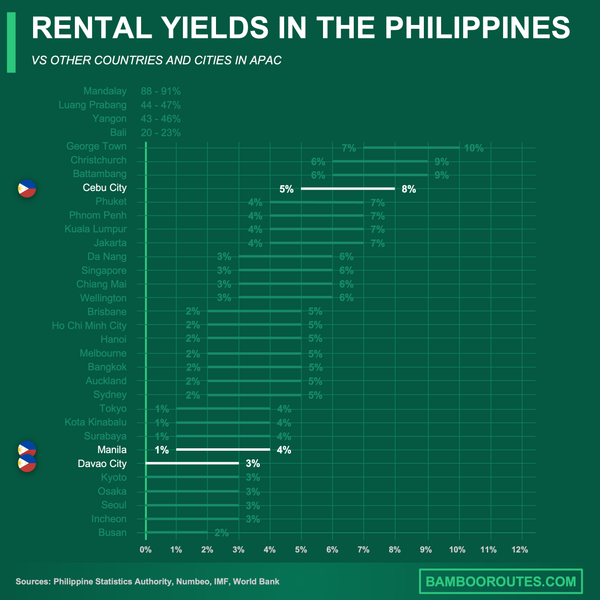
We did some research and made this infographic to help you quickly compare rental yields of the major cities in the Philippines versus those in neighboring countries. It provides a clear view of how this country positions itself as a real estate investment destination, which might interest you if you’re planning to invest there.
What are the real numbers I should budget for renting out in Central Luzon in 2026?
What's the total "all-in" monthly cost to hold a rental in Central Luzon in 2026?
As of early 2026, the total all-in monthly cost to hold and maintain a typical condo rental in Central Luzon is approximately PHP 12,000 to PHP 15,000 (USD 205 to USD 260 / EUR 195 to EUR 245), excluding any mortgage payments.
The realistic range for monthly holding costs in Central Luzon spans from about PHP 9,000 (USD 155 / EUR 148) for a smaller unit with minimal management to PHP 18,000 (USD 310 / EUR 295) for a larger property with full professional management.
The single largest cost category for rental property owners in Central Luzon is typically the condominium association dues or HOA fees, which can run PHP 3,000 to PHP 8,000 per month depending on the development's amenities and whether it includes common area maintenance.
You want to go into more details? Check our list of property taxes and fees you have to pay when buying a property in Central Luzon.
What's the typical vacancy rate in Central Luzon in 2026?
As of early 2026, the typical vacancy rate for rental properties in Central Luzon is approximately 10%, which translates to about 1.2 months of vacancy per year.
Landlords in Central Luzon should realistically budget for 0.7 to 2.0 months of vacancy per year (6% to 17% vacancy rate) because even well-located properties experience turnover between tenants and occasional slow leasing periods.
The main factor that causes vacancy rates to vary across Central Luzon neighborhoods is proximity to stable employment centers, with areas near Clark Freeport Zone, San Fernando's commercial district, and Bulacan's commuter corridors experiencing lower vacancy than more remote provincial towns.
Tenant turnover in Central Luzon tends to peak during the first quarter of the year (January to March) when many lease contracts expire and employees relocate after receiving year-end bonuses or changing jobs.
We have a whole part covering the best rental strategies in our pack about buying a property in Central Luzon.
Get fresh and reliable information about the market in Central Luzon
Don't base significant investment decisions on outdated data. Get updated and accurate information with our guide.
Where do rentals perform best in Central Luzon in 2026?
Which neighborhoods have the highest long-term demand in Central Luzon in 2026?
As of early 2026, the top three neighborhoods with the highest overall long-term rental demand in Central Luzon are Clark Freeport Zone and its immediate surroundings in Mabalacat, Angeles City's Balibago and Malabanias districts, and the City of San Fernando's Dolores and Sindalan areas.
Families looking to rent in Central Luzon gravitate toward Clark Manor and other Clark-adjacent subdivisions in Mabalacat, San Fernando's Telabastagan neighborhood, and the Malolos-Guiguinto corridor in Bulacan where space, schools, and stability are the priorities.
Students generate the strongest rental demand in Angeles City near the clusters of colleges and universities around Balibago, as well as in Cabanatuan City's central barangays in Nueva Ecija where local universities drive room and studio demand.
Expats and international professionals seeking rentals in Central Luzon concentrate heavily in Clark Freeport Zone itself and the Balibago and Malabanias areas of Angeles City where furnished units, security, and Western-style amenities are readily available.
By the way, we've written a blog article detailing what are the current best areas to invest in property in Central Luzon.
Which neighborhoods have the best yield in Central Luzon in 2026?
As of early 2026, the top three neighborhoods with the best rental yields in Central Luzon are Angeles City's non-prime Balibago-adjacent barangays, select mid-market condo and townhouse areas in San Fernando, and the Olongapo and Subic gateway areas in Zambales.
These high-yield neighborhoods in Central Luzon typically deliver gross rental yields in the 7% to 9% range, compared to the regional average of around 6.5%.
The main characteristic that allows these neighborhoods to achieve higher yields is that purchase prices have not yet caught up with rental demand, meaning you can buy at relatively modest prices while still attracting steady tenants who work at Clark, commute to Metro Manila, or visit Subic on weekends.
We cover a lot of neighborhoods and provide a lot of updated data in our pack about real estate in Central Luzon.
Where do tenants pay the highest rents in Central Luzon in 2026?
As of early 2026, the top three neighborhoods where tenants pay the highest rents in Central Luzon are inside Clark Freeport Zone, the prime Balibago corridor in Angeles City, and high-end Clark-adjacent subdivisions like those in Mabalacat.
A standard apartment in these premium Central Luzon neighborhoods typically rents for PHP 40,000 to PHP 80,000 per month (USD 690 to USD 1,380 / EUR 660 to EUR 1,315), with large furnished houses exceeding PHP 100,000 in some cases.
The main characteristic that makes these neighborhoods command the highest rents is their combination of gated security, proximity to Clark International Airport and major business locators, and access to international-standard amenities that tenants cannot easily find elsewhere in the region.
The typical tenant profile in these highest-rent Central Luzon neighborhoods includes foreign executives working at Clark locator companies, airline crew on extended stays, embassy staff, and Filipino-American returnees who prioritize security, modern finishes, and reliable utilities.
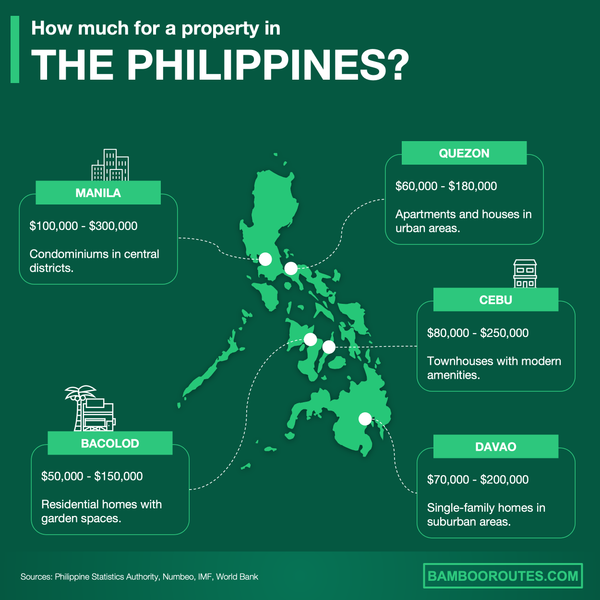
We created this infographic to give you a simple idea of how much it costs to buy property in different parts of the Philippines. As you can see, it breaks down price ranges and property types for popular cities in the country. We hope this makes it easier to explore your options and understand the market.
What do tenants actually want in Central Luzon in 2026?
What features increase rent the most in Central Luzon in 2026?
As of early 2026, the top three property features that increase monthly rent the most in Central Luzon are reliable split-type air conditioning in every bedroom (essential in the region's hot climate), backup power or a generator connection (critical given occasional outages), and 24/7 security with controlled gate access (a major selling point in Clark and Angeles City).
Reliable air conditioning is the single most valuable feature in Central Luzon rentals, adding an estimated 10% to 15% rent premium because tenants simply will not consider units without proper cooling in this tropical region.
One commonly overrated feature that landlords invest in but tenants do not pay much extra for in Central Luzon is a swimming pool, which adds maintenance costs but rarely justifies a significant rent increase unless the property targets short-term vacation renters.
One affordable upgrade that provides a strong return on investment for landlords in Central Luzon is installing fiber internet wiring and a quality router, which costs under PHP 15,000 but makes the property significantly more attractive to remote workers and business travelers.
Do furnished rentals rent faster in Central Luzon in 2026?
As of early 2026, furnished apartments in Central Luzon typically rent one to two weeks faster than unfurnished units, especially in Clark and Angeles City where business travelers and expats want move-in-ready options.
Furnished apartments in Central Luzon command a rent premium of approximately 15% to 25% over comparable unfurnished units, though landlords must budget for higher wear-and-tear costs and furniture replacement every few years.
Get to know the market before you buy a property in Central Luzon
Better information leads to better decisions. Get all the data you need before investing a large amount of money. Download our guide.
How regulated is long-term renting in Central Luzon right now?
Can I freely set rent prices in Central Luzon right now?
Landlords in Central Luzon have significant freedom to set initial rent prices at market rates, with rent control only applying to lower-priced units renting at or below approximately PHP 10,000 per month under the Rent Control Act framework.
For covered low-rent units in Central Luzon, annual rent increases are capped at a government-set percentage (recently around 2% to 7% depending on the resolution period), but most investor-grade properties rent above the threshold and can be adjusted to market rates between tenants.
What's the standard lease length in Central Luzon right now?
The standard lease length for residential rentals in Central Luzon is 12 months (one year), which is the market norm for both condos and houses across Angeles City, San Fernando, and Clark-adjacent areas.
Landlords in Central Luzon typically require one month advance rent plus one to two months security deposit, and while Philippine law does not set a strict maximum, anything beyond two months deposit is uncommon in the market.
Security deposits in Central Luzon must be returned within a reasonable period after the tenant vacates (often 30 to 60 days per the lease contract), minus any legitimate deductions for unpaid utilities, damages beyond normal wear, or other agreed expenses.

We made this infographic to show you how property prices in the Philippines compare to other big cities across the region. It breaks down the average price per square meter in city centers, so you can see how cities stack up. It’s an easy way to spot where you might get the best value for your money. We hope you like it.
How does short-term renting really work in Central Luzon in 2026?
Is Airbnb legal in Central Luzon right now?
Airbnb-style short-term rentals are legal and widely operated in Central Luzon, though hosts must comply with local government permit requirements and BIR registration for rental income.
Operating a short-term rental in Central Luzon typically requires a barangay clearance, a business permit from the city or municipality, BIR registration, and optionally DOT accreditation if you want to market the property as an accredited tourist accommodation.
Central Luzon does not currently impose a uniform annual night cap like some European cities, so you can technically rent your property year-round as long as you maintain proper permits and your building or subdivision rules allow it.
The most common consequence for operating an unlicensed short-term rental in Central Luzon is receiving a notice of violation from the local government unit, which can lead to fines, permit revocation, or forced closure if you continue operating without compliance.
By the way, we also have a blog article detailing whether owning an Airbnb rental is profitable in Central Luzon.
What's the average short-term occupancy in Central Luzon in 2026?
As of early 2026, the average annual occupancy rate for short-term rentals in Central Luzon is approximately 50%.
The realistic occupancy range for most short-term rentals in Central Luzon spans from about 40% for average listings to around 60% or higher for professionally managed properties with strong reviews and competitive pricing.
Short-term rentals in Central Luzon typically see their highest occupancy rates during December and January (holiday season), Holy Week in March or April, and long weekends throughout the year when domestic tourists flock to Subic and Clark.
The lowest occupancy periods for short-term rentals in Central Luzon are typically June through September (rainy season) and the post-holiday lull in February, when both tourism and business travel slow down significantly.
Finally, please note that you can find much more granular data about this topic in our property pack about Central Luzon.
What's the average nightly rate in Central Luzon in 2026?
As of early 2026, the average nightly rate for short-term rentals in Central Luzon is approximately PHP 3,200 (USD 55 / EUR 52).
The realistic nightly rate range for most short-term rentals in Central Luzon spans from about PHP 2,400 (USD 41 / EUR 39) for basic units in secondary locations to PHP 4,800 (USD 83 / EUR 79) for premium furnished condos and houses near Clark Freeport Zone.
The typical nightly rate difference between peak season (December, Holy Week, long weekends) and off-season (rainy months) in Central Luzon is approximately PHP 800 to PHP 1,500 (USD 14 to USD 26 / EUR 13 to EUR 25), with some hosts increasing rates by 30% or more during high-demand periods.
Is short-term rental supply saturated in Central Luzon in 2026?
As of early 2026, short-term rental supply in Central Luzon is partially saturated, with competition notably intense in certain pockets but still manageable for well-differentiated properties.
The number of active short-term rental listings in Central Luzon has been gradually growing as more investors chase Airbnb yields, though growth has moderated compared to the rapid expansion seen in 2022 and 2023.
The most oversaturated neighborhoods for short-term rentals in Central Luzon are Angeles City's Balibago district and the areas immediately surrounding Clark Freeport Zone, where supply has grown faster than demand in recent years.
Neighborhoods in Central Luzon that still have room for new short-term rental supply include parts of San Fernando targeting domestic business travelers, the Subic Bay Freeport area for weekend leisure demand, and emerging areas along the Bulacan commuter belt where supply remains thin.
Don't lose money on your property in Central Luzon
100% of people who have lost money there have spent less than 1 hour researching the market. We have reviewed everything there is to know. Grab our guide now.

What sources have we used to write this blog article?
Whether it's in our blog articles or the market analyses included in our property pack about Central Luzon, we always rely on the strongest methodology we can … and we don't throw out numbers at random.
We also aim to be fully transparent, so below we've listed the authoritative sources we used, and explained how we used them and the methods behind our estimates.
| Source | Why it's authoritative | How we used it |
|---|---|---|
| Condominium Act (RA 4726) - Lawphil | This is the primary Philippine law governing condominium ownership including foreign ownership limits. | We used it to clarify what foreigners can legally own in Central Luzon. We then applied that to realistic buy-to-rent scenarios for condo investors. |
| Investors' Lease Act (RA 7652) - Lawphil | This is the controlling law for long-term land leases by foreign investors. | We used it to explain the lease alternative to owning land outright. We also referenced the term limits to clarify long-term rental strategies. |
| Rent Control Act (RA 9653) - Lawphil | This is the core statute enabling rent regulation for covered residential units. | We used it to explain when rent increases are capped in Central Luzon. We then showed which investor properties typically fall outside coverage. |
| Bureau of Internal Revenue - Withholding Tax Portal | This is the official BIR portal consolidating withholding and compliance rules. | We used it to confirm that foreign landlords need BIR registration. We then summarized the practical compliance steps for remote owners. |
| BSP Residential Property Price Index Report | BSP is the central bank and its RPPI is one of the most credible housing price references. | We used it to anchor the price side when calculating yields. We paired it with rent data to produce confident yield ranges for Central Luzon. |
| Colliers Philippines - Residential Market Report | Colliers is a global brokerage with published methodology and recurring Philippine market reporting. | We used it to confirm Pampanga and Bulacan are strong residential markets. We then used that to justify demand assumptions and vacancy estimates. |
| Philippine Statistics Authority - Central Luzon 2024 Census | PSA is the national statistics office with official regional population data. | We used it to validate Central Luzon's large and growing population base. We then factored that into long-term rental demand projections. |
| AirDNA - Short-Term Rental Data Platform | AirDNA is a widely used STR data provider tracking occupancy, rates, and supply. | We used it to benchmark short-term occupancy and nightly rates in Central Luzon. We adjusted the data for local seasonality patterns in Clark and Subic. |
| Clark Development Corporation - Memo Circulars | CDC administers Clark Freeport Zone and publishes official circulars affecting residents. | We used it to highlight Clark's additional governance layer for rentals. We then explained why Clark-area rentals behave differently than regular city rentals. |
| Department of Tourism - Accommodation Accreditation Rules | DOT is the government regulator for tourism establishments and accreditation. | We used it to explain the compliance angle for short-term rentals. We converted it into practical STR registration steps for investors. |
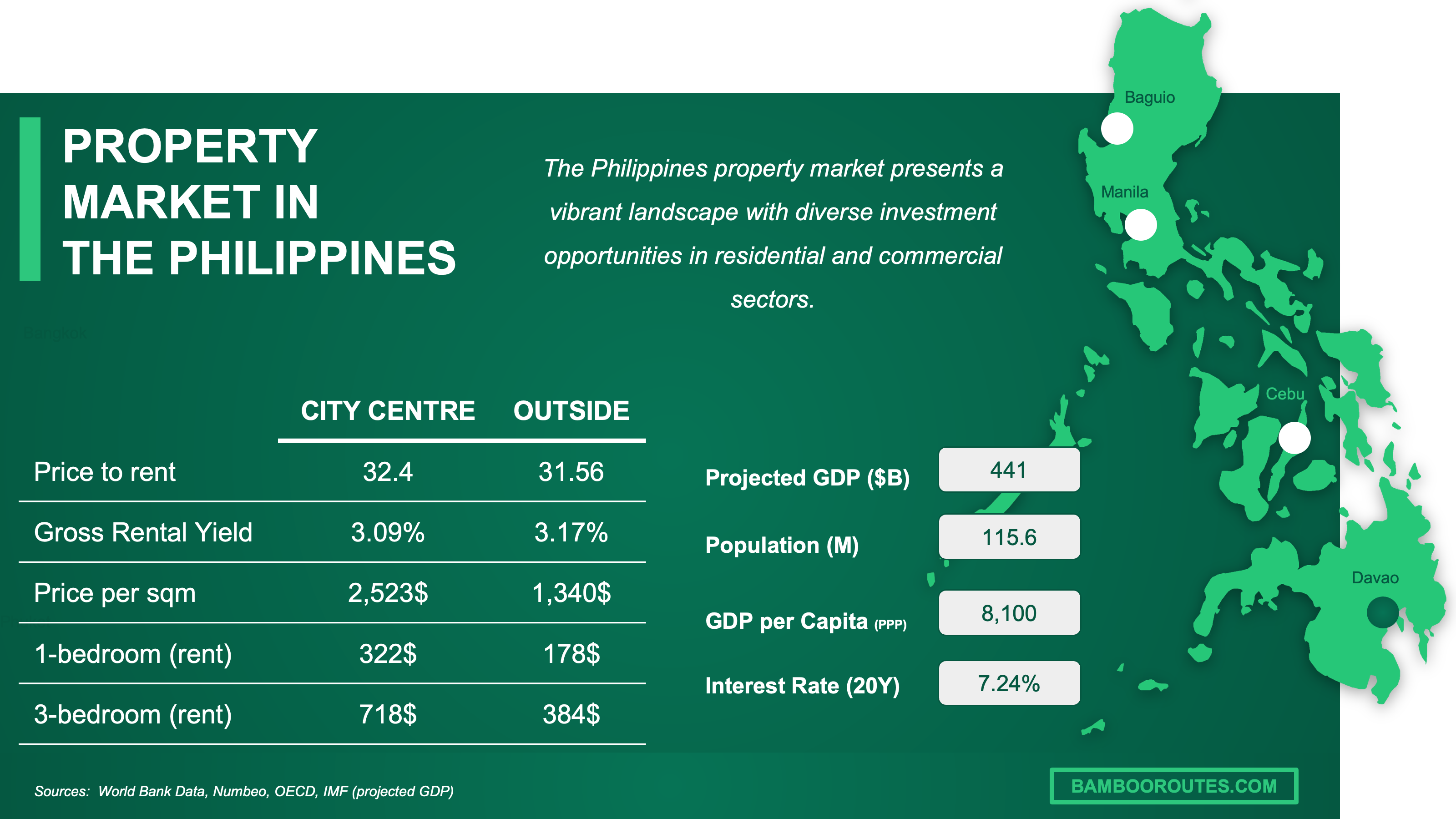
We have made this infographic to give you a quick and clear snapshot of the property market in the Philippines. It highlights key facts like rental prices, yields, and property costs both in city centers and outside, so you can easily compare opportunities. We’ve done some research and also included useful insights about the country’s economy, like GDP, population, and interest rates, to help you understand the bigger picture.
Related blog posts
- Is now a good time to invest in property in Central Luzon?