
Authored by the expert who managed and guided the team behind the Philippines Property Pack
Everything you need to know before buying real estate is included in our The Philippines Property Pack
Negros Island sits in the heart of the Visayas region, and whether you are drawn to Bacolod's urban energy, Dumaguete's university-town charm, or the beaches of Dauin and Sipalay, the rules for foreigners buying land here follow national Philippine law.
This guide breaks down exactly what you can and cannot do as a foreign buyer on Negros Island, covering the legal structures, costs, risks, and practical steps you need to know.
We constantly update this blog post to reflect the latest legal changes and market conditions.
And if you're planning to buy a property in this place, you may want to download our pack covering the real estate market in Negros Island.
Insights
- Foreigners on Negros Island cannot directly own land in 2026, but the 2025 amendment to the Investors' Lease Act now allows lease terms up to 99 years, which is a significant improvement from the previous 75-year maximum.
- The capital gains tax alone on a Negros Island land sale runs at 6% of the property value, and in practice, buyers often end up paying it even though it is technically the seller's responsibility.
- In Bacolod, popular residential barangays like Villamonte, Mandalagan, and Taculing see the same foreign ownership restrictions as beach towns like Dauin, because the rule is national and not local.
- Nominee or "dummy" ownership arrangements, where land is placed in a Filipino's name but controlled by a foreigner, are actively scrutinized by the SEC and can result in forfeiture of the property.
- A clean land purchase on Negros Island typically takes 6 to 12 weeks, but agrarian reform clearances or unsettled heir issues can push timelines to 6 months or longer.
- Buying only a "tax declaration" instead of a registered title is one of the most common traps for foreign buyers on Negros Island, and it does not give you legal ownership.
- The Registry of Deeds for Negros Occidental (covering Bacolod) and Negros Oriental (covering Dumaguete) are separate offices, and verifying your title at the correct one is essential.
- Coastal "beachfront" parcels on Negros Island sometimes turn out to be foreshore or public land, meaning they cannot be privately owned at all, regardless of what a seller claims.
- Total buyer-side closing costs on Negros Island typically range from 4% to 7% of the property price, but this can rise to 10% to 13% if the buyer also covers the seller's capital gains tax.

Can a foreigner legally own land on Negros Island right now?
Can foreigners own land on Negros Island in 2026?
As of early 2026, the Philippine Constitution prohibits foreigners from directly owning private land on Negros Island, with only a narrow exception for inheritance through hereditary succession.
This ban means that a foreign individual cannot simply purchase a residential lot in Bacolod, Dumaguete, or anywhere else on the island and have the title placed in their name.
The closest legal alternative for foreigners on Negros Island is a long-term lease of private land, which under Republic Act 12252 (signed in 2025) can now extend up to 99 years, or purchasing a condominium unit where foreign ownership caps apply but land ownership is not required.
These restrictions are citizenship-based rather than nationality-based, so a buyer from the United States, Australia, or any other country faces the same rules as long as they are not Filipino citizens.
Can I own a house but not the land on Negros Island in 2026?
As of early 2026, Philippine law does not provide a common framework for foreigners to own a standalone house separately from the land it sits on, because in most normal transactions the house and land are treated as a single ownership package.
What foreigners typically do instead is lease the land on a long-term basis and either build a house under that lease or purchase an existing structure, with the lease contract spelling out their rights to the improvements.
When the underlying land lease expires on Negros Island, the terms of your lease agreement determine what happens to any building you constructed or purchased, so it is critical to negotiate renewal rights and compensation clauses upfront.
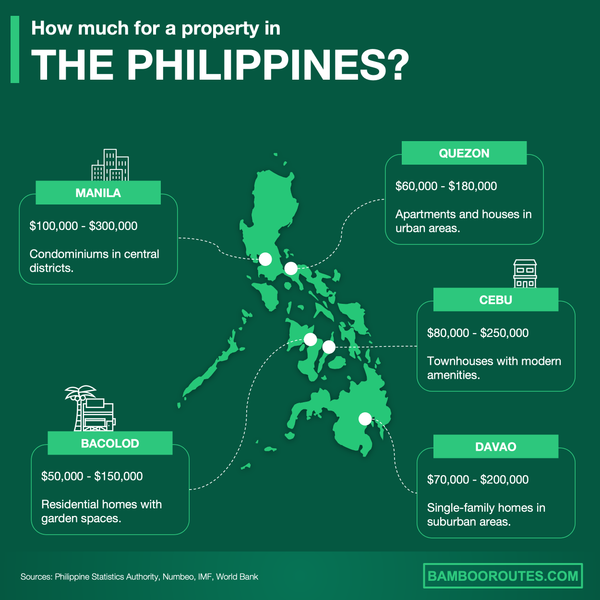
We created this infographic to give you a simple idea of how much it costs to buy property in different parts of the Philippines. As you can see, it breaks down price ranges and property types for popular cities in the country. We hope this makes it easier to explore your options and understand the market.
Do rules differ by region or city for land ownership on Negros Island right now?
The foreign ownership restriction on Negros Island does not vary between Bacolod in Negros Occidental, Dumaguete in Negros Oriental, or smaller towns like Sipalay or Dauin, because it is a national constitutional rule that applies uniformly across the Philippines.
What does differ locally is land classification, zoning, and practical risks, so a parcel in Piapi (Dumaguete) might have different development permits than one in Granada (Bacolod), and coastal lots near Dauin may involve protected area overlays that interior lots do not have.
These local differences exist because municipalities handle zoning, the Department of Agrarian Reform controls agricultural land transfers, and agencies like DENR manage environmental classifications, all of which can affect what you can do with a property even if the foreign ownership rule itself is the same everywhere.
We cover a lot of different regions and cities in our pack about the property market in Negros Island.
Can I buy land on Negros Island through marriage to a local in 2026?
As of early 2026, marrying a Filipino citizen does not grant a foreigner the right to own land on Negros Island, because the constitutional restriction is based on citizenship and marriage does not change a foreigner's citizenship status.
If land is purchased, it must legally be in the Filipino spouse's name, and the foreign spouse should ensure they have proper documentation such as a prenuptial agreement or postnuptial contract that clarifies their financial contributions and rights.
In the event of divorce or annulment on Negros Island, a foreign spouse does not automatically gain ownership of the land, and property division will follow Philippine family law, which generally means land stays with the qualified Filipino owner unless specific arrangements were made.
There is a lot of mistakes you can make, we cover 99% of them in our list of risks and pitfalls people face when buying property in Negros Island.
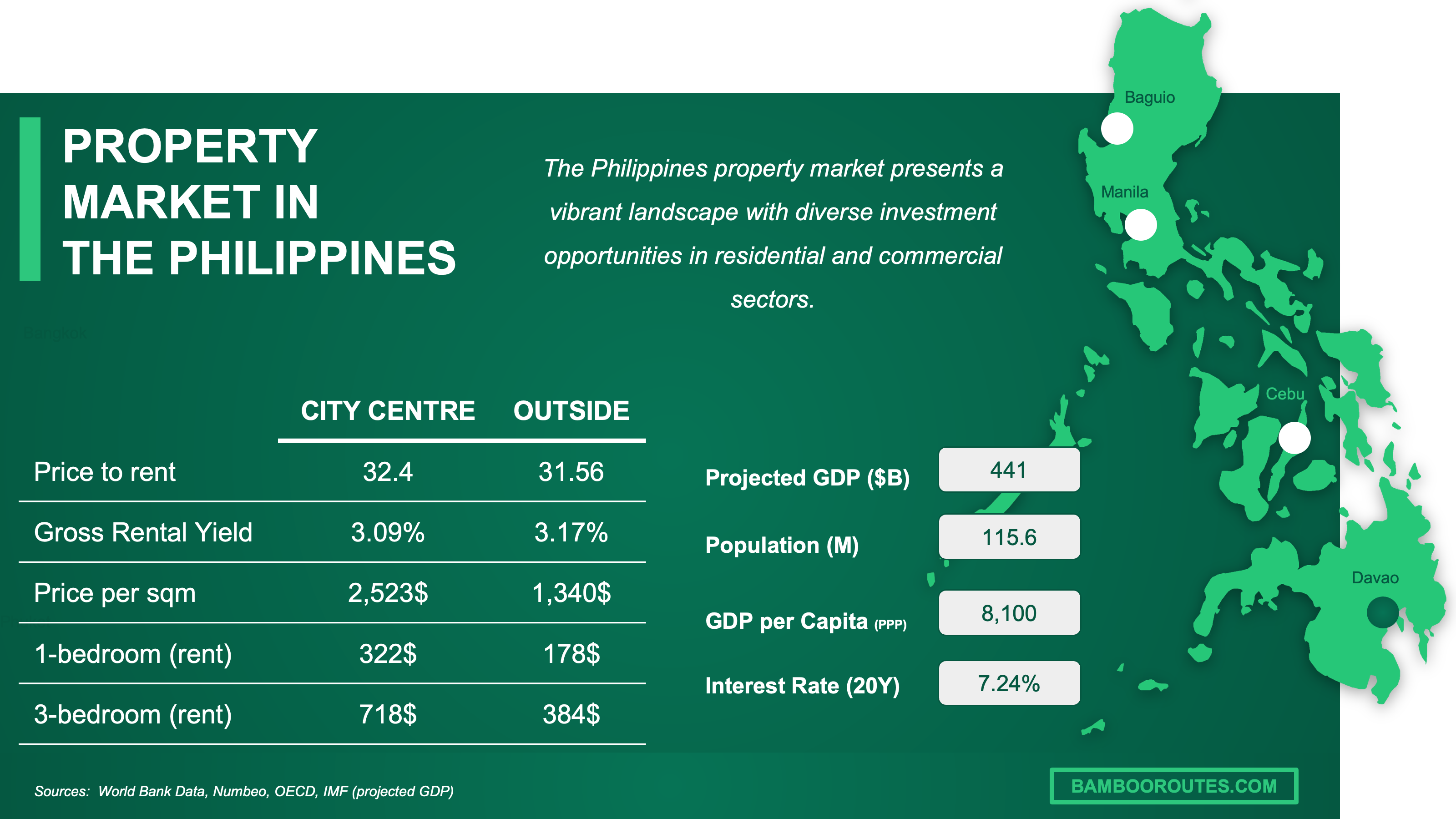
We have made this infographic to give you a quick and clear snapshot of the property market in the Philippines. It highlights key facts like rental prices, yields, and property costs both in city centers and outside, so you can easily compare opportunities. We’ve done some research and also included useful insights about the country’s economy, like GDP, population, and interest rates, to help you understand the bigger picture.
What eligibility and status do I need to buy land on Negros Island?
Do I need residency to buy land on Negros Island in 2026?
As of early 2026, residency in the Philippines does not solve the core issue for foreigners on Negros Island, because even long-term residents cannot own land unless they are Filipino citizens or qualify under the narrow inheritance exception.
For the legal alternatives like long-term leases, no specific visa is required to sign a contract, but having a valid visa (such as a tourist visa, SRRV, or investor visa) makes the process smoother and helps with related steps like obtaining a tax identification number.
It is legally possible for a foreigner to execute a lease or other property transaction on Negros Island remotely using a Special Power of Attorney, though most cautious buyers still visit at least once to verify the property and meet involved parties.
Do I need a local tax number to buy lands on Negros Island?
If you are entering any formal property transaction on Negros Island, whether a lease or assisting a qualified buyer, you will almost certainly need a TIN (Taxpayer Identification Number) because BIR paperwork gates the entire registration process.
Obtaining a TIN as a foreigner in the Philippines typically takes a few days to a couple of weeks, involving a visit to the local BIR office with your passport and visa, or working through an authorized representative if you are abroad.
Opening a local bank account on Negros Island is not strictly required by law, but it is practically very useful for paying local taxes, fees, and producing a clear money trail that authorities and sellers find reassuring.
Is there a minimum investment to buy land on Negros Island as of 2026?
As of early 2026, there is no official minimum investment threshold that allows a foreigner to bypass the constitutional ban on land ownership on Negros Island, so paying more money does not unlock direct ownership.
For the lease route, the minimum is simply whatever the landowner requires and what fits within the legal framework of RA 12252, meaning you could lease a small lot for a modest sum or a large estate for millions depending on the negotiation.
Are there restricted zones foreigners can't buy on Negros Island?
Since foreigners generally cannot buy land anywhere on Negros Island, the more useful question is which restricted zones can derail a lease, a Filipino spouse's purchase, or a company's land acquisition plans.
On Negros Island, the main restricted categories include protected areas under the NIPAS Act, ancestral domains covered by the Indigenous Peoples' Rights Act, agricultural land subject to agrarian reform rules, and foreshore or coastal public lands that cannot be privately owned.
To verify whether a specific plot on Negros Island falls within a restricted zone, you should check with the Department of Environment and Natural Resources (DENR) for protected areas, the National Commission on Indigenous Peoples (NCIP) for ancestral domains, and the Department of Agrarian Reform (DAR) for agricultural classifications.
Can foreigners buy agricultural, coastal or border land on Negros Island right now?
The baseline rule remains the same: foreigners cannot directly own agricultural, coastal, or border land on Negros Island because the constitutional ban applies to all private land regardless of classification.
Agricultural land on Negros Island carries additional restrictions because even Filipino-to-Filipino transfers often require DAR clearance, and land that was once under agrarian reform may have conditions that prevent sale to certain buyers.
Coastal land on Negros Island, especially "beachfront" parcels near Dauin or Sipalay, can be particularly tricky because some of it is actually foreshore or public land where private ownership claims are invalid, and what the seller shows you may not match the legal reality.
Land near strategic infrastructure or sensitive areas on Negros Island is already blocked by the foreign ownership ban, but even for Filipino buyers or companies, such parcels may require extra permits, easements, or security clearances.
Get fresh and reliable information about the market in Negros Island
Don't base significant investment decisions on outdated data. Get updated and accurate information with our guide.

What are the safest legal structures to control land on Negros Island?
Is a long-term lease equivalent to ownership on Negros Island right now?
A long-term lease on Negros Island can feel similar to ownership in daily use, but legally it gives you contract rights over the land rather than a title in your name, which means you are a lessee, not an owner.
Under Republic Act 12252 (the 2025 amendment to the Investors' Lease Act), foreigners can now secure leases on Negros Island for up to 99 years, a significant increase from the previous 75-year maximum, and renewability depends on how your lease contract is drafted within the law's framework.
Whether you can sell, transfer, or bequeath your lease rights on Negros Island depends entirely on the assignment and transfer clauses in your contract, so this is a must-negotiate item before signing because many standard leases quietly block assignment.
Can I buy land on Negros Island via a local company?
A foreigner can only purchase land on Negros Island through a Philippine corporation if that corporation is legally qualified to own land, which in practice means it must be Filipino-controlled with at least 60% Filipino equity.
If foreign ownership in the company exceeds 40%, the corporation becomes disqualified from holding land, and the SEC actively scrutinizes structures that appear designed to circumvent nationality rules, so this is not a loophole for foreign control.
What "grey-area" ownership setups get foreigners in trouble on Negros Island?
Grey-area ownership arrangements are unfortunately common on Negros Island, often promoted by agents or friends who assure foreigners that "everyone does it" without explaining the legal risks.
The most common problematic setups include nominee or "dummy" ownership where land is placed in a Filipino's name with side contracts saying the foreigner "really owns" it, and buying a tax declaration instead of a registered title under the belief that it is "basically the same."
If Philippine authorities discover such arrangements, consequences can include forfeiture of the property, criminal liability for the Filipino nominee, and the foreigner losing their entire investment with no legal recourse to recover it.
By the way, you can avoid most of these bad surprises if you go through our pack covering the property buying process in Negros Island.
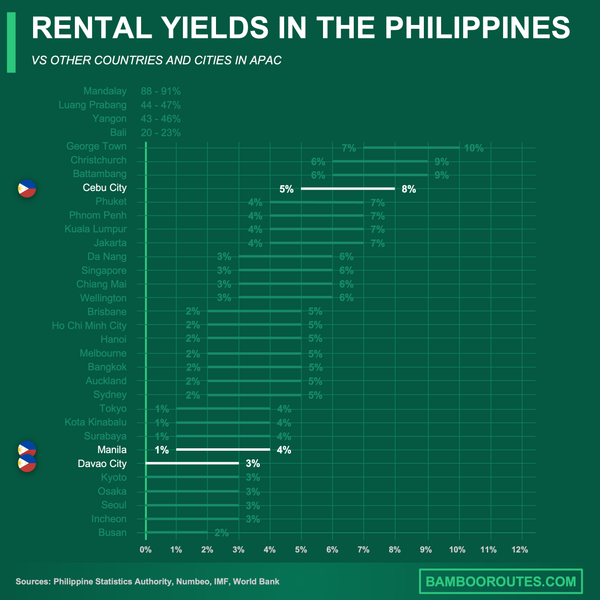
We did some research and made this infographic to help you quickly compare rental yields of the major cities in the Philippines versus those in neighboring countries. It provides a clear view of how this country positions itself as a real estate investment destination, which might interest you if you’re planning to invest there.
How does the land purchase process work on Negros Island, step-by-step?
What are the exact steps to buy land on Negros Island right now?
Because foreigners usually cannot buy land directly, the step-by-step process on Negros Island applies when you are leasing long-term, or when a Filipino-qualified buyer (such as a spouse or a compliant corporation) is purchasing: first identify the correct Registry of Deeds (Negros Occidental or Negros Oriental), conduct due diligence on the title, verify land classification and restrictions with DAR/DENR/NCIP, sign the appropriate instrument (Deed of Absolute Sale for purchases or a long-term lease contract for leases), complete BIR tax processing, pay local fees, and register at the Registry of Deeds.
A clean, single-owner, no-issues land transaction on Negros Island typically takes 6 to 12 weeks from offer to registered title, but if you encounter missing heirs, agrarian clearance requirements, boundary disputes, or tax delinquencies, expect 3 to 6 months or longer.
The key documents you will sign include the Deed of Absolute Sale or Lease Contract, tax declarations, BIR forms for capital gains tax and documentary stamp tax, and the application for registration at the Registry of Deeds.
What scams are common when it comes to buying land on Negros Island right now?
What scams target foreign land buyers on Negros Island right now?
Scams targeting foreign land buyers on Negros Island are unfortunately common, driven by the combination of high foreign interest, complex local rules, and buyers who do not always verify what they are told.
The most common scams include selling a "tax declaration" as if it were a title, presenting fake or recycled titles, having one heir sell land informally without the knowledge or consent of other heirs, and showing property boundaries on the ground that do not match the official lot plan.
The top three warning signs of a fraudulent deal on Negros Island are a seller who resists Registry of Deeds verification, a price that seems too good to be true, and pressure to close quickly without proper due diligence.
Foreigners who fall victim to a land scam on Negros Island have limited legal recourse because they were likely attempting to circumvent ownership rules, though civil suits and criminal complaints are possible if fraud can be proven.
We cover all these things in length in our pack about the property market in Negros Island.
How do I verify the seller is legit on Negros Island right now?
The best method to verify a land seller on Negros Island is to match the seller's identity to the registered owner on the title at the Registry of Deeds, or confirm they have a properly documented Special Power of Attorney if they are acting on behalf of the owner.
To confirm the land title is clean and free of disputes on Negros Island, you request a Certified True Copy of the title from the Registry of Deeds and check the annotations page for any mortgages, liens, adverse claims, or court orders.
Checking for existing liens, mortgages, or debts requires examining both the title annotations at the Registry of Deeds and the real property tax status at the local treasurer's office, since delinquencies often surface there first.
The most essential professional for verifying seller legitimacy on Negros Island is a lawyer experienced in Philippine real estate, who can conduct due diligence, interpret annotations, and ensure all documents are properly executed.
How do I confirm land boundaries on Negros Island right now?
The standard procedure for confirming land boundaries on Negros Island before purchase is to hire a licensed geodetic engineer to conduct a survey and produce a lot plan that matches the technical description in the title.
The official documents you should review include the Transfer Certificate of Title (with its technical description), the approved survey plan from the DENR, and the tax declaration map from the assessor's office.
Hiring a licensed geodetic engineer is not legally required but is strongly recommended on Negros Island, because boundary disputes are among the most expensive and time-consuming problems buyers face after closing.
Common boundary-related problems on Negros Island include fences or walls that encroach on neighboring lots, sellers who show a larger area than the title describes, and overlapping claims where multiple parties believe they own the same strip of land.
Buying real estate in Negros Island can be risky
An increasing number of foreign investors are showing interest. However, 90% of them will make mistakes. Avoid the pitfalls with our comprehensive guide.

What will it cost me, all-in, to buy and hold land on Negros Island?
What purchase taxes and fees apply on Negros Island as of 2026?
As of early 2026, the total purchase taxes and fees for a land transaction on Negros Island typically range from 4% to 7% of the property price for buyer-side costs alone, or 10% to 13% if the buyer also covers the seller's capital gains tax as is common in practice.
Using a PHP 5 million property as an example (roughly USD 90,000 or EUR 82,000), buyer-side closing costs would run between PHP 200,000 to PHP 350,000 (USD 3,600 to USD 6,300 or EUR 3,300 to EUR 5,700), potentially rising to PHP 500,000 to PHP 650,000 (USD 9,000 to USD 11,700 or EUR 8,200 to EUR 10,600) if the buyer pays all taxes.
The main individual taxes and fees include the Documentary Stamp Tax (1.5% of the property value), local transfer tax (up to 0.75% depending on the locality), registration fees at the Registry of Deeds (around 0.25% to 0.5%), and the Capital Gains Tax (6% of the selling price or zonal value, whichever is higher).
These taxes and fees do not formally differ for foreign buyers versus local buyers on Negros Island, but since foreigners typically cannot own land directly, they may encounter additional legal and structuring costs when setting up leases or working through qualified entities.
What hidden fees surprise foreigners on Negros Island most often?
Hidden or unexpected fees on Negros Island typically add PHP 25,000 to PHP 150,000 (roughly USD 450 to USD 2,700 or EUR 400 to EUR 2,500) beyond the official taxes, depending on the complexity of the transaction.
The top hidden fees that surprise foreigners on Negros Island include geodetic survey costs (PHP 15,000 to PHP 50,000), clearing tax delinquencies the seller promised to handle (varies widely), DAR-related processing if the land has agricultural history (PHP 5,000 to PHP 30,000), notarial and document procurement fees (PHP 5,000 to PHP 20,000), and legal fees for properly drafting lease contracts under RA 12252 (PHP 20,000 to PHP 75,000).
These hidden fees typically appear at the due diligence stage when you discover issues that need resolution, during the BIR processing stage when clearances are required, and at registration when missing documents surface.
The best protection against unexpected fees on Negros Island is to get a detailed cost estimate from your lawyer before signing anything, budget an extra 2% to 3% as a contingency, and never rely on the seller's assurances about what is "already taken care of."

We made this infographic to show you how property prices in the Philippines compare to other big cities across the region. It breaks down the average price per square meter in city centers, so you can see how cities stack up. It’s an easy way to spot where you might get the best value for your money. We hope you like it.
What sources have we used to write this blog article?
Whether it's in our blog articles or the market analyses included in our property pack about Negros Island, we always rely on the strongest methodology we can, and we don't throw out numbers at random.
We also aim to be fully transparent, so below we've listed the authoritative sources we used, and explained how we used them and the methods behind our estimates.
| Source | Why it's authoritative | How we used it |
|---|---|---|
| 1987 Philippine Constitution (Article XII) | It's the highest legal authority in the Philippines on land ownership. | We used it to establish the baseline ban on foreign land ownership. We treated all other structures as "only allowed if consistent with this." |
| Republic Act 12252 (2025) | It's the current statute setting the foreign lease framework. | We used it to confirm the maximum 99-year lease term. We also used it to explain what leasing offers compared to ownership. |
| SEC Memorandum Circular No. 8 (2013) | It's the official SEC guidance on foreign ownership compliance. | We used it to explain why corporate structures are not loopholes. We also used it to describe risks around nominee setups. |
| Land Registration Authority (LRA) | LRA is the national authority over land registration and titles. | We used it to anchor verification procedures and identify the correct Registry of Deeds. We used it to emphasize that registration is the core safety step. |
| Bureau of Internal Revenue (Capital Gains Tax) | BIR is the national tax authority for property transactions. | We used it to ground the tax steps required before title transfer. We also used it to build the closing cost estimates. |
| Bureau of Internal Revenue (Documentary Stamp Tax) | It's the official BIR page for DST rules. | We used it to support the list of taxes in a land transaction. We used it as the basis for our all-in cost calculations. |
| Department of Agrarian Reform (Land Transfer Clearance) | DAR regulates agricultural land transfers. | We used it to explain why some parcels need clearance before transfer. We used it to flag a common buyer trap on Negros Island. |
| Indigenous Peoples' Rights Act (RA 8371) | It's the governing law for ancestral domains. | We used it to explain a major restricted-zone category. We used it to justify checking for ancestral domain coverage. |
| Expanded NIPAS Act (RA 11038) | It's the statute governing protected areas. | We used it to explain environmental restrictions on development. We used it to add a second restricted-zone lens beyond foreign ownership rules. |
| President's Communications Office (RA 12252 announcement) | It's an official government release confirming the 2025 lease law changes. | We used it as a second confirmation of the expanded lease regime. We used it to explain, in plain language, the law's intent. |
Get the full checklist for your due diligence in Negros Island
Don't repeat the same mistakes others have made before you. Make sure everything is in order before signing your sales contract.
Related blog posts