
Authored by the expert who managed and guided the team behind the Philippines Property Pack
Everything you need to know before buying real estate is included in our The Philippines Property Pack
Negros Island is attracting more foreign buyers in 2026 than ever before, but it also comes with scams, traps, and legal gray areas that catch newcomers off guard.
This article will walk you through the real risks, the tricks that target foreigners, and the practical steps you need to stay safe when buying residential property in Negros Island.
We constantly update this blog post as new regulations emerge and market conditions evolve.
And if you're planning to buy a property in this place, you may want to download our pack covering the real estate market in Negros Island.

How risky is buying property in Negros Island as a foreigner in 2026?
Can foreigners legally own properties in Negros Island in 2026?
As of early 2026, foreigners cannot directly own land in Negros Island because the Philippine Constitution reserves land ownership for Filipino citizens and corporations with at least 60% Filipino ownership.
However, foreigners in Negros Island can legally own condominium units, provided that foreign ownership in the entire condominium project does not exceed 40%, which is why condos in Bacolod and Dumaguete remain the most straightforward ownership option for non-Filipinos.
For those who want a house with land in Negros Island, the most common legal structure is either a long-term lease (now extendable up to 99 years under Republic Act 12252 signed in September 2025) or setting up a corporation with 60% Filipino ownership to hold the land.
Nominee arrangements, where a Filipino holds the title on behalf of a foreigner, are illegal under the Anti-Dummy Law and can result in the foreigner losing both the property and any money invested.
What buyer rights do foreigners actually have in Negros Island in 2026?
As of early 2026, foreigners who buy property legally in Negros Island (such as a condominium unit) have enforceable rights under Philippine contract law, including the right to sue for breach of contract and claim damages.
If a seller breaches a contract in Negros Island, the foreign buyer can file a case in the Regional Trial Court where the property is located, but realistically this process can take several years and cost significant legal fees.
The most common right that foreigners mistakenly assume they have in Negros Island is the ability to enforce informal "side agreements" for land ownership, which are actually void and unenforceable under Philippine law.
How strong is contract enforcement in Negros Island right now?
Contract enforcement for real estate transactions in Negros Island is slower and less predictable than in countries like Singapore, Japan, or the United States, with commercial disputes often taking multiple years to resolve in Philippine courts.
The main weakness in contract enforcement that foreigners should be aware of in Negros Island is that even with a valid contract, recovering money or property through litigation is expensive and slow, which means scammers and bad actors can disappear or outlast you financially.
By the way, we detail all the documents you need and what they mean in our property pack covering Negros Island.
Buying real estate in Negros Island can be risky
An increasing number of foreign investors are showing interest. However, 90% of them will make mistakes. Avoid the pitfalls with our comprehensive guide.

Which scams target foreign buyers in Negros Island right now?
Are scams against foreigners common in Negros Island right now?
Property scams targeting foreigners in Negros Island are not as frequent as in Metro Manila or Cebu, but they happen regularly because many transactions occur through social media and unlicensed agents who operate without oversight.
The type of property transaction most frequently targeted by scammers in Negros Island is land sales (beach lots, hillside lots, farm-adjacent lots), because land is exactly what foreigners cannot legally own, making them vulnerable to illegal workarounds.
The profile of foreign buyer most commonly targeted by scammers in Negros Island is someone who shops primarily through Facebook groups or Marketplace, pays reservation fees before verifying documents, and trusts a friendly local "fixer" instead of a licensed broker.
The single biggest warning sign that a deal may be a scam in Negros Island is when the seller pressures you to pay a deposit or reservation fee before you can independently verify the title through the Land Registration Authority.
What are the top three scams foreigners face in Negros Island right now?
The top three scams that foreigners most commonly face when buying property in Negros Island are fake authority to sell (someone poses as the owner or representative), forged or duplicated title documents, and nominee ownership schemes that promise land control through illegal side agreements.
The most common scam typically unfolds like this in Negros Island: a seller shows you a property, presents a photocopy of the title, asks for a reservation fee to "hold" the property, and then either disappears or keeps stalling indefinitely while you discover the title was fake or belonged to someone else.
The single most effective way to protect yourself from each of these three scams in Negros Island is to independently pull a Certified True Copy of the title from the LRA eSerbisyo portal, match the owner's name exactly to government IDs, and refuse to sign any nominee or side agreement for land ownership.
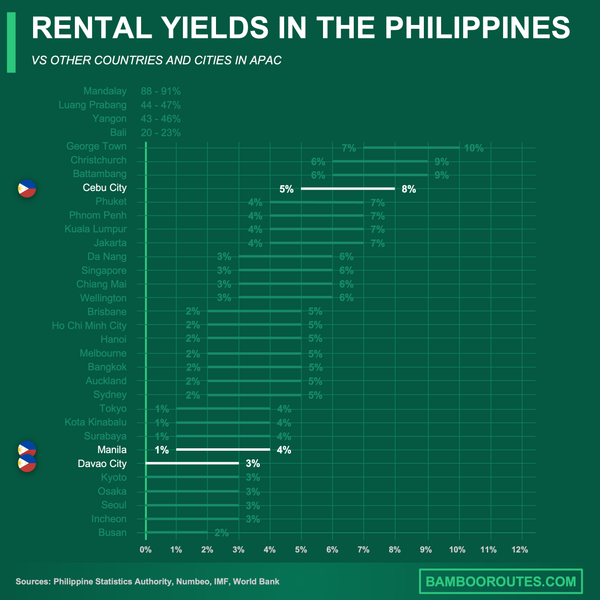
We did some research and made this infographic to help you quickly compare rental yields of the major cities in the Philippines versus those in neighboring countries. It provides a clear view of how this country positions itself as a real estate investment destination, which might interest you if you’re planning to invest there.
How do I verify the seller and ownership in Negros Island without getting fooled?
How do I confirm the seller is the real owner in Negros Island?
The standard verification process to confirm the seller is the real owner in Negros Island is to request a Certified True Copy (CTC) of the Transfer Certificate of Title directly from the Registry of Deeds or through the LRA eSerbisyo portal, then match the name on the title exactly to the seller's government-issued ID.
The official document foreigners should check to verify ownership in Negros Island is the Certified True Copy of the title from the Land Registration Authority, not a photocopy provided by the seller, because only the official copy shows current annotations, liens, and encumbrances.
The most common trick fake sellers use to appear legitimate in Negros Island is presenting a Special Power of Attorney (SPA) that claims to authorize them to sell on behalf of the owner, and this trick is common enough that you should treat every SPA as suspicious until verified by a lawyer and the notary who issued it.
Where do I check liens or mortgages on a property in Negros Island?
The official registry where you check liens or mortgages on a property in Negros Island is the Registry of Deeds, which maintains records under the Torrens system, and the annotations section of the Certified True Copy will show any encumbrances.
When checking for liens in Negros Island, you should specifically request to see all annotations on the title, including mortgages, adverse claims, lis pendens (pending litigation), and any restrictions that would affect your ownership rights.
The type of lien or encumbrance most commonly missed by foreign buyers in Negros Island is an unresolved BIR tax issue that blocks the issuance of the electronic Certificate Authorizing Registration (eCAR), which effectively prevents you from registering the property in your name even if you have paid the seller.
It's one of the aspects we cover in our our pack about the real estate market in Negros Island.
How do I spot forged documents in Negros Island right now?
The most common type of forged document used in property scams in Negros Island is a fake or altered Transfer Certificate of Title, and this sometimes happens when scammers copy legitimate titles and change the owner's name or property details.
Specific visual or procedural red flags that indicate a document may be forged in Negros Island include mismatched fonts, inconsistent serial numbers, missing or altered annotations, and any reluctance by the seller to let you independently verify the title with the LRA.
The official verification method you should use to authenticate documents in Negros Island is to request a Certified True Copy directly from the Registry of Deeds or through the LRA eSerbisyo portal, then compare every detail with what the seller provided.
Get the full checklist for your due diligence in Negros Island
Don't repeat the same mistakes others have made before you. Make sure everything is in order before signing your sales contract.
What "grey-area" practices should I watch for in Negros Island?
What hidden costs surprise foreigners when buying a property in Negros Island?
The three most common hidden costs that foreigners overlook in Negros Island are Documentary Stamp Tax (1.5% of the property price, around PHP 75,000 / USD 1,300 / EUR 1,200 on a PHP 5 million property), Capital Gains Tax (6% of the selling price or zonal value, whichever is higher), and transfer fees at the Registry of Deeds that can add another 1% to 2%.
The hidden cost most often deliberately concealed by sellers or agents in Negros Island is the true tax liability, and it sometimes happens that sellers quote a price "net of taxes" but then push all tax responsibilities onto the buyer at the last minute.
Are "cash under the table" requests common in Negros Island right now?
Requests for "cash under the table" in property transactions in Negros Island sometimes happen, usually when a seller wants to declare a lower sale price to reduce taxes, and this practice is more common in private resales than in developer transactions.
The typical reason sellers give for requesting undeclared cash payments in Negros Island is to "save on taxes" by recording a lower price on the Deed of Sale, which benefits them but creates legal and financial risks for you as the buyer.
The legal risks foreigners face if they agree to an undeclared cash payment in Negros Island include potential liability for tax evasion, difficulty proving the true purchase price if disputes arise, and complications when you try to resell the property later at a higher declared value.
Are side agreements used to bypass rules in Negros Island right now?
Side agreements used to bypass official rules in property transactions in Negros Island are common, especially in land deals where a foreigner cannot legally own the property directly, and these arrangements are heavily marketed to foreigners despite being illegal.
The most common type of side agreement used to circumvent regulations in Negros Island is a private contract that promises the foreigner "beneficial ownership" or "full control" of land that is titled in a Filipino nominee's name.
The legal consequences foreigners face if a side agreement is discovered by authorities in Negros Island include nullification of the arrangement under the Anti-Dummy Law, criminal penalties for both parties, and total loss of any money invested in the property.

We made this infographic to show you how property prices in the Philippines compare to other big cities across the region. It breaks down the average price per square meter in city centers, so you can see how cities stack up. It’s an easy way to spot where you might get the best value for your money. We hope you like it.
Can I trust real estate agents in Negros Island in 2026?
Are real estate agents regulated in Negros Island in 2026?
As of early 2026, licensed real estate brokers in Negros Island are regulated under Republic Act 9646 (the Real Estate Service Act), which requires them to pass a board exam and register with the Professional Regulation Commission (PRC).
A legitimate real estate agent in Negros Island should have a valid PRC license as a Real Estate Broker (for those who passed the board exam) or work under a licensed broker if they are a salesperson, and they should be able to show you their PRC ID with a current license number.
Foreigners can verify whether an agent is properly licensed in Negros Island by asking for their PRC license number and checking it on the PRC website or by calling the PRC directly, which takes just a few minutes and can save you from dealing with unlicensed "fixers."
Please note that we have a list of contacts for you in our property pack about Negros Island.
What agent fee percentage is normal in Negros Island in 2026?
As of early 2026, the normal agent fee percentage in Negros Island ranges from 3% to 5% of the property's sale price, with 5% being a common starting ask and 3% being a reasonable negotiated outcome for most residential transactions.
The typical range of agent fee percentages that covers most transactions in Negros Island is 3% to 5%, and this applies whether you are buying a condominium in Bacolod or a house and lot in Dumaguete.
In Negros Island, the seller typically pays the agent fee for residential property sales, but this is negotiable and should be clarified in writing before you sign any agreement.
Get the full checklist for your due diligence in Negros Island
Don't repeat the same mistakes others have made before you. Make sure everything is in order before signing your sales contract.
What due diligence actually prevents disasters in Negros Island?
What structural inspection is standard in Negros Island right now?
The standard structural inspection process for property purchases in Negros Island is less formal than in Western countries, and most buyers either skip inspections entirely or hire a licensed engineer privately, which means you need to be proactive about arranging one yourself.
A qualified inspector in Negros Island should check specific structural elements including the foundation, roof integrity, drainage systems, electrical wiring, plumbing, and any signs of water damage or termite infestation.
The type of professional qualified to perform structural inspections in Negros Island is a licensed civil engineer, and you can find one through the Philippine Institute of Civil Engineers or by asking for referrals from local lawyers.
The most common structural issues that inspections reveal in properties in Negros Island are water intrusion (especially in roofs and foundations due to heavy tropical rains), termite damage in older wooden structures, and electrical systems that do not meet code.
How do I confirm exact boundaries in Negros Island?
The standard process for confirming exact property boundaries in Negros Island is to hire a licensed geodetic engineer to conduct a relocation survey, which physically verifies where the property starts and ends based on the title's technical description.
The official document that shows the legal boundaries of a property in Negros Island is the technical description on the Transfer Certificate of Title, which includes lot numbers, bearings, and distances that a surveyor uses to plot the property.
The most common boundary dispute that affects foreign buyers in Negros Island involves properties in semi-rural or coastal areas where fences, trees, or informal markers do not match the official lot boundaries on the title.
The professional you should hire to physically verify boundaries on the ground in Negros Island is a licensed geodetic engineer, who can conduct a relocation survey and issue a report that you can use to compare against the title's technical description.
What defects are commonly hidden in Negros Island right now?
The top three defects that sellers frequently conceal from buyers in Negros Island are water intrusion issues (common), termite damage in structural wood (common), and unpermitted room additions or carports (sometimes happens).
The inspection technique that helps uncover hidden defects in Negros Island is to visit the property during or right after heavy rain, which reveals leaks, drainage problems, and water pooling that would not be visible on a dry day.
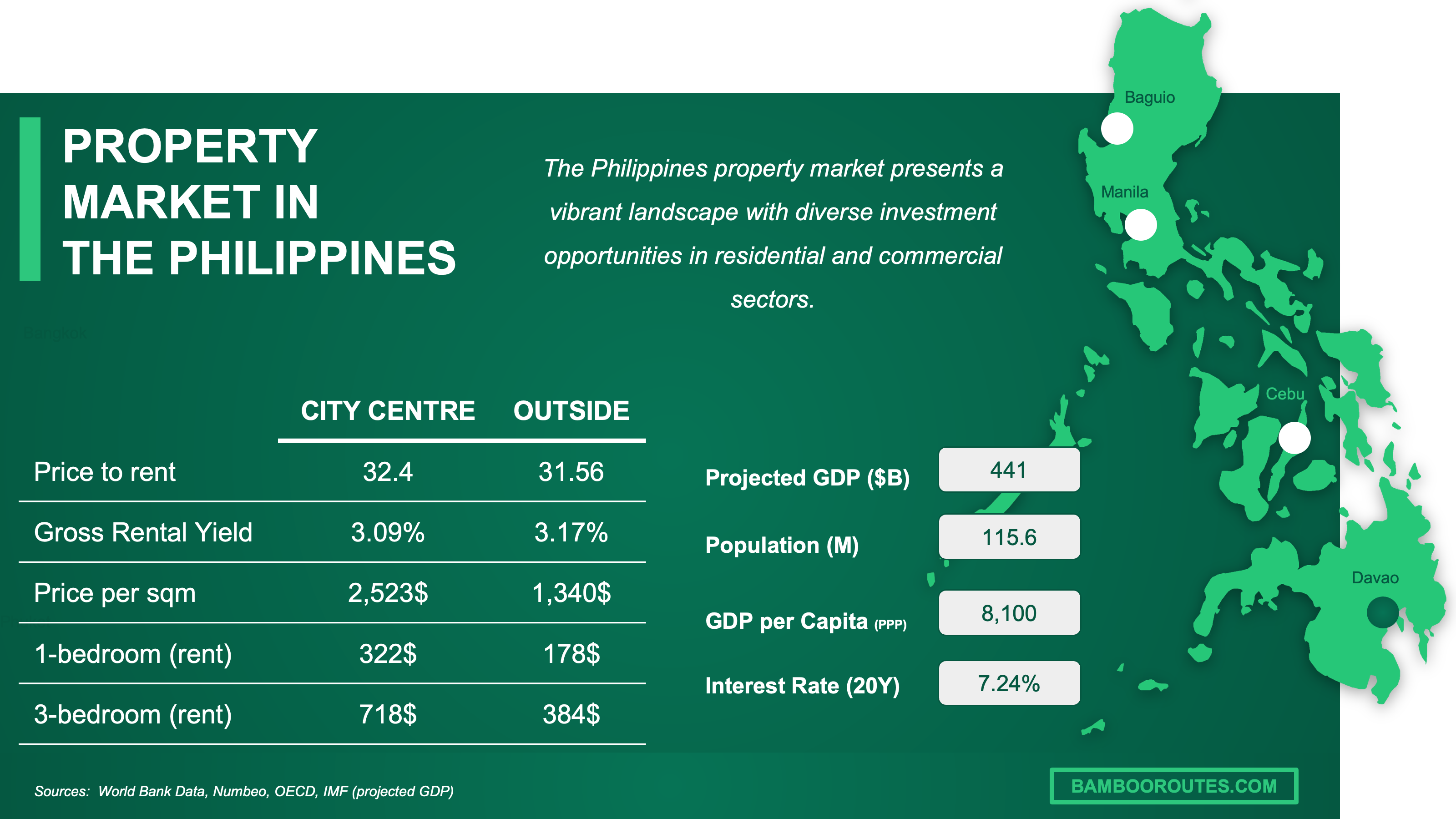
We have made this infographic to give you a quick and clear snapshot of the property market in the Philippines. It highlights key facts like rental prices, yields, and property costs both in city centers and outside, so you can easily compare opportunities. We’ve done some research and also included useful insights about the country’s economy, like GDP, population, and interest rates, to help you understand the bigger picture.
What insider lessons do foreigners share after buying in Negros Island?
What do foreigners say they did wrong in Negros Island right now?
The most common mistake foreigners say they made when buying property in Negros Island is paying a reservation fee or deposit before independently verifying the title through official LRA channels.
The top three regrets foreigners most frequently mention after buying in Negros Island are trusting an unlicensed "fixer" to handle paperwork, not checking for Kanlaon Volcano hazard exposure before falling in love with a property, and underestimating the total closing costs including taxes and fees.
The single piece of advice experienced foreign buyers most often give to newcomers in Negros Island is to pull the Certified True Copy of the title yourself before paying anything, even if the seller seems trustworthy and everyone says "it's fine."
The mistake foreigners say cost them the most money or caused the most stress in Negros Island is entering into a nominee or side agreement for land ownership, which led to losing everything when the relationship with the nominee broke down.
What do locals do differently when buying in Negros Island right now?
The key difference in how locals approach buying property in Negros Island compared to foreigners is that locals start by asking around about the seller's family and reputation before even looking at paperwork, because they know that personal history and family disputes often affect property deals.
The verification step locals routinely take that foreigners often skip in Negros Island is checking with the barangay captain or neighbors to find out if there are any informal claims, family disputes, or "soft" ownership issues that would not appear on the title.
The local knowledge advantage that helps locals get better deals in Negros Island is their understanding that many sellers are motivated by specific circumstances (medical bills, overseas migration, inheritance disputes), and knowing these motivations gives them negotiating leverage that foreigners typically miss.
Don't buy the wrong property, in the wrong area of Negros Island
Buying real estate is a significant investment. Don't rely solely on your intuition. Gather the right information to make the best decision.

What sources have we used to write this blog article?
Whether it's in our blog articles or the market analyses included in our property pack about Negros Island, we always rely on the strongest methodology we can and we don't throw out numbers at random.
We also aim to be fully transparent, so below we've listed the authoritative sources we used, and explained how we used them and the methods behind our estimates.
| Source | Why it's authoritative | How we used it |
|---|---|---|
| Land Registration Authority (LRA) | The government authority supervising land title registration in the Philippines. | We used LRA guidance to build the title verification checklist. We also used it to explain why Certified True Copies are essential. |
| LRA eSerbisyo Portal | The official online service for requesting title documents from LRA. | We used it to show the safest path to obtaining title documents independently. We recommended it as the primary defense against fake titles. |
| Anti-Dummy Law (Lawphil) | The official statute criminalizing evasion of foreign ownership restrictions. | We used it to explain why nominee arrangements are illegal. We also used it to warn against side agreements. |
| Condominium Act (Supreme Court eLibrary) | The official judiciary-hosted law governing condo ownership. | We used it to explain the main legal ownership path for foreigners. We also used it to clarify the 40% foreign ownership cap. |
| World Justice Project Rule of Law Index 2025 | A globally recognized governance dataset built from expert surveys. | We used it to describe contract enforcement reality in the Philippines. We also used it to justify strong safeguards for foreign buyers. |
| BIR Capital Gains Tax Portal | The tax authority's official guidance on property transfer taxes. | We used it to anchor unavoidable tax components in closings. We also used it to help buyers budget realistically. |
| BIR eCAR Checklist | The official checklist for transfer clearance requirements. | We used it to explain the hard gate in Philippine closings. We also used it to build the "no eCAR, no confidence" rule. |
| PHIVOLCS Volcano Hazard Maps | The national authority on volcano and earthquake hazards. | We used it to add Negros-specific hazard due diligence for Kanlaon. We recommended checking hazard maps before choosing a location. |
| Real Estate Service Act RA 9646 (Lawphil) | The official statute defining licensing and regulation of brokers. | We used it to explain what "licensed broker" means. We also used it to help buyers distinguish regulated brokers from unlicensed agents. |
| Colliers Philippines Residential Report | A major global real estate consultancy with published research methods. | We used it to support demand trends outside Metro Manila. We also used it to explain why Bacolod attracts both genuine listings and sales talk. |
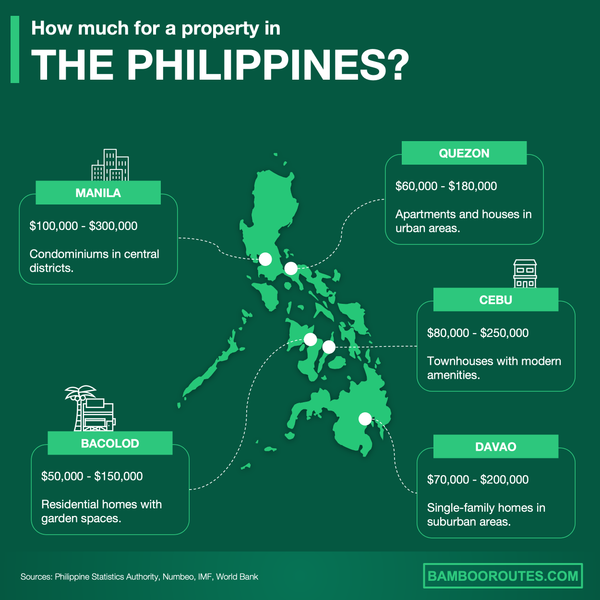
We created this infographic to give you a simple idea of how much it costs to buy property in different parts of the Philippines. As you can see, it breaks down price ranges and property types for popular cities in the country. We hope this makes it easier to explore your options and understand the market.
Related blog posts