
Authored by the expert who managed and guided the team behind the Philippines Property Pack
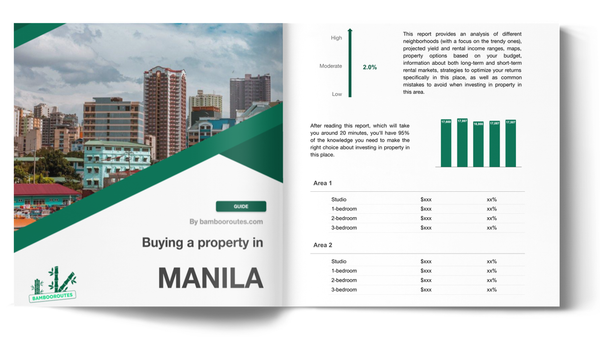
Yes, the analysis of Manila's property market is included in our pack
You're buying residential property in Manila as a foreigner in early 2026, and here's what you need to know: the Philippines is paperwork-driven for property, and most foreigners get burned when they trust people more than they trust official registries, licenses, and receipts.
In Metro Manila right now, the market vibe is "buyers have leverage" because developers are pushing promos and inventory discounts, but this also shifts the scam angle toward "pressure you to pay fast, reserve now, sign now."
We constantly update this blog post to reflect the latest regulations and market conditions in Manila.
And if you're planning to buy a property in this place, you may want to download our pack covering the real estate market in Manila.

How risky is buying property in Manila as a foreigner in 2026?
Can foreigners legally own properties in Manila in 2026?
As of early 2026, foreigners can legally own condominium units in Manila, but they cannot directly own land under Philippine law, which reserves land ownership for Filipino citizens or corporations that are at least 60% Filipino-owned.
The main restriction is the 40% foreign ownership cap per condominium project, meaning if a building already has 40% of its units owned by foreigners, you cannot buy there, and you must verify this quota before committing to any purchase.
When direct ownership is restricted, foreigners in Manila commonly use long-term land leases (up to 50 years with a 25-year renewal option) or form a Philippine corporation with 60% Filipino ownership to control land-based properties, though condos remain the cleanest and safest path.
If a seller or agent in Manila pitches you a "house and lot in your name" deal or a "nominee arrangement" where a Filipino holds the title for you, treat it as a major red flag because these structures often collapse when relationships sour or when authorities scrutinize the arrangement.
What buyer rights do foreigners actually have in Manila in 2026?
As of early 2026, foreigners who buy a properly titled condominium unit in Manila have ownership rights that are almost identical to local buyers, including the right to sell, lease, mortgage, and enforce contracts through Philippine courts.
If a seller in Manila breaches a contract, you can legally pursue remedies through the court system, but the practical challenge is that Philippine litigation is slow (often taking years), so your real protection comes from structuring deals with verified documents and milestone-based payments rather than relying on lawsuits.
The most common buyer right that foreigners mistakenly assume they have in Manila is automatic land ownership when buying a "house and lot" package, when in reality they can only own the building structure and must lease the land, making verification of the exact ownership structure essential before signing anything.
How strong is contract enforcement in Manila right now?
Contract enforcement in Manila exists and works, but it is significantly slower than in countries like the United States, Australia, or Singapore, with the Philippines ranking 97th out of 143 countries in the 2025 World Justice Project Rule of Law Index and scoring particularly low on civil justice (106th globally).
The main weakness in contract enforcement that foreigners should be aware of in Manila is the time it takes to resolve disputes through courts, often several years, which means your best protection is to avoid needing court intervention by using verified titles, escrow-like payment structures, and licensed professionals from the start.
By the way, we detail all the documents you need and what they mean in our property pack covering Manila.
Buying real estate in Manila can be risky
An increasing number of foreign investors are showing interest. However, 90% of them will make mistakes. Avoid the pitfalls with our comprehensive guide.

Which scams target foreign buyers in Manila right now?
Are scams against foreigners common in Manila right now?
Property scams targeting foreigners in Manila are common enough that you should assume you will encounter at least one "abnormal" ask during your property search, with an estimated 10% to 20% of listings or interactions showing material red flags like fake urgency, unverifiable agents, or requests to pay into personal accounts.
The type of property transaction most frequently targeted by scammers in Manila is the resale condo market and pre-selling projects from lesser-known developers, because these involve more intermediaries and less institutional oversight compared to buying directly from established developers like Ayala Land or SMDC.
The profile of foreign buyer most commonly targeted by scammers in Manila is the first-time investor who does not speak Tagalog, is unfamiliar with local processes, and is emotionally attached to a "dream unit" they found online, making them more likely to skip verification steps under pressure.
The single biggest warning sign that a deal may be a scam in Manila is when the seller or agent resists your request to obtain a Certified True Copy of the title from the Registry of Deeds or pushes you to pay a reservation fee before you can verify ownership, because legitimate sellers have nothing to hide.
What are the top three scams foreigners face in Manila right now?
The top three scams foreigners most commonly face when buying property in Manila are: (1) "you can own the land" schemes involving nominee arrangements or fake corporate structures that collapse under scrutiny, (2) title fraud using forged documents or impersonating real owners, and (3) double sales or reservation fee traps where the same property is promised to multiple buyers or your money simply disappears.
The most common scam in Manila typically unfolds like this: a friendly agent shows you a great unit at an attractive price, pressures you to pay a "reservation fee" immediately to "secure it before another buyer," directs payment to a personal bank account rather than a developer or escrow account, and then becomes unreachable after you pay.
The single most effective way to protect yourself from each of these three scams in Manila is to never pay meaningful money until you have: (1) obtained a Certified True Copy of the title from the Registry of Deeds yourself, (2) verified the seller's identity matches the title record exactly, and (3) confirmed any agent's license through the PRC online verification portal.
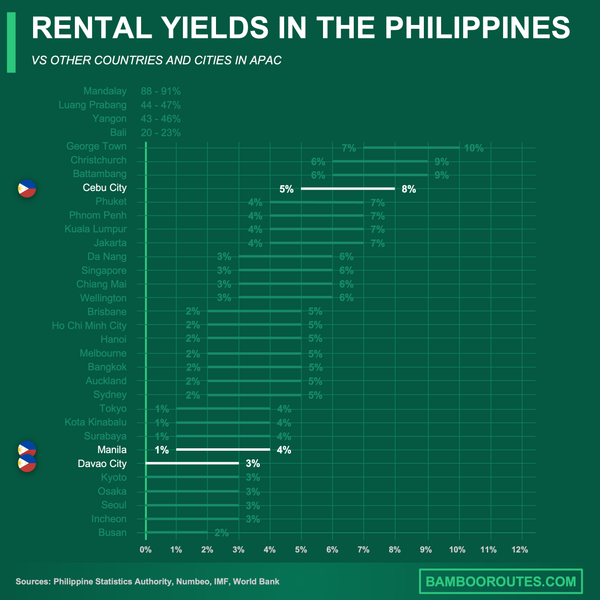
We did some research and made this infographic to help you quickly compare rental yields of the major cities in the Philippines versus those in neighboring countries. It provides a clear view of how this country positions itself as a real estate investment destination, which might interest you if you’re planning to invest there.
How do I verify the seller and ownership in Manila without getting fooled?
How do I confirm the seller is the real owner in Manila?
The standard verification process to confirm the seller is the real owner in Manila is to request the Condominium Certificate of Title (CCT) number from the seller, then independently obtain a Certified True Copy (CTC) of that title from the Registry of Deeds through the LRA eSerbisyo portal, and match the registered owner name exactly against the seller's valid government ID.
The official document foreigners should check to verify ownership in Manila is the Certified True Copy of the title from the Registry of Deeds, not the seller's photocopy, because the CTC shows the current registered owner and all annotations including mortgages, liens, and adverse claims that could affect your purchase.
The most common trick fake sellers use to appear legitimate in Manila is presenting convincing photocopies of titles or notarized "authority to sell" documents while blocking your attempts to get an independent CTC from the Registry, and this tactic is common enough that you should treat any resistance to verification as an automatic deal-breaker.
Where do I check liens or mortgages on a property in Manila?
The official registry where you check liens or mortgages on a property in Manila is the Registry of Deeds, which maintains all title records and annotations, and the most practical way to access this is through the Certified True Copy request via the LRA eSerbisyo portal or by visiting the specific Registry of Deeds office where the property is registered.
When checking for liens in Manila, you should request a Certified True Copy of the title and carefully review all annotations on the back pages, looking specifically for mortgages, adverse claims, lis pendens (pending litigation), levies, attachments, and any notices that suggest someone else has a legal claim on the property.
The type of lien or encumbrance most commonly missed by foreign buyers in Manila is unpaid condo association dues and special assessments, because these do not always appear as formal title annotations but can still give the condo corporation leverage to block or complicate your title transfer if the previous owner left debts.
It's one of the aspects we cover in our our pack about the real estate market in Manila.
How do I spot forged documents in Manila right now?
The most common type of forged document used in property scams in Manila is the fake or altered Condominium Certificate of Title (CCT), and while sophisticated forgeries are not extremely common, they happen often enough that you should never rely on any document the seller provides without independent verification through the Registry of Deeds.
Specific red flags that indicate a document may be forged in Manila include: the seller refuses to let you get a CTC from the Registry, the notarization story sounds unusual ("notarized abroad" or "special arrangement"), there are small spelling differences between the name on the title and the seller's ID, or the "authority to sell" document is vague, expired, or does not match the registered owner.
The official verification method you should use to authenticate documents in Manila is to obtain a Certified True Copy from the Registry of Deeds for title records, use the PRC online verification portal to check broker licenses, and use SEC Express document verification if a corporation is the seller, because forged private documents collapse when checked against government registries.
Get the full checklist for your due diligence in Manila
Don't repeat the same mistakes others have made before you. Make sure everything is in order before signing your sales contract.
What "grey-area" practices should I watch for in Manila?
What hidden costs surprise foreigners when buying a property in Manila?
The three most common hidden costs that foreigners overlook when buying property in Manila are: Documentary Stamp Tax at 1.5% of the sale price (around 75,000 PHP or 1,300 USD or 1,200 EUR on a 5 million PHP condo), local transfer tax at 0.5% to 0.75% (around 25,000 to 37,500 PHP or 430 to 650 USD or 400 to 600 EUR), and condo corporation transfer fees and move-in fees that can add 20,000 to 100,000 PHP (350 to 1,750 USD or 320 to 1,600 EUR) depending on the building.
The hidden cost most often deliberately concealed by sellers or agents in Manila is the outstanding unpaid condo association dues and special assessments from the previous owner, and this happens commonly enough that you should always request a clearance certificate from the condo corporation before closing, because these debts can become your problem after transfer.
If you want to go into more details, we also have a blog article detailing all the property taxes and fees in Manila.
Are "cash under the table" requests common in Manila right now?
Requests for undeclared cash payments in property transactions in Manila still happen, but in early 2026 you should treat them as a high-risk signal rather than a normal practice, because anti-money laundering regulations now explicitly cover real estate developers and brokers, pushing legitimate players toward better documentation.
The typical reason sellers give for requesting undeclared cash payments in Manila is to reduce the official sale price on paper, which lowers the Documentary Stamp Tax, Capital Gains Tax, and transfer tax for both parties, and they often frame it as "everyone does it" or "this is how things work here."
The legal risks foreigners face if they agree to an undeclared cash payment in Manila include potential tax evasion charges from the Bureau of Internal Revenue, complications and delays during title registration if the declared price looks suspicious, and losing any legal recourse if the deal goes wrong because you participated in an illegal arrangement.
Are side agreements used to bypass rules in Manila right now?
Side agreements used to bypass official rules in property transactions in Manila are common, especially when dealing with foreigners who are unfamiliar with local regulations, and they often appear in deals involving land ownership workarounds, price under-declaration, or "special arrangements" that the seller insists should stay off the official paperwork.
The most common type of side agreement used to circumvent regulations in Manila is the price split arrangement, where the official deed shows a lower price while a separate private document records the "real" price, allowing both parties to pay lower taxes but creating serious vulnerabilities if the deal is later disputed.
If a side agreement is discovered by authorities in Manila, the legal consequences for foreigners include voiding of the main transaction if it depended on an illegal structure (like a nominee land arrangement), tax penalties and potential criminal charges for under-declaration, and loss of your investment with little legal recourse since courts do not enforce illegal contracts.

We made this infographic to show you how property prices in the Philippines compare to other big cities across the region. It breaks down the average price per square meter in city centers, so you can see how cities stack up. It’s an easy way to spot where you might get the best value for your money. We hope you like it.
Can I trust real estate agents in Manila in 2026?
Are real estate agents regulated in Manila in 2026?
As of early 2026, real estate agents in Manila are regulated under Republic Act 9646 (the Real Estate Service Act), which requires brokers and salespersons to be licensed by the Professional Regulation Commission (PRC) and establishes standards for professional conduct.
A legitimate real estate broker in Manila should have a valid PRC license as a Real Estate Broker, and if you are dealing with a salesperson, they should be properly accredited and working under the supervision of a licensed broker whose credentials you should also verify.
Foreigners can verify whether an agent is properly licensed in Manila by visiting the PRC online verification portal at verification.prc.gov.ph, entering the agent's name or license number, and confirming that the license is current and valid, which takes only a few minutes and should be a non-negotiable step before sharing any personal information or signing anything.
Please note that we have a list of contacts for you in our property pack about Manila.
What agent fee percentage is normal in Manila in 2026?
As of early 2026, the normal agent fee percentage for residential property sales in Manila is typically between 3% and 5% of the sale price, though there is no single mandatory rate and fees are ultimately determined by contract between the parties.
The typical range of agent fee percentages that covers most residential transactions in Manila is 3% to 5%, with standard non-luxury resale condos usually falling around 3% to 5%, while hard-to-sell inventory or very large transactions may be negotiated lower.
In Manila, the agent fee is customarily paid by the seller out of the sale proceeds, but this can be a point of negotiation, so you should clarify in writing who pays what before signing any agreement, and be suspicious if an agent asks you as the buyer for a large extra fee on top of the standard commission without a clear written scope of services.
Get the full checklist for your due diligence in Manila
Don't repeat the same mistakes others have made before you. Make sure everything is in order before signing your sales contract.
What due diligence actually prevents disasters in Manila?
What structural inspection is standard in Manila right now?
The standard structural inspection process for property purchases in Manila, especially for condos, is often lighter than foreigners expect from Western markets, so you should proactively arrange and pay for a professional inspection rather than assuming the seller will provide one.
Specific structural elements a qualified inspector should check in Manila include: water intrusion and leaks (especially around windows, bathrooms, and ceilings), electrical load and wiring condition, plumbing performance, HVAC system function, and signs of cracks or settlement that could indicate structural problems.
The type of professional qualified to perform structural inspections in Manila is a licensed civil engineer or architect, and for comprehensive assessments you can also hire specialized property inspection firms that have experience with condominium units in Metro Manila.
The most common structural issues that inspections reveal in Manila condo properties are water damage and seepage (especially in older buildings or after heavy rains), poor waterproofing, electrical system limitations, and thin walls with inadequate soundproofing, all of which can be expensive to fix if you discover them after purchase.
How do I confirm exact boundaries in Manila?
The standard process for confirming exact property boundaries in Manila for condo purchases is to verify that the Condominium Certificate of Title (CCT) correctly identifies your specific unit number, floor, building, and condominium project name, since condo unit boundaries are defined by the title and building plans rather than ground surveys.
The official document that shows the legal boundaries of a condo property in Manila is the CCT itself combined with the condominium's master deed and building floor plans, which should all be consistent, and any discrepancy between what you are shown and what the title says is a serious red flag.
The most common boundary dispute that affects foreign buyers in Manila is not physical land boundaries but rather confusion about what is included in a unit purchase, such as parking slots, storage areas, or balcony spaces that may be separately titled or subject to different ownership rules than the main unit.
For condo purchases in Manila, you do not typically need to hire a geodetic engineer to survey boundaries, but you should have a lawyer review the CCT, master deed, and any supplementary documents to confirm that the unit description matches exactly what you are buying.
What defects are commonly hidden in Manila right now?
The top three defects that sellers commonly conceal from buyers in Manila condos are: water leaks and seepage history (especially damage that has been cosmetically patched but not properly fixed), building management problems like underfunded maintenance reserves or upcoming special assessments, and pest issues in older or poorly maintained buildings, all of which are common rather than rare.
The inspection technique that helps uncover hidden defects in Manila is to visit the unit multiple times at different times of day and ideally during or after heavy rain, request maintenance records and recent PMO (property management office) advisories from the condo corporation, and ask direct questions to building security or neighbors about any recurring issues.
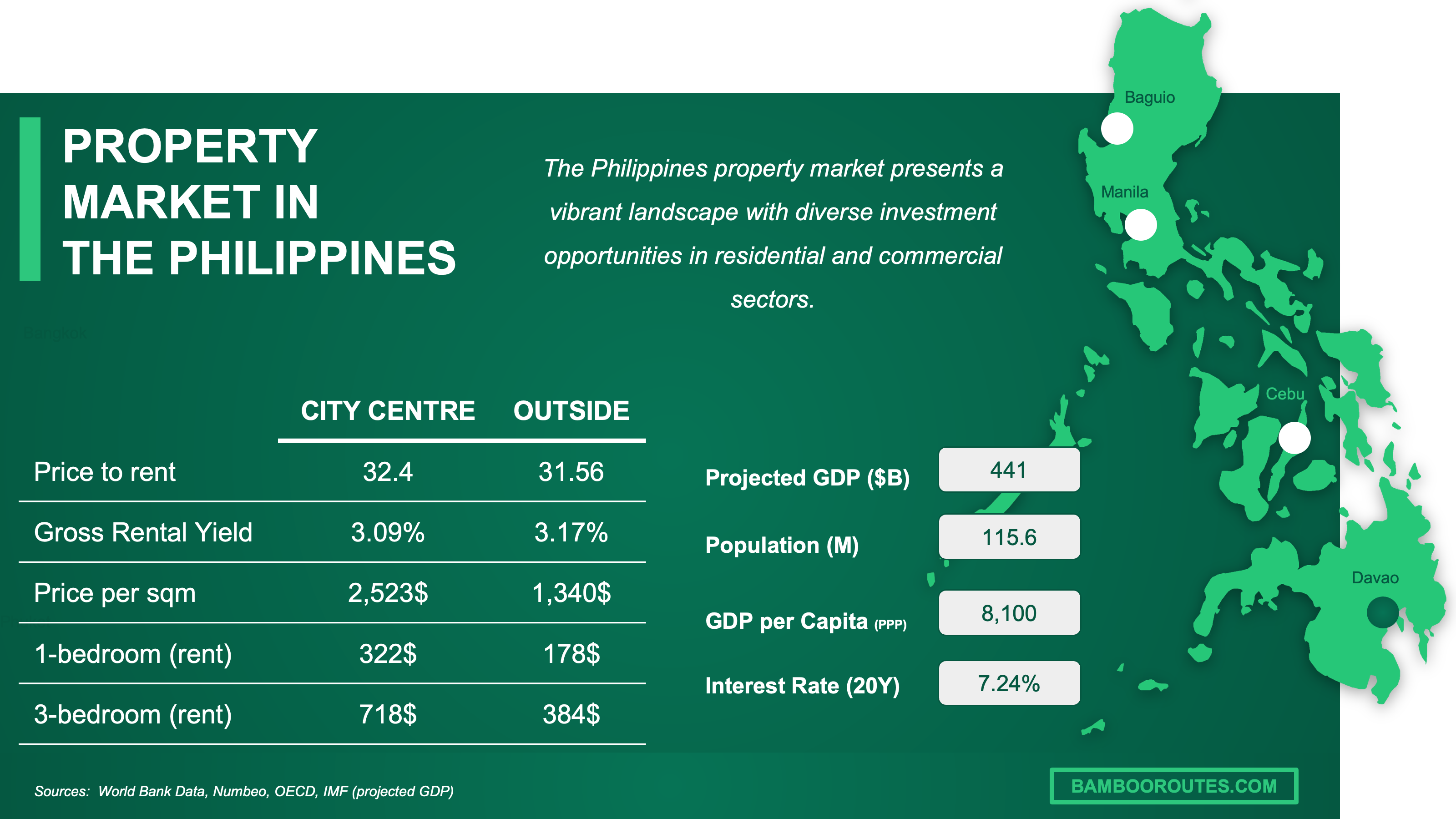
We have made this infographic to give you a quick and clear snapshot of the property market in the Philippines. It highlights key facts like rental prices, yields, and property costs both in city centers and outside, so you can easily compare opportunities. We’ve done some research and also included useful insights about the country’s economy, like GDP, population, and interest rates, to help you understand the bigger picture.
What insider lessons do foreigners share after buying in Manila?
What do foreigners say they did wrong in Manila right now?
The most common mistake foreigners say they made when buying property in Manila is paying a reservation fee or deposit before independently verifying the title through the Registry of Deeds, which left them vulnerable when the seller's story turned out to be different from the official records.
The top three regrets foreigners most frequently mention after buying in Manila are: trusting an "agent" who turned out to be unlicensed or working outside proper supervision, accepting a "this is normal here" workaround involving cash payments or side agreements, and rushing into a deal because of manufactured urgency like "another buyer is ready, pay today."
The single piece of advice experienced foreign buyers most often give to newcomers in Manila is to treat the LRA Certified True Copy of the title as the only truth and to walk away from any deal where the seller resists your independent verification, no matter how attractive the property seems.
The mistake foreigners say cost them the most money or caused the most stress in Manila is buying a pre-selling unit from a developer without proper DHSUD licensing, which led to construction delays, broken promises, and no effective recourse when things went wrong.
What do locals do differently when buying in Manila right now?
The key difference in how locals approach buying property compared to foreigners in Manila is that experienced local buyers treat the Registry of Deeds record as the only truth from day one, never emotionally committing to a property until they have verified the title themselves, while foreigners often trust the agent's or seller's story first and verify later (or not at all).
The verification step locals routinely take that foreigners often skip in Manila is checking the condo corporation's financial health and upcoming special assessments before purchasing, because locals know that a building with poor management or underfunded reserves can create expensive surprises that wipe out any savings from a "good deal" on the unit price.
The local knowledge or network advantage that helps locals get better deals in Manila is understanding the actual pace of government processes (taxes, registration, title transfer) and negotiating realistic timelines and payment milestones based on that reality, rather than accepting a seller's or agent's optimistic promises about how quickly things can be done.
Don't buy the wrong property, in the wrong area of Manila
Buying real estate is a significant investment. Don't rely solely on your intuition. Gather the right information to make the best decision.

What sources have we used to write this blog article?
Whether it's in our blog articles or the market analyses included in our property pack about Manila, we always rely on the strongest methodology we can … and we don't throw out numbers at random.
We also aim to be fully transparent, so below we've listed the authoritative sources we used, and explained how we used them and the methods behind our estimates.
| Source | Why it's authoritative | How we used it |
|---|---|---|
| LRA eSerbisyo Portal | Official government land title verification portal. | We used it to explain the safest way to verify title records through Certified True Copy requests. We built the ownership verification workflow around this official channel. |
| Condominium Act (RA 4726) via Lawphil | Controlling law text on condo ownership rights. | We used it to define what foreigners can legally own in Manila. We also referenced it for condo-specific warnings about dues and assessment liens. |
| PRC License Verification Portal | Official government tool for verifying professional licenses. | We used it to show how to verify a broker's license in minutes. We recommended it as a non-negotiable step before working with any agent. |
| World Justice Project Rule of Law Index 2025 | Widely cited global benchmark for rule-of-law measurement. | We used it to describe real-world enforcement reliability in Manila. We calibrated expectations for dispute timelines and buyer leverage based on these rankings. |
| Bureau of Internal Revenue (BIR) | Official tax authority for property transfer taxes. | We used it to map the real tax checklist buyers must budget for. We explained why under-declaring prices can backfire during registration. |
| DHSUD (Department of Human Settlements) | National housing regulator for developers and projects. | We used it to anchor developer due diligence around official registration. We explained why pre-selling without proper approvals is a major foreigner trap. |
| Anti-Money Laundering Council (AMLC) | Official AML regulator covering real estate transactions. | We used it to explain why legitimate players ask for more documentation now. We flagged "cash-only plus no paperwork" as structurally abnormal in 2026. |
| Real Estate Service Act (RA 9646) via Lawphil | Core law regulating brokers and licensing framework. | We used it to explain what "licensed broker" really means in Manila. We justified "verify their PRC record" as a non-negotiable step. |
| Inquirer reporting on LRA title fraud | Major national newspaper covering government-facing issues. | We used it as a reality check that title fraud is an acknowledged risk. We justified why foreigners should never skip the Certified True Copy step. |
| SEC Express Document Verification | SEC-affiliated channel for validating corporate filings. | We used it to show how to verify a developer or seller corporation's existence. We reduced the risk of paying a company not in good standing. |
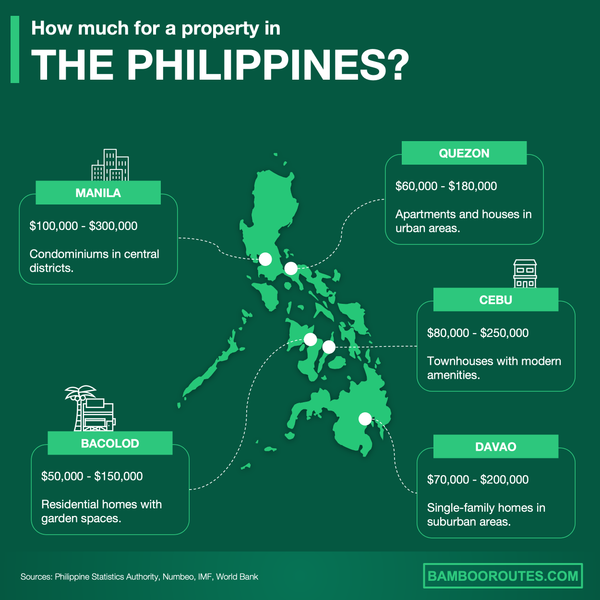
We created this infographic to give you a simple idea of how much it costs to buy property in different parts of the Philippines. As you can see, it breaks down price ranges and property types for popular cities in the country. We hope this makes it easier to explore your options and understand the market.
Related blog posts