
Authored by the expert who managed and guided the team behind the South Korea Property Pack
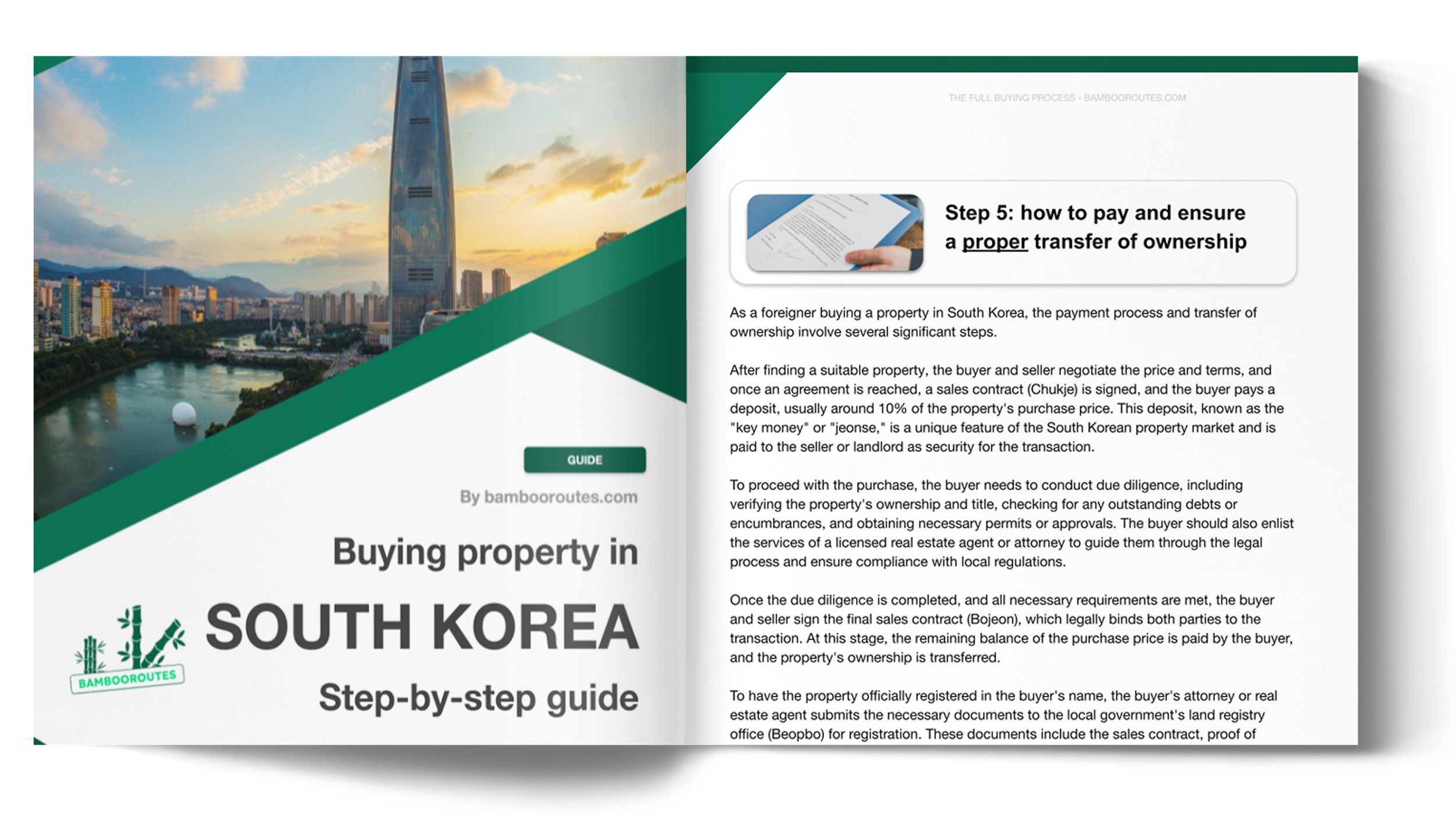
Get all the data you need about the real estate market in Gwangju
Foreigners can buy and own most normal residential property in Gwangju in 2026, but the safest purchase is still a well-checked apartment or house with clean registration.
We constantly update this blog post because South Korea has tightened foreign buyer reporting rules, especially around visa status, funding documents and suspicious transactions.
For Gwangju, the main risks are not foreign ownership quotas, but title problems, tenant deposits, redevelopment zones, older low-rise housing and misunderstood mortgage rules.
And if you’re planning to buy a property in this place, you may want to download our pack covering the real estate market in Gwangju.

What can I legally buy and truly own as a foreigner in Gwangju?
What property types can foreigners legally buy in Gwangju right now?
Foreigners can legally buy most normal residential property in Gwangju in 2026, including apartments, officetels used as housing, low-rise villas, row houses, detached houses and residential land with a house on it.
The main condition is that the Gwangju property must be properly reported, paid for through a compliant funding route and registered in the buyer’s name, while sensitive land can need prior permission.
In practical terms, Gwangju apartments in areas such as Sangmu, Suwan, Chumdan, Bongseon and Gwangju-Songjeong are usually simpler than old villas or detached houses because the registry, building records and resale market are easier to check.
Foreign buyers should be more careful with cheap villas, old houses, redevelopment areas, commercial officetels and properties with tenants, because these Gwangju properties can hide legal, tax, mortgage or lease-deposit problems.
Finally, please note that our pack about the property market in Gwangju is specifically tailored to foreigners.
Can I own land in my own name in Gwangju right now?
Yes, a foreign individual can own land in their own name in Gwangju in 2026, including the land share under an apartment and the land under a detached house.
This does not mean every plot is automatically safe, because land in military, cultural heritage, natural monument, ecological, landscape or wildlife protection zones can require prior permission before the contract is signed.
For a normal apartment in Seo-gu, Nam-gu, Buk-gu, Gwangsan-gu or Dong-gu, this sensitive-land issue is usually not the first concern, but it can matter for older houses, hill-edge plots, riverside areas and redevelopment districts.
As of 2026, what other key foreign-ownership rules or limits should I know in Gwangju?
As of 2026, the key Gwangju foreign-ownership rules are reporting the real estate transaction, proving funding when needed, checking protected land and completing ownership registration correctly.
There is no general foreigner quota for Gwangju apartments or condos in 2026, so a foreign buyer is not limited by a building-wide percentage rule like in some other Asian markets.
Foreign buyers in Gwangju usually need a real estate transaction report after contract signing, and non-residents or foreign-funded buyers can also face foreign-exchange and source-of-funds documentation checks.
The important 2026 change is that Korea expanded foreign buyer reporting details from February 10, 2026, including visa status, address and overseas funding information, even though the strict Seoul-area permit rule is not a general Gwangju rule.
What’s the biggest ownership mistake foreigners make in Gwangju right now?
The biggest mistake foreigners make in Gwangju in 2026 is assuming that legal foreign ownership automatically means the specific apartment, villa or house has clean title.
If a buyer skips registry, lease-deposit and building checks, the buyer can inherit a mortgage problem, a tenant-deposit problem, a resale problem or a property that is harder to finance.
Other classic Gwangju pitfalls include buying old villas without checking illegal extensions, ignoring redevelopment plans, misunderstanding officetel use and relying only on an agent’s verbal explanation.
Get fresh and reliable information about the market in Gwangju
Don't base significant investment decisions on outdated data. Get updated and accurate information.

Which visa or residency status changes what I can do in Gwangju?
Do I need a specific visa to buy property in Gwangju right now?
You do not need a specific visa to buy residential property in Gwangju in June 2026, and even a non-resident or tourist can buy if the paperwork, funding and registration steps are handled correctly.
The most common administrative issue for non-resident buyers in Gwangju is getting an identification number that can be used for real estate registration and tax records.
A local tax ID or alien registration number is not always needed before searching, but a usable registration number is needed before ownership transfer can be registered.
A typical Gwangju foreign buyer file includes passport, visa or stay information, Korean address details if available, proof of funds, sale contract, registration number, tax documents and bank remittance records when funds come from abroad.
Does buying property help me get residency and citizenship in Gwangju in 2026?
As of 2026, buying a normal apartment, villa, officetel or house in Gwangju does not automatically give a foreigner Korean residency, permanent residency or citizenship.
Korea has used real estate investment immigration routes in selected areas, but a normal Gwangju residential purchase should not be treated as an immigration investment product.
Foreigners who want long-term status should usually look at work, business, family, study, investor or long-term residence routes first, because ordinary Gwangju property ownership is mainly an asset decision.
Can I legally rent out property on my visa in Gwangju right now?
A foreign owner can usually rent out a Gwangju residential property on a long-term lease, but rental income is Korean-source income and the owner must handle tax reporting correctly.
You do not normally need to live in Korea to rent out a Gwangju property, but you should have a reliable local agent, tax contact and bank setup if you are abroad.
The main details are to use a proper lease contract, understand tenant deposit priority, avoid unregistered short-term lodging activity and keep clear records of rent, costs and repairs.
We cover everything there is to know about buying and renting out in Gwangju here.
Get to know the market before buying a property in Gwangju
Better information leads to better decisions. Get all the data you need before investing a large amount of money.
How does the buying process actually work step-by-step in Gwangju?
What are the exact steps to buy property in Gwangju right now?
The standard Gwangju buying sequence is to choose the property, check registry and zoning, sign the contract, pay the deposit, file reports, move funds, pay taxes, close, and register ownership.
You do not always need to be physically present if you appoint a properly documented representative, but most amateur foreign buyers should be present for bank, contract, inspection and closing steps.
The sale contract and deposit payment are usually the step that makes the deal feel legally binding in practice, so the registry and funding checks should happen before signing.
A normal Gwangju apartment purchase often takes about four to eight weeks from accepted offer to ownership registration, while older houses, foreign remittances or mortgage approval can take longer.
We have a document entirely dedicated to the whole buying process our pack about properties in Gwangju.
Is it mandatory to get a lawyer or a notary to buy a property in Gwangju right now?
A lawyer is not mandatory for every standard Gwangju home purchase in 2026, and Korea does not use a Western-style notary closing system for ordinary residential transactions.
In Gwangju, a judicial scrivener usually handles registration paperwork, while a lawyer reviews legal risk, contract wording, tenant issues, zoning problems and foreign-buyer complications.
The engagement scope should clearly include registry review, building register review, land-use review, tenant-deposit review, contract clauses, tax sequencing and foreign funding documents.
Make a profitable investment in Gwangju
Better information leads to better decisions. Save time and money. Download our data.
What checks should I run so I don’t buy a problem property in Gwangju?
How do I verify title and ownership history in Gwangju right now?
The official place to verify title and ownership history in Gwangju is the Supreme Court Internet Registry Office, usually known as IROS.
The key document to request is the real estate registry certificate, which shows the property description, current owner and registered rights over the Gwangju property.
A realistic look-back check is at least the current owner and recent transfer history, with deeper review if there were inheritance transfers, quick resales, co-owners or redevelopment hints.
A red flag that should pause a Gwangju purchase is any mismatch between the seller, the registry owner, the building record, the real use or the agent’s explanation.
You will find here the list of classic mistakes people make when buying a property in Gwangju.
How do I confirm there are no liens in Gwangju right now?
The standard way to confirm liens in Gwangju is to read the real estate registry certificate and check the rights section before contract signing and again before closing.
The common encumbrance to ask about is a collateral security right, mortgage, seizure, provisional seizure, provisional disposition or tenant deposit that affects the true risk of ownership.
The best written proof is an up-to-date real estate registry certificate from IROS, supported by closing documents showing that any mortgage or seizure will be removed.
How do I check zoning and permitted use in Gwangju right now?
For Gwangju zoning and permitted use in 2026, start with Gwangju’s land-use portal and confirm important decisions with an official land-use planning confirmation certificate.
The key document is the Land Use Planning Confirmation, which shows zoning, planning restrictions, use limits and other land-use matters for the specific parcel.
A common Gwangju pitfall is buying an old house, villa or mixed-use officetel without checking whether the actual use, road access, redevelopment context and building record match the legal status.
Don't buy the wrong property, in the wrong area of Gwangju
Buying real estate is a significant investment. Don't rely solely on your intuition. Gather the right information to make the best decision.
Can I get a mortgage as a foreigner in Gwangju, and on what terms?
Do banks lend to foreigners for homes in Gwangju in 2026?
As of 2026, Korean banks can lend to foreigners for homes in Gwangju, but approval depends much more on local residency, Korean income and credit records than on nationality alone.
A realistic Gwangju LTV range is about 40% to 60% for strong resident foreign borrowers, about 0% to 40% for weaker profiles and often very limited lending for pure non-residents.
The single most important requirement is usually stable Korean income with an Alien Registration Card, a Korean bank account, tax records and a visa status that the bank understands.
You can also read our latest update about mortgage and interest rates in South Korea.
Which banks are most foreigner-friendly in Gwangju in 2026?
As of 2026, the most realistic first banks for a foreigner mortgage in Gwangju are Hana Bank, Shinhan Bank and KB Kookmin Bank, with Woori and NH NongHyup also worth checking.
The feature that matters most is not the brand name, but whether the Gwangju branch can process foreign documents, Korean income proof, overseas funds and English or bilingual explanations.
These banks may consider non-residents case by case, but a buyer without Korean residency, Korean income or Korean credit history should assume approval is difficult.
We actually have a specific document about how to get a mortgage as a foreigner in our pack covering real estate in Gwangju.
What mortgage rates are foreigners offered in Gwangju in 2026?
As of 2026, a qualified foreign resident buying a home in Gwangju should expect a rough mortgage rate range of about 4.5% to 7.2% per year.
Fixed-rate loans usually cost a little more at the start but give payment certainty, while variable-rate loans can start lower but expose the buyer to future rate changes.
Get fresh and reliable information about the market in Gwangju
Don't base significant investment decisions on outdated data. Get updated and accurate information.
What will taxes, fees, and ongoing costs look like in Gwangju?
What are the total closing costs as a percent in Gwangju in 2026?
A standard foreign residential buyer in Gwangju in 2026 should usually budget about 3% to 5.5% of the purchase price for closing costs.
A simple apartment under KRW 600 million can often sit near 3% to 4%, while a larger, financed or legally reviewed purchase can move closer to 4.5% to 5.5%.
The main Gwangju closing-cost categories are acquisition tax, local surtaxes, brokerage commission, registration costs, judicial scrivener fees, certificates, bank fees and legal review if used.
The biggest single cost is usually acquisition tax and related local surtaxes, not the registry certificate or administrative paperwork.
If you want to go into more details, we also have a blog article detailing all the property taxes and fees in Gwangju.
What annual property tax should I budget in Gwangju in 2026?
As of 2026, a standard owner-occupied Gwangju home often needs about KRW 300,000 to KRW 900,000 per year in property tax, or roughly USD 200 to USD 600 and EUR 170 to EUR 520.
Annual property tax in Gwangju is assessed through Korean official value and tax formulas, so the tax bill is not simply a flat percentage of the sale price.
How is rental income taxed for foreigners in Gwangju in 2026?
As of 2026, a modest foreign-owner rental in Gwangju often produces an effective Korean tax cost around 6.6% to 16.5% of net rental income, depending on deductions and total income.
A foreign owner usually needs to report Korean-source rental income to the National Tax Service, and a non-resident should check whether treaty rules, withholding or local filing steps apply.
What insurance is common and how much in Gwangju in 2026?
As of 2026, a standard Gwangju home policy often costs about KRW 80,000 to KRW 500,000 per year, or roughly USD 50 to USD 330 and EUR 45 to EUR 290.
The most common coverage is fire insurance, often with added protection for water leakage, liability, contents and landlord risk when the property is rented out.
The biggest pricing factor in Gwangju is usually the property type and building management structure, because apartments often have shared building coverage while villas and detached houses need more individual protection.
Get to know the market before buying a property in Gwangju
Better information leads to better decisions. Get all the data you need before investing a large amount of money.
What sources have we used to write this blog article?
Whether it’s in our blog articles or the market analyses included in our property pack about Gwangju, we always rely on the strongest methodology we can … and we don’t throw out numbers at random.
We also aim to be fully transparent, so below we’ve listed the authoritative sources we used, and explained how we used them and the methods behind our estimates.
| Source | Why this source is reliable | How we used it |
|---|---|---|
| KLRI, Act on Report on Real Estate Transactions | It is an official English legal database for Korean statutes. | We used it to understand the legal basis for real estate reporting. We cross-checked practical steps with EasyLaw and Invest Korea. |
| EasyLaw, Acquisition of Real Estate by Foreigners | It is a government-backed legal guide for practical buyers. | We used it for foreign acquisition reporting and protected land rules. We applied those rules to normal Gwangju residential purchases. |
| MOLIT, February 2026 foreign buyer reporting update | It is Korea’s land and housing ministry. | We used it for the 2026 reporting update on visa status, address and overseas funds. We separated Korea-wide reporting from Seoul-area permit rules. |
| Invest Korea, Related Laws on Real Estate Acquisition | It is Korea’s national investment promotion agency. | We used it to simplify the foreign acquisition framework. We treated it as a practical official source for non-specialist buyers. |
| Invest Korea, Procedures and Required Documents | It explains buyer steps for resident and non-resident foreigners. | We used it to map the buying process from contract to registration. We adapted the workflow to Gwangju residential buyers. |
| Supreme Court Internet Registry Office | It is Korea’s official real estate registration portal. | We used it as the main title-check source. We focused on owner, mortgage, seizure and registered-right checks. |
| Supreme Court of Korea, Public e-Court Services | It explains Korea’s electronic court and registry services. | We used it to support the registry workflow. We used it together with IROS for ownership verification guidance. |
| Gwangju land-use plan portal | It is Gwangju’s local land-use information portal. | We used it for Gwangju-specific zoning due diligence. We treated online viewing as screening, not final proof. |
| Government24, Land Use Planning Confirmation | It is Korea’s official civil-service portal. | We used it to confirm how land-use certificates are requested. We used the certificate as proof-grade zoning evidence. |
| Korea Real Estate Board R-ONE | It is Korea’s official real estate statistics institution. | We used it to frame Gwangju housing as an official local market. We used it for price and transaction context, not legal advice. |
| Bank of Korea | It is Korea’s central bank. | We used it as the mortgage-rate and macro-rate anchor. We then widened ranges for foreign borrower risk. |
| Korea Housing Finance Corporation | It is Korea’s public housing-finance institution. | We used it for public mortgage benchmarks in 2026. We did not assume every foreign buyer qualifies for policy loans. |
| National Tax Service English portal | It is Korea’s national tax authority. | We used it for rental-income and tax-filing context. We cross-checked foreigner tax treatment with PwC. |
| PwC Korea individual tax summary | It is a regularly updated professional tax reference. | We used it as a secondary source on resident and non-resident income tax. We still treated NTS as the primary authority. |
| Invest Korea, brokerage commission | It summarizes Korean brokerage fee practice in English. | We used it to estimate closing-cost components. We combined it with acquisition tax and registration cost assumptions. |
Make a profitable investment in Gwangju
Better information leads to better decisions. Save time and money. Download our data.
Related blog posts