
Authored by the expert who managed and guided the team behind the South Korea Property Pack
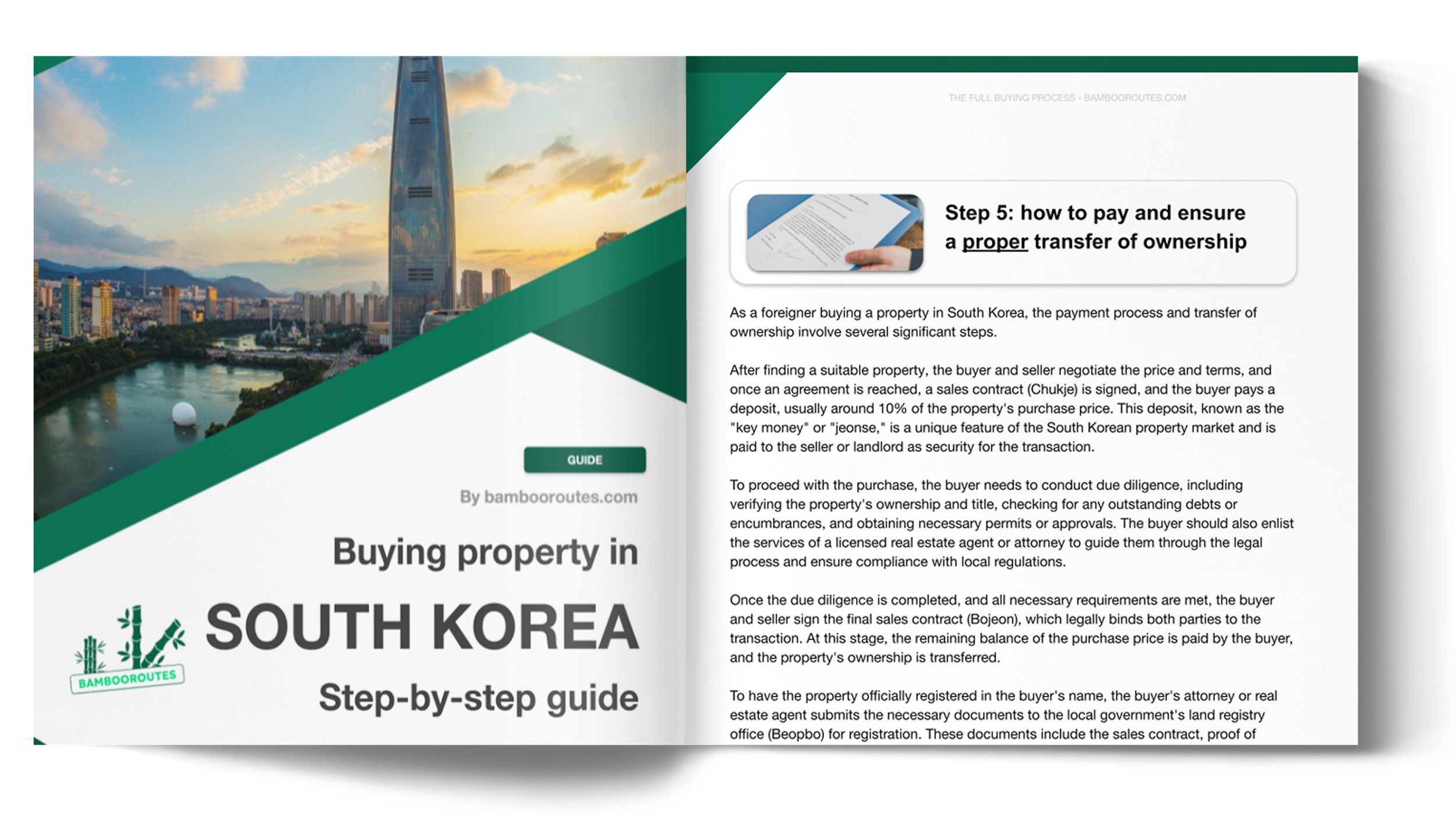
Everything you need to know before buying real estate is included in our South Korea Property Pack
Buying property in Gwangju as a foreigner can feel overwhelming, especially when you hear stories about rental deposit scams and unfamiliar legal processes that trip up even experienced investors.
This guide gives you the insider knowledge you need to protect yourself from the specific risks and grey areas that catch foreigners off guard in Gwangju in 2026.
We constantly update this blog post to reflect the latest regulatory changes and market conditions, so the information stays relevant and actionable.
And if you're planning to buy a property in this place, you may want to download our pack covering the real estate market in Gwangju.

How risky is buying property in Gwangju as a foreigner in 2026?
Can foreigners legally own properties in Gwangju in 2026?
As of early 2026, foreigners can legally buy and own residential property in Gwangju without needing prior government approval, since Gwangju is not part of the Seoul Metropolitan Area that now requires special permits for foreign buyers.
The main condition that applies to foreigners buying property in Gwangju is the mandatory reporting requirement, which means you must report your acquisition to the local district office (si/gun/gu) within 60 days of signing the contract or paying the balance.
Unlike some countries where foreigners must use special legal structures like trusts or corporate vehicles, in Gwangju you can hold residential property directly in your own name, which simplifies ownership and makes your rights clearer.
However, if you plan to purchase land in certain protected zones like military facility areas or cultural heritage sites, you will need prior government permission before entering any contract, though most standard residential apartments in Gwangju neighborhoods are not affected by these restrictions.
[VARIABLE FOREIGNER-RIGHTS]What buyer rights do foreigners actually have in Gwangju in 2026?
As of early 2026, foreigners in Gwangju have essentially the same property ownership rights as Korean citizens once the purchase is properly registered with the Supreme Court's registry system.
If a seller breaches a contract in Gwangju, you can pursue legal remedies through Korean courts, including claims for damages, specific performance, or contract rescission, and the Korean judiciary is generally accessible and procedurally formal.
The most common right that foreigners mistakenly assume they have in Gwangju is automatic protection of their deposit or purchase funds before registration, when in reality your ownership is only legally secure once it appears in the official property registry maintained by the Supreme Court.
How strong is contract enforcement in Gwangju right now?
Contract enforcement in Gwangju is generally strong by global standards, comparable to developed markets like Japan or Germany, with Korea ranking in the top 20 globally on the World Justice Project Rule of Law Index for civil justice accessibility.
The main weakness in contract enforcement that foreigners should be aware of in Gwangju is that legal proceedings take time and money, so winning a court case after a bad transaction is far more costly than preventing the problem through proper due diligence upfront.
By the way, we detail all the documents you need and what they mean in our property pack covering Gwangju.
Buying real estate in Gwangju can be risky
An increasing number of foreign investors are showing interest. However, 90% of them will make mistakes. Avoid the pitfalls with our comprehensive guide.

Which scams target foreign buyers in Gwangju right now?
Are scams against foreigners common in Gwangju right now?
Real estate scams targeting foreigners in Gwangju are not extremely common compared to Seoul or Incheon, but they do occur, and the nationwide jeonse fraud wave from 2023 to 2025 has made all Korean markets more cautious.
The type of property transaction most frequently targeted by scammers in Gwangju is the jeonse rental deposit system, where large lump-sum deposits can be lost if the landlord disappears or the property is over-leveraged with hidden mortgages.
The profile of foreign buyer most commonly targeted by scammers in Gwangju is someone who does not speak Korean fluently, is unfamiliar with the registry verification process, and is eager to close a deal quickly without independent legal advice.
The single biggest warning sign that a deal may be a scam in Gwangju is pressure to pay any deposit or significant funds before you have independently verified ownership through the Supreme Court's IROS registry system.
What are the top three scams foreigners face in Gwangju right now?
The top three scams that foreigners most commonly face when buying property in Gwangju are fake or unauthorized seller scams where someone claims ownership they do not have, jeonse deposit traps where hidden mortgages make your deposit unrecoverable, and price manipulation schemes where you are pressured to under-report the transaction value or sign side agreements.
The most common scam typically unfolds when someone poses as the property owner or claims power of attorney, shows you convincing-looking documents, pressures you to pay a reservation deposit quickly, and then disappears before you discover the registry shows a completely different owner.
The single most effective way to protect yourself from each of these three scams in Gwangju is to independently verify ownership through the IROS registry before paying any money, refuse any pressure to pay before verification is complete, and insist that all transaction terms appear in the official reported contract rather than in side agreements.

We did some research and made this infographic to help you quickly compare rental yields of the major cities in South Korea versus those in neighboring countries. It provides a clear view of how this country positions itself as a real estate investment destination, which might interest you if you’re planning to invest there.
How do I verify the seller and ownership in Gwangju without getting fooled?
How do I confirm the seller is the real owner in Gwangju?
The standard verification process to confirm the seller is the real owner in Gwangju involves pulling the official registry certificate (등기부등본) from the Supreme Court's IROS portal at iros.go.kr and matching the registered owner's name exactly to the seller's identification documents.
The official document foreigners should check to verify ownership in Gwangju is the registry certificate (등기부등본), which you can access online through IROS by entering the exact property address and paying a small fee for the certified document.
The most common trick fake sellers use to appear legitimate in Gwangju is showing you screenshots or PDF copies of documents rather than letting you pull fresh registry records yourself, and this trick is common enough that you should treat any resistance to independent verification as a red flag.
Where do I check liens or mortgages on a property in Gwangju?
The official registry where you check liens or mortgages on a property in Gwangju is the same Supreme Court IROS system at iros.go.kr, since all mortgages, provisional seizures, and legal encumbrances must be registered there to be legally enforceable.
When checking for liens in Gwangju, you should specifically request the full registry certificate (등기부등본), which contains three sections covering ownership information, rights restrictions, and encumbrances including creditor names, loan amounts, and registration dates.
The type of lien most commonly missed by foreign buyers in Gwangju is a provisional registration (가등기) or provisional seizure (가압류), which can appear between your initial check and your final payment if you do not pull a fresh registry extract right before closing.
It's one of the aspects we cover in our our pack about the real estate market in Gwangju.
How do I spot forged documents in Gwangju right now?
The most common type of forged document used in property scams in Gwangju is a fake or altered registry certificate (등기부등본) shown as a screenshot or PDF, and while not extremely common, it happens often enough that you should never rely on documents provided by the seller or agent alone.
The specific visual or procedural red flags that indicate a document may be forged in Gwangju include blurry text or inconsistent formatting, reluctance to let you pull records yourself, pressure to move quickly before you can verify, and any mismatch between the property address on the contract and the registry.
The official verification method you should use to authenticate documents in Gwangju is to pull your own fresh registry certificate directly from the IROS portal, compare it against any documents provided, and do this again within 24 to 48 hours of your final payment.
Get the full checklist for your due diligence in Gwangju
Don't repeat the same mistakes others have made before you. Make sure everything is in order before signing your sales contract.
What "grey-area" practices should I watch for in Gwangju?
What hidden costs surprise foreigners when buying a property in Gwangju?
The three most common hidden costs that foreigners overlook in Gwangju are the acquisition tax (about 1% to 4% depending on property value, roughly 3 to 12 million KRW / 2,200 to 8,800 USD / 2,000 to 8,000 EUR on a typical apartment), brokerage commission (up to 0.4% to 0.7% of sale price), and maintenance fund or move-in fees charged by some apartment complexes (typically 500,000 to 2 million KRW / 370 to 1,500 USD / 340 to 1,360 EUR).
The hidden cost most often deliberately concealed by sellers or agents in Gwangju is outstanding maintenance fees or utility arrears on the property, and while not extremely common, it sometimes happens that these obligations transfer to the buyer without clear disclosure.
If you want to go into more details, we also have a blog article detailing all the property taxes and fees in Gwangju.
Are "cash under the table" requests common in Gwangju right now?
Cash under the table requests in Gwangju property transactions are not standard practice, but they do occur sometimes, usually framed as a way to save on taxes or simplify the paperwork.
The typical reason sellers give for requesting undeclared cash payments in Gwangju is that reporting a lower transaction value will reduce acquisition taxes or capital gains taxes, often presented as "how locals do it" or "standard practice."
The legal risks foreigners face if they agree to an undeclared cash payment in Gwangju include tax penalties and reassessments if authorities discover the true price, a weaker legal position in any future disputes because your contract does not reflect reality, and potential complications with fund repatriation since your documented purchase price will not match your actual investment.
Are side agreements used to bypass rules in Gwangju right now?
Side agreements to bypass official rules in Gwangju property transactions do exist, particularly for price-splitting or undisclosed terms, and while not universal, they are common enough that foreigners should be prepared to refuse them.
The most common type of side agreement used to circumvent regulations in Gwangju is a separate document for fixtures, furniture, or "key money" that is really just a way to split the reported transaction value and reduce the taxable amount on the main contract.
The legal consequences foreigners face if a side agreement is discovered by authorities in Gwangju include tax penalties, potential fines, and the risk that your side agreement is unenforceable in court because it was designed to evade official reporting, leaving you with no legal recourse if something goes wrong.

We made this infographic to show you how property prices in South Korea compare to other big cities across the region. It breaks down the average price per square meter in city centers, so you can see how cities stack up. It’s an easy way to spot where you might get the best value for your money. We hope you like it.
Can I trust real estate agents in Gwangju in 2026?
Are real estate agents regulated in Gwangju in 2026?
As of early 2026, real estate agents in Gwangju are regulated under a national licensing system with legal duties, commission caps, and penalties for misconduct, making Korea one of the more formally regulated markets in Asia.
The official license a legitimate real estate agent should have in Gwangju is the Licensed Real Estate Agent Certificate (공인중개사 자격증), and the office itself must display a Real Estate Brokerage Office Registration Certificate (부동산중개업등록증) from the local government.
Foreigners can verify whether an agent is properly licensed in Gwangju by asking to see the registration certificate displayed in the office, checking the registration number with the local district office, or consulting the Korean Association of Realtors for confirmation.
Please note that we have a list of contacts for you in our property pack about Gwangju.
What agent fee percentage is normal in Gwangju in 2026?
As of early 2026, the normal agent fee percentage in Gwangju for residential property purchases typically ranges from about 0.4% to 0.7% of the transaction price, with legal maximum caps set by national law and local ordinance.
The typical range of agent fee percentages that covers most apartment transactions in Gwangju is 0.4% to 0.5% for properties valued over 600 million KRW (about 440,000 USD), with higher rates up to 0.9% applying to lower-value properties, though many buyers negotiate below the cap.
In Gwangju, both the buyer and seller typically pay their own agent fees separately, though the seller often pays the listing agent and buyers may pay their own representing agent if they use one, with the exact arrangement subject to negotiation.
Get the full checklist for your due diligence in Gwangju
Don't repeat the same mistakes others have made before you. Make sure everything is in order before signing your sales contract.
What due diligence actually prevents disasters in Gwangju?
What structural inspection is standard in Gwangju right now?
The standard structural inspection process for property purchases in Gwangju is less formalized than in Western countries, with many apartment buyers relying on the building's reputation and management history rather than independent professional inspections.
A qualified inspector in Gwangju should check the foundation and load-bearing walls, plumbing and electrical systems, water damage or mold signs, window sealing and insulation, and any evidence of prior renovations that may have compromised structural integrity.
The type of professional qualified to perform structural inspections in Gwangju is a licensed building inspector or construction engineer, though for apartments you may also consult the building management office for maintenance records and known issues.
The most common structural issues that inspections reveal in properties in Gwangju include water damage and mold hidden behind fresh paint or wallpaper, poor soundproofing especially in older buildings, and plumbing or electrical shortcuts concealed by cosmetic renovations.
How do I confirm exact boundaries in Gwangju right now?
The standard process for confirming exact property boundaries in Gwangju involves checking the registry certificate for the registered parcel and building details, and for anything involving land (detached houses or small multi-units), hiring a licensed surveyor to verify physical boundaries.
The official document that shows the legal boundaries of a property in Gwangju is the cadastral map (지적도) and the land registry, both of which can be obtained from the local district office or through online government portals.
The most common boundary dispute that affects foreign buyers in Gwangju involves older detached houses or small multi-unit buildings where physical fences or walls do not match the official cadastral boundaries, sometimes due to informal agreements between neighbors.
The professional you should hire to physically verify boundaries on the ground in Gwangju is a licensed land surveyor (측량사), who can compare the official cadastral records with the actual physical markers and identify any discrepancies before you finalize your purchase.
What defects are commonly hidden in Gwangju right now?
The top three defects that sellers frequently conceal from buyers in Gwangju are water damage and mold disguised by fresh wallpaper or paint (common), poor soundproofing that is difficult to detect during short viewings (common), and plumbing or electrical problems masked by cosmetic renovations (sometimes happens).
The inspection technique that helps uncover hidden defects in Gwangju is using a moisture meter to detect water damage behind walls, checking during rainy weather if possible, and asking building management for the unit's maintenance and complaint history.

We have made this infographic to give you a quick and clear snapshot of the property market in South Korea. It highlights key facts like rental prices, yields, and property costs both in city centers and outside, so you can easily compare opportunities. We’ve done some research and also included useful insights about the country’s economy, like GDP, population, and interest rates, to help you understand the bigger picture.
What insider lessons do foreigners share after buying in Gwangju?
What do foreigners say they did wrong in Gwangju right now?
The most common mistake foreigners say they made when buying property in Gwangju is trusting the agent's verbal reassurances or provided documents instead of independently verifying ownership and liens through the IROS registry system.
The top three regrets foreigners most frequently mention after buying in Gwangju are wiring money before the final registry check, accepting side agreements that later weakened their legal position, and underestimating the language barrier during contract signing.
The single piece of advice experienced foreign buyers most often give to newcomers in Gwangju is to never pay any significant money until you have pulled your own fresh registry certificate from IROS within 48 hours of the payment date.
The mistake foreigners say cost them the most money or caused the most stress in Gwangju is getting caught in a jeonse deposit situation where hidden mortgages or prior claims meant their deposit was not recoverable when the landlord defaulted.
What do locals do differently when buying in Gwangju right now?
The key difference in how locals approach buying property compared to foreigners in Gwangju is that locals instinctively treat the IROS registry as the only source of truth and never rely on agents or sellers for ownership verification.
The verification step locals routinely take that foreigners often skip in Gwangju is checking the jeonse deposit stack, meaning they verify not just their own position but also any existing tenant deposits and how those rank against the property's mortgage and market value.
The local knowledge that helps Gwangju residents get better deals is their awareness of specific building reputations, construction company track records, and neighborhood-level price trends in areas like Bongseon-dong, Chipyeong-dong, Cheomdan, and Suwan-dong that are not visible in online listings.
Don't buy the wrong property, in the wrong area of Gwangju
Buying real estate is a significant investment. Don't rely solely on your intuition. Gather the right information to make the best decision.

What sources have we used to write this blog article?
Whether it's in our blog articles or the market analyses included in our property pack about Gwangju, we always rely on the strongest methodology we can and we don't throw out numbers at random.
We also aim to be fully transparent, so below we've listed the authoritative sources we used, and explained how we used them and the methods behind our estimates.
| Source | Why it's authoritative | How we used it |
|---|---|---|
| Supreme Court Internet Registry Office (IROS) | It's the official registry platform under the Supreme Court where ownership and liens are recorded. | We used it to explain the verification process that protects buyers in Gwangju. We also used it as the benchmark for what counts as legal proof of ownership. |
| Korea Law Translation Center (Foreigner's Land Acquisition Act) | It provides official English translations of Korean statutes used by foreign investors. | We used it to explain the legal framework for foreign ownership in Gwangju. We also used it to clarify which restrictions are real versus rumors. |
| National Law Information Center (Licensed Real Estate Agents Act) | It's the government's official legal text database including English versions. | We used it to describe agent regulations and fee caps in Gwangju. We also used it to create practical checklists for working with agents. |
| Korea Housing & Urban Guarantee Corporation (HUG) | HUG is the state-backed guarantor central to Korea's rental deposit risk ecosystem. | We used it to explain jeonse deposit risks specific to Gwangju. We also used it to justify the importance of deposit verification. |
| Korea.net (Government Portal) | It republishes official government communications in English for the public. | We used it to list government-endorsed anti-jeonse-fraud practices. We also used it to align our advice with enforcement expectations. |
| Real Estate Transaction Management System (RTMS) | It's the government system tied to legal reporting of real estate transactions. | We used it to explain proper reporting requirements in Gwangju. We also used it to highlight why off-book behavior is risky. |
| InvestKOREA (KOTRA) | KOTRA is the national trade and investment promotion agency with official guides. | We used it to map the step-by-step process foreigners follow in Gwangju. We also used it to identify where scammers insert shortcuts. |
| World Justice Project Rule of Law Index 2025 | It's a widely used international benchmark built from household and expert surveys. | We used it to anchor contract enforcement strength in Gwangju. We also used it to avoid relying on anecdotes alone. |
| Korea Real Estate Board (REB) | It's the official public institution that publishes core real estate statistics in Korea. | We used it to provide market context for Gwangju. We also used it as a benchmark for normal versus suspicious price patterns. |
| Gwangju Metropolitan City Portal | It's the city government portal with local administration information. | We used it to keep the article grounded in Gwangju-specific reality. We also used it to identify local district-level processes. |

We created this infographic to give you a simple idea of how much it costs to buy property in different parts of South Korea. As you can see, it breaks down price ranges and property types for popular cities in the country. We hope this makes it easier to explore your options and understand the market.
Related blog posts