
Authored by the expert who managed and guided the team behind the South Korea Property Pack
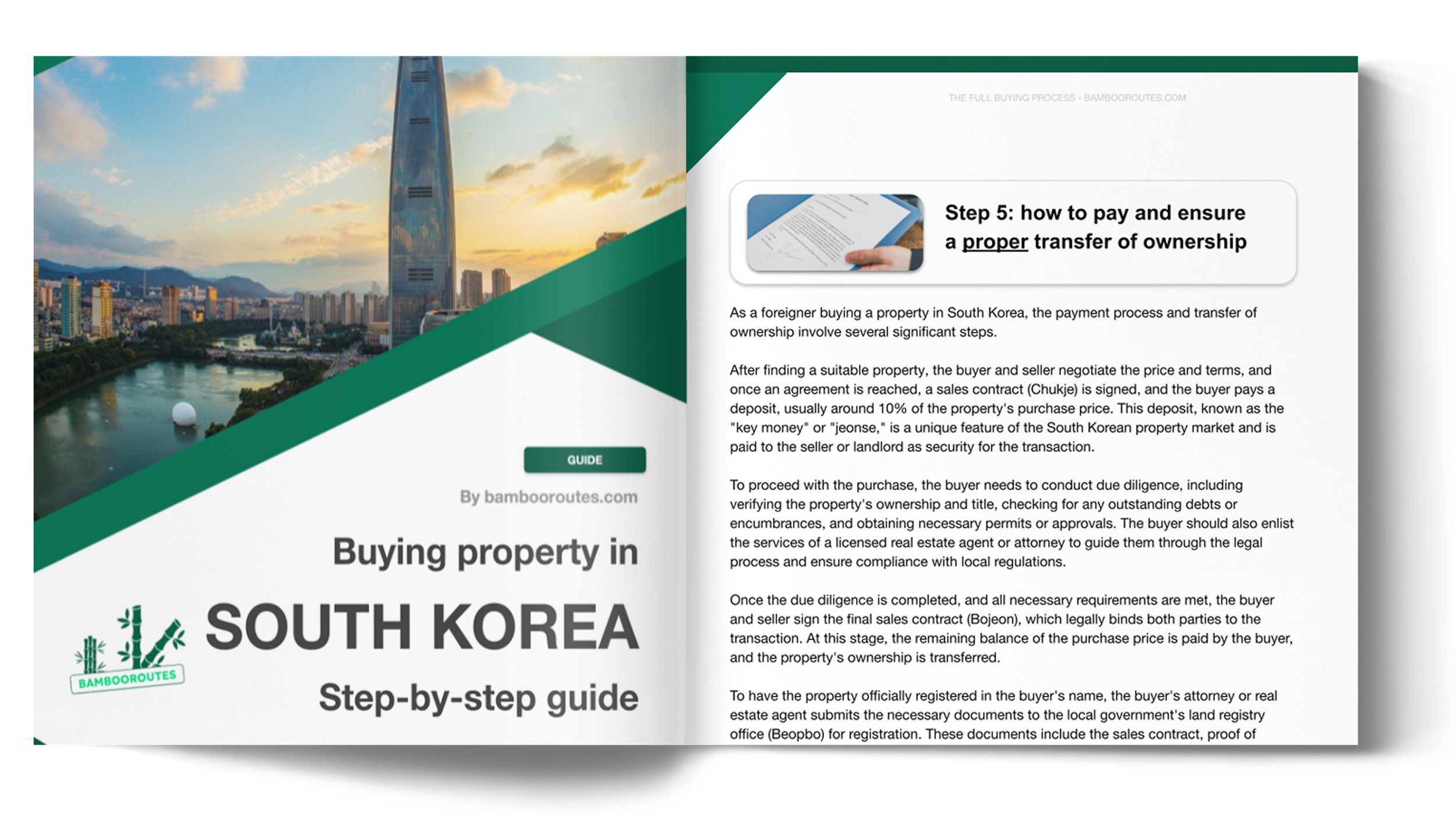
Everything you need to know before buying real estate is included in our South Korea Property Pack
Buying property as a foreigner in Daegu can feel overwhelming, but the rules are actually more straightforward than in many other countries.
This guide covers everything you need to know about what you can legally buy, the exact steps to follow, and the costs you should expect in January 2026.
We constantly update this blog post with the latest information on housing prices in Daegu and any regulatory changes that affect foreign buyers.
And if you're planning to buy a property in this place, you may want to download our pack covering the real estate market in Daegu.
Insights
- Foreigners in Daegu must file a land acquisition report within 60 days of signing a purchase contract, and missing this deadline can result in fines of up to 3 million Korean won.
- Unlike Seoul and the Capital region, Daegu has not been designated as a "permission-required zone" for foreigners, so most residential purchases follow the standard nationwide process.
- Mortgage rates for foreign buyers in Daegu in 2026 typically range from 4.8% to 6.5%, about 0.5 to 1.5 percentage points higher than what Korean nationals pay.
- Closing costs in Daegu generally run between 3.5% and 5.5% of the purchase price, with acquisition tax being the single largest expense.
- Korea's stressed debt-service ratio (DSR) rules that tightened in mid-2025 mean that even high-income foreigners may qualify for smaller loans than expected.
- Apartment management fees in Daegu for a standard 85-square-meter unit typically cost between 150,000 and 300,000 Korean won per month, a recurring cost many buyers underestimate.
- The official registry record from the Supreme Court's IROS system is the only definitive proof of property ownership and liens in Daegu, not the contract or marketing materials.
- Officetels in Daegu may be marketed as residential but legally classified as commercial, which changes your brokerage commission caps and some tax obligations.

What can I legally buy and truly own as a foreigner in Daegu?
What property types can foreigners legally buy in Daegu right now?
In January 2026, foreigners can legally buy the same residential property types that Korean citizens can purchase in Daegu, including apartments, officetels, villas, multi-family buildings, and detached houses.
The main difference is not what you can buy but what you must do afterward: foreigners are required to file a mandatory land acquisition report within 60 days of signing the purchase contract.
In certain special zones, such as military protection areas or cultural heritage sites, foreigners may need to obtain prior permission before completing the purchase, though these restrictions rarely apply to typical Daegu residential neighborhoods.
The 2025 headlines about tighter foreign ownership rules focused mainly on Seoul and the Capital region, so Daegu purchases currently follow the standard nationwide framework without additional local restrictions.
Finally, please note that our pack about the property market in Daegu is specifically tailored to foreigners.
Can I own land in my own name in Daegu right now?
Yes, foreigners can own land in their own name in Daegu, and Korea does not require you to use a local company or nominee structure for standard residential purchases.
However, land ownership is where you are most likely to encounter special controls, since plots in military-protection areas, cultural heritage zones, or ecological reserves may require prior government permission before a foreigner can complete the purchase.
When you buy an apartment in Daegu, you automatically receive a share of the building's land rights through the registry structure, which is typically straightforward, while buying a detached house with its own land plot is more likely to trigger questions about whether the site falls within a controlled zone.
As of 2026, what other key foreign-ownership rules or limits should I know in Daegu?
As of early 2026, Daegu does not impose foreign ownership quotas on apartments or residential condominiums, unlike some Southeast Asian countries where foreigners can only own a limited percentage of units in a building.
There is no condominium quota system in Daegu, so you can purchase any available apartment unit regardless of how many other foreigners already own in the same complex.
The most important requirement is the mandatory foreigner land acquisition report, which must be filed with the local district office within 60 days of signing your purchase contract, and failure to file on time can result in fines.
One recent development worth noting is that Korea tightened household borrowing rules in mid-2025, which affects how much mortgage financing foreigners can obtain even though it does not restrict what you can buy.
What's the biggest ownership mistake foreigners make in Daegu right now?
The biggest mistake foreigners make in Daegu is treating the signed purchase contract as the finish line rather than the starting point of the legal process, which leads them to skip critical registry checks or miss mandatory reporting deadlines.
If you miss the 60-day deadline to file your foreigner land acquisition report, you can face fines of up to 3 million Korean won, and repeated violations can lead to more serious consequences.
Other classic pitfalls in Daegu include paying deposits before verifying ownership and liens through the official registry system, not understanding that an officetel marketed as "residential" may be legally classified as commercial, and underestimating the ongoing apartment management fees that can add 150,000 to 300,000 won monthly to your housing costs.
Get fresh and reliable information about the market in Daegu
Don't base significant investment decisions on outdated data. Get updated and accurate information.

Which visa or residency status changes what I can do in Daegu?
Do I need a specific visa to buy property in Daegu right now?
No, you do not need a specific visa or residency status to buy property in Daegu, and foreigners on tourist visas can legally purchase residential real estate in South Korea.
The main practical challenge for non-residents is that setting up a Korean bank account and obtaining the identification documents needed for the transaction can be more complicated without a long-term visa.
You should expect to need a Korea-recognized taxpayer identifier for parts of the process, including tax payments and registration, and the National Tax Service offers foreigner helpdesk services to assist with this requirement.
A typical document set for foreign buyers in Daegu includes your passport, proof of funds, a notarized power of attorney if you are using a representative, and any visa or alien registration card if you have one.
Does buying property help me get residency and citizenship in Daegu in 2026?
As of early 2026, buying a standard home in Daegu does not automatically grant you residency or citizenship in South Korea.
Korea does have investment-based residence pathways, but these are tied to specific government-designated programs and investment thresholds, not to general residential property purchases in cities like Daegu.
Other pathways to permanent residency or citizenship include work-based visas held for several years, marriage to a Korean national, the points-based skilled worker system, or qualifying investment programs that typically require investments in designated development projects or government bonds rather than regular apartments.
We give you all the details you need about the different pathways to get residency and citizenship in Daegu here.
Can I legally rent out property on my visa in Daegu right now?
Owning property in Daegu does not restrict your ability to rent it out, but your visa status affects whether you need to register as a business and how your rental income is taxed.
You do not need to live in Korea to rent out your Daegu property, and many foreign owners manage rentals from abroad using licensed local agents and property managers.
The key details foreigners must know include proper tax handling, as Korea taxes rental income differently for residents versus non-residents, and careful management of tenant security deposits, which follow Korea's unique "jeonse" and "wolse" systems.
We cover everything there is to know about buying and renting out in Daegu here.
Get to know the market before buying a property in Daegu
Better information leads to better decisions. Get all the data you need before investing a large amount of money.
How does the buying process actually work step-by-step in Daegu?
What are the exact steps to buy property in Daegu right now?
The standard sequence in Daegu is: first verify ownership and liens through the registry, then sign the purchase contract with staged payments, file transaction reporting and your foreigner land acquisition report, pay acquisition taxes, and finally register the ownership transfer at the registry office.
You do not have to be physically present for every step in Daegu, as many parts of the process can be handled by a properly authorized representative with a notarized power of attorney, though Korea's documentation requirements are strict.
The step that makes the deal legally binding is typically the signing of the formal purchase contract along with payment of the initial deposit, which creates enforceable obligations for both buyer and seller.
From accepted offer to final registration, most Daegu property purchases take between 4 and 8 weeks, though complex cases or financing delays can extend the timeline.
We have a document entirely dedicated to the whole buying process our pack about properties in Daegu.
Is it mandatory to get a lawyer or a notary to buy a property in Daegu right now?
Using a lawyer or notary is not legally mandatory for every property purchase in Daegu, but it is very common and strongly recommended because one paperwork mistake can cost far more than the professional fee.
In Korea, a "judicial scrivener" or lawyer typically handles the ownership transfer registration paperwork, while your job is to ensure the contract terms protect you and the registry checks are done properly before you commit money.
One key item that should be explicitly included in your professional engagement is verification of the registry record before any deposit is paid, confirming current ownership, the absence of liens, and that no legal disputes are registered against the property.
Make a profitable investment in Daegu
Better information leads to better decisions. Save time and money. Download our data.
What checks should I run so I don't buy a problem property in Daegu?
How do I verify title and ownership history in Daegu right now?
The official registry you should use to verify title and ownership history in Daegu is the Supreme Court's Internet Registry Office, known as IROS, which is the definitive public record of property rights in South Korea.
The key document to request is the registry extract, called "deunggi-sahang-jeungmyeongseo" in Korean, which shows the current legal owner, all ownership changes, and any registered rights like mortgages.
A realistic look-back period for ownership history checks in Daegu is 10 to 15 years, which helps you identify any patterns of frequent sales, disputes, or issues that might not appear in a shorter search.
One clear red flag that should stop or pause your purchase is finding a registered seizure, attachment, or ongoing legal dispute on the property, as these encumbrances can transfer to you as the new owner.
You will find here the list of classic mistakes people make when buying a property in Daegu.
How do I confirm there are no liens in Daegu right now?
The standard way to confirm there are no liens or encumbrances on a property in Daegu is to pull the official registry extract from IROS, where mortgages, seizures, and other third-party rights are recorded in a dedicated section.
One common type of lien that buyers should specifically ask about in Daegu is the mortgage registered by a previous owner, which must be fully discharged before or at closing, as well as any unpaid apartment management fees that can become the new owner's responsibility.
The single best form of written proof that shows lien status in Daegu is the official registry extract dated as close to your closing date as possible, since new encumbrances can be registered at any time before ownership transfers.
How do I check zoning and permitted use in Daegu right now?
The authority you should use to check zoning and permitted use in Daegu is your local district office, known as "gu-cheong," which can provide land-use certificates and confirm whether any special zone restrictions apply to your property.
The document that confirms the zoning classification is the land-use planning confirmation, called "toji-iyong-gyehoek-hwaginwon" in Korean, which shows the official land category and any development restrictions.
One common zoning pitfall foreign buyers miss in Daegu is purchasing an officetel that is legally classified as commercial property even though it is marketed and used as residential, which changes your brokerage fee caps, some tax obligations, and potentially your loan options.
Don't buy the wrong property, in the wrong area of Daegu
Buying real estate is a significant investment. Don't rely solely on your intuition. Gather the right information to make the best decision.
Can I get a mortgage as a foreigner in Daegu, and on what terms?
Do banks lend to foreigners for homes in Daegu in 2026?
As of early 2026, Korean banks do lend to foreigners for home purchases in Daegu, especially to those who are legal residents with stable income documented in Korea.
The realistic loan-to-value range that foreign borrowers see in Daegu typically falls between 40% and 70%, with the exact percentage depending on your residency status, income verification, and the bank's risk assessment.
The single most common eligibility requirement is having verifiable Korean-source income, as banks must comply with stressed debt-service ratio rules that tightened in 2025 and limit how much you can borrow based on your documented earnings.
You can also read our latest update about mortgage and interest rates in South Korea.
Which banks are most foreigner-friendly in Daegu in 2026?
As of early 2026, the most foreigner-friendly banks for mortgages in Daegu are typically the major nationwide commercial banks with global banking desks, including KB Kookmin Bank, Shinhan Bank, and Woori Bank, all of which have Daegu branches with experience serving foreign clients.
The feature that makes these banks more foreigner-friendly is that they have English-capable staff, established procedures for processing foreign documentation, and experience underwriting borrowers with non-Korean income sources.
These banks will sometimes lend to non-residents who do not have Korean residency, but the terms are typically stricter, requiring larger down payments and more extensive documentation of overseas income and assets.
We actually have a specific document about how to get a mortgage as a foreigner in our pack covering real estate in Daegu.
What mortgage rates are foreigners offered in Daegu in 2026?
As of early 2026, foreign buyers in Daegu can expect mortgage interest rates in the range of 4.8% to 6.5%, which is typically 0.5 to 1.5 percentage points higher than the rates offered to Korean nationals with equivalent credit profiles.
Fixed-rate mortgages in Daegu tend to carry slightly higher interest rates than variable-rate options, often by 0.3 to 0.7 percentage points, though the fixed option provides payment stability that many foreign buyers prefer.
Get fresh and reliable information about the market in Daegu
Don't base significant investment decisions on outdated data. Get updated and accurate information.
What will taxes, fees, and ongoing costs look like in Daegu?
What are the total closing costs as a percent in Daegu in 2026?
Typical total closing costs for a residential property purchase in Daegu in 2026 run around 3.5% to 5.5% of the purchase price for most standard transactions.
The realistic range spans from about 2.5% at the low end for straightforward purchases to 7% or more at the high end if tax rates step up for higher-value properties or if your property classification increases certain fees.
The specific fee categories that make up total closing costs in Daegu include acquisition tax, brokerage commission, registration fees, judicial scrivener fees, and small administrative costs.
Acquisition tax is usually the biggest contributor to closing costs in Daegu, typically accounting for 1% to 3% of the purchase price depending on the property value and whether it is your first home.
If you want to go into more details, we also have a blog article detailing all the property taxes and fees in Daegu.
What annual property tax should I budget in Daegu in 2026?
As of early 2026, a typical annual property tax budget for a standard owner-occupied home in Daegu ranges from about 300,000 to 1,200,000 Korean won per year, which is roughly 220 to 880 USD or 200 to 800 EUR, depending on the assessed value of your property.
Annual property tax in Daegu is assessed based on the government-determined standard value of your property, not your purchase price, using a rate structure that applies progressively higher rates to higher-value properties.
How is rental income taxed for foreigners in Daegu in 2026?
As of early 2026, non-resident foreigners earning rental income from Daegu property typically face an effective tax rate of around 22% once local surtaxes are included, though tax treaty provisions may reduce this for residents of certain countries.
Foreign owners must either have tax withheld at source by their tenant or property manager, or file an annual Korean tax return through the National Tax Service, which offers foreigner assistance services to help navigate the process.
What insurance is common and how much in Daegu in 2026?
As of early 2026, a typical annual home insurance premium in Daegu ranges from about 150,000 to 400,000 Korean won per year, which is roughly 110 to 290 USD or 100 to 270 EUR, for a standard apartment with basic fire and liability coverage.
The most common type of property insurance coverage that owners carry in Daegu is fire insurance combined with basic liability protection, as many apartment complexes require proof of fire coverage.
The biggest factor that makes insurance premiums higher or lower for the same property type in Daegu is the building's age and construction quality, with older buildings and those without modern fire suppression systems costing more to insure.
Get to know the market before buying a property in Daegu
Better information leads to better decisions. Get all the data you need before investing a large amount of money.
What sources have we used to write this blog article?
Whether it's in our blog articles or the market analyses included in our property pack about Daegu, we always rely on the strongest methodology we can … and we don't throw out numbers at random.
We also aim to be fully transparent, so below we've listed the authoritative sources we used, and explained how we used them and the methods behind our estimates.
| Source | Why It's Authoritative | How We Used It |
|---|---|---|
| Korea Law Translation (KLRI) | Official English translation portal for Korean statutes. | We used it to confirm the mandatory foreigner land acquisition report and the 60-day deadline. We treated it as the primary legal reference for what the law requires. |
| Easy Law | Korean government-supported legal guidance for the public. | We used it to cross-check where prior permission applies and to keep explanations accessible. We relied on it for practical foreigner compliance steps. |
| Invest Korea (KOTRA) - Taxes | Korea's official investment promotion agency. | We used it to outline the major tax categories foreigners face. We cross-checked these with other professional tax summaries. |
| Invest Korea (KOTRA) - Procedures | Official guidance for foreign participants in Korea's system. | We used it to validate the core purchase sequence. We filled in legal deadlines from the KLRI statute. |
| Supreme Court IROS | Official judiciary portal for property registry records. | We used it to explain how to verify title and liens in Korea. We emphasized that the registry record is the definitive reference for property rights. |
| National Tax Service (NTS) | Korea's tax authority with official foreigner guidance. | We used it to anchor practical tax compliance expectations. We referenced their helpdesk services for foreign taxpayers. |
| Financial Services Commission (FSC) | National financial regulator and primary source for lending rules. | We used it to explain why mortgage approval depends on income-based rules. We tracked the 2025 household debt tightening measures. |
| Bank of Korea (BOK) | The central bank with authoritative interest rate context. | We used it to anchor the interest rate environment for early 2026. We triangulated mortgage pricing using BOK-reported data. |
| PwC Tax Summaries - Korea | Major international tax reference with transparent review dates. | We used it to cross-check residency and tax concepts. We referenced it for rental income treatment mechanics. |
| Korea Visa Portal | Korea's official visa information and service portal. | We used it to verify visa requirements for property purchases. We avoided speculation by anchoring all visa claims here. |
| Korea Real Estate Board / K-apt | Official apartment management disclosure platform. | We used it to support due diligence on management fees. We referenced it for building transparency checks. |
| Seoul Metropolitan Government | Official city government publication citing national legal basis. | We used it as a benchmark for commission cap structures. We noted that Daegu's local ordinance may differ slightly. |
| Global Property Guide | Long-running property data publisher citing BOK data. | We used it to triangulate mortgage rate bands for 2025-2026. We treated it as secondary to BOK and FSC sources. |
| Reuters | Top-tier global wire careful about sourcing policy changes. | We used it to corroborate household borrowing rule tightening from mid-2025. We treated it as macro-policy context. |
Make a profitable investment in Daegu
Better information leads to better decisions. Save time and money. Download our data.
Related blog posts