
Authored by the expert who managed and guided the team behind the Philippines Property Pack
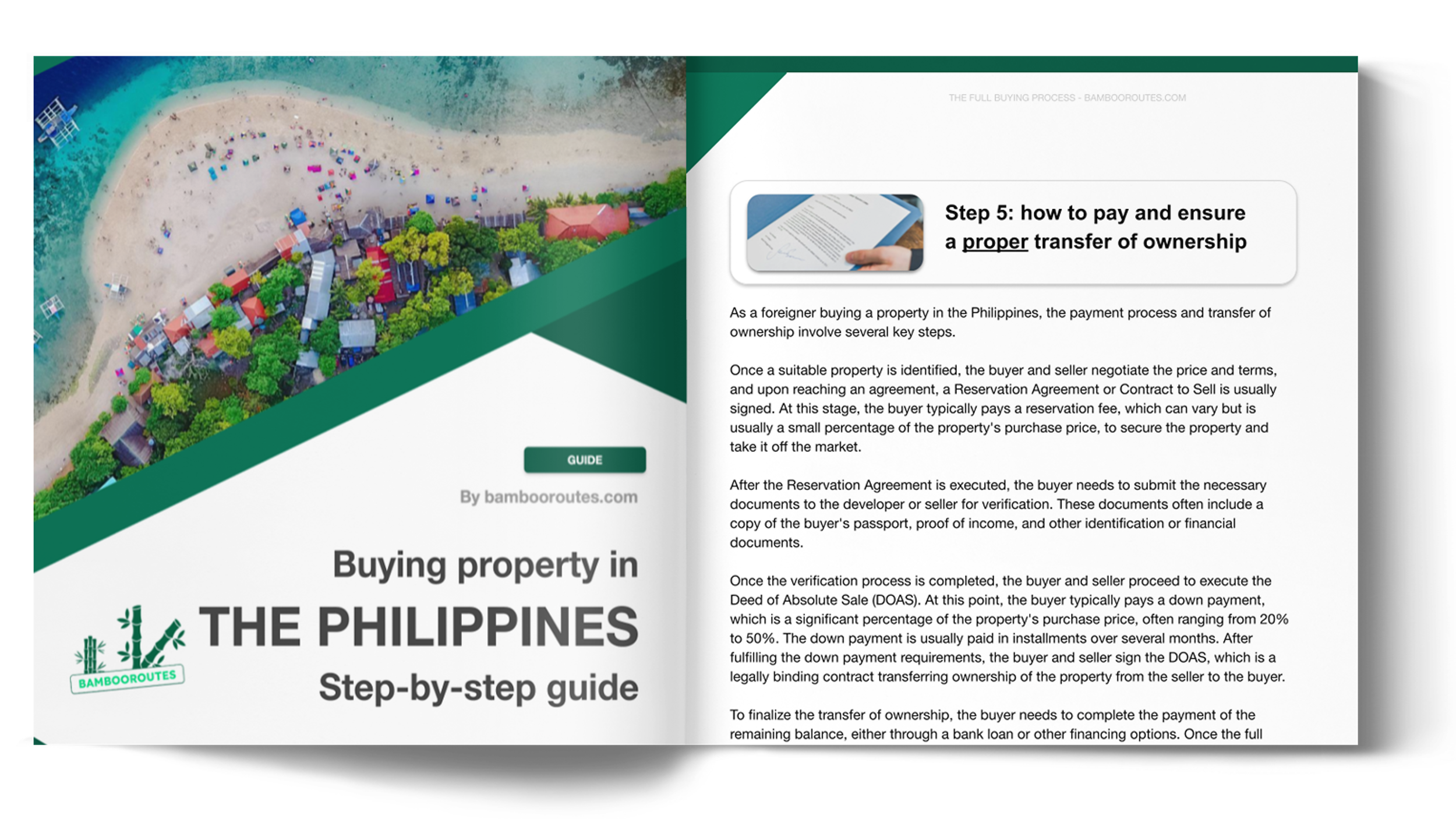
Everything you need to know before buying real estate is included in our The Philippines Property Pack
Yes, buying land in Mindoro Island as a foreigner is complicated, but it is not impossible if you understand the rules and use the right legal structures.
This guide explains everything you need to know about foreign property ownership in Mindoro Island in 2026, including what you can and cannot buy, the safest workarounds, the costs involved, and the scams to avoid.
We constantly update this blog post to reflect any changes in Philippine law and local conditions on Mindoro Island.
And if you're planning to buy a property in this place, you may want to download our pack covering the real estate market in Mindoro Island.
Insights
- Mindoro Island ancestral domain claims cover roughly 30% of the island's total land area, meaning almost one in three parcels could involve Mangyan tribal verification through the NCIP before any purchase.
- The 99-year lease reform (RA 12252) signed in September 2025 nearly doubled the previous maximum, making Mindoro Island long-term leases more attractive to foreign investors than ever before.
- Puerto Galera's UNESCO biosphere reserve spans 23,200 hectares at Mindoro's northern tip, creating stricter environmental scrutiny for any coastal land deals in this popular tourist area.
- Closing costs for foreign buyers in Mindoro Island typically run between 8% and 10% of the purchase price when the buyer covers all taxes, compared to 3% to 5% with a standard split.
- Legal structuring costs for foreigners in Mindoro Island, such as setting up a Philippine corporation with 60% Filipino ownership, range from 100,000 to 250,000 PHP (roughly 1,700 to 4,300 USD).
- Anti-Dummy Law violations in the Philippines can result in both criminal penalties and forfeiture of the property, making "nominee" arrangements one of the riskiest workarounds for foreigners in Mindoro Island.
- Mindoro Island property prices remain 30% to 60% below comparable markets like Palawan or Boracay, but this discount is narrowing rapidly in Puerto Galera and Calapan City.
- The Iraya Mangyan hold a certificate of ancestral domain title covering over 5,700 hectares in Puerto Galera alone, which directly affects land availability in this popular foreigner destination.

Can a foreigner legally own land in Mindoro Island right now?
Can foreigners own land in Mindoro Island in 2026?
As of early 2026, foreigners generally cannot own land outright in Mindoro Island because the Philippine Constitution (Article XII, Section 7) explicitly restricts land transfers to Philippine citizens, with the only exception being hereditary succession.
The main prohibition is straightforward: a foreigner cannot hold a Transfer Certificate of Title (TCT) or Original Certificate of Title (OCT) in their personal name, and any "nominee" arrangement where a Filipino holds title on your behalf triggers Anti-Dummy Law risks that can result in criminal charges and property forfeiture.
The closest legal alternatives for foreigners in Mindoro Island are either purchasing a condominium unit (where foreign ownership in the building stays under 40%) or entering a long-term land lease that can now extend up to 99 years in aggregate under RA 12252, which was signed into law in September 2025.
These restrictions apply equally to all foreign nationalities, meaning there are no bilateral treaties or special exemptions that give citizens of certain countries better access to Mindoro Island land than others.
Can I own a house but not the land in Mindoro Island in 2026?
As of early 2026, a foreigner in Mindoro Island can legally own a house or building structure separately from the land it sits on by entering a long-term lease agreement for the land while holding ownership of the improvements built upon it.
In this arrangement, you typically receive building permits and documentation showing you own the structure, while the land title remains with a qualified Filipino owner or lessor, and your lease contract should be registered with the Registry of Deeds to provide legal protection.
When the underlying land lease expires, the fate of your building depends entirely on what your lease contract specifies, so well-drafted agreements in Mindoro Island typically include renewal options, compensation clauses, or transfer provisions to protect your investment in the structure.
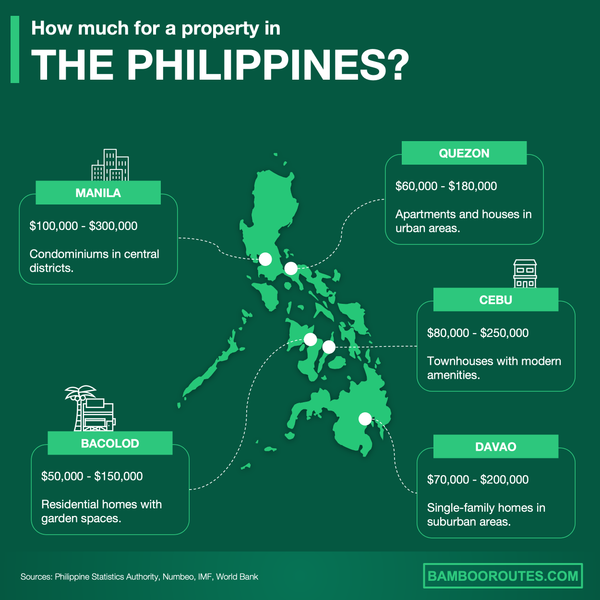
We created this infographic to give you a simple idea of how much it costs to buy property in different parts of the Philippines. As you can see, it breaks down price ranges and property types for popular cities in the country. We hope this makes it easier to explore your options and understand the market.
Do rules differ by region or city for land ownership in Mindoro Island right now?
The foreign ownership restriction itself is a national constitutional rule that applies identically across Oriental Mindoro and Occidental Mindoro, so there is no city or municipality in Mindoro Island where a foreigner can legally own land when they cannot elsewhere in the Philippines.
However, specific zones within Mindoro Island have additional layers of restriction: Puerto Galera falls within a 23,200-hectare UNESCO biosphere reserve with stricter environmental and development controls, while large portions of the island's interior are covered by Mangyan ancestral domain claims that require verification through the National Commission on Indigenous Peoples (NCIP).
These regional differences exist because Mindoro Island combines high conservation value (coral reefs, endemic species, protected forests) with significant indigenous cultural heritage, and both layers add complexity that buyers must navigate on top of the baseline foreign ownership ban.
We cover a lot of different regions and cities in our pack about the property market in Mindoro Island.
Can I buy land in Mindoro Island through marriage to a local in 2026?
As of early 2026, marriage to a Filipino citizen does not grant a foreigner the right to own land in Mindoro Island because the Constitution's nationality-based restriction remains in effect regardless of marital status.
The practical workaround is for the land to be purchased in your Filipino spouse's name only, but you should ensure proper documentation such as a prenuptial agreement or postnuptial contract that clarifies the source of funds and protects your financial interest without attempting to claim land ownership.
If the marriage ends in divorce or annulment (annulment being the standard process in the Philippines), the foreign spouse has no direct claim to the land itself, though they may be entitled to reimbursement for funds contributed to the purchase, depending on the property regime and documentation in place.
There is a lot of mistakes you can make, we cover 99% of them in our list of risks and pitfalls people face when buying property in Mindoro Island.
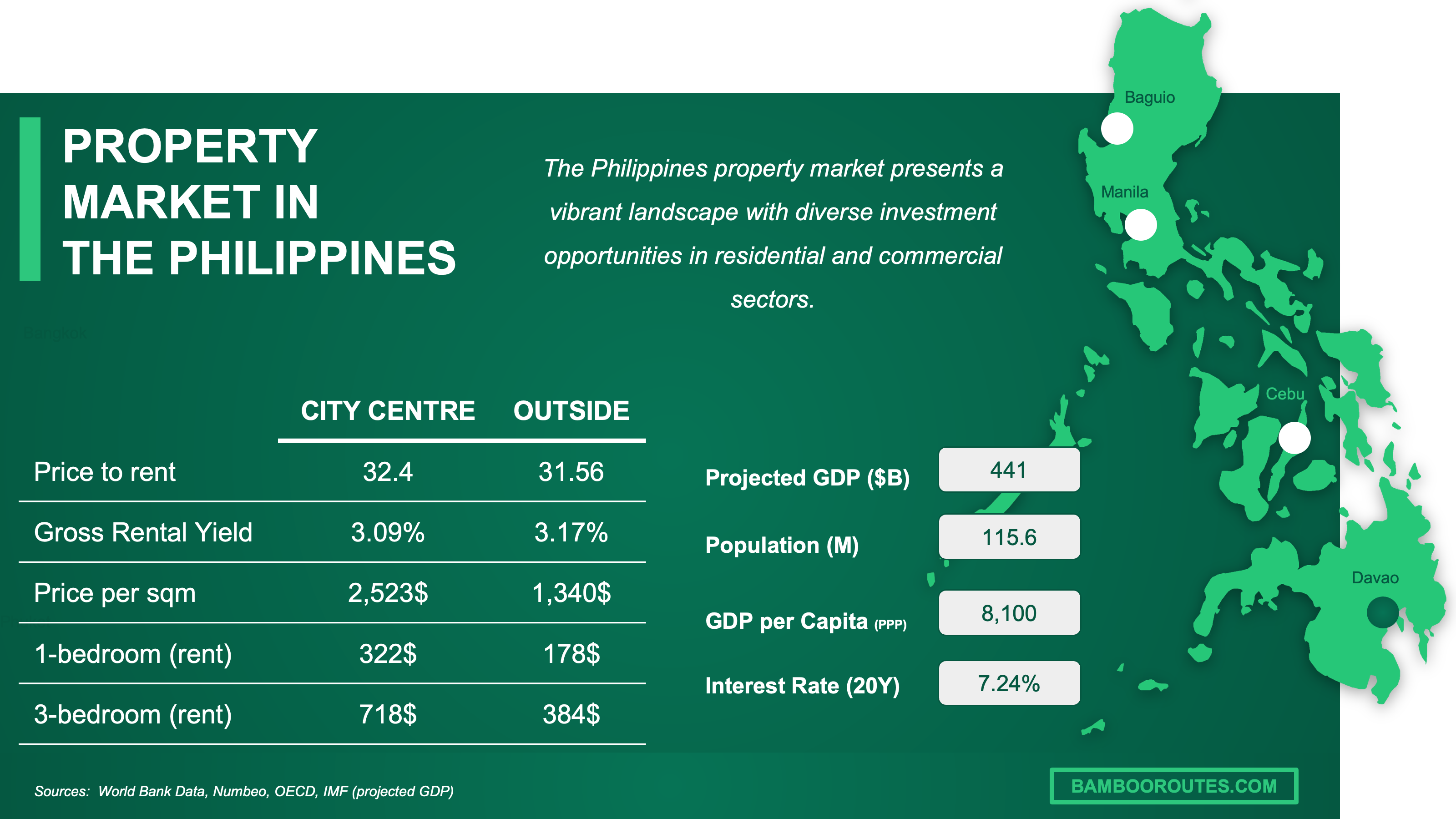
We have made this infographic to give you a quick and clear snapshot of the property market in the Philippines. It highlights key facts like rental prices, yields, and property costs both in city centers and outside, so you can easily compare opportunities. We’ve done some research and also included useful insights about the country’s economy, like GDP, population, and interest rates, to help you understand the bigger picture.
What eligibility and status do I need to buy land in Mindoro Island?
Do I need residency to buy land in Mindoro Island in 2026?
As of early 2026, residency status in the Philippines does not remove the constitutional restriction on foreign land ownership in Mindoro Island, meaning you cannot buy land even if you have lived there for decades.
No specific visa or permit grants land-buying rights to foreigners, though long-term visas like the Special Resident Retiree's Visa (SRRV) or Special Investor's Resident Visa (SIRV) make property management and extended stays easier if you pursue a lease or condominium purchase.
Foreigners can complete lease agreements or condominium purchases remotely using a properly notarized Special Power of Attorney (SPA), though physical presence or a trusted local representative is highly recommended for verifying documents at the Registry of Deeds and other offices in Mindoro Island.
Do I need a local tax number to buy lands in Mindoro Island?
Foreigners entering property transactions in Mindoro Island should expect to interact with the Bureau of Internal Revenue (BIR) for tax clearances, and while the exact requirements depend on your transaction structure, you will generally need to be identifiable to Philippine tax authorities.
Obtaining a Tax Identification Number (TIN) as a foreigner typically involves submitting identification documents and an application to the BIR, a process that can take a few days to a few weeks depending on the local office workload in Oriental or Occidental Mindoro.
Opening a local bank account is not strictly required for all transactions, but it is operationally helpful for paying local taxes, fees, and lease payments, and it provides cleaner fund-tracing documentation for your records.
Is there a minimum investment to buy land in Mindoro Island as of 2026?
As of early 2026, there is no minimum investment threshold that magically allows a foreigner to own land in Mindoro Island because the constitutional ban applies regardless of how much money you spend.
For leases or condominium purchases, there is no national minimum amount, but specific developments or projects may have their own pricing floors, and some investment-linked visa programs require minimum capital commitments (for example, the SIRV requires a USD 75,000 investment in qualifying assets).
Are there restricted zones foreigners can't buy in Mindoro Island?
Beyond the blanket foreign ownership ban, Mindoro Island has two major categories of restricted zones that add further complications even for lease arrangements: environmentally protected areas and ancestral domains.
Puerto Galera's UNESCO biosphere reserve (23,200 hectares) imposes stricter development and environmental controls, while ancestral domain areas held by Mangyan tribes, which cover roughly 30% of Mindoro's total land, require free, prior, and informed consent processes through the NCIP before any transaction.
To verify whether a specific plot falls within a restricted zone in Mindoro Island, you should request a certified true copy of the title from the Registry of Deeds (checking for annotations), consult the NCIP for ancestral domain overlaps, and check with the local DENR office for protected area boundaries.
Can foreigners buy agricultural, coastal or border land in Mindoro Island right now?
Direct ownership of agricultural, coastal, or border land in Mindoro Island is prohibited for foreigners under the same constitutional rule that blocks all land ownership, and these categories add extra layers of restriction even for Filipino buyers.
Agricultural land in Mindoro Island may be subject to agrarian reform restrictions under CARP (Comprehensive Agrarian Reform Program), meaning some parcels carry CLOA titles (Certificate of Land Ownership Award) that limit transferability and require DAR clearance.
Coastal land, especially around Puerto Galera's tourism zones, often falls within environmental buffer areas or easement zones that restrict development, and the UNESCO biosphere designation adds scrutiny to any commercial or residential project.
Land near national borders is less of a concern on Mindoro Island specifically, but general Philippine rules do restrict foreign ownership and even Filipino ownership in certain security-sensitive zones, so any parcel near military installations or strategic infrastructure warrants extra verification.
Get fresh and reliable information about the market in Mindoro Island
Don't base significant investment decisions on outdated data. Get updated and accurate information with our guide.

What are the safest legal structures to control land in Mindoro Island?
Is a long-term lease equivalent to ownership in Mindoro Island right now?
A long-term lease in Mindoro Island is not legally identical to freehold ownership, but for practical residential purposes it can deliver an "ownership-like" experience if the lease is properly structured, registered, and enforceable over decades.
As of early 2026, the maximum lease length available to foreigners in Mindoro Island is 99 years in aggregate under RA 12252 (signed September 2025), which nearly doubled the previous 50+25 year limit and makes Philippine leases more competitive with regional alternatives.
Lease rights can typically be sold, transferred, or bequeathed to another party in Mindoro Island if the lease contract explicitly allows assignment, and proper documentation and registration of the transfer are completed through the relevant offices.
Can I buy land in Mindoro Island via a local company?
A foreigner can gain indirect control over land in Mindoro Island by investing in a Philippine corporation that is qualified to hold land, but the company must meet the constitutional requirement of at least 60% Filipino ownership.
This means a foreigner can hold up to 40% of the shares in a land-owning Philippine company, and while this provides some degree of control and economic benefit, it does not amount to full ownership and requires genuine Filipino partners who actually exercise their ownership rights.
What "grey-area" ownership setups get foreigners in trouble in Mindoro Island?
Grey-area arrangements are widespread in Mindoro Island's tourist markets like Puerto Galera, where brokers sometimes pitch risky workarounds to eager foreign buyers who do not fully understand the legal consequences.
The most common grey-area structures include nominee title arrangements (land in a Filipino's name with a private side agreement), blank or back-to-back deeds kept "just in case," lease contracts with automatic transfer clauses attempting to function as disguised sales, and companies with paper Filipino shareholders but actual foreign control.
If Philippine authorities discover you are using an illegal ownership structure in Mindoro Island, the consequences can include criminal prosecution under the Anti-Dummy Law, forfeiture of the property, and deportation, with the Filipino "nominees" also facing potential criminal liability.
By the way, you can avoid most of these bad surprises if you go through our pack covering the property buying process in Mindoro Island.
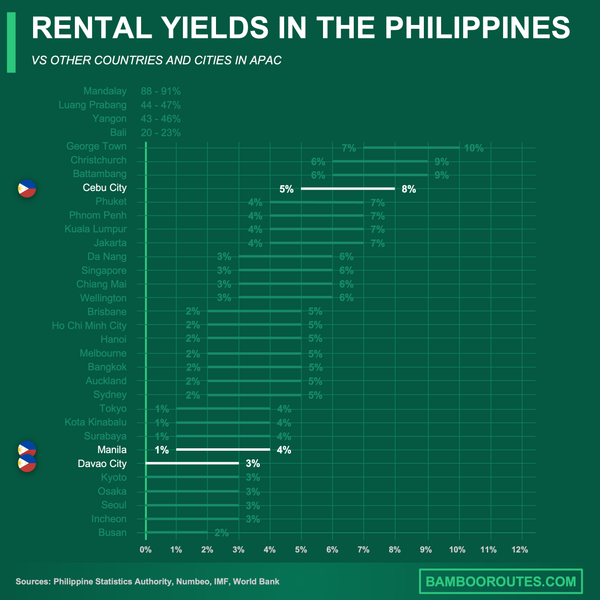
We did some research and made this infographic to help you quickly compare rental yields of the major cities in the Philippines versus those in neighboring countries. It provides a clear view of how this country positions itself as a real estate investment destination, which might interest you if you’re planning to invest there.
How does the land purchase process work in Mindoro Island, step-by-step?
What are the exact steps to buy land in Mindoro Island right now?
For a foreigner pursuing a lease or assisting a qualified Filipino buyer in Mindoro Island, the typical process involves: (1) verifying the title at the Registry of Deeds with a certified true copy, (2) checking all annotations for mortgages, liens, or ancestral domain overlaps, (3) confirming tax status with the local Assessor and Treasurer, (4) screening for CARP/CLOA issues if the land is rural, (5) signing the notarized deed or lease contract, (6) processing BIR tax clearances, and (7) registering the transaction with the Registry of Deeds.
A realistic timeline for completing a land transaction in Mindoro Island is 6 to 12 weeks from agreement to registration, assuming no surprises such as contested heirs, missing documents, agrarian reform flags, or ancestral domain disputes.
Key documents you will sign include the Deed of Absolute Sale (or Deed of Lease), identification documents and marital status certifications, a Special Power of Attorney if transacting remotely, and the various tax and registry forms required for official processing.
What scams are common when it comes to buying land in Mindoro Island right now?
What scams target foreign land buyers in Mindoro Island right now?
Scams targeting foreign buyers in Mindoro Island are common enough that vigilance is essential, particularly in tourist-heavy areas like Puerto Galera where eager buyers sometimes skip proper due diligence.
The most common scams include "tax declaration only" sales marketed as "basically ownership" (tax declarations are not the same as Torrens titles), heirs property where one family member sells without authority from other heirs, fake or recycled titles, and nominee arrangements pitched as "standard practice" that leave you legally exposed.
Top warning signs include a seller who cannot produce the original title or refuses to let you get a certified copy from the Registry of Deeds, pressure to close quickly without verification, prices dramatically below market, and any suggestion to skip notarization or registration steps.
Legal recourse for scam victims in Mindoro Island involves filing complaints with the local prosecutor's office and pursuing civil remedies through Philippine courts, but recovery is slow, expensive, and uncertain, making prevention far more effective than cure.
We cover all these things in length in our pack about the property market in Mindoro Island.
How do I verify the seller is legit in Mindoro Island right now?
The most reliable way to verify a seller in Mindoro Island is to obtain a certified true copy of the title from the Registry of Deeds and confirm that the seller's name and identification match the registered owner exactly.
To confirm the title is clean, you need to read every annotation line on the certified copy, looking for mortgages, adverse claims, lis pendens (pending litigation), court orders, or agrarian reform notations that could affect the transaction.
Checking for liens, mortgages, or debts involves reviewing the title annotations plus verifying with the local Treasurer's office that real property taxes are current, as delinquent taxes can result in government claims on the property.
Hiring a Philippine lawyer is not legally mandatory but is highly recommended in Mindoro Island, as legal fees (typically 50,000 to 150,000 PHP depending on complexity) are a small price compared to the risk of a fraudulent or defective transaction.
How do I confirm land boundaries in Mindoro Island right now?
The standard procedure for confirming boundaries in Mindoro Island is to hire a licensed geodetic engineer to conduct a relocation survey, which physically verifies the corners and edges of the parcel against the technical description in the title.
Official documents to review include the title's technical description, the original survey plan on file with the Land Management Bureau or Registry of Deeds, and the tax declaration map from the local Assessor's office.
Hiring a licensed geodetic engineer is strongly recommended (not just optional) for any significant purchase in Mindoro Island, particularly for rural, coastal, or irregularly shaped parcels where informal boundary assumptions are common.
Common boundary problems foreigners encounter in Mindoro Island include encroachments by neighbors, discrepancies between the title's technical description and actual occupation, overlapping claims near rivers or coastlines, and informal "agreed" boundaries that do not match official records.
Buying real estate in Mindoro Island can be risky
An increasing number of foreign investors are showing interest. However, 90% of them will make mistakes. Avoid the pitfalls with our comprehensive guide.

What will it cost me, all-in, to buy and hold land in Mindoro Island?
What purchase taxes and fees apply in Mindoro Island as of 2026?
As of early 2026, the total tax and fee burden for a land transaction in Mindoro Island typically ranges from 8% to 10% of the purchase price if the buyer pays everything, or 3% to 5% if using a standard split where the seller covers capital gains tax.
Typical closing costs for the buyer side include documentary stamp tax (commonly 1.5%), local transfer tax (usually less than 1%), registration fees at the Registry of Deeds, and notary fees, totaling roughly 3% to 5% of the transaction value, or approximately 30,000 to 50,000 PHP per million PHP of purchase price.
The main individual taxes are: Capital Gains Tax at 6% of the gross selling price (or zonal/fair market value if higher), Documentary Stamp Tax at 1.5%, local transfer tax set by the LGU, and registration fees based on a schedule at the Registry of Deeds.
These taxes do not formally differ for foreign buyers compared to local buyers in Mindoro Island, but foreigners often incur additional legal and structuring costs (100,000 to 250,000 PHP) for setting up compliant ownership vehicles.
What hidden fees surprise foreigners in Mindoro Island most often?
Hidden costs in Mindoro Island typically add 1% to 3% on top of the headline closing costs, catching foreigners off guard when they have budgeted only for the obvious taxes and registration fees.
The most common surprise fees include geodetic survey costs (20,000 to 50,000 PHP or more for complex parcels), unpaid back taxes that the seller "forgot" to mention, environmental or zoning compliance fees near Puerto Galera, and legal clean-up costs if the land has agrarian or ancestral domain issues.
These hidden fees typically appear at two stages: during due diligence (when surveys and document checks reveal problems) and at registration (when the BIR or Registry of Deeds flags outstanding obligations).
The best protection is to budget 10% to 15% above the purchase price for all costs, hire a lawyer to review everything before you commit, and insist on a thorough title and tax status check before signing any binding agreement in Mindoro Island.

We made this infographic to show you how property prices in the Philippines compare to other big cities across the region. It breaks down the average price per square meter in city centers, so you can see how cities stack up. It’s an easy way to spot where you might get the best value for your money. We hope you like it.
What sources have we used to write this blog article?
Whether it's in our blog articles or the market analyses included in our property pack about Mindoro Island, we always rely on the strongest methodology we can and we don't throw out numbers at random.
We also aim to be fully transparent, so below we've listed the authoritative sources we used, and explained how we used them and the methods behind our estimates.
| Source | Why it's authoritative | How we used it |
|---|---|---|
| Supreme Court E-Library (Article XII) | Official Supreme Court publication of constitutional text. | We used it to verify the exact wording of foreign land ownership restrictions. We treated it as the legal ceiling that no contract can override. |
| RA 12252 (99-year lease reform) | Official text of the 2025 lease law amendment. | We used it to update the maximum lease length discussion. We used it to show how the Philippines expanded leasing options for foreigners. |
| Anti-Dummy Law (CA 108) | Primary criminal law targeting nominee arrangements. | We used it to explain why "put it in a Filipino's name" is legally risky. We used it to flag grey-area structures that get foreigners in trouble. |
| UNESCO Puerto Galera Biosphere Reserve | Official UNESCO designation for the protected area. | We used it to identify Mindoro-specific restricted zones. We used it to explain environmental scrutiny affecting land deals in Puerto Galera. |
| NCIP (National Commission on Indigenous Peoples) | Lead government agency for ancestral domain matters. | We used it to direct buyers to the correct verification authority. We used it to explain the CADT process affecting Mindoro land. |
| IPRA (RA 8371) | National law defining ancestral domain protections. | We used it to explain why parts of Mindoro have restricted transferability. We used it to outline buyer verification steps for ancestral overlaps. |
| PD 1529 (Property Registration Decree) | Core law governing the Torrens land registration system. | We used it to explain what titles are and why TCT/OCT matters. We used it to outline the registration steps in any land transaction. |
| BIR Capital Gains Tax Page | Official Bureau of Internal Revenue tax guidance. | We used it to anchor the CGT rate and tax clearance process. We used it to frame BIR as the gatekeeper for transfer taxes. |
| DAR (RA 6657 agrarian reform) | Department of Agrarian Reform's legal text repository. | We used it to flag agrarian reform land as a due diligence risk. We used it to explain why some farm lots cannot be freely transferred. |
| Condominium Act (RA 4726) | Primary statute governing condo ownership in the Philippines. | We used it to explain the condominium route for foreigners. We used it to clarify what you own versus what the condo corporation holds. |
Get the full checklist for your due diligence in Mindoro Island
Don't repeat the same mistakes others have made before you. Make sure everything is in order before signing your sales contract.
Related blog posts