
Authored by the expert who managed and guided the team behind the South Korea Property Pack
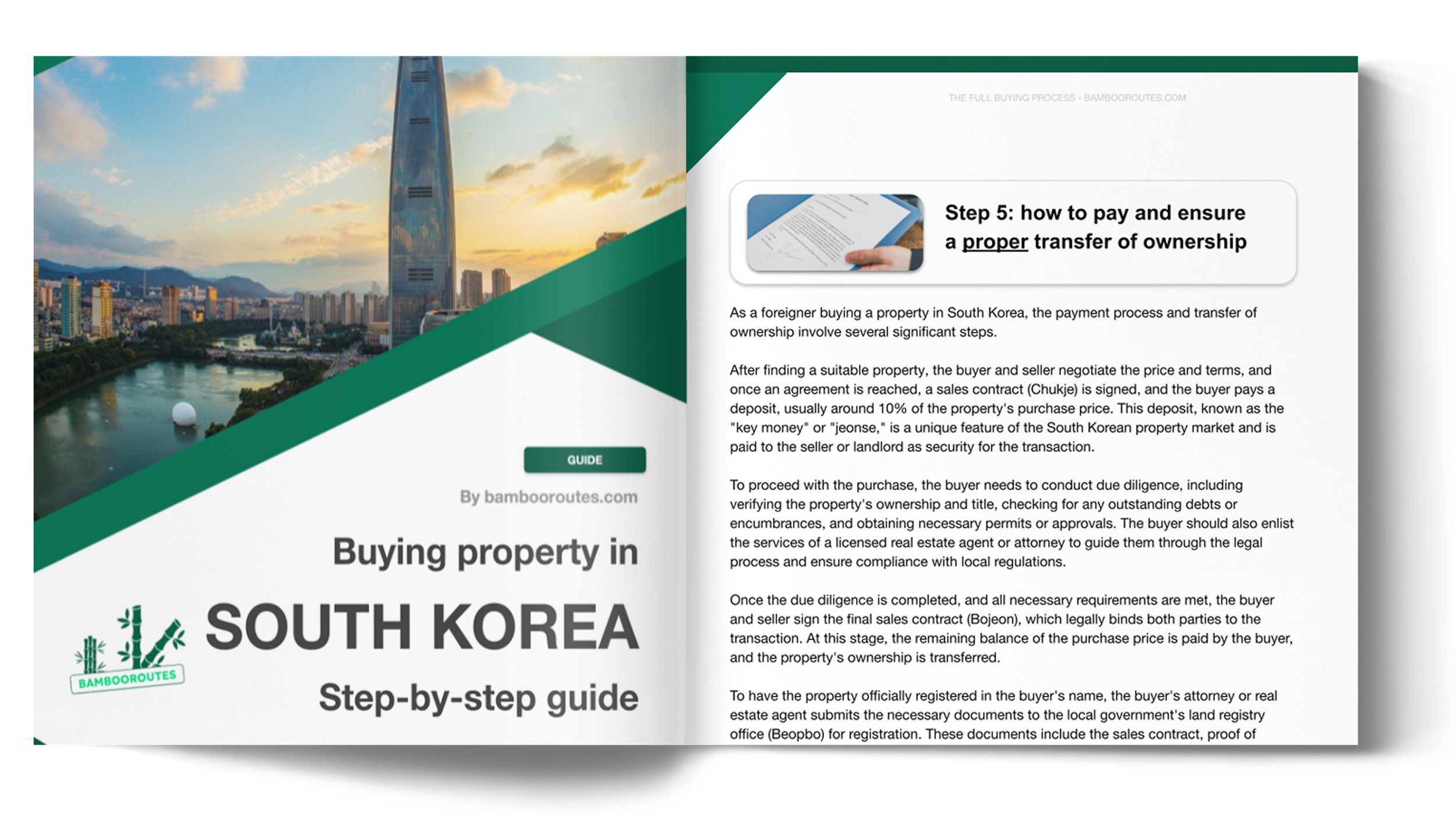
Everything you need to know before buying real estate is included in our South Korea Property Pack
Incheon offers foreign investors a unique mix of airport-driven demand, international business districts like Songdo, and more affordable entry prices than Seoul.
This guide covers the legal reality, rental yields, neighborhood performance, and short-term rental rules that matter if you want to rent out property in Incheon in 2026.
We constantly update this blog post to reflect the latest regulations and market data.
And if you're planning to buy a property in this place, you may want to download our pack covering the real estate market in Incheon.
Insights
- Seven districts in Incheon now require foreigners to obtain purchase approval before buying residential property, a rule that runs through late August 2026 and directly affects how quickly you can close a deal.
- Gross rental yields in Incheon average around 2.3% in early 2026, which is typical for Korean metro areas where property prices tend to outpace rent growth.
- Songdo commands Incheon's highest rents but often delivers compressed yields because purchase prices in this international district are also significantly elevated.
- Short-term rentals in Incheon average only about 39% occupancy, meaning most Airbnb-style listings sit empty more nights than they are booked.
- Korea's 5% rent increase cap only kicks in when a tenant exercises their renewal right, so landlords can still set initial rents freely at market rates.
- Bupyeong-gu offers some of Incheon's best yield potential because strong transit links keep tenant demand stable while purchase prices remain lower than Songdo or Cheongna.
- Monthly holding costs for a typical Incheon apartment run between ₩350,000 and ₩750,000 (roughly $270 to $575), with building management fees being the largest single expense.
- Furnished apartments in Incheon typically rent 10% to 20% faster than unfurnished units, especially in Songdo where expat arrivals often need move-in ready options.

Can I legally rent out a property in Incheon as a foreigner right now?
Can a foreigner own-and-rent a residential property in Incheon in 2026?
As of early 2026, foreigners can legally own and rent out residential property in Incheon, but buying in certain districts now requires government approval under a permit regime introduced in August 2025.
The most common ownership structure for foreign landlords in Incheon is direct individual ownership, which is straightforward and does not require setting up a Korean company or using a nominee arrangement.
The biggest restriction right now is that seven Incheon districts (including Yeonsu-gu, Seo-gu, and Bupyeong-gu) are designated "foreigner purchase permit zones" through late August 2026, meaning you need approval from MOLIT before acquiring property there.
If you're not a local, you might want to read our guide to foreign property ownership in Incheon.
Do I need residency to rent out in Incheon right now?
You do not need Korean residency to be a landlord in Incheon, though you will need a system for handling tax obligations, tenant communication, and rent collection.
In practice, you should register for Korean tax administration to ensure rental income is declared correctly, and the National Tax Service provides the framework for how foreigners interact with this system.
A local Korean bank account is not strictly required by law, but it makes rent collection, utility payments, and management fees dramatically easier to handle.
Managing a rental property in Incheon remotely is practically feasible if you work with a local property manager or agent who can handle tenant issues, inspections, and administrative tasks on your behalf.
Thinking of buying real estate in Incheon?
Acquiring property in a different country is a complex task. Don't fall into common traps – grab our guide and make better decisions.

What rental strategy makes the most money in Incheon in 2026?
Is long-term renting more profitable than short-term in Incheon in 2026?
As of early 2026, long-term renting is the more reliable and legally straightforward strategy for most foreign investors in Incheon because short-term rentals face significant regulatory hurdles.
A well-managed long-term rental in Incheon might generate around ₩7 million to ₩12 million per year (roughly $5,400 to $9,200 or €5,000 to €8,500), while a legally compliant short-term rental in a prime location could potentially earn more but with higher vacancy risk and operational complexity.
Short-term rentals tend to perform better financially in Incheon's airport-adjacent areas like Yeongjongdo or tourism-friendly pockets of Songdo, where transient visitors create consistent demand.
What's the average gross rental yield in Incheon in 2026?
As of early 2026, the average gross rental yield for residential properties in Incheon sits around 2.3%, which reflects Korea's broader pattern of property prices outpacing rent growth.
The realistic gross yield range in Incheon spans from about 1.7% for premium properties in Songdo to around 3.0% for well-located older apartments in districts like Bupyeong-gu or Michuhol-gu.
Smaller units like studios and compact one-bedrooms near transit hubs typically achieve the highest gross yields in Incheon because they attract a steady pool of single professionals and students willing to pay relatively higher rents per square meter.
By the way, we have much more granular data about rental yields in our property pack about Incheon.
What's the realistic net rental yield after costs in Incheon in 2026?
As of early 2026, the average net rental yield for residential properties in Incheon lands around 1.2% after accounting for all typical ownership costs.
Most landlords in Incheon realistically experience net yields ranging from about 0.6% on higher-priced properties to around 2.0% on well-optimized smaller units in transit-friendly locations.
The three main cost categories that reduce gross yield to net yield in Incheon are building management fees (which run high in newer apartment complexes with amenities), property management or agent fees for remote owners, and the Korean tax compliance burden including income tax withholding.
You might want to check our latest analysis about gross and net rental yields in Incheon.
What monthly rent can I get in Incheon in 2026?
As of early 2026, typical monthly rents in Incheon under the wolse (monthly rent plus deposit) structure run around ₩500,000 ($385/€355) for a studio, ₩700,000 ($540/€500) for a one-bedroom, and ₩1,200,000 ($920/€855) for a two-bedroom apartment.
A decent studio in Incheon can realistically rent for ₩400,000 to ₩650,000 per month (roughly $310 to $500 or €285 to €465), with the lower end found in older buildings in Michuhol-gu and the higher end in newer complexes near major stations.
A typical one-bedroom apartment in Incheon rents for ₩500,000 to ₩900,000 per month (roughly $385 to $690 or €355 to €640), depending heavily on whether it is located in a transit hub like Bupyeong or a premium area like Songdo.
A standard two-bedroom apartment in Incheon commands ₩850,000 to ₩1,600,000 per month (roughly $655 to $1,230 or €605 to €1,140), with the top of that range found in family-oriented neighborhoods like Songdo and Cheongna.
If you want to know more about this topic, you can read our guide about rents and rental incomes in Incheon.

We did some research and made this infographic to help you quickly compare rental yields of the major cities in South Korea versus those in neighboring countries. It provides a clear view of how this country positions itself as a real estate investment destination, which might interest you if you’re planning to invest there.
What are the real numbers I should budget for renting out in Incheon in 2026?
What's the total "all-in" monthly cost to hold a rental in Incheon in 2026?
As of early 2026, the total monthly cost to hold and maintain a typical rental apartment in Incheon (excluding mortgage payments) runs between ₩350,000 and ₩750,000 (roughly $270 to $575 or €250 to €535).
For most standard rental properties in Incheon, you should budget a realistic monthly cost range of ₩400,000 to ₩600,000 ($310 to $460 or €285 to €430), which covers management fees, maintenance reserves, and administrative expenses.
The largest single contributor to monthly holding costs in Incheon is the building management fee (gwanlibi), which can reach ₩300,000 or more in newer apartment complexes with elevators, security, parking, and shared amenities.
You want to go into more details? Check our list of property taxes and fees you have to pay when buying a property in Incheon.
What's the typical vacancy rate in Incheon in 2026?
As of early 2026, the typical vacancy rate for long-term rentals in Incheon hovers around 8%, which translates to roughly one month of vacancy per year for planning purposes.
Landlords in Incheon should realistically budget for 0.5 to 1.5 months of vacancy per year, with the lower end applying to well-priced units near major subway stations and the higher end for older or poorly located properties.
The main factor that causes vacancy rates to vary across Incheon neighborhoods is proximity to rapid transit connections to Seoul, since tenants prioritize commute times and will pay premiums (or wait longer) for station-adjacent units.
Tenant turnover and vacancy in Incheon typically peak in late winter and early spring (February to March), when many Korean leases end and tenants relocate before the new school and work year begins.
We have a whole part covering the best rental strategies in our pack about buying a property in Incheon.
Get fresh and reliable information about the market in Incheon
Don't base significant investment decisions on outdated data. Get updated and accurate information with our guide.
Where do rentals perform best in Incheon in 2026?
Which neighborhoods have the highest long-term demand in Incheon in 2026?
As of early 2026, the three neighborhoods with the highest overall long-term rental demand in Incheon are Bupyeong-gu (especially around Bupyeong Station), Namdong-gu (particularly Guwol-dong), and Songdo in Yeonsu-gu.
Families looking for rentals in Incheon gravitate toward Songdo (Yeonsu-gu) and Cheongna (Seo-gu) because these master-planned districts offer newer housing stock, international schools, parks, and a quieter suburban atmosphere.
Students in Incheon concentrate their rental searches around Michuhol-gu (near Inha University in areas like Yonghyeon-dong and Juan-dong) and parts of Bupyeong-gu where transit access meets affordable rents.
Expats and international professionals in Incheon strongly prefer Songdo International City (Yeonsu-gu) for its English-friendly amenities and international school ecosystem, with Yeongjongdo (Jung-gu) also attracting airport-linked corporate renters.
By the way, we've written a blog article detailing what are the current best areas to invest in property in Incheon.
Which neighborhoods have the best yield in Incheon in 2026?
As of early 2026, the three neighborhoods offering the best rental yields in Incheon are Bupyeong-gu, parts of Namdong-gu, and student-adjacent pockets of Michuhol-gu near Inha University.
These top-yielding Incheon neighborhoods typically deliver gross rental yields in the range of 2.5% to 3.0%, compared to around 1.7% to 2.2% in premium areas like Songdo.
The main characteristic that allows these neighborhoods to achieve higher yields is their combination of strong transit-driven tenant demand and significantly lower purchase prices compared to Incheon's international or master-planned districts.
We cover a lot of neighborhoods and provide a lot of updated data in our pack about real estate in Incheon.
Where do tenants pay the highest rents in Incheon in 2026?
As of early 2026, the three neighborhoods where tenants pay the highest rents in Incheon are Songdo (Yeonsu-gu), Cheongna (Seo-gu), and parts of Yeongjongdo including Sky City (Jung-gu).
In these premium Incheon neighborhoods, a standard two-bedroom apartment typically rents for ₩1,200,000 to ₩1,600,000 per month (roughly $920 to $1,230 or €855 to €1,140), with larger family units commanding even more.
These neighborhoods command Incheon's highest rents because they offer a combination of newer construction, international school proximity, and either direct airport access (Yeongjongdo) or a self-contained business and lifestyle ecosystem (Songdo).
The typical tenant profile in these highest-rent Incheon neighborhoods includes expat families with children enrolled in international schools, corporate transferees on housing allowances, and Korean professionals seeking premium amenities and commute convenience.

We created this infographic to give you a simple idea of how much it costs to buy property in different parts of South Korea. As you can see, it breaks down price ranges and property types for popular cities in the country. We hope this makes it easier to explore your options and understand the market.
What do tenants actually want in Incheon in 2026?
What features increase rent the most in Incheon in 2026?
As of early 2026, the three property features that increase monthly rent the most in Incheon are walking distance to a major subway station (especially lines connecting to Seoul), proximity to international schools in Songdo or Cheongna, and newer building construction with modern security and elevator systems.
Being within a five-minute walk of a major Incheon Metro station can add an estimated 10% to 15% rent premium compared to otherwise similar units that require a bus transfer.
One commonly overrated feature in Incheon is luxury interior finishes like high-end countertops or designer fixtures, since most tenants prioritize location and building condition over showroom-level aesthetics and will not pay proportionally more for them.
One affordable upgrade that provides a strong return on investment for Incheon landlords is installing a modern digital door lock and video intercom system, which Korean tenants expect as a baseline security feature and will avoid units that lack them.
Do furnished rentals rent faster in Incheon in 2026?
As of early 2026, furnished apartments in Incheon typically rent about 10% to 20% faster than unfurnished units, with the advantage being strongest in Songdo where expat arrivals often need move-in ready options.
Furnished apartments in Incheon generally command a rent premium of around 10% to 15% over comparable unfurnished units, though this premium comes with higher upfront investment and faster wear-and-tear that remote landlords need to factor into their calculations.
Get to know the market before you buy a property in Incheon
Better information leads to better decisions. Get all the data you need before investing a large amount of money. Download our guide.
How regulated is long-term renting in Incheon right now?
Can I freely set rent prices in Incheon right now?
Landlords in Incheon can freely set initial rent prices at market rates when signing a new lease with a new tenant, with no government cap on what you can charge at the start of a tenancy.
However, when an existing tenant exercises their legal right to renew the lease, rent increases in Incheon are capped at 5% under Korea's Housing Lease Protection Act, which creates the well-known "2+2 year" structure where tenants can stay up to four years with limited rent growth.
What's the standard lease length in Incheon right now?
The standard lease length for residential rentals in Incheon is two years, and tenants have a legal right to request one renewal for an additional two years, creating the common "2+2" four-year tenancy structure.
Korea uses a unique deposit system where there is no simple legal cap, but deposits under the jeonse or ban-jeonse structures can range from a few months of rent equivalent to hundreds of millions of won depending on the lease type, with wolse (monthly rent) deposits typically running ₩5 million to ₩30 million ($3,850 to $23,000 or €3,570 to €21,400).
At the end of a tenancy in Incheon, landlords must return the full deposit to the tenant, and Korean law provides strong deposit protection mechanisms including priority repayment rights that tenants can register to secure their funds.

We made this infographic to show you how property prices in South Korea compare to other big cities across the region. It breaks down the average price per square meter in city centers, so you can see how cities stack up. It’s an easy way to spot where you might get the best value for your money. We hope you like it.
How does short-term renting really work in Incheon in 2026?
Is Airbnb legal in Incheon right now?
Airbnb-style short-term rentals in Incheon are legal only if you operate within specific accommodation categories defined by Korea's Tourism Promotion Act, which means most normal apartments cannot simply be listed without meeting regulatory requirements.
To legally operate a short-term rental in Incheon, you typically need to register under a category like "foreign tourist urban homestay," which involves property eligibility checks, local government notification, and compliance with building use regulations.
Korea does not have a simple nationwide night limit like some European cities, but the legal categories themselves restrict who can host (often requiring owner-occupancy) and what types of guests you can accept (often limited to foreign tourists).
Operating an unlicensed or non-compliant short-term rental in Incheon can result in fines, delisting from platforms like Airbnb, and potential legal action under Korea's tourism and housing laws.
By the way, we also have a blog article detailing whether owning an Airbnb rental is profitable in Incheon.
What's the average short-term occupancy in Incheon in 2026?
As of early 2026, the average annual occupancy rate for short-term rentals in Incheon sits around 39%, meaning most listings are empty more nights than they are booked.
The realistic occupancy range for short-term rentals in Incheon spans from about 25% for poorly located or overpriced listings to around 55% for well-optimized properties in prime tourist or business traveler locations.
Short-term rental occupancy in Incheon peaks during summer months (July and August) and around major Korean holidays like Chuseok and Lunar New Year, when domestic and international travel increases.
The lowest occupancy periods for Incheon short-term rentals typically fall in late autumn (November) and late winter (January to February outside of Lunar New Year), when both tourism and business travel slow down.
Finally, please note that you can find much more granular data about this topic in our property pack about Incheon.
What's the average nightly rate in Incheon in 2026?
As of early 2026, the average nightly rate for short-term rentals in Incheon is approximately ₩115,000 (roughly $89 or €82), though this varies significantly by property type and location.
The realistic nightly rate range for Incheon short-term rentals spans from about ₩60,000 to ₩200,000 ($46 to $154 or €43 to €143), with budget studios at the low end and well-appointed apartments near Songdo or the airport at the high end.
During peak seasons in Incheon, nightly rates can increase by ₩30,000 to ₩50,000 ($23 to $38 or €21 to €36) above off-season pricing, with the biggest premiums seen around major holidays and summer vacation periods.
Is short-term rental supply saturated in Incheon in 2026?
As of early 2026, the short-term rental market in Incheon is moderately competitive but not as saturated as Seoul, though the more important constraint is that legal supply is limited by Korea's strict accommodation registration requirements.
The number of active short-term rental listings in Incheon has been relatively stable, with growth constrained more by regulatory barriers than by lack of investor interest.
The most saturated neighborhoods for short-term rentals in Incheon include the airport vicinity on Yeongjongdo and the tourist-friendly core of Songdo, where competition among legal operators is highest.
Neighborhoods in Incheon that may still have room for new short-term rental supply include emerging areas of Cheongna and parts of Namdong-gu, though operators must still navigate the legal compliance requirements that limit what can actually be listed.
Don't lose money on your property in Incheon
100% of people who have lost money there have spent less than 1 hour researching the market. We have reviewed everything there is to know. Grab our guide now.

What sources have we used to write this blog article?
Whether it's in our blog articles or the market analyses included in our property pack about Incheon, we always rely on the strongest methodology we can and we don't throw out numbers at random.
We also aim to be fully transparent, so below we've listed the authoritative sources we used, and explained how we used them and the methods behind our estimates.
| Source | Why it's authoritative | How we used it |
|---|---|---|
| Korea Real Estate Board (REB) | Government-affiliated body publishing official real estate statistics. | We used it as our official baseline for Incheon housing market data. We cross-checked all market claims against what REB measures. |
| KOSIS (Korean Statistical Information Service) | Korea's official statistics portal run by Statistics Korea. | We used it for housing stock and macro context data. We treat KOSIS as our first stop before any private data source. |
| National Tax Service of Korea | Korea's official tax authority for all tax compliance matters. | We used it to explain what tax compliance means for foreign landlords. We cross-referenced with professional tax summaries for clarity. |
| PwC Tax Summaries (Korea) | Big-4 accounting firm with regularly updated tax guidance. | We used it to translate resident versus non-resident taxation into plain language. We verified the main concepts against official NTS positioning. |
| Kim & Chang Law Firm | One of Korea's most established law firms citing official MOLIT notifications. | We used it to validate the legal reality of foreigner purchase permit zones. We avoided relying on newspaper-only summaries for legal claims. |
| Gwanak District Office (Seoul) | Local government page summarizing key tenant rules in plain English. | We used it to explain lease renewal and 5% cap rules simply. We cross-checked against official legislation notes. |
| Airbnb Responsible Hosting (Korea) | Platform's own compliance guidance referencing Korean law. | We used it to explain what Airbnb tells hosts about Korean rules. We verified the legal framing with government and press sources. |
| AirDNA (Incheon) | Widely used short-term rental data provider with consistent methodology. | We used it for occupancy, nightly rate, and supply estimates. We sanity-checked the data against Korea's regulatory constraints. |
| Expat.com (Incheon Guide) | Established expat community resource with on-the-ground insights. | We used it to identify expat and family neighborhood preferences. We validated the Songdo international school ecosystem claims. |
| Global Property Guide (South Korea) | Established international property market analysis resource. | We used it for Korea-wide yield context and price trends. We kept our conclusions consistent with their low-yield assessment. |
| KLRI e-Law (Statutes of Korea) | Official English statute database from Korea Legislation Research Institute. | We used it to avoid secondhand legal claims about deposits and protections. We justified the legal tone on tenant rights directly from statute text. |

We have made this infographic to give you a quick and clear snapshot of the property market in South Korea. It highlights key facts like rental prices, yields, and property costs both in city centers and outside, so you can easily compare opportunities. We’ve done some research and also included useful insights about the country’s economy, like GDP, population, and interest rates, to help you understand the bigger picture.
Related blog posts