
As of June 2026, a realistic Daegu apartment budget is about ₩260 million to ₩520 million for ordinary resale apartments, which is roughly $173,000 to $347,000 or €148,000 to €295,000, while prime family apartments in Suseong-gu can easily go above ₩600 million, or about $400,000 and €341,000.
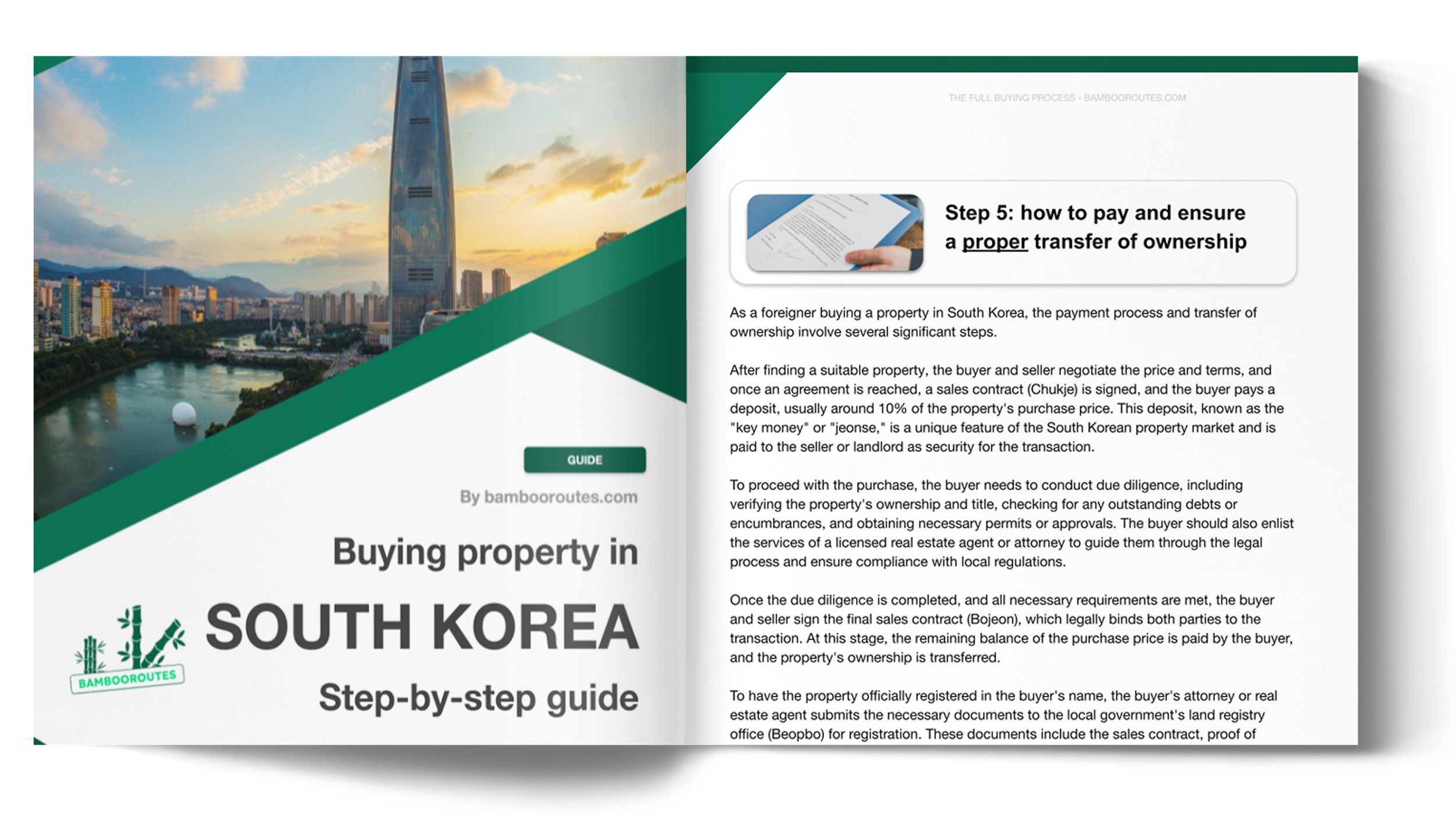
Get all the data you need about the real estate market in Daegu
We constantly update this blog post so the apartment price estimates for Daegu stay close to the latest market data.
Daegu in 2026 is not a Seoul-style shortage market, because buyers have more room to negotiate in many older and outer apartment areas.
The safest way to read Daegu apartment prices in 2026 is to separate prime Suseong-gu homes from normal resale apartments in Dalseo-gu, Buk-gu, Nam-gu and Seo-gu.
And if you’re planning to buy a property in this place, you may want to download our pack covering the real estate market in Daegu.
Insights
- Daegu apartment prices in 2026 are very split: a normal resale apartment can cost around ₩330 million, but a good Suseong-gu family unit can cost twice as much.
- The average apartment price in Daegu in 2026 is less useful than the neighborhood price, because Beomeo-dong and Pyeongni-dong sit in completely different markets.
- New apartments in Daegu still ask a big premium, often 35% to 55% above resale apartments, even though Daegu has had serious unsold-new-apartment pressure.
- A foreign buyer in Daegu should usually plan for 40% to 50% cash down, because Korean mortgage approval depends heavily on income, residency and DSR limits.
- For a normal two-bedroom apartment in Daegu in 2026, the working buyer budget is about ₩350 million, plus another ₩15 million to ₩21 million in closing cash.
- The cheapest Daegu apartments are not always the best bargains, because old buildings can come with weaker resale demand, higher repair risk and slower buyer interest.
- Korean apartment management fees are not a small side cost, because an 84 m² Daegu apartment can easily cost ₩230,000 to ₩330,000 per month before utilities.
- Daegu’s hot summers matter for ownership costs, because electricity and cooling can push monthly utility bills much higher in July, August and early September.
- Budget buyers should look closely at Daemyeong-dong, Chimsan-dong and Sangin-dong, but should still check subway distance, building age and repair funds.

How much do apartments really cost in Daegu in 2026?
What's the average and median apartment price in Daegu in 2026?
As of June 2026, the estimated median apartment price in Daegu is about ₩330 million, or roughly $220,000 and €188,000, while the estimated average apartment price in Daegu is about ₩390 million, or roughly $260,000 and €222,000.
On a floor-area basis, the estimated median apartment price in Daegu in 2026 is about ₩4.2 million per m², or about $2,800 and €2,390 per m², which is roughly ₩390,000 per sq ft, or about $260 and €222 per sq ft.
For most standard resale apartments in Daegu in 2026, a realistic price range is about ₩260 million to ₩520 million, or roughly $173,000 to $347,000 and €148,000 to €295,000, with higher prices in the strongest Suseong-gu school-zone locations.
Sources and methodology: we compared Korea Real Estate Board R-ONE, MOLIT real transaction data and KOSIS.
We then checked Daegu district patterns against asking-price ranges and our own apartment-level market model.
Currency conversions use a simple June 2026 working rate of about ₩1,500 per $1 and ₩1,760 per €1.
How much is a studio apartment in Daegu in 2026?
As of June 2026, a typical studio apartment or small officetel-style unit in Daegu costs about ₩130 million, or roughly $87,000 and €74,000.
For Daegu studios in 2026, entry-level to mid-range units usually sit around ₩90 million to ₩180 million, or about $60,000 to $120,000 and €51,000 to €102,000, while better central or station-adjacent studios can move closer to ₩200 million, or about $133,000 and €114,000.
Most Daegu studio apartments are small, often about 20 m² to 35 m², so the buyer should check management fees and resale liquidity before judging the unit only by its low price.
Sources and methodology: we used MOLIT transaction records, REB R-ONE and K-apt.
We treated studios separately because many small Daegu units are officetels, older villas or compact apartments.
We also compared central areas such as Banwoldang, Jungangno, Dongdaegu Station and university districts.
How much is a one-bedroom apartment in Daegu in 2026?
As of June 2026, a typical one-bedroom apartment in Daegu costs about ₩220 million, or roughly $147,000 and €125,000.
For one-bedroom apartments in Daegu in 2026, entry-level to mid-range prices usually run from about ₩160 million to ₩280 million, or about $107,000 to $187,000 and €91,000 to €159,000, while premium small units in Suseong-gu or near strong transport links can go above ₩300 million, or about $200,000 and €170,000.
A normal Daegu one-bedroom apartment is often about 35 m² to 50 m², which makes this segment more comfortable than a studio but still easier to finance than a family apartment.
Sources and methodology: we compared MOLIT real transactions, Korea Real Estate Board and K-apt regional fee data.
We adjusted the range for older buildings, station access and Suseong-gu school-zone premiums.
We also checked our own Daegu apartment-size estimates before rounding the numbers for readability.
How much is a two-bedroom apartment in Daegu in 2026?
As of June 2026, a typical two-bedroom apartment in Daegu costs about ₩350 million, or roughly $233,000 and €199,000.
For two-bedroom apartments in Daegu in 2026, entry-level to mid-range prices usually sit around ₩260 million to ₩460 million, or about $173,000 to $307,000 and €148,000 to €261,000, while high-end two-bedroom units in better Suseong-gu or central locations can reach ₩500 million to ₩650 million, or about $333,000 to $433,000 and €284,000 to €369,000.
By the way, you will find much more detailed price ranges for apartments in our property pack covering the property market in Daegu.
Sources and methodology: we used MOLIT transaction data, REB R-ONE and HUG private-apartment sale-price data.
We focused on this segment because two-bedroom homes are usually more liquid than very small units.
We then compared Wolseong-dong, Sangin-dong, Jisan-dong, Sincheon-dong and Chimsan-dong examples.
How much is a three-bedroom apartment in Daegu in 2026?
As of June 2026, a typical three-bedroom family apartment in Daegu costs about ₩520 million, or roughly $347,000 and €295,000.
For three-bedroom apartments in Daegu in 2026, entry-level to mid-range prices usually run from about ₩380 million to ₩750 million, or about $253,000 to $500,000 and €216,000 to €426,000, while high-end Suseong-gu family units can sit around ₩650 million to ₩900 million, or about $433,000 to $600,000 and €369,000 to €511,000.
A normal Daegu three-bedroom apartment is often close to 75 m² to 100 m², with the common 84 m² family layout being the key benchmark for local buyers.
Sources and methodology: we combined MOLIT reported sales, REB apartment indices and KOSIS housing context.
We treated 84 m² family apartments as the clearest local benchmark.
We then adjusted for Suseong-gu school-zone demand and older stock in Dalseo-gu, Seo-gu and Nam-gu.
What's the price gap between new and resale apartments in Daegu in 2026?
As of June 2026, new-build apartments in Daegu are usually about 35% to 55% more expensive than comparable resale apartments.
The estimated average price for new private apartments in Daegu in 2026 is about ₩6.4 million to ₩7.0 million per m², or roughly $4,270 to $4,670 and €3,640 to €3,980 per m².
By comparison, the estimated average resale apartment price in Daegu in 2026 is about ₩4.4 million to ₩4.8 million per m², or roughly $2,930 to $3,200 and €2,500 to €2,730 per m², so the premium matters a lot in a city with unsold-new-apartment pressure.
Sources and methodology: we compared HUG new private-apartment sale prices, MOLIT resale transactions and REB market indices.
We used the new-build premium only after checking that Daegu’s supply cycle was still soft.
We also separated completed-new stock from prime resale apartments, because the risk is not the same.
Make a profitable investment in Daegu
Better information leads to better decisions. Save time and money. Download our data.

Can I afford to buy in Daegu in 2026?
What's the typical total budget (all-in) to buy an apartment in Daegu in 2026?
As of June 2026, a typical all-in budget for a standard Daegu apartment is about ₩365 million to ₩371 million, or roughly $243,000 to $247,000 and €207,000 to €211,000, based on a normal two-bedroom resale apartment priced around ₩350 million.
This all-in Daegu apartment budget usually includes the purchase price, acquisition tax, broker fee, registration costs, legal or scrivener help, national housing bond discount cost, mortgage setup costs, moving costs and a small repair budget.
We go deeper and try to understand what costs can be avoided or minimized (and how) in our Daegu property pack.
Sources and methodology: we used Wetax, Invest Korea brokerage guidance and MOLIT transaction data.
We applied a safe 4% to 6% closing-cost range because foreign buyers often need extra support.
We also checked Daegu apartment prices against our own buyer-budget model before rounding.
What down payment is typical to buy in Daegu in 2026?
As of June 2026, many foreign buyers should expect a down payment of about 40% to 50% in Daegu, which means about ₩140 million to ₩175 million, or roughly $93,000 to $117,000 and €80,000 to €99,000, for a ₩350 million apartment.
The minimum down payment for a strong resident borrower can be closer to 30%, or about ₩105 million, $70,000 and €60,000 on a ₩350 million Daegu apartment, but this is not the safest assumption for a foreign buyer.
The recommended down payment for better mortgage terms in Daegu is usually 40% or more, because Korean lenders look closely at income, residency, credit file and debt-service-ratio limits.
Sources and methodology: we used Financial Services Commission, Bank of Korea and Korea Housing Finance Corporation.
We treated DSR as more important than headline LTV because income testing can reduce the real loan amount.
We also reflected 2026 bank mortgage-rate conditions when estimating practical affordability.
Get fresh and reliable information about the market in Daegu
Don't base significant investment decisions on outdated data. Get updated and accurate information.
Which neighborhoods are cheapest or priciest in Daegu in 2026?
How much does the price per m² for apartments vary by neighborhood in Daegu in 2026?
As of June 2026, apartment prices across Daegu neighborhoods range from about ₩2.9 million to ₩10.0 million per m², or roughly $1,930 to $6,670 and €1,650 to €5,680 per m².
The most affordable Daegu neighborhoods in 2026 include Pyeongni-dong, Daemyeong-dong, Chimsan-dong and parts of Sangin-dong, where typical apartment prices are often around ₩2.9 million to ₩4.8 million per m², or about $1,930 to $3,200 and €1,650 to €2,730 per m².
The most expensive Daegu neighborhoods in 2026 include Beomeo-dong, Manchon-dong, Hwanggeum-dong and Suseong-dong, where good apartments often sit around ₩6.5 million to ₩10.0 million per m², or about $4,330 to $6,670 and €3,690 to €5,680 per m².
Sources and methodology: we compared MOLIT transactions, REB district signals and KOSIS local indicators.
We then grouped neighborhoods by school-zone strength, subway access, apartment age and buyer depth.
We rounded each range because individual complexes can vary sharply within the same dong.
What neighborhoods are best for first-time buyers on a budget in Daegu in 2026?
As of June 2026, the top three Daegu neighborhoods for first-time buyers on a budget are Daemyeong-dong, Chimsan-dong and Sangin-dong.
In these budget-friendly Daegu neighborhoods, a practical apartment price range is about ₩250 million to ₩420 million, or roughly $167,000 to $280,000 and €142,000 to €239,000, depending on size, age and subway access.
Daemyeong-dong gives inner-city access, Chimsan-dong offers reasonable north-side convenience, and Sangin-dong gives family-sized apartments at more manageable Dalseo-gu prices.
The trade-off is that these Daegu budget areas usually have less prestige than Suseong-gu, more older stock and slower resale demand during weak market periods.
Sources and methodology: we used MOLIT resale evidence, REB trend data and K-apt building-cost context.
We focused on neighborhoods where buyers can still find normal apartments below prime Suseong-gu pricing.
We also considered resale depth, not just the lowest visible asking prices.
Which neighborhoods have the fastest-rising apartment prices in Daegu in 2026?
As of June 2026, the Daegu neighborhoods showing the strongest apartment-price momentum are Beomeo-dong, Manchon-dong and Sincheon-dong, although the word “rising” should be read carefully in a soft market.
For good complexes, Beomeo-dong is roughly up 2% to 5% year on year, Manchon-dong is roughly up 1% to 4%, and Sincheon-dong is roughly flat to up 3%.
The main driver is not citywide speculation, but a mix of Suseong-gu school-zone demand, transport convenience near Dongdaegu Station and buyer preference for liquid apartments in proven locations.
Sources and methodology: we compared REB price-index direction, MOLIT transaction patterns and MOLIT supply data.
We call these areas “stabilizing first” rather than “booming” because Daegu’s wider market remains selective.
We also gave more weight to completed transactions than to optimistic asking prices.
Get to know the market before buying a property in Daegu
Better information leads to better decisions. Get all the data you need before investing a large amount of money.
What extra costs will I pay on top of the apartment price in Daegu in 2026?
What are all the buyer closing costs when you buy an apartment in Daegu?
For a typical ₩350 million apartment purchase in Daegu, buyer closing costs are usually about ₩14 million to ₩21 million, or roughly $9,300 to $14,000 and €8,000 to €12,000.
The main closing costs in Daegu are acquisition tax, broker fee, registration or legal scrivener cost, national housing bond discount cost, stamp and certificate fees, and mortgage setup costs if the buyer borrows.
The largest closing cost is usually acquisition tax, because ordinary residential acquisition tax in Korea is based on the transaction price and can rise with property value and ownership status.
Some Daegu closing costs can vary or be negotiated, especially brokerage fee within legal caps, legal support, mortgage setup costs and the level of due diligence a foreign buyer chooses.
Sources and methodology: we used Wetax, Invest Korea brokerage guidance and Supreme Court Internet Registry Office.
We estimated total costs with a conservative foreign-buyer buffer.
We also separated statutory taxes from negotiable transaction support costs.
On average, how much are buyer closing costs as a percentage of the purchase price for an apartment in Daegu?
For most apartment purchases in Daegu, buyers should budget about 4% to 6% of the purchase price for closing costs.
A simple low-to-high range is about 3.5% for a clean, low-risk, ordinary one-home purchase and closer to 6% for a foreign buyer using financing, translation help and deeper legal checks.
We actually cover all these costs and strategies to minimize them in our pack about the real estate market in Daegu.
Sources and methodology: we checked Wetax, Invest Korea and MOLIT transaction values.
We used percentage ranges because the final cost changes with price, loan use and buyer profile.
We also included a small safety margin because foreign buyers often face extra paperwork costs.
Buying real estate in Daegu can be risky
An increasing number of foreign investors are showing interest. However, 90% of them will make mistakes. Avoid the pitfalls with our comprehensive guide.

What are the ongoing monthly and yearly costs of an apartment in Daegu in 2026?
What are typical HOA fees in Daegu right now?
In Daegu, the closest equivalent to an HOA fee is the apartment management fee, and a typical 84 m² apartment often costs about ₩230,000 to ₩330,000 per month, or roughly $153 to $220 and €131 to €188.
For Daegu apartments in 2026, basic smaller or older buildings can be closer to ₩120,000 per month, or about $80 and €68, while larger or higher-service complexes can reach ₩400,000 per month, or about $267 and €227.
Sources and methodology: we used K-apt regional management-fee data, K-apt complex disclosures and Korea Real Estate Board.
We converted won-per-m² disclosures into monthly budgets for common apartment sizes.
We kept utilities separate because Korean management bills can include both common charges and usage-based items.
What utilities should I budget monthly in Daegu right now?
For a typical 84 m² apartment in Daegu, monthly utilities are usually about ₩130,000 to ₩250,000, or roughly $87 to $167 and €74 to €142, before any mortgage payment.
The realistic monthly utility range in Daegu is about ₩100,000 to ₩350,000, or roughly $67 to $233 and €57 to €199, depending on apartment size, summer cooling, winter heating and household habits.
A normal Daegu utility budget includes electricity, city gas or heating, water and sewage, internet, and sometimes small building-related usage charges shown on the apartment management bill.
Electricity can become the most painful utility in Daegu during the hottest summer months, while gas or heating can be the larger cost in colder winter periods.
Sources and methodology: we used KEPCO electricity-rate guidance, Daesung Energy and K-apt billing structures.
We treated Daegu summer cooling as a local cost risk because the city is known for very hot summers.
We separated utilities from common management fees so buyers can see the real monthly cash need.
How much is property tax on apartments in Daegu?
For a normal Daegu apartment, annual property tax is usually about ₩300,000 to ₩1.0 million, or roughly $200 to $670 and €170 to €570.
Korean property tax is calculated on the official taxable value, not simply the full market price, so the effective tax burden on many ordinary Daegu apartments is usually around 0.10% to 0.25% of market value.
A realistic annual property-tax range in Daegu is about ₩150,000 to ₩1.8 million, or roughly $100 to $1,200 and €85 to €1,020, depending on property value, official assessment and ownership situation.
Sources and methodology: we used Wetax, National Tax Service and KOSIS housing-value context.
We kept the range simple because official taxable values differ from market prices.
We also flagged that multiple-home ownership can change the tax picture.
What's the yearly building maintenance cost in Daegu?
A typical Daegu apartment owner should budget about ₩1.5 million to ₩4.0 million per year for owner-level building maintenance and repair risk, or roughly $1,000 to $2,700 and €850 to €2,300.
For Daegu apartments, the realistic yearly range is about ₩1.5 million for a newer large complex and more than ₩6.0 million, or about $4,000 and €3,400, for an older building that needs windows, plumbing, elevator or interior repairs.
These maintenance costs usually cover owner repairs, long-term repair-fund pressure, small interior fixes, leakage risk, appliance replacement and building-age problems that are not fully visible in the purchase price.
In Daegu, some maintenance items appear inside the monthly apartment management bill, but owner-only repairs and special replacement costs should be budgeted separately.
Sources and methodology: we used K-apt repair-fund disclosures, K-apt regional cost data and MOLIT building-age context.
We gave older Daegu apartments a higher risk budget because cheap stock can hide future repair costs.
We also separated monthly common fees from owner-level repairs.
How much does home insurance cost in Daegu?
A typical annual home insurance budget for a Daegu apartment is about ₩100,000 to ₩300,000, or roughly $67 to $200 and €57 to €170.
A realistic annual insurance range in Daegu is about ₩100,000 to ₩600,000, or roughly $67 to $400 and €57 to €341, depending on contents cover, water leakage liability, fire cover and property value.
Home insurance is usually optional for a cash buyer in Daegu, but lenders may require cover when a mortgage is used, and water leakage liability is worth checking in Korean apartment buildings.
Sources and methodology: we compared Korean apartment insurance quotes, K-apt building-risk context and Korea Housing Finance Corporation mortgage logic.
We treated water leakage liability as especially important for apartment owners.
We kept the estimate conservative because coverage level matters more than city location.
Get the full checklist for your due diligence in Daegu
Don't repeat the same mistakes others have made before you. Make sure everything is in order before signing your sales contract.
What sources have we used to write this blog article?
Whether it’s in our blog articles or the market analyses included in our property pack about Daegu, we always rely on the strongest methodology we can … and we don’t throw out numbers at random.
We also aim to be fully transparent, so below we’ve listed the authoritative sources we used, and explained how we used them and the methods behind our estimates.
| Source | Why we trust it | How we used it |
|---|---|---|
| Korea Real Estate Board R-ONE | R-ONE is Korea’s official real-estate statistics platform. | We used it to anchor Daegu apartment price direction and regional comparisons. We treated it as the main official source for market trend signals. |
| Korea Real Estate Board | REB is Korea’s national real-estate statistics institution. | We used it to confirm that R-ONE and K-apt are official systems. We also used it to avoid relying only on listing portals. |
| MOLIT Statistics Nuri | MOLIT is Korea’s central land and housing ministry. | We used it for housing supply, unsold inventory and transaction-market context. We cross-checked supply pressure against REB price trends. |
| MOLIT Real Transaction System | This is Korea’s official real-estate transaction reporting system. | We used it as the logic base for resale-price estimates by apartment type. We compared reported deals with market asking-price evidence. |
| KOSIS | KOSIS is Korea’s official national statistics portal. | We used it to cross-check demographic, housing and local statistical indicators. We used official tables when they were safer than media summaries. |
| HUG Private Apartment Sale Price Trend | HUG publishes official new private-apartment sale-price statistics. | We used it to estimate new-build apartment pricing in Daegu. We compared it with resale prices to estimate the new-versus-resale premium. |
| K-apt Regional Management-Fee Data | K-apt is Korea’s official apartment management-fee disclosure system. | We used it for monthly apartment management fees by area. We converted per-m² fees into realistic monthly budgets for common home sizes. |
| K-apt Main System | It publishes management, repair-fund and maintenance data from complexes. | We used it to separate common fees from utilities and repair charges. We relied on it because Korean apartment fees are relatively standardized. |
| Financial Services Commission | FSC sets and explains Korea’s mortgage and DSR rules. | We used it for debt-service-ratio constraints and lending-risk context. We treated DSR as more important than advertised LTV for many foreign buyers. |
| Bank of Korea | BOK is Korea’s central bank and rate-statistics reference source. | We used it to benchmark 2026 mortgage affordability. We used recent mortgage-rate conditions to estimate buyer monthly payment pressure. |
| Korea Housing Finance Corporation | HF is Korea’s public housing-finance agency. | We used it to understand long-term mortgage product context. We cross-checked public housing-finance logic against BOK rate trends. |
| Wetax | Wetax is Korea’s official local-tax payment platform. | We used it for acquisition-tax and property-tax logic. We translated statutory tax rules into buyer-friendly budget percentages. |
| Supreme Court Internet Registry Office | IROS is the official real-estate registry access point. | We used it to frame title, lien and registration checks. We included it because ownership verification matters for foreign buyers. |
| Invest Korea Brokerage Commission Guide | Invest Korea gives foreign investors official transaction-cost guidance. | We used it to understand brokerage-fee caps for real-estate deals. We treated broker fees as capped but still negotiable within the legal limit. |
| KEPCO Residential Electricity Rates | KEPCO is Korea’s official electricity provider. | We used it to estimate electricity costs for Daegu apartments. We paid special attention to summer cooling because Daegu gets very hot. |
| Daesung Energy | Daesung Energy is the main city-gas provider in Daegu. | We used it to frame gas and heating-cost context. We combined it with apartment-size assumptions to estimate winter utility pressure. |
| European Central Bank KRW Reference Rates | ECB publishes transparent euro foreign-exchange reference rates. | We used it to convert Daegu apartment prices into euros. We rounded conversions so readers can understand the scale quickly. |
| Federal Reserve Economic Data USD/KRW Series | FRED tracks the Korean won to US dollar exchange rate. | We used it to support USD conversions for Daegu apartment prices. We used rounded June 2026 working rates rather than false precision. |
Make a profitable investment in Daegu
Better information leads to better decisions. Save time and money. Download our data.
Related blog posts