
Authored by the expert who managed and guided the team behind the Philippines Property Pack

Yes, the analysis of Cebu's property market is included in our pack
Cebu's real estate market in early 2026 is still growing, but the heavy supply of new condominiums has created a promo-heavy, sales-driven environment where foreign buyers need to be extra careful.
Scams targeting foreigners in Cebu are documented regularly, with fake title cases and unauthorized pre-selling schemes making headlines as recently as December 2025.
This guide, which we constantly update, breaks down the specific risks, grey areas, and verification steps that can protect you from losing money in Cebu's property market.
And if you're planning to buy a property in this place, you may want to download our pack covering the real estate market in Cebu.

How risky is buying property in Cebu as a foreigner in 2026?
Can foreigners legally own properties in Cebu in 2026?
As of early 2026, foreigners can legally own condominium units in Cebu, but they cannot own land directly under the Philippine Constitution.
The main restriction in Cebu is that foreign ownership in any condominium building cannot exceed 40% of the total units, so you need to confirm availability before committing to a purchase.
When direct land ownership is off the table, foreigners in Cebu typically use long-term lease agreements (up to 75 years), form corporations with 60% Filipino ownership, or buy through a Filipino spouse, though each of these structures comes with its own legal and practical risks.
What buyer rights do foreigners actually have in Cebu in 2026?
As of early 2026, foreigners who own a properly titled condominium in Cebu have the same ownership rights as Filipino buyers, meaning they can sell, mortgage, lease, or inherit the property.
If a seller in Cebu breaches a contract, foreigners can file civil cases and seek damages through Philippine courts, but enforcement depends heavily on having clean documentation and a title that is registered correctly with the Registry of Deeds.
The most common right that foreigners mistakenly assume they have in Cebu is the ability to enforce "side agreements" or informal promises that were never registered with the proper authorities, which often have no legal weight when disputes arise.
How strong is contract enforcement in Cebu right now?
Contract enforcement for real estate transactions in Cebu is weaker than in countries like Singapore, Japan, or Australia, with the Philippines ranking in the lower half of global rule-of-law indices, which means court cases can drag on for years and outcomes are less predictable.
The main weakness foreigners should know about in Cebu is that local networks and familiarity with the system often favor the other party, making prevention through proper due diligence far more valuable than relying on courts to fix problems after they happen.
By the way, we detail all the documents you need and what they mean in our property pack covering Cebu.
Buying real estate in Cebu can be risky
An increasing number of foreign investors are showing interest. However, 90% of them will make mistakes. Avoid the pitfalls with our comprehensive guide.

Which scams target foreign buyers in Cebu right now?
Are scams against foreigners common in Cebu right now?
Real estate scams targeting foreigners in Cebu are a documented and regular occurrence, with the NBI making arrests in fake title cases as recently as December 2025 in Mandaue City.
Pre-selling condominium transactions and "rush sale" resale deals in expat-heavy areas like IT Park, Cebu Business Park, and Mactan are the property types most frequently targeted by scammers in Cebu.
The foreign buyer profile most commonly targeted in Cebu is someone who is eager to close quickly, unfamiliar with local verification processes, and trusts relationships or referrals over official documents.
The single biggest warning sign that a deal may be a scam in Cebu is pressure to pay a reservation fee or deposit before you have verified the title with the Registry of Deeds yourself.
What are the top three scams foreigners face in Cebu right now?
The top three scams foreigners face in Cebu are fake ownership or forged title scams, double-selling schemes where the same property is sold to multiple buyers, and "guaranteed rental return" pitches that quietly turn into unregulated investment contracts.
The most common scam in Cebu unfolds like this: someone claims to be the owner or an authorized representative, shows you convincing documents and an "owner's copy" of the title, pressures you to pay a reservation fee quickly because "another buyer is interested," and then disappears with your money or you later discover the real owner never agreed to the sale.
The single most effective protection against each of these three scams in Cebu is to never release any money until you have personally verified the title at the correct Registry of Deeds, confirmed the seller's identity matches the title, and for new projects, confirmed the developer has a valid License to Sell from DHSUD.
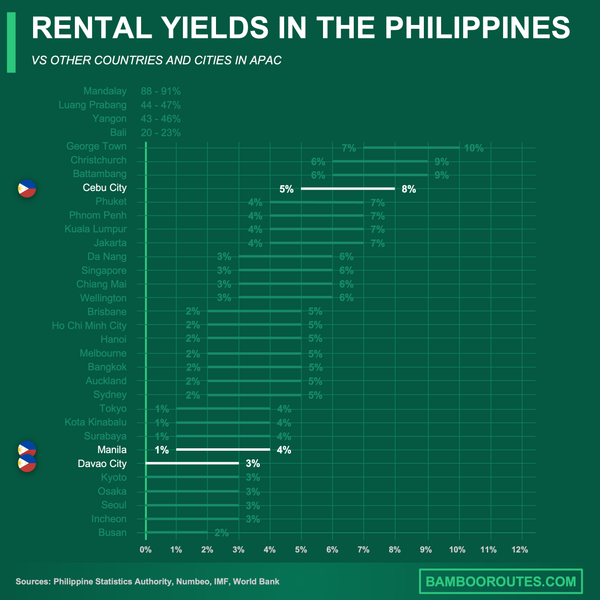
We did some research and made this infographic to help you quickly compare rental yields of the major cities in the Philippines versus those in neighboring countries. It provides a clear view of how this country positions itself as a real estate investment destination, which might interest you if you’re planning to invest there.
How do I verify the seller and ownership in Cebu without getting fooled?
How do I confirm the seller is the real owner in Cebu?
The standard verification process in Cebu is to request a certified true copy of the title from the correct Registry of Deeds (Cebu City, Lapu-Lapu, or Mandaue, depending on where the property is located) and match the seller's identity to the name on that official document.
The official document foreigners should check is the Transfer Certificate of Title (TCT) for land or Condominium Certificate of Title (CCT) for condos, obtained directly from the Registry of Deeds, not from the seller.
The most common trick fake sellers use in Cebu is presenting a photocopy or "owner's duplicate copy" of the title along with a convincing ID and story, which happens regularly enough that the NBI arrested five people for exactly this scheme in Cebu City in December 2025.
Where do I check liens or mortgages on a property in Cebu?
The official place to check liens or mortgages on a property in Cebu is the Registry of Deeds office that covers the property's location, where encumbrances are recorded as annotations on the title.
When checking for liens in Cebu, you should request a certified true copy of the title and carefully read the "annotations" or "encumbrances" section, which lists any mortgages, adverse claims, court orders, or other restrictions on the property.
The type of lien most commonly missed by foreign buyers in Cebu is unpaid condominium association dues or special assessments, which may not appear on the title itself but can block the transfer of ownership or create immediate financial obligations after purchase.
It's one of the aspects we cover in our our pack about the real estate market in Cebu.
How do I spot forged documents in Cebu right now?
The most common type of forged document in Cebu property scams is a fake Transfer Certificate of Title or Condominium Certificate of Title, and this happens regularly enough that the NBI conducts ongoing operations against document forgers in the region.
Red flags that indicate a document may be forged in Cebu include inconsistent fonts or spacing, serial numbers that do not match Registry of Deeds records, missing security features, and any seller who resists letting you verify the document with the Registry directly.
The official verification method in Cebu is to personally request a certified true copy from the Registry of Deeds and compare it to what the seller provided, while also verifying any agent's license through the PRC online verification system.
Get the full checklist for your due diligence in Cebu
Don't repeat the same mistakes others have made before you. Make sure everything is in order before signing your sales contract.
What "grey-area" practices should I watch for in Cebu?
What hidden costs surprise foreigners when buying a property in Cebu?
The three most common hidden costs foreigners overlook in Cebu are transfer taxes (around 0.5% to 0.75% of the property value, or PHP 25,000 to PHP 75,000 / USD 450 to USD 1,350 / EUR 415 to EUR 1,250 on a typical condo), unpaid association dues inherited from the previous owner, and documentary stamp taxes that can add another 1.5% to the total cost.
The hidden cost most often deliberately concealed by sellers or agents in Cebu is unpaid real property taxes or association dues with penalties, which is common enough that buyers should always request clearance certificates before releasing any payment.
If you want to go into more details, we also have a blog article detailing all the property taxes and fees in Cebu.
Are "cash under the table" requests common in Cebu right now?
Requests for undeclared cash payments in Cebu property transactions are common, usually framed as a way to reduce the declared sale price and lower your tax burden.
The typical reason sellers give in Cebu for requesting undeclared cash is "we will declare a lower price so both of us pay less taxes," which sounds helpful but creates serious problems for you later.
The legal risks foreigners face in Cebu if they agree to an undeclared cash payment include BIR penalties if the under-declaration is discovered, a weakened paper trail that makes your ownership harder to defend in disputes, and potential complications when you try to resell the property at its true value.
Are side agreements used to bypass rules in Cebu right now?
Side agreements to bypass foreign ownership rules are common in Cebu, especially informal arrangements where a foreigner puts land in a Filipino friend's or partner's name with a private "understanding" about true ownership.
The most common type of side agreement in Cebu is the nominee arrangement, where a Filipino holds the title on paper while a foreigner provides all the money and considers themselves the "real" owner based on an unregistered side contract.
The legal consequences in Cebu if such a side agreement is discovered or challenged are severe: the arrangement can be declared void, the foreigner has no enforceable ownership claim, and the nominee can legally keep the property with no obligation to return your money.

We made this infographic to show you how property prices in the Philippines compare to other big cities across the region. It breaks down the average price per square meter in city centers, so you can see how cities stack up. It’s an easy way to spot where you might get the best value for your money. We hope you like it.
Can I trust real estate agents in Cebu in 2026?
Are real estate agents regulated in Cebu in 2026?
As of early 2026, real estate brokers and salespersons in Cebu are regulated under the Real Estate Service Act (RA 9646), which requires them to pass a licensure exam and register with the Professional Regulation Commission.
A legitimate real estate agent in Cebu should have a PRC license as either a Real Estate Broker or a Real Estate Salesperson, with the salesperson required to work under a licensed broker's supervision.
Foreigners can verify whether an agent in Cebu is properly licensed by checking their name and license number on the PRC online verification system, which takes about two minutes.
Please note that we have a list of contacts for you in our property pack about Cebu.
What agent fee percentage is normal in Cebu in 2026?
As of early 2026, the normal agent commission in Cebu ranges from 3% to 5% of the property's selling price, with 5% being the most common rate for resale transactions.
The typical range that covers most Cebu transactions is 3% to 5% for resales and secondary market deals, while developer sales often have commissions built into the price rather than charged separately to buyers.
In Cebu, the seller typically pays the agent's commission on resale transactions, though this is negotiable and should always be clarified in writing before you proceed.
Get the full checklist for your due diligence in Cebu
Don't repeat the same mistakes others have made before you. Make sure everything is in order before signing your sales contract.
What due diligence actually prevents disasters in Cebu?
What structural inspection is standard in Cebu right now?
The standard structural inspection for property purchases in Cebu is minimal compared to Western countries, which means foreign buyers should proactively arrange their own independent inspection rather than assuming one will happen automatically.
A qualified inspector in Cebu should check foundations, load-bearing walls, roof condition, plumbing systems, electrical wiring, window seals, and for condos specifically, signs of water intrusion or concrete spalling.
The professionals qualified to perform structural inspections in Cebu are licensed civil engineers or architects, and you should hire one independently rather than relying on someone recommended by the seller or developer.
The most common structural issues inspections reveal in Cebu properties are water intrusion and moisture damage (due to humidity and coastal exposure near Mactan), poor waterproofing, electrical system inadequacies, and workmanship variations between different towers or phases of the same development.
How do I confirm exact boundaries in Cebu?
For condominium purchases in Cebu, which is what most foreigners buy legally, the standard process is to verify that the unit plan and floor area match the Condominium Certificate of Title (CCT) rather than conducting a land survey.
The official document showing legal boundaries for a Cebu condo is the CCT and the Master Deed with Declaration of Restrictions filed with the Registry of Deeds, which defines your unit's exact location and the common areas you share.
The most common boundary-related dispute affecting foreign buyers in Cebu condos is discrepancies between the marketed floor area and the actual titled area, which can affect both your purchase price and resale value.
For the rare cases where foreigners lease land in Cebu, a licensed geodetic engineer should be hired to verify boundaries on the ground against the survey plan attached to the title.
What defects are commonly hidden in Cebu right now?
The top three defects sellers commonly hide in Cebu are paper defects disguised as "minor admin issues" (unpaid dues, unregistered documents, pending encumbrances), unrealistic rental income projections presented as guarantees, and livability problems you only discover after moving in (noise, traffic access, poor building management), with paper defects being the most common.
The inspection technique that helps uncover hidden defects in Cebu is combining an independent physical inspection by a licensed engineer with a thorough paper audit that includes verifying the title at the Registry of Deeds, requesting clearance certificates for taxes and association dues, and for properties marketed with rental income, checking whether any "guarantee" is actually SEC-compliant.
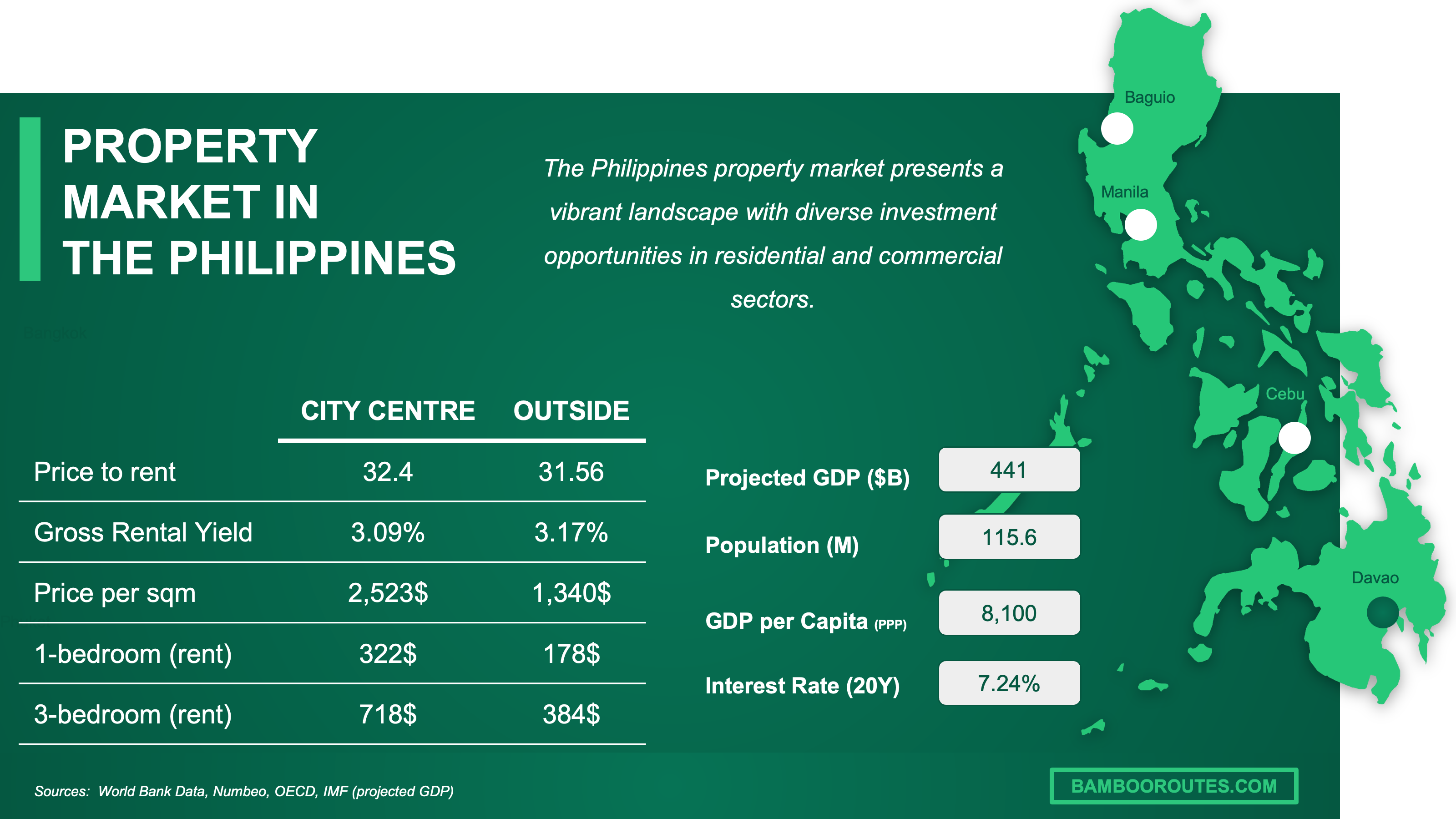
We have made this infographic to give you a quick and clear snapshot of the property market in the Philippines. It highlights key facts like rental prices, yields, and property costs both in city centers and outside, so you can easily compare opportunities. We’ve done some research and also included useful insights about the country’s economy, like GDP, population, and interest rates, to help you understand the bigger picture.
What insider lessons do foreigners share after buying in Cebu?
What do foreigners say they did wrong in Cebu right now?
The most common mistake foreigners say they made when buying property in Cebu is trusting a person (agent, friend, referral) instead of verifying documents through official channels like the Registry of Deeds and PRC.
The top three regrets foreigners mention after buying in Cebu are moving too fast because of a "limited time discount" or "last unit" pitch, assuming rental income projections were guaranteed when they were not, and not hiring an independent lawyer before signing anything.
The single piece of advice experienced foreign buyers in Cebu give to newcomers is: never release money until you have personally verified the title at the correct Registry of Deeds, no matter how trustworthy the seller seems.
The mistake foreigners say cost them the most money or stress in Cebu is entering into nominee arrangements or informal "side agreements" for land ownership, which have no legal protection when relationships change or disputes arise.
What do locals do differently when buying in Cebu right now?
The key difference in how locals approach buying property in Cebu compared to foreigners is that locals prioritize checking the property management company's reputation and the condo corporation's financial health, because they have seen firsthand how quickly a building's livability and resale value can collapse under poor management.
The verification step locals routinely take in Cebu that foreigners often skip is visiting the correct Registry of Deeds in person (knowing immediately whether to go to Cebu City, Lapu-Lapu, or Mandaue) and asking building staff or security guards about actual day-to-day conditions before committing.
The local knowledge advantage that helps Cebuanos get better deals is understanding the developer promo cycles: when condo supply is high (as it is in early 2026), locals negotiate harder on price and freebies because they know developers are under pressure to move units, while foreigners often accept the first offer.
Don't buy the wrong property, in the wrong area of Cebu
Buying real estate is a significant investment. Don't rely solely on your intuition. Gather the right information to make the best decision.

What sources have we used to write this blog article?
Whether it's in our blog articles or the market analyses included in our property pack about Cebu, we always rely on the strongest methodology we can and we don't throw out numbers at random.
We also aim to be fully transparent, so below we've listed the authoritative sources we used, and explained how we used them and the methods behind our estimates.
| Source | Why it's authoritative | How we used it |
|---|---|---|
| Bangko Sentral ng Pilipinas (BSP) RPPI | The Philippine central bank's official house price index. | We used it to ground market trend claims in official price data. We also referenced its methodology to avoid over-relying on listing site prices. |
| Land Registration Authority (LRA) | The national authority overseeing land registration in the Philippines. | We used it as the anchor for ownership verification processes. We also used its Registry of Deeds directory to help readers find the correct office. |
| DHSUD | The national housing and real estate development regulator. | We used it to explain License to Sell requirements. We also used it to frame what constitutes legitimate pre-selling versus illegal schemes. |
| PRC License Verification | The official government tool for verifying professional licenses. | We used it as the concrete step for checking if a broker is licensed. We turned "trust but verify" into a two-minute action. |
| Condominium Act (RA 4726) | The primary law defining condominium ownership in the Philippines. | We used it to explain what foreigners can legally own. We also used it to frame why condo ownership is the standard path for foreign buyers. |
| World Justice Project Rule of Law Index | A globally recognized rule-of-law dataset using expert surveys. | We used it to ground contract enforcement claims in comparative data. We avoided hand-wavy claims about courts by citing actual rankings. |
| Transparency International CPI | The primary publisher of the Corruption Perceptions Index. | We used it to contextualize grey-area risks as systemic. We justified extra verification steps based on documented corruption patterns. |
| Colliers Philippines Cebu Research | A major global real estate consultancy with published methodology. | We used it for Cebu-specific supply pipeline data. We explained why heavy supply creates conditions for aggressive and risky selling tactics. |
| Bureau of Internal Revenue (BIR) | The national tax authority with official tax guidance. | We used it to explain tax-trigger points and documentation chains. We highlighted why under-declaring creates concrete transaction risk. |
| NBI Anti-Fraud Division | The official government page for fraud complaint intake. | We used it to show where to go if you encounter a scam. We also used it to shape the evidence-keeping checklist. |
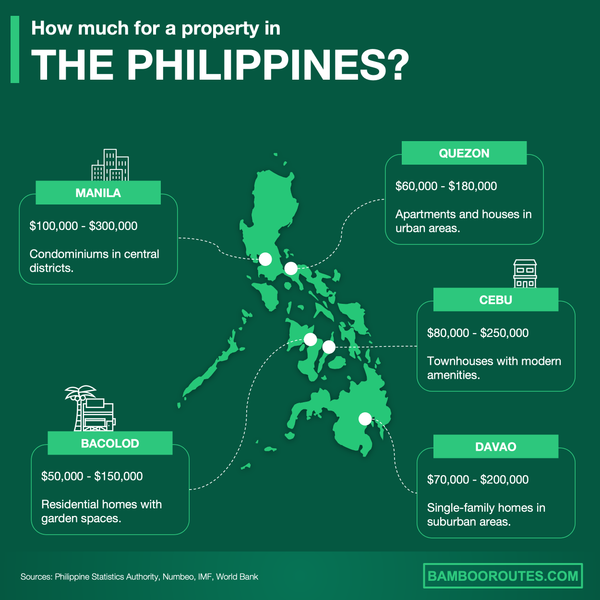
We created this infographic to give you a simple idea of how much it costs to buy property in different parts of the Philippines. As you can see, it breaks down price ranges and property types for popular cities in the country. We hope this makes it easier to explore your options and understand the market.
Related blog posts