
Authored by the expert who managed and guided the team behind the Philippines Property Pack

Yes, the analysis of Cebu's property market is included in our pack
Yes, foreigners can legally rent out property in Cebu in 2026, but there are specific ownership rules you need to understand first.
This guide breaks down the actual numbers, legal requirements, and neighborhood performance data so you can make an informed decision about Cebu rental investment.
We constantly update this blog post to reflect the latest market conditions and regulations in Cebu.
And if you're planning to buy a property in this place, you may want to download our pack covering the real estate market in Cebu.
Insights
- Cebu condos typically yield 5% to 7% gross annually, but net yields drop to 3% to 5% once you factor in condo dues, taxes, and management fees that many foreign investors underestimate.
- Short-term rentals in Cebu City show only 45% to 55% average occupancy despite strong tourism, meaning your Airbnb income projections should assume nearly half the year vacant.
- Rent control in Cebu only applies to units at 10,000 pesos per month or below, so most foreign-owned investment condos can set market rates freely without government caps.
- Mabolo and Guadalupe often deliver better yields than premium Cebu Business Park locations because purchase prices are lower while rental demand from local professionals stays strong.
- Corporate tenants in Cebu may withhold tax directly from your rent payments, which catches many foreign landlords off guard when they receive less than the agreed amount.
- Furnished condos in Cebu IT Park typically rent 2 to 3 weeks faster than unfurnished units because BPO workers relocating for jobs need move-in-ready apartments.
- Central Visayas recorded 7.5 million tourists in 2024, which directly supports Cebu short-term rental demand but also means more competition from the 8,000+ active Airbnb listings.
- A typical 30 square meter Cebu condo costs 1,500 to 3,600 pesos monthly in association dues alone, before you add repairs, insurance, and property management fees.
- Mactan and Lapu-Lapu attract expat renters willing to pay premium rates for airport proximity and resort-style living, but building restrictions often prohibit short-term rentals.

Can I legally rent out a property in Cebu as a foreigner right now?
Can a foreigner own-and-rent a residential property in Cebu in 2026?
As of early 2026, foreigners can legally own and rent out condominium units in Cebu under the Condominium Act (RA 4726), but direct land ownership remains prohibited for non-Filipino citizens.
The two main ownership structures available to foreigners in Cebu are outright condo unit ownership (where you hold the unit title while the land belongs to the condo corporation) and long-term land leases of up to 50 years under the Investors' Lease Act (RA 7652) combined with building ownership.
The biggest restriction foreigners face in Cebu is the constitutional ban on land ownership, which means you cannot buy a traditional house-and-lot property in your own name, pushing most foreign investors toward the condo market instead.
If you're not a local, you might want to read our guide to foreign property ownership in Cebu.
Do I need residency to rent out in Cebu right now?
No, you do not need to be a Philippine resident to rent out property in Cebu, and many foreign landlords successfully manage their rentals remotely through local property managers.
However, you will need a Tax Identification Number (TIN) from the Bureau of Internal Revenue if you earn taxable rental income in the Philippines, even as a non-resident.
While not strictly required by law, having a local Philippine bank account is practically necessary in Cebu because tenants, condo corporations, and utility companies strongly prefer local payment methods over international transfers.
Remote management is entirely feasible in Cebu since the property management industry is well-established, though you should budget 8% to 12% of monthly rent for professional management services.
Thinking of buying real estate in Cebu?
Acquiring property in a different country is a complex task. Don't fall into common traps – grab our guide and make better decisions.

What rental strategy makes the most money in Cebu in 2026?
Is long-term renting more profitable than short-term in Cebu in 2026?
As of early 2026, short-term rentals can generate higher gross income in the right Cebu locations, but long-term rentals typically deliver more predictable returns with significantly less operational effort.
A well-managed short-term rental in a prime Cebu location might gross 400,000 to 600,000 pesos annually (around 7,000 to 10,500 USD or 6,500 to 9,800 EUR), while a comparable long-term rental would generate 300,000 to 420,000 pesos (5,200 to 7,300 USD or 4,900 to 6,800 EUR), though STR costs eat heavily into that premium.
Short-term renting tends to outperform financially in Cebu IT Park, Cebu Business Park, and Mactan areas near the airport where business travelers and tourists concentrate, especially in buildings that actually permit Airbnb-style operations.
What's the average gross rental yield in Cebu in 2026?
As of early 2026, the average gross rental yield for residential properties in Cebu ranges from 5% to 7% annually, which positions Cebu competitively among Philippine cities for rental investment.
Most Cebu rental properties fall within a gross yield range of 4% on the low end (premium locations with high purchase prices) to 8% on the high end (value neighborhoods with strong rental demand).
Studio and one-bedroom units in Cebu typically achieve the highest gross yields because they have lower purchase prices while commanding relatively strong rents from the large pool of young professionals and BPO workers.
By the way, we have much more granular data about rental yields in our property pack about Cebu.
What's the realistic net rental yield after costs in Cebu in 2026?
As of early 2026, the average net rental yield in Cebu after all costs typically falls between 3% and 5% annually for most foreign individual landlords.
The realistic net yield range spans from 2.5% (for high-maintenance properties or those with frequent vacancies) up to 5.5% (for efficiently managed units in strong demand areas with minimal turnover).
The three main cost categories that reduce gross to net yield specifically in Cebu are condo association dues (which run 50 to 120 pesos per square meter monthly in most buildings), income tax on rental earnings (which applies even to non-residents), and the withholding tax that corporate tenants deduct directly from your rent payments.
You might want to check our latest analysis about gross and net rental yields in Cebu.
What monthly rent can I get in Cebu in 2026?
As of early 2026, typical monthly rents in good Cebu rental locations are 15,000 to 22,000 pesos (260 to 385 USD or 245 to 360 EUR) for studios, 22,000 to 35,000 pesos (385 to 610 USD or 360 to 570 EUR) for one-bedrooms, and 35,000 to 60,000 pesos (610 to 1,050 USD or 570 to 980 EUR) for two-bedrooms.
A realistic entry-level monthly rent for a decent studio in Cebu starts around 12,000 to 18,000 pesos (210 to 315 USD or 195 to 295 EUR), though location and building quality heavily influence what tenants will pay.
For a typical one-bedroom apartment in Cebu, mid-range monthly rents fall between 25,000 and 32,000 pesos (435 to 560 USD or 410 to 520 EUR), with furnished units commanding the higher end of that range.
A typical two-bedroom apartment in Cebu commands 40,000 to 55,000 pesos monthly (700 to 960 USD or 655 to 900 EUR), with premium buildings in Cebu Business Park or IT Park often exceeding 60,000 pesos.
If you want to know more about this topic, you can read our guide about rents and rental incomes in Cebu.
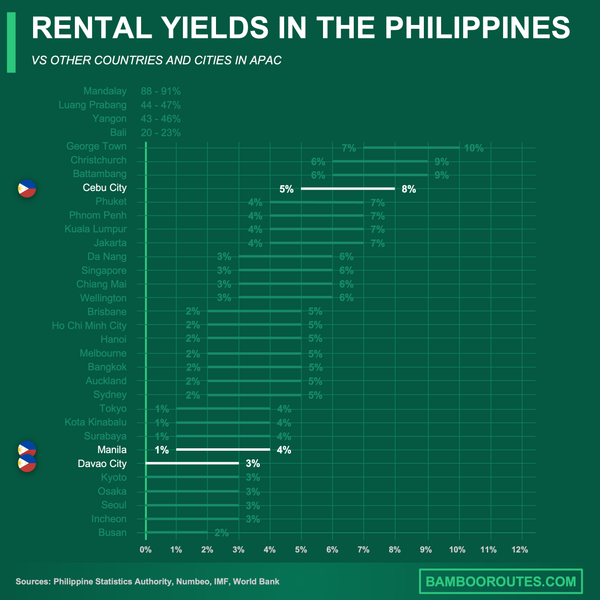
We did some research and made this infographic to help you quickly compare rental yields of the major cities in the Philippines versus those in neighboring countries. It provides a clear view of how this country positions itself as a real estate investment destination, which might interest you if you’re planning to invest there.
What are the real numbers I should budget for renting out in Cebu in 2026?
What's the total "all-in" monthly cost to hold a rental in Cebu in 2026?
As of early 2026, the total all-in monthly cost to hold a typical rental condo in Cebu runs 5,000 to 12,000 pesos (85 to 210 USD or 80 to 195 EUR), excluding mortgage payments and income taxes.
The realistic monthly cost range spans from 4,000 pesos (70 USD or 65 EUR) for a small, efficiently-run studio to 15,000 pesos (260 USD or 245 EUR) for a larger unit in a high-amenity building with professional management.
Condo association dues are typically the single largest monthly cost in Cebu, often accounting for 40% to 60% of total holding costs, especially in buildings with pools, gyms, and 24-hour security.
You want to go into more details? Check our list of property taxes and fees you have to pay when buying a property in Cebu.
What's the typical vacancy rate in Cebu in 2026?
As of early 2026, the typical vacancy rate for long-term rentals in Cebu is around 8%, which translates to roughly one month of vacancy per year for a well-priced unit in a decent location.
Landlords in Cebu should realistically budget for 1 to 1.5 months of vacancy annually because tenant turnover, even with good properties, requires time for cleaning, minor repairs, and finding qualified replacements.
The main factor causing vacancy rates to vary across Cebu neighborhoods is proximity to employment hubs, with areas near IT Park and Cebu Business Park enjoying lower vacancy than peripheral locations with weaker transport links.
Tenant turnover in Cebu tends to peak in March through May when many lease renewals coincide with the end of the school year and when BPO workers commonly relocate between contracts.
We have a whole part covering the best rental strategies in our pack about buying a property in Cebu.
Get fresh and reliable information about the market in Cebu
Don't base significant investment decisions on outdated data. Get updated and accurate information with our guide.
Where do rentals perform best in Cebu in 2026?
Which neighborhoods have the highest long-term demand in Cebu in 2026?
As of early 2026, the top three neighborhoods with the highest overall long-term rental demand in Cebu are Cebu IT Park/Lahug, Cebu Business Park (Ayala area), and Mabolo, all driven by their proximity to major employment centers.
Families in Cebu tend to prefer Banilad, Talamban, and the Maria Luisa Estate Park area because these neighborhoods offer larger units, access to international schools, and a quieter residential atmosphere.
Students in Cebu cluster around Lahug, the Capitol/Fuente Osmena area, and parts of Talamban due to proximity to universities like UP Cebu, University of San Carlos, and Cebu Doctors' University.
Expats and international professionals in Cebu gravitate toward Banilad, Lahug, Cebu Business Park, and Mactan Newtown because these areas offer international-standard amenities, English-friendly services, and easy airport access.
By the way, we've written a blog article detailing what are the current best areas to invest in property in Cebu.
Which neighborhoods have the best yield in Cebu in 2026?
As of early 2026, the top three neighborhoods offering the best rental yields in Cebu are Mabolo, Guadalupe, and parts of Mandaue near industrial zones, where purchase prices remain moderate while rental demand stays consistently strong.
These top-yielding Cebu neighborhoods typically deliver gross rental yields in the 6% to 8% range, compared to 4% to 6% in premium CBD locations where property prices are significantly higher.
The main characteristic allowing these neighborhoods to achieve higher yields is their "value-demand overlap," meaning they attract steady tenants (young professionals, local workers) without the premium pricing that drags down returns in places like Cebu Business Park.
We cover a lot of neighborhoods and provide a lot of updated data in our pack about real estate in Cebu.
Where do tenants pay the highest rents in Cebu in 2026?
As of early 2026, the top three neighborhoods where tenants pay the highest rents in Cebu are Cebu Business Park (Ayala area), premium buildings in Cebu IT Park/Lahug, and select developments in Mactan/Lapu-Lapu.
Standard apartments in these premium Cebu neighborhoods typically rent for 40,000 to 80,000 pesos monthly (700 to 1,400 USD or 655 to 1,310 EUR), with luxury units and larger configurations exceeding 100,000 pesos.
These neighborhoods command the highest rents in Cebu because they combine walkability to high-paying jobs, internationally-branded building management, and lifestyle amenities that corporate tenants and expats specifically seek out.
The typical tenant profile in these highest-rent Cebu neighborhoods includes expatriate executives, BPO managers on housing allowances, business owners, and foreign professionals who prioritize convenience and security over maximizing space per peso.
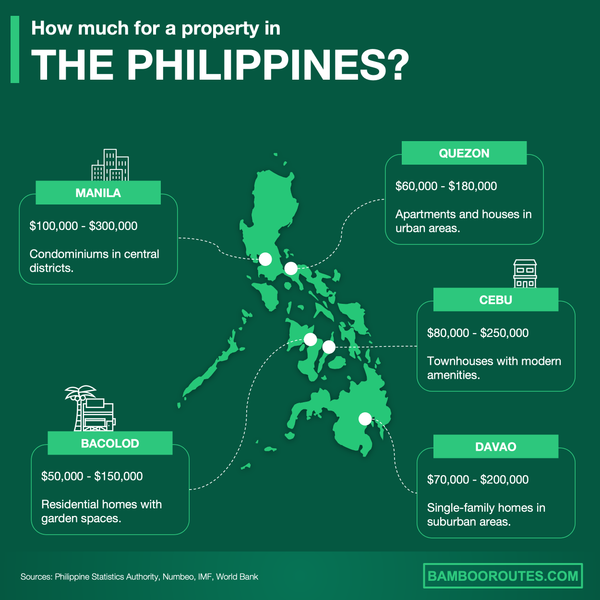
We created this infographic to give you a simple idea of how much it costs to buy property in different parts of the Philippines. As you can see, it breaks down price ranges and property types for popular cities in the country. We hope this makes it easier to explore your options and understand the market.
What do tenants actually want in Cebu in 2026?
What features increase rent the most in Cebu in 2026?
As of early 2026, the top three features that increase monthly rent the most in Cebu are dedicated parking (critical in congested areas), reliable high-speed internet with backup power capability, and location within walking distance of IT Park or Cebu Business Park.
Parking adds the largest rent premium in Cebu, typically 3,000 to 5,000 pesos monthly (around 10% to 15% extra), because traffic congestion makes car storage extremely valuable in dense urban areas.
One commonly overrated feature that Cebu landlords invest in but tenants rarely pay extra for is elaborate kitchen upgrades, since many young professional renters eat out frequently and prioritize bedroom and workspace over cooking amenities.
One affordable upgrade that delivers strong returns for Cebu landlords is installing a quality inverter air conditioning unit, which costs around 25,000 to 40,000 pesos but allows you to market the unit as energy-efficient and comfortable year-round.
Do furnished rentals rent faster in Cebu in 2026?
As of early 2026, furnished apartments in Cebu typically rent 2 to 3 weeks faster than unfurnished units because the large pool of relocating BPO workers and young professionals need move-in-ready homes without the hassle of buying furniture.
Furnished rentals in Cebu command a rent premium of approximately 15% to 25% over unfurnished equivalents, which generally covers the cost of furnishing within 2 to 3 years while also reducing vacancy time.
Get to know the market before you buy a property in Cebu
Better information leads to better decisions. Get all the data you need before investing a large amount of money. Download our guide.
How regulated is long-term renting in Cebu right now?
Can I freely set rent prices in Cebu right now?
Landlords in Cebu have significant freedom to set initial rent prices for most investment-grade properties, since the Rent Control Act (RA 9653) only applies to units rented at 10,000 pesos per month or below.
For units covered by rent control, increases are capped at just 1% for 2026 when the same tenant renews, but if your Cebu rental is priced above 10,000 pesos monthly (which most foreign-owned condos are), you can negotiate rent increases freely with your tenant.
What's the standard lease length in Cebu right now?
The standard lease length for residential rentals in Cebu is 12 months, though there is no single mandatory term and landlords can negotiate shorter or longer periods depending on tenant needs.
For units covered by rent control, landlords in Cebu can legally require a maximum of 1 month advance rent and 2 months security deposit (totaling around 30,000 pesos or 525 USD/490 EUR for a typical covered unit), though higher-rent properties commonly follow this same market norm voluntarily.
Under Cebu rental practice and the Rent Control Act, the security deposit must be returned to the tenant at the end of the lease minus any legitimate deductions for unpaid rent or damages beyond normal wear and tear.

We made this infographic to show you how property prices in the Philippines compare to other big cities across the region. It breaks down the average price per square meter in city centers, so you can see how cities stack up. It’s an easy way to spot where you might get the best value for your money. We hope you like it.
How does short-term renting really work in Cebu in 2026?
Is Airbnb legal in Cebu right now?
Airbnb-style short-term rentals are generally permitted in Cebu, but legality depends heavily on your specific building's rules and whether you obtain the required local government permits.
Operating a short-term rental in Cebu typically requires a barangay clearance, a mayor's business permit, BIR tax registration, and potentially DOT accreditation if you operate at a commercial scale, though enforcement varies by area.
Cebu does not currently impose a citywide annual night limit like some European destinations, so your main constraints are building-level restrictions (many condos prohibit stays under 30 days) and permit compliance.
The most common consequence for operating a non-compliant short-term rental in Cebu is being shut down by your condo corporation, which can fine you, restrict building access for guests, or take legal action under the house rules you agreed to when you bought.
By the way, we also have a blog article detailing whether owning an Airbnb rental is profitable in Cebu.
What's the average short-term occupancy in Cebu in 2026?
As of early 2026, the average annual occupancy rate for short-term rentals in Cebu City is approximately 45% to 55%, meaning your unit will likely sit empty nearly half the year on average.
The realistic occupancy range in Cebu spans from around 35% for poorly-located or uncompetitive listings up to 65% to 70% for professionally-managed units in prime tourist and business areas.
Peak occupancy months in Cebu typically fall during the Sinulog Festival period (January), Holy Week (March/April), and the Christmas holiday season (December), when both domestic and international tourism surges.
The lowest occupancy months in Cebu are generally during the rainy season from July through September, when tourism slows and fewer business travelers visit, though BPO-driven demand provides some baseline floor.
Finally, please note that you can find much more granular data about this topic in our property pack about Cebu.
What's the average nightly rate in Cebu in 2026?
As of early 2026, the average nightly rate for short-term rentals in Cebu City is approximately 1,800 to 2,400 pesos (31 to 42 USD or 29 to 39 EUR) for typical entire-home listings.
The realistic nightly rate range in Cebu spans from around 1,200 pesos (21 USD or 20 EUR) for budget rooms and basic studios up to 5,000 pesos or more (87 USD or 82 EUR) for premium two-bedroom units with resort-style amenities.
Peak season rates in Cebu during Sinulog and Christmas can run 30% to 50% higher than off-season rates, meaning a unit averaging 2,000 pesos nightly might command 2,600 to 3,000 pesos (45 to 52 USD or 42 to 49 EUR) during high-demand periods.
Is short-term rental supply saturated in Cebu in 2026?
As of early 2026, the short-term rental market in Cebu City shows moderate saturation with over 8,000 active listings competing for guests, which means mediocre properties struggle while well-positioned units still perform.
The number of active STR listings in Cebu has been growing steadily, adding competitive pressure that keeps occupancy rates in the mid-range rather than allowing them to climb toward hotel-like levels.
The most oversaturated neighborhoods in Cebu for short-term rentals are parts of IT Park and Lahug where numerous investor-owned condos compete directly, often in buildings where many units run similar Airbnb operations.
Neighborhoods in Cebu that still have room for quality short-term rental supply include select pockets of Mactan near resort areas, parts of Mandaue with business traveler access, and emerging areas where new developments attract tourists but listing competition remains lighter.
Don't lose money on your property in Cebu
100% of people who have lost money there have spent less than 1 hour researching the market. We have reviewed everything there is to know. Grab our guide now.

What sources have we used to write this blog article?
Whether it's in our blog articles or the market analyses included in our property pack about Cebu, we always rely on the strongest methodology we can … and we don't throw out numbers at random.
We also aim to be fully transparent, so below we've listed the authoritative sources we used, and explained how we used them and the methods behind our estimates.
| Source | Why it's authoritative | How we used it |
|---|---|---|
| Condominium Act (RA 4726) via Lawphil | It's the actual statute defining condo ownership for foreigners in the Philippines. | We used it to explain what foreigners can legally own. We anchored the condo ownership path as the main foreign investor option. |
| Investors' Lease Act (RA 7652) via Lawphil | It's the law enabling long-term land leases for foreign investors. | We used it to explain the leasehold alternative to condo ownership. We framed this as the path for house-like control without land ownership. |
| Rent Control Act (RA 9653) via Lawphil | It's the law capping rent increases for covered low-rent units. | We used it to clarify when rent control applies in Cebu. We explained deposit and advance rent limits for covered properties. |
| BIR Taxation of Non-Residents | It's the official tax authority page for non-resident taxpayers. | We used it to explain rental income tax obligations for foreign landlords. We clarified that non-residents still need tax registration. |
| AirDNA Cebu City Overview | It's a leading STR analytics provider using actual platform data. | We used it to estimate Cebu STR occupancy, nightly rates, and listing counts. We assessed market saturation risk using their metrics. |
| Colliers Cebu Residential Report | It's a dedicated Metro Cebu analysis from a top global consultancy. | We used it to identify where Cebu supply and demand concentrate. We informed vacancy and competition assumptions for 2026. |
| Global Property Guide Philippines | It's an established property research publisher with disclosed yield methodology. | We used it to triangulate gross yield ranges for Cebu. We calculated net yields using their gross-to-net gap guidance. |
| SunStar (citing DOT-7 arrivals) | It reports official Department of Tourism regional arrival figures. | We used it to justify STR demand based on real tourism numbers. We explained Cebu seasonality patterns using these figures. |
| Airbnb Help Center Regulations | It's Airbnb's official guidance on permits and local compliance. | We used it to set expectations that Airbnb doesn't make you legal automatically. We reinforced the need to check Cebu LGU permits. |
| Lamudi Philippines Cebu Rentals | It's a major Philippine property portal with current listing data. | We used it to sample actual asking rents across Cebu neighborhoods. We validated our rent range estimates against live market prices. |
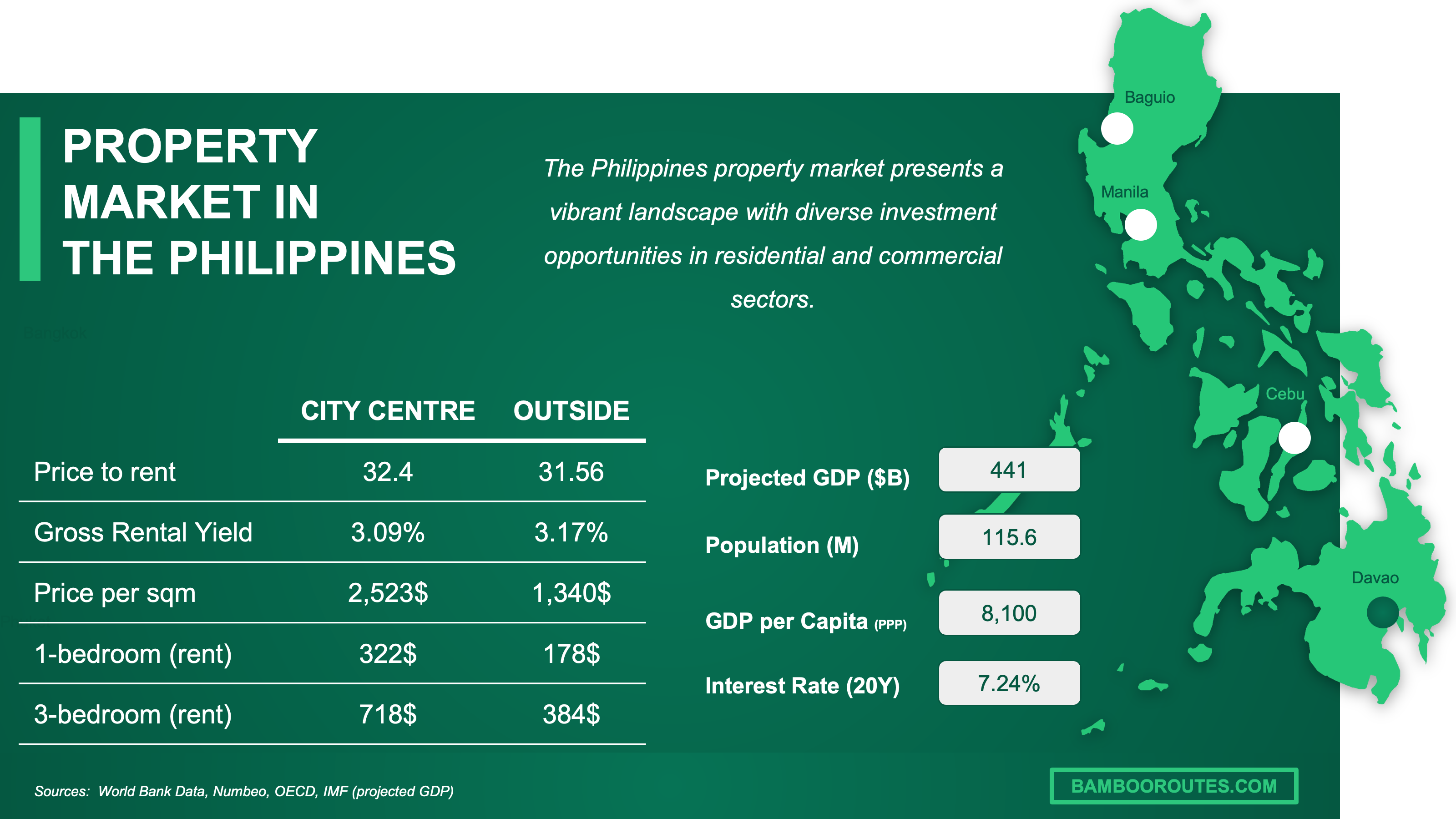
We have made this infographic to give you a quick and clear snapshot of the property market in the Philippines. It highlights key facts like rental prices, yields, and property costs both in city centers and outside, so you can easily compare opportunities. We’ve done some research and also included useful insights about the country’s economy, like GDP, population, and interest rates, to help you understand the bigger picture.
Related blog posts